Introduction
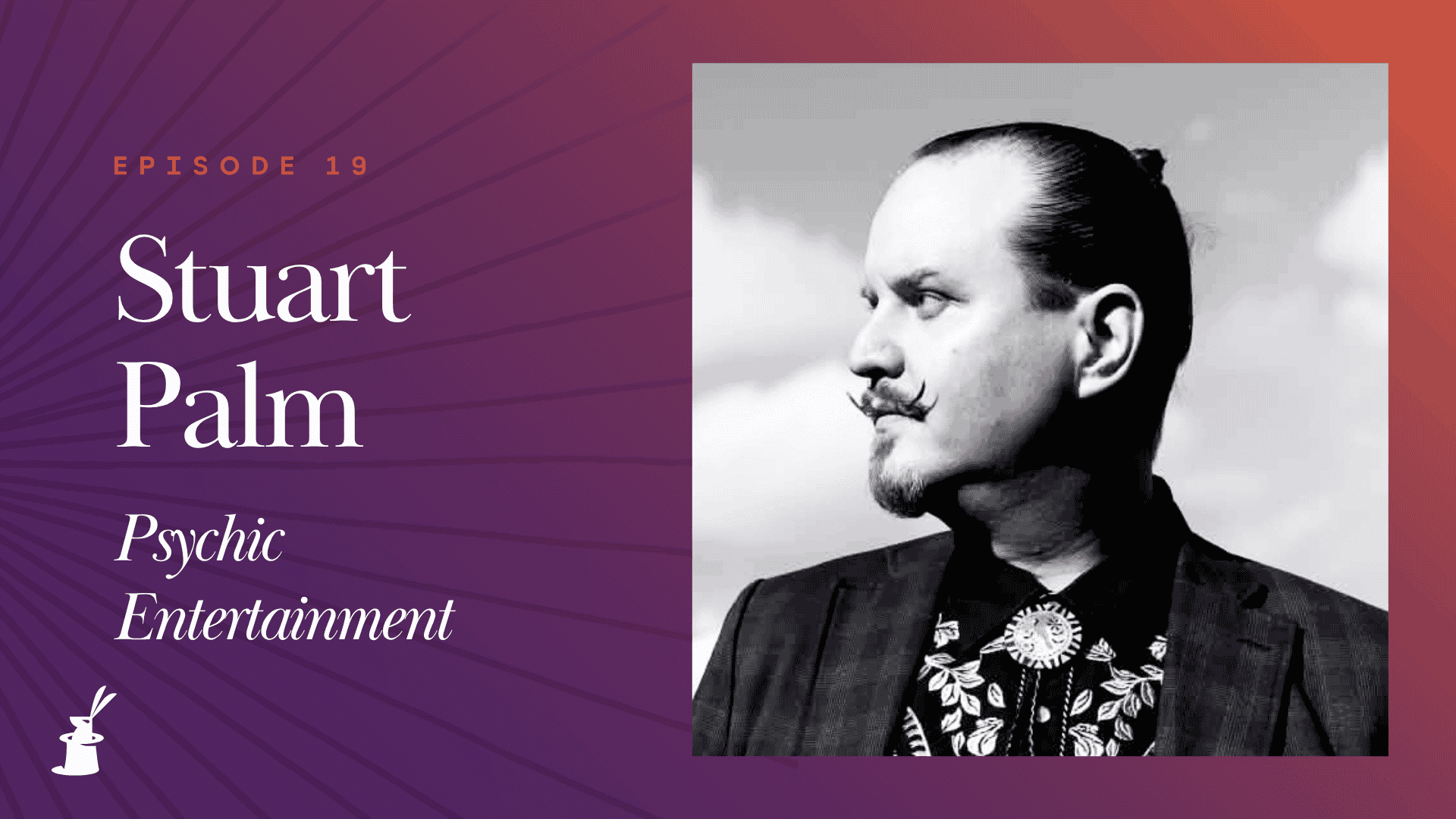
Stuart Palm's journey from Florida to New York City to Hong Kong traces an unlikely path through the world of psychic entertainment.
Now one of Asia's premier performers, Stuart's approach to mentalism was shaped not just by his studies with legendary figures at venues like Monday Night Magic, but by a health crisis that became central to his performing identity.
As an internationally recognized psychic entertainer, Stuart recently published "Psychic Entertainment," a comprehensive 600-plus page guide to his unique approach to creating powerful psychic effects. The book includes contributions from notable performers including Alain Nu, Neal Scryer, Peter Turner, and Richard Webster, who also wrote the Foreword.
During our conversation on The Magic Book Podcast, Stuart shared insights from his remarkable journey, his philosophy on what separates psychic entertainment from mentalism, and why he believes there are no shortcuts to creating truly miraculous experiences.
Origins of Mystery
Stuart's earliest connection to magic comes from family legend—one involving pennies and a diaper:
"My grandmother, I think at some family gathering when I was between one and two years old, they would give me pennies and I would make them disappear because I had an uncle who would make coins disappear. And they didn't know where they were until my grandmother changed my diaper and found it full of pennies."
His childhood fascination with mystery was nurtured in two distinct environments. In Florida, he played Ouija board with neighborhood kids. In Tennessee, where his family spent summers, he discovered Gatlinburg—a town he describes as "kind of like a carnival inside the Smoky Mountains. So you get nature and the beauty of that and the mystery of the forest and then haunted houses and, you know, Ripley's Believe It Or Not, and things like that. And that's where I first went to a magic shop."
Finding His Path in New York
Stuart moved to New York City in 2001, just months before September 11th. Working for a company that built trade show booths, he lost his job when the trade shows disappeared after the attacks. What followed was an organic evolution into performance:
"I had already started renting this painting studio, so I needed to pay for that in my apartment. Took work as a bartender. And I just started showing different effects from the bar. And that became a draw for people to come and see me."
Unlike many performers who grew up immersed in magic clubs, Stuart found his way into the community through discovery rather than formal channels:
"I didn't know what Tannen's was. I was not a member of a magic club. Today, it seems like there's these communities of people who all kind of know each other... I didn't know anything."
His search for a specific effect—how to bend a wine glass—led him to Tannen's Magic Shop, where he was sold "Mind, Myth and Magic" and Ted Lesley's "Paramiracles" DVD. Through Monday Night Magic, the weekly magic show in New York, he connected with performers who would become mentors, including Jon Stetson:
"I started working with them and worked with them for many years because I would regularly see whoever was on the bill every week and then hang out with them. So I met a lot of people and found people that influenced me and, you know, became mentors later."
A Brain Condition and an Origin Story
Stuart's performing journey took a dramatic turn when he experienced a grand mal seizure in his sleep that dislocated both his shoulders. The subsequent medical investigation revealed a hereditary brain condition called cavernous angiomas:
"What this is is that my brain develops little malformations in my brain that they sometimes will call tumors, which confuses everybody and makes them scared, because basically they are tumors and they can bleed, and if they bleed, you can have seizures. So I have a strange brain. And so whenever I have visions of things, I can say it's supernatural or maybe it's just my strange brain."
Rather than hiding this condition, Stuart integrated it into his performance identity. The surgery left him with four metal plates in his head and, he notes with characteristic humor, "if you're going to be a mentalist, I can't think of a better origin story than having a brain condition."
The condition proved to be hereditary—his sisters, mother, and children all have it. His daughter underwent the same surgery Stuart did, an experience he describes simply: "taking your kid to go through brain surgery is much harder than doing it yourself."
Moving to Hong Kong
Fifteen years ago, Stuart made a major life change for the most universal of reasons:
"Met a girl, my now wife – I met in New York. She hired me for a birthday party. I tell people it's a good case of post hypnotic suggestion."
During an initial month-long visit to Hong Kong, he discovered a welcoming community and quickly secured a gig at a major bank's event. The smaller performer community proved more accessible than New York's competitive landscape: "Love. Love will be the guide."
Psychic Entertainment Versus Mentalism
Stuart draws a meaningful distinction between his work and traditional mentalism:
"The big difference to me is that when you are considering yourself a psychic entertainer, you're working on psychic entertainment. You're not in a performing place where it's a psychological effect or a body language reading. You're getting into a deeper connection. And the presentation comes from a place where there's a sort of a soul to the experience."
He summarizes his philosophy succinctly: "I think psychic entertainment is mentalism with more soul. The way I think of it anyway. It's not the mind, it's the heart."
Writing "Psychic Entertainment"
The book emerged organically from Stuart's extensive note-taking practice. He keeps multiple small notebooks, filling them quickly before starting new ones. When developing routines, he types up these handwritten notes, and over time accumulated enough material for a substantial work:
"At the beginning, actually, the impetus was to do something with astrology because I had a lot of work based in astrology, and I wanted to share my notes on Day For Date. And so that was part of like, 'Oh, yeah, this should be in with the astrology stuff.' And then that just kind of grew."
The title itself was strategic: "My Instagram handle is @PsychicEntertainer. I was like, 'Well, if you're going to write a book and you can say "I perform psychic entertainment, actually, I wrote the book on it." That's the way to go.'"
The book's structure moves from defining psychic entertainment through Stuart's personal story, then into venues and performance contexts, followed by detailed sections on astrology, mnemonics, readings, and numerology. It includes routines categorized as intimate mentalism, stage work, and crossover pieces, along with an extensive section on pendulum work and essays on deepening performance impact.
Collaboration and Community
Stuart reached out individually to contributors, beginning with his friend Richard Webster, whose work heavily influenced the book's tone and thinking:
"Anybody who doesn't know Richard Webster, there's almost 200 books you could go and study from him."
The contributors' pieces emerged from shared interests. Brandon Bell's contribution grew from a mutual love of billet work. Anson Chen's piece on Name and Place developed from years of collaboration that began in Shanghai. Bob Cassidy, whom Stuart studied with before his death through weekly conversations, influenced much of the Fourth Dimensional Telepathy-based material.
The Ethics of Psychic Performance
On the ethical questions surrounding claims of genuine powers, Stuart advocates for individual judgment and audience autonomy:
"I think it's up to each performer to find the line for themselves. And I think probably the best way is to leave it open, not make a claim, and let your audience decide."
He distinguishes between his private reading work—"me sitting down with a person, legitimately scrying and usually using oracle or tarot cards and giving a reading"—and theatrical performance, which exists "within the construct of a theatrical experience, and the audience is allowed to make with it whatever they will."
His view on magician's guilt about audience beliefs is pragmatic: "People are going to believe what they believe, and that's their issue. I'm not going to try to change it."
The Problem with Shortcuts
Stuart sees one primary challenge among aspiring psychic entertainers:
"They want to take shortcuts. People want an electronic thing that does it for them... What I see a lot of people doing is going, 'No, no, no, no. I want the quick way. What's the way to do it easy?' And it's not worth it to do it easy because it looks fake. It doesn't come across as deep as the real experience. And also it's not as fun."
His own approach prioritizes authenticity: "If I can have somebody place an object somewhere in the world and then hold their hand and find it, I want to be able to really do that. I don't want it to be a technological secret."
He recalls advice from manipulator Jeff Sheridan about split fan productions: "You shouldn't even try performing this for 15 years." While acknowledging this is extreme, Stuart now understands the wisdom: "some of it doesn't quite click till you've been doing it that long. So give it the time and you have to be passionate about it."
The Power of Personal Story
For performers facing physical challenges or limitations, Stuart advocates weaving personal truth into performance:
"People like to hear stories and they like to know you. And the thing that makes the show good is you. Not the trick, not the effect, not the routine. It's that you connect as a real person."
He credits a university poetry teacher with a principle that has guided his work: "The more personal you are, the more universal it will communicate."
A Cherished Book
When asked about his most treasured magic book, Stuart struggled to name just one but highlighted Ormond McGill's "How To Produce Miracles":
"I point this one out in particular because it comes from a similar place to my mindset at writing psychic entertainment, as I believe that the performer of psychic entertainment is creating a situation where miracles happen. The experience of the audience should include a feeling of wow, I just saw a miracle in that mindset that should be wondrous and amazing."
He notes the book is extremely difficult to find in physical form—he owns only a digital copy—and puts out a collector's call: "If anybody has one, let me know because I would love a copy of it."
What's Next
Stuart continues developing new work, including a prediction device he uses regularly but is still refining before production. He's also writing a piece on performing book tests that he plans to offer free on his website as a thank-you to book purchasers. His Oracle cards, developed during COVID, represent another creative venture available through his site.
Books and Publications Mentioned
Stuart Palm's Works:
"Psychic Entertainment" (2024)
Books Referenced:
"Mind, Myth and Magic" by T.A. Waters
"Paramiracles" by Ted Lesley (Book and DVD)
"The Artful Mentalism of Bob Cassidy, Volume 2" by Bob Cassidy
"Notes From A Fellow Traveller" by Derren Brown
"In The Spotlight" by Christopher Carter
"How To Produce Miracles" by Ormond McGill
Harry Lorayne's memory books
Resources
Venues and Organizations:
Monday Night Magic (New York)
Tannen's Magic Shop (New York)
Key Figures Mentioned:
Jon Stetson (mentor)
Bob Cassidy (mentor, author)
Jeff Sheridan (manipulator)
Richard Webster (author, Foreword contributor)
Alain Nu (contributor)
Peter Turner (contributor)
Neal Scryer (contributor)
Brandon Bell (contributor, editor)
Anson Chen (contributor)
Paul Voodini (performer, readings specialist)
Ted Lesley (performer, author)
Mark Stevens (Stevens Magic Emporium)
Contact Information:
Website: stuartpalm.com
Instagram: @psychicentertainer
Book available at: stuartpalm.com or stevensmagic.com
Timestamps
02:05: Early exposure to magic and the penny story
03:12: Childhood influences in Florida and Tennessee
04:02: Moving to New York and 9/11's impact
05:20: Finding Tannen's and early influences
06:23: Monday Night Magic and meeting mentors
08:01: Brain condition diagnosis and surgery
11:19: When psychic entertainment became his path
12:36: Moving to Hong Kong for love
14:02: Decision to write "Psychic Entertainment"
16:01: Comparison to T.A. Waters' work
17:09: Difference between psychic entertainer and mentalist
18:09: Structure of the book
19:53: Selecting material for inclusion
20:58: Ethical considerations in psychic entertainment
22:26: Memory aid in the jacket design
23:40: Writing process during COVID
25:13: Contributors and their pieces
27:07: Initial response from the community
29:03: Common challenges performers face
32:08: Social media and online presence
34:26: Current trends in psychic entertainment
36:37: Advice for performers with limitations
38:03: Most cherished magic book
40:32: Where to find Stuart and purchase the book
41:45: Upcoming projects