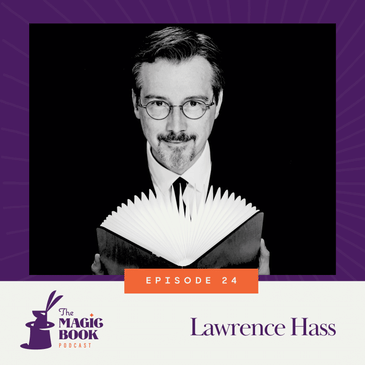
Philosopher-turned-magician Dr. Larry Hass discusses his publishing life, Eugene Burger's secret commission, and his landmark new book: "The Ross Johnson Legacy."
Adrian Tennant [00:00:02]:
Coming up in this episode of The Magic Book Podcast.
Larry Hass [00:00:06]:
Theory and Art of Magic Press has never been about just publishing whatever comes across my desk. It's publishing magic books that are within my vision of educational elevating of magic as an art form by people who I've learned deep things about magic from. So I'm always looking for authors who open up a doorway to thinking about their performance material in terms of, well – art, in terms of artistic possibilities that would work in the real world.
Adrian Tennant [00:00:39]:
You're listening to The Magic Book Podcast, conversations about classic and contemporary books that teach, illuminate and celebrate the art of magic. I'm your host, Adrian Tennant, a lifetime student of magic and mentalism, occasional performer, and longtime book collector. Thanks for joining me today. My guest is Lawrence Hass, a philosopher, performer, author, publisher and educator. Larry spent more than 25 years as a professor of philosophy before making a bold leap, retiring from academia to become a full time professional magician. Since then, he's performed thousands of shows worldwide, from the Wynn Casino in Las Vegas to Princeton University and served as dean of McBride's Magic and Mystery School, which the BBC has called “the most prestigious magic school in the world.” As the founder of Theory and Art of Magic Press, Larry has published some of the most intellectually serious and beautifully produced books in contemporary magic, including major works by Eugene Burger, Robert E. Neale, Jeff McBride, and Judge Gary Brown. Larry's own writing, more than 15 books translated into nine languages, has been celebrated as some of the finest in the field.
Adrian Tennant [00:02:06]:
Now, Larry has brought all of those roles together in his most ambitious publishing project to date: “The Ross Johnson Legacy: Hard-Hitting Mentalism,” officially released earlier this month at a special event at the Magic Castle in Los Angeles. All his friends call him Larry, and as Larry himself likes to say, everyone in magic is his friend. [MUSIC] Larry, welcome to The Magic Book Podcast!
Larry Hass [00:02:34]:
Adrian. Thank you so much. I'm delighted to be with you.
Adrian Tennant [00:02:37]:
Many of the guests on this podcast share stories of beginnings in magic that involve a family member showing them a trick or being given a magic set or a book, typically between the ages of 7 and 12 years old. But that's not your story. Can you tell us about your path into magic?
Larry Hass [00:02:57]:
Yes. I've come to realize it's quite unusual. When I was a boy, I may have encountered someone doing magic here or there, but that didn't really call to me. As a boy and then a teenager and an adult, I was a musician. Music was my art. But when I was 34 and a young assistant professor of philosophy, that's when the magic bug hit. Here's the story briefly. I saw that David Copperfield was having a special on television and I grabbed my son. He was five years old.
Larry Hass [00:03:33]:
I thought, “Oh, he'll love the magic show.” But as we started watching David Copperfield perform, my son quickly fell asleep. But I woke up. And I realized as I was watching David perform that magic was a performing art at a really high level and that most of the critical tradition and philosophical tradition about art had completely ignored this. And I woke up, I really did, to the fact that magic was an under-theorized art form.
Adrian Tennant [00:04:09]:
Well, in 1994, you created the Theory and Art of Magic program at Muhlenberg College. Now, can you describe what that program was, and what you were hoping to accomplish by bringing magic into a liberal arts curriculum?
Larry Hass [00:04:28]:
What I was really hoping to accomplish was spending more time with great magicians so I could learn more! And that I was able to create this college program to kind of feed my own interests, but also to share wonderful professional-level magic with not only the campus community, but the larger city - that became a real calling to me. Because I knew that magic was an art form, and I wanted to help share this larger perspective about the art with others. So my strategy for the program was to only bring the best magicians. I think one reason magic is undervalued is because in magic, people often associate the art form with the least practitioners, with the practitioners who, like “Uncle Bob,” showed them a card trick and it wasn't very deceptive. But really, what we want to do is associate performing magic with the highest-level performers, the people who excel at the highest level. That's what my program was all about.
Adrian Tennant [00:05:36]:
Well, your program didn't disappoint. It featured guest lecturers including David Blaine, Jeff McBride, Juan Tamariz, and Teller. Definitely the upper echelon of magic. So what was it like to share a room with those performers? And I guess, what did you learn from being around them?
Larry Hass [00:05:58]:
It was really such an honor. One of the surprises for me was that as I was reaching out to the top tier of magicians of that time, the 1990s, they all said “yes.” No one said “no” to me. Everyone saw the value of this kind of programming in an academic context and were delighted to be a part of it. In addition to doing their full show and then a public lecture, those magicians also came and taught my magic students. I was teaching classes through the theater arts program in performing magic. And so you have Teller, for example, sitting in a classroom with 20 young magicians and the experience of that was amazing. I got to see, first of all, how incredibly generous every magician I had on campus was, what great teachers they were, and that they were passionate about the importance of magic, which is exactly what I was looking for.
Larry Hass [00:07:00]:
I learned, among other things, that there are concepts in magic that go very deep and can help people understand this art. As a philosopher, I latched onto those concepts. You know, one of the things - magicians are so smart and creative, so I just found myself filling notebooks with ideas that they inspired or ideas that they shared.
Adrian Tennant [00:07:27]:
One name I know will come up probably more than once in this conversation is Eugene Burger. And as we were preparing for this interview, you told me that Eugene is absolutely central to your story. So I'm curious, when did you first encounter his work, and what was the beginning of your friendship with him?
Larry Hass [00:07:47]:
It's quite a story. In that first summer after I saw David Copperfield fly, my wife and I, we were spending our summers in Chicago. We were both academics, so we could do that. And I had just gotten hooked on magic, and I'm making my way into it by going to the magic shop, which in Chicago was Magic Incorporated, the magic shop run by the great Jay Marshall. I would go in there, and I'd buy some tricks and go home, and I'd study the books, and I'd buy some more, and I'd go home, and I'd buy some more tricks, and I'd go home. And I started to lose my taste for it because I was accumulating these piles of tricks without any resources to help me do with them what David Copperfield had done, which is turn them into art.
Larry Hass [00:08:37]:
And I expressed my frustration one day to the person working behind the counter, and he said, “Oh, don't buy tricks, Larry. Oh, no. You want to buy books, because that's really where you learn about this art.” He said, “And here's one of the very best magic books of all.” And he put in my hands Eugene Burger's little brown booklet called “Intimate Power.” So I took that home, and I read it, and WHOA! I finished it, and I read it again, this time with pen in hand, and I read it again, and it was like Eugene was answering all my questions. The book showed how magic could be a great art and the kind of errors magicians needed to overcome to get it there. So it was just a coincidental moment where Eugene's writings and my questions came together.
Larry Hass [00:09:34]:
And the fortunate thing is, of course, Eugene lived in Chicago and was performing every Thursday and Friday night at Biggs restaurant there. So I quickly gathered my family together and we went down to have dinner at Biggs. I called in advance and said “We would love to have some time with Eugene Burger.” And Eugene came to our table and did a 20-minute show for us. It was unforgettable for everybody at the table. And Eugene and I just kept that line of communication going. Very, very quickly, we were the closest of friends because of our shared philosophical backgrounds.
Adrian Tennant [00:10:15]:
In your TEDx talk at SMU, you offer a working definition of magic as, quote, “The artful performance of impossible things that generates delight and wonder,” end quote. That definition feels like it came from hard experience as much as it did from philosophical reasoning. Larry, how did you arrive at it?
Larry Hass [00:10:42]:
Yes, just as you said, Adrian. That's very perceptive. Some philosophers sit around and they come up with definitions in their head in the ivory tower. I've never been that kind of philosopher. I'm a philosopher of life. So I've always gone to the world of experience to try and understand things. And I certainly did that with magic. Even though I've done theory about magic, I knew early on that my calling was to perform magic.
Larry Hass [00:11:11]:
That was absolutely my calling. And that went back to all my performing experience as a musician. So I had that background, and now I wanted to perform magic. So after I would say a year-and-a-half of just working and trying to get good enough to do it, I started performing, and I learned from every show. And I watched every audience; I knew to do that. It was on the basis of these performances, over and over and over, I made every opportunity I could, that I started to put together that definition, and I had the first half of it: “Magic is the artful performance of impossible things.” That's what I had at first. Magicians create impossibilities.
Larry Hass [00:11:58]:
They are artists who create the impossible. And then over a little more time, I added the second part, that “Impossible things that generate energy, delight and wonder.” Adrian, I added that because I would see their faces when I would perform a piece of magic that felt impossible, really impossible. Their eyes would open, their faces would open, their jaws would open. You can feel the energy from an audience when you have truly astonished them. And this definition is so useful for me still, because I ask myself, “Have I really astonished them, or are they ‘thinking and figuring’ after I finish performing?” My goal in magic, and the goal I share with our magic students, is you don't want them ‘thinking and figuring’ at the end of the show. You want them to be, “Wow!”, eyes wide open, face wide open, feeling the excitement that magic brings.
Adrian Tennant [00:13:03]:
I'm reminded of the Maya Angelou quote, “People will forget what you said, people will forget what you did, but people will never forget how you made them feel.”
Larry Hass [00:13:13]:
Yes, I think that is so true with magic. I mean, when you are in the subculture of magic and we're fascinated by tricks – and we buy tricks and we're always looking for material and so on – it's very tempting for magicians to think that magic is about the tricks. And it is, but only in a secondary sense. What it is really about is you, the performer, being able to communicate the impossible, whatever your props, whatever your tools are to do this. So, I've often thought about Maya Angelou's quote in this way. And I do say to magicians, “The tricks need to be good. They need to be really good.”
Larry Hass [00:13:56]:
“They need to be impossible. But after the show, they are thinking and talking about you. So, did you do your job as a performer? And understand that, you know, magic is about the magician.”
Adrian Tennant [00:14:12]:
I'm a subscriber to your newsletter, and in one of your essays, you write about verisimilitude in magic: the idea that the believability of a performance is as “fragile as a soap bubble and that magicians can burst it in a dozen ways without even realizing it.” Larry, can you give a practical example of what that looks like in the moment of a performance?
Larry Hass [00:14:40]:
Yes. Thank you for being a subscriber and reading that essay. I'm glad it landed with you. You know, some of my thinking about this came from my own theatrical training many years ago. In the theater, as an actor, verisimilitude is the watchword. Believability. You know, the thing you never want your theater director to say is, “I don't believe you.” If you hear that, you're failing as an actor. And I think magicians have lost sight of the fact that there is a direct application here to magic.
Larry Hass [00:15:15]:
Magic isn't real. What we are asking our audiences to do is “make believe.” Not “believe,” but “make believe” that the impossible might be able to happen. And this state of their being willing to trust me enough to “make believe” is a fragile thing. And there is an agreement on both sides. The audience has to agree to make believe, to try and enter into the game. But more often, the problems are caused by magicians who fail to understand this dynamic. They do and say things that burst the bubble. And then audiences just bounce out of the show feeling tricked or feeling like they've been lied to or whatever it is.
Larry Hass [00:16:06]:
One way this happens a lot, Adrian, to answer your question directly, is through what I would call the reckless use of humor. When you are performing, there are many opportunities for laughs, and sometimes, often, those laughs come with you slipping out of character, puncturing the bubble, putting your tongue in your cheek in a way that the audience is like, “Oh, I was right there with you, but then you ruined it.” So, the bubble can break because of bad technique, that's for sure. “Oh, I've just seen what he's doing.” But the bubble can break because magicians aren't trained in theatrical elements like character and movement. Those are part of the actor's toolkit for creating and shoring up the bubble in which this make believe can happen.
Adrian Tennant [00:16:58]:
In 2010, you made the big decision to retire from college teaching and become a full-time professional magician. Your memoir essay “Dying to Change” is subtitled “How I Used Magic to Kill My Professor.” For anyone listening who hasn't taken that kind of leap – I know many of us dream about it – how do you describe it?
Larry Hass [00:17:26]:
It was a major transformation in my life, one of the biggest changes I've ever made. Because, as you and the listeners will appreciate, I had worked so hard and so long to get my Ph.D. in Philosophy, as well as an international reputation in the area of philosophy I specialized in, which is phenomenology. I studied and wrote extensively on the French phenomenologist Maurice Merleau-Ponty. I worked hard for that first career and worked hard on my teaching with students. But in 1994, the hook had gotten sunk and I started becoming a magician. Over time, performing, my avocation, somehow became my vocation. And so in 2010, it was just time to retire early, really, from the academic classroom and become a full-time magician. So I would say a couple of things that made this change so difficult. I can say it was a shift in identity, a major shift in my identity from being a professor and a scholar to being a performing artist.
Larry Hass [00:18:39]:
Now, I wanted that shift in identity, but actually making that happen took some time, took some therapy, and of course I have never regretted it. But it also involved a shift in finances. As a college professor, you do well financially. You work hard, but you're paid well. As a magician, you don't get an annual salary anymore. You only get paid when you work as a professional performing artist. So that was a major shift. Not that I was ignorant about it, but the reality of needing to book shows in order to pay the bills was a real game-changer. And finally, I would mention that this change brought a change in my daily work.
Larry Hass [00:19:28]:
I no longer spent my days in the library reading books. Instead, I spent my days at Home Depot or Officemax accumulating supplies and trying to build props, and practicing and rehearsing in my studio. So, all of these changes were what I was going through. And I am happy to report to everyone listening that I was able to do it. And I'm never sorry I did it. Because as much as I love philosophy, I am still a philosopher. But as much as I love that, I love magic more.
Adrian Tennant [00:20:09]:
If you're enjoying this episode of The Magic Book Podcast, please consider leaving a rating on Spotify or a review on Apple Podcasts. You can also follow The Magic Book Podcast page on Facebook. Thanks. Larry. When we were preparing for this conversation, I asked you about your book publishing and you said to me that you see it not simply as a series of publications, but actually as part of a larger project, a project of honoring your mentors and teachers. Can you explain what you mean by that?
Larry Hass [00:20:47]:
So, when I started as a full time professional magician, even a little bit earlier than that, I had a magic teaching platform and I had a performing platform, and I did both of them co-equally. But around the middle of the 2000s, I realized that I also had a writing platform and then that spilled into publishing. I had finished my first book, “Transformations,” and the publishers who considered that book really liked it, but they had long pipelines before publishing it. And one of those people said to me, “Larry, just publish it yourself.” So I taught myself the book publishing business as well and published “Transformations,” and then many other books. But the question you asked is “How do you decide who to publish and what is your press going to be about?” And I realized very early on that it was going to be about honoring my friends and mentors in the art. Theory and Art of Magic Press has never been about just publishing whatever comes across my desk. It's about publishing magic books that are within my educational vision of elevating of magic as an art form and by people who I've learned deep things about magic from.
Larry Hass [00:22:15]:
So Bob Neale was my first outside author, and I've published eight of Bob Neale's books, and they're incredible. Bob was just recently recognized by FISM with the Max Maven FISM Special Award in Teaching and Philosophy. And then Jeff McBride and I, we did the “Show Doctor” together. And then Eugene, and now Ross Johnson. I am a “Pop Shop.” My publishing company is Larry, and what I do then is choose very carefully whose books I'm going to invest my life energy in producing. It is really a way of saying “thank you” to my teachers.
Adrian Tennant [00:22:58]:
One of your major collaborations in that spirit was “The Show Doctor,” with Jeff McBride, which expanded his MAGIC Magazine columns into a major book with more than 45,000 words of new material. Larry, what does it look like, practically speaking, to translate a performer's instincts and ideas onto the page? How do you capture another performer's voice without overwriting it with your own?
Larry Hass [00:23:33]:
“The Show Doctor” is a great example for me to talk about this. I had read “The Show Doctor” columns that Jeff was publishing in MAGIC Magazine, and it was must-read reading for me. I mean, the columns were so good because they are about how to perform successfully in the real world. Jeff has made tens of thousands of shows in every circumstance. So, here was an expert sharing their expertise about so many areas of performing magic. I was completely taken with the idea of putting this together in a book that would expand Jeff's thinking. We were at the Magic Castle together. We were performing there as part of Magic & Mystery School Week in 2008, and we were having a meal together, and I proposed to Jeff the idea of this book.
Larry Hass [00:24:22]:
As soon as I finished asking if he would be interested in this, Jeff put out his hand to shake, and the deal was done. That's the kind of person Jeff McBride is. He was so excited by the idea and the deal was done. So, Jeff is such a strong performer and such a rich person, so full. “How do I help write and create this book of his columns and performing material and have it stay true to him?” A big part of the answer is the realization I had very early on that, and I'm quoting myself, “It's not about me. This book is not about me. This book is about Jeff.” So that reminder, “it's not about me,” mutes every temptation I might have as an author to insert myself into the text.
Larry Hass [00:25:19]:
I have followed that path throughout all of the books. It's not about me. It's about Bob or about Eugene or about Jeff. My whole goal is to not insert myself in the work but to let them “speak” as much as possible.
Adrian Tennant [00:25:39]:
Well, you also mentioned to me in a pre-interview conversation the orchestra that most people never see behind any serious magic book: the designers, illustrators, editors, and of course the printers. So can you describe what it actually takes to bring a book to life through your press?
Larry Hass [00:25:59]:
That's a tremendous question and I'm glad to talk about it. Books are magical things. They appear, and they are ubiquitous. They're everywhere. But we, as readers, lose sight of the profound process that's involved in bringing a professional book into being. We see the effects of the opposite of this in magic. Sometimes you can tell a magic book was just kind of coughed out by somebody and not edited and not really thought about.
Larry Hass [00:26:25]:
Those are very poor books. But I was never going to do that. I had to learn how to be a book publisher, and the standard was always high quality. I needed the book to look good and feel good in people's hands. Because as a philosopher of art, I know that the look and feel of a book completely matters in terms of people's experience of it. Reading is not just a cognitive operation. It's also an aesthetic operation. Now, I am good at recognizing my limits.
Larry Hass [00:27:01]:
I do very, very well as a writer and an editor. I have expertise in those skills. But even though I know art well and I have a good eye, I am not a designer and I'm not a graphic designer, either. So I have always hired people and paid them well to bring those skills to the table. Once a manuscript is done and it's written and edited (I also bring on many people to help me with the editing process), now we have to turn it from a manuscript into a physical book. And this does require what I think of as an orchestra. I have to conduct the orchestra.
Larry Hass [00:27:44]:
It's my job to conduct the orchestra, but I can't play all the instruments. So with the most recent book, there was a cover and slip case designer, involving a separate set of skills. And then there was the interior graphic designer and layout artist. And then there is the printer–finding the right printer for the book and working through the materials that would be used in its preparation. The last two months of the Ross Johnson book, two months, was spent on a daily basis communicating with one person or another in the orchestra, doing my very best to make sure how it came out was how I envisioned it.
Adrian Tennant [00:28:27]:
Well, it came out beautifully, and we're going to talk about that in a moment.
Larry Hass [00:28:31]:
Thank you.
Adrian Tennant [00:28:32]:
Your press, of course, has also published work by George Parker and Robert E. Neale, among others. When you read a manuscript and decide whether to publish it, what are you actually looking for?
Larry Hass [00:28:46]:
What I'm always looking for is, “Does this manuscript speak to the higher level of magic, or is it just a collection of tricks?” Tricks are fine. We all need good tricks. But there's no shortage of magic publishers publishing good tricks. I mean, “We're drowning in tricks,” as Eugene used to say. What we are not drowning in are ways of thinking about how you take these tricks, this material, these “notes” of magic, and turn them into “music.” How do you take these materials, these methods, and make them into something that real people will resonate with and enjoy, whether it's laughter or tears, you know? So, I am always looking for authors who open up a doorway to thinking about their performance material in terms of, well – art, in terms of artistic possibilities that would work in the real world. This is a really important distinction.
Larry Hass [00:29:52]:
Magicians spend a lot of time in the mirror performing for other magicians. That's fine. I do that, too. But really, the reputation of magic will be won or lost as we perform for people who are not magicians in the real world. That's where we will be able to show people what our astonishing art can be.
Adrian Tennant [00:30:16]:
Let's talk about Eugene Burger. Before his passing in 2017, Eugene asked you to take on what many consider one of the most significant publishing commissions in contemporary magic: two posthumous books that would finally release his unpublished professional repertoire. He imposed two conditions: the books would appear only after his death, and you were not to speak of the project beforehand. Larry, what was it like to carry that responsibility in silence?
Larry Hass [00:30:55]:
It was difficult. It was awesome. The request by Eugene, when he called me to ask if I would do this – he was very healthy at the time – it came out of the blue. I had no idea. But since I was so close to Eugene, his friend and also a scholar, I had kept notes on all of his material. So I knew Eugene's repertoire as well as my own.
Larry Hass [00:31:22]:
And I realize now, of course, I was a natural person for him to ask to take on this work. But as you say, there were two conditions from the very beginning: that it had to be kept absolutely secret and that these books would not come out until after he was gone. The issue about waiting until he had passed was not a problem at all. I had a lot of things to do, so waiting was not an issue.
Adrian Tennant [00:31:46]:
Right.
Larry Hass [00:31:47]:
But secrecy was an issue. I could tell my wife, who was also a very close friend of Eugene, but Eugene was very clear: I couldn't tell anybody else, and I didn't. I keep my promises. I'm an iron vault about those things. One thing that made it difficult is I couldn't talk about it with people like Max Maven or Jeff McBride, who were also good friends of mine. So now I'm in a position of needing to keep a big secret from my friends, especially friends who I knew would be so helpful in creating the books, because they knew Eugene at least as well as I did, and for much longer. So not talking about it with nearest and dearest friends of both of us, that was hard.
Larry Hass [00:32:38]:
And I realized later that Eugene had been very wise in asking me to keep it secret. I understand all the reasons, but I should mention a primary reason: if word of these books came out, Eugene was afraid he would be answering questions about them for the rest of his life. Like: “Eugene, when are we going to get your books?” “So, Eugene, when are you going to die so we can get your books?” I mean, he did not want to have any of those conversations with anybody! That's why an iron vault was put around this project. But over time, I realized in asking me to keep it secret, he was asking kind of a terrible thing. I mean, it's a terrible promise I had to make. Because keeping secrets can be very corrosive and difficult on a person. This is why magicians share their secrets so readily and frequently.
Larry Hass [00:33:30]:
Because keeping something really secret from everybody is hard. As human beings, we are not really built to do that. We are built to share. One thing that did help is – even though I kept the pledge – there were times I was with Eugene when he wouldn't keep that standard, when he would tell someone really close to him in my presence. Then I knew that person knew, and that made it possible for me to communicate with them. There were not many people in that category. Two or three, I mean, at the most.
Larry Hass [00:34:09]:
But then, of course, once Eugene did pass, now I needed to let the world know I was doing this. Because at that time, after Eugene passed, people were wanting to publish and reveal his unpublished material. So I had to inform the world that these books were coming. I did that after consulting with Eugene's executors. And they, of course, granted permission to do that.
Adrian Tennant [00:34:36]:
Well, the first of those books, “Eugene Burger from Beyond,” followed by “Eugene Burger: Final Secrets,” together document 16 stand-up and Spirit Theater routines, and 17 card routines that had never before appeared in print. So for someone who knew Eugene as well as you did, what was the experience of working through that material after he was gone?
Larry Hass [00:35:03]:
Yes, it was amazing. So, after Eugene had raised the books as an idea for me, and of course I said “Yes,” I went through all of my records, and I had about 54, 55 items on my list of routines or interviews or essays that had never been published. And Eugene saw the list. Here I'll quote Eugene, using his voice: “Far out!” [Laughter] That's what he said. And it was actually when he saw the list, that he said, “Larry, we actually have two books. One is on all the psychological card magic and close-up card magic, and the other is on the stage magic and Spirit Theater.” So I sat in Chicago in the summer of 2010 for three days with Eugene.
Larry Hass [00:35:53]:
It was amazing. We were working through all of these performing pieces, and he's sharing the methods for them, Some of which I knew, but many of which I never bothered to ask about because, you know, they were his secrets. Previously, he would tell me his methods if he felt like telling me, and he did sometimes. But one thing that summer was my anxiety about capturing it all on video, because I knew it was going to be a while before Eugene was gone. I needed to make sure I not only had video of what he was teaching me, but backups and backups for the backups. So I was like a child at Christmas or a kid in a candy shop, as Eugene was teaching me his incredible material. I think I could say one more thing on this. As you will know, Adrian and others as well, one of Eugene's superpowers was that he had impeccable taste in performing material.
Larry Hass [00:36:50]:
He rarely got distracted by some lesser, minor magical item. If something was in his performing repertoire, it was excellent. So that was also part of the fun. I'm dealing with the best of the best.
Adrian Tennant [00:37:06]:
Well, Eugene was also famously precise about his words in his scripts. Nothing was accidental. How do you approach editing a man's unpublished work when you can't go back and simply ask him what he meant?
Larry Hass [00:37:25]:
Yes, that's really a good question. Eugene was, as you said, so meticulous. He was a wordsmith. He loved words. He loved his performing scripts. So, when it came to his scripts for performance, they are untouched. And I didn't need to touch them because Eugene's scripts would go through 8, 9, 10, 11, 12 drafts before it settled into what I would call a “locked” condition. So they were impeccable.
Larry Hass [00:37:58]:
He often consulted me as he edited those scripts, because I was his friend, not at that time his writer. I guess we talked about that a lot. He appreciated my editing skills, and so later on the scripts didn't need adjustment. Eugene is such a powerful thinker with depths and layers. I didn't want to mess around too much with that. My mantra, remember, “This is not about you.” But there were some things that I cleaned up because Eugene empowered me to do that. Eugene said, “These books are going to come out after I'm gone.”
Larry Hass [00:38:32]:
And he said, “I completely empower you to make changes as necessary for the time or the circumstances of the book.” So he understood he needed to do that for me. Thus, I wasn't hamstrung by what he had written. But I will tell everyone I treaded very lightly. I cleaned up some comma faults, but I didn't really mess with Eugene's texts much at all.
Adrian Tennant [00:39:02]:
The new book, “The Ross Johnson Legacy” is the most recent installment in your project of honoring teachers, and is no less ambitious than your previous works. For listeners who may not be familiar with Ross Johnson's name, can you tell us a bit about him?
Larry Hass [00:39:22]:
You bet. It wouldn't be surprising if you are a listener and you haven't heard of Ross Johnson's, but Ross is one of the world's leading mentalists. Hands down. I have seen three world class mentalists in my lifetime. I've seen many others. But the three top mentalists I've seen are: Max Maven, Derren Brown, and Ross Johnson. And they are all at the highest level of the art. And if you don't know that, it's because Ross has spent his entire 60-year career performing.
Larry Hass [00:39:56]:
Performing for Fortune 500 corporate banquets and staying out of the limelight in the world of magic. He didn't want the celebrity in the magic subculture because those secrets were how he was making his living. So really, Ross spent his entire life and career actually NOT talking about how he did things. That's part of Ross. The man has made countless shows in the real world, and I think that's an important piece of it. When you are only hired if you are outstanding, as is the case in a corporate environment, your material gets really good. Because they won't hire you if you're not getting standing ovations. If the material isn’t super strong, you are not going to have that career for long. Ross's decision to proceed with me in creating this book took many years.
Larry Hass [00:40:55]:
It took many years for him to decide he was ready and willing to let this book come to the world.
Adrian Tennant [00:41:03]:
I understand that the introduction between you and Ross was made by Eugene Burger back in the late 2000s. What were your first impressions of Ross as a performer?
Larry Hass [00:41:16]:
Yes, I met Ross then. And Eugene was Ross Johnson's very first magician, which is really interesting. They had a long friendship, too. So Eugene invited us both to lunch in Chicago, and Ross and I hit it off. Ross's personality is, well, I'm kind of sunny and Ross is a little more wry, perhaps even, I wouldn't say sarcastic exactly, but dark. He sometimes has a dark and dry sense of humor. So we're a little bit like night and day, and that's good.
Larry Hass [00:41:52]:
That's been part of our friendship. So then I got to see him, and I've seen Ross perform now countless times, I really can't count the number of times. As a performer, Ross takes that dryness, his wry sense of humor, even moments approaching darkness, and he builds that into his show. Ross's performances are stunning. I don't quite know how to say that without sounding too hyperbolic. I once recommended to my wife, who is a CEO, that she should book Ross to perform at a big event she was holding ,an after-dinner banquet. So there are the leaders of industry and technology, and doctors and academics, and lawyers, and, I mean, just this high-powered room. Ross took the stage, and in 45 minutes, he brought them to stunned silence.
Larry Hass [00:42:50]:
After about 10 seconds of just pin-drop silence, the applause starts. Oh, first over here and now over here, and now over here, and louder and louder. Before we know it, everyone is on their feet, like, applauding with their arms in the air. Because Ross has the skill and the talent and the experience to perform mentalism that's not just deceptive, but stunning, shocking, deeply mysterious.. That's why I was so interested in working with Ross on this book. He has the highest possible standards for what mentalism is and should be, and he spent a career performing it that way. And I thought that this book would be wonderful.
Adrian Tennant [00:43:40]:
Who actually suggested the book? Was it Eugene? Was it Ross, or was it an idea you came up with?
Larry Hass [00:43:46]:
So it was Eugene. Ross and I, we met back in the 2000s, and in a couple of years, I was brought onto the teaching team at the Mystery School for the class on mentalism that Ross teaches. So it was Jeff and Eugene and me and Ross. We would all teach the masterclass for mentalism there, which I've done now for 14 years. So Ross and I have known each other a very long time. And one night after the students had left and they were going to have their dinner, we are sitting over a glass of wine, Eugene and Ross and I. And Eugene leans over to Ross and he says – and this is one of those moments when he blew the secret, right? – and Eugene said to Ross, “You know, Larry is writing two books that'll come out after I'm dead.” Pause, pause, pause.
Larry Hass [00:44:34]:
And then he said to Ross, “and you should have him write yours, too!” Now, after that, Ross and I were both really uncomfortable, because I already had two books to write. I didn't need any more books! And Ross was like, “I'm not ready to share my lifetime secrets yet.” So it was really interesting. Eugene brought it up, but Ross and I were both like, “No, don't go there. We're not doing this.” But the idea kind of got in Ross, and it kind of got in me.
Larry Hass [00:45:08]:
I never, ever put any pressure on Ross about this because I could see he wasn't ready. But in 2018, he said, after we talked about it, he said, “You could start filming some of what I'm doing.” You know, he came to know me and trust me. And he had also seen the quality of “Eugene Burger: From Beyond.” So he knew the quality of the book was good. I started filming, and then in 2022, Ross and I sat down with the express purpose of deciding if this was going to go forward or not. Both of us decided we would go forward with this. And I think part of it for Ross is that he realized it was going to take a number of years for this book to come out.
Larry Hass [00:45:50]:
And so he felt okay with people having this book when he was, you know, in his late 70s or early 80s. Ross is now 80, and he's still performing, but he's comfortable with those secrets being out there.
Adrian Tennant [00:46:06]:
Well, you had celebrated Chicago filmmaker Michael Caplan produce a professional three-camera shoot of Ross’s full evening show, “A Funny Thing Happened … Tomorrow” at the Rhapsody Theater. Can you describe what it was like to watch Ross perform that show in a real theater for a real audience?
Larry Hass [00:46:30]:
Yes, it's a good question. To go back just one notch, one of the big breakthroughs in 2022 for both Ross and I, that we each brought this to the conversation, was the belief that if there was going to be a book, the readers had to be able to watch Ross perform. Because Ross is such a distinctive performer, so much of what happens in his show happens between the routines. He doesn't just do individual routines. He has a show that builds in a powerful way to an explosive ending. So we both knew it had to be filmed. And that's when I got connected with Michael Caplan, who also knew Ross.
Larry Hass [00:47:14]:
Thankfully, Michael agreed to accept a commission to film three installments of the show at the Rhapsody Theater. And it was absolutely thrilling to see Ross work long form with an intermission in the middle. I was part of the conversations to help him think about, “Okay, what material would you do in the first half and what would you do in the second half and how would this all go?” But the show is his, and he's still performing. It is a tour de force. I can also tell you this, Adrian, I think you'll like it. Michael and I worked months and months and months to create the final edit of the film. I shared it with Ross and I sat there realizing, “Oh my God, he might hate it!”
Larry Hass [00:47:58]:
But he didn't. He loved it. That was a really good day for the project because he saw the finished film and loved it. He may have had one small little editing request, but I was a much fussier film editor than Ross was.
Adrian Tennant [00:48:15]:
Just a reminder that you can be notified when new episodes of this podcast are published by subscribing to the email alerts. You'll find all the details on the podcast website at TheMagicBookPodcast.com, which is where you can also find transcripts plus accompanying blog posts with summaries, timestamps, and links to resources mentioned in each episode. Larry, “The Ross Johnson Legacy” is a premium publication. Some listeners may have seen the advertisement in Genii magazine that really shows it off: 410 pages plus a 14-page full-color insert, clothbound hardcover in a slip case with foil stamped titling and art. It's a large, 8-and-a-half by 11-inch format with a foreword by Michael Weber. When you set the physical specifications for a book like this, how do you decide what a project deserves?
Larry Hass [00:49:16]:
Wow, that's such a great question. Thank you for asking it because I get to talk a little bit about that orchestra process when I start a book project. In terms of the physical thing, I never quite know at first. The question I always ask myself is “What does this book want to be? What does this book want to be?” And I often don't know for quite a while in the process. With Ross's book, I knew it wanted to be a hardcover. With Eugene's posthumous books, hardcover, large format. I mean I knew that, but I didn't know that Ross book would have a slip case and cloth covering until actually rather late in the game, when I was in those two months of working on the physical product. At first I started out thinking it would have a dust jacket with a photo, a really nice strong photo on it.
Larry Hass [00:50:16]:
But pretty early on I realized, “No, that's not good enough for Ross. This is his legacy book. We need to go for an absolute premium thing.” So to answer your question, it depends on the book. It depends on issues relating to price. There is that real factor of costliness, that when you're creating a book as a work of art, you also have to keep in mind the costliness of it. But then also, “what does it want to be?” Ross's book told me, kind of late in the game, that it wanted to have a slip case.
Adrian Tennant [00:50:49]:
The book also comes with, as we've mentioned, more than three hours of video and audio content, including Michael Caplan's three-camera shoot of Ross's full-evening show. In the age of YouTube, why is the combination of a premium physical book and accompanying media still the right format for preserving a performer's legacy at this level?
Larry Hass [00:51:14]:
It might not always be that that's the case, but it is still the case. One of the problems about YouTube and TikTok and all of this stuff is how short and compressed and mediated these videos are. I mean, you know, there are advertisements in the frame trying to sell you stuff while you're watching magicians perform. I mean, it compromises our ability to attend to what's going on. I'm keenly sensitive to the “costs” of that. I'm not going to have Ross's show be broadcast on YouTube with all of their advertisements. That's not going to happen. I really try to make my books and the video pieces of them remain somewhat special by being exclusive.
Adrian Tennant [00:52:01]:
The book was officially launched at a special event at the Magic Castle on March 8th. You were there, Ross was there, and Michael Weber hosted. For those of us who weren't lucky enough to attend, can you tell us about that experience?
Larry Hass [00:52:16]:
Oh, it was really a thrill. I want to thank Randy and Kristy Pitchford for inviting us to have the event at the Magic Castle. It was wonderful. I stopped in Las Vegas, rented a car, loaded it with books and drove to Los Angeles for this. Ross flew in. So the three of us, Michael Weber and Ross and I, we had about a 75-minute presentation where Michael interviewed both of us. And in the course of that presentation, Ross performed one of his sensational, stunning mind reading routines. Which is in the book, by the way.
Larry Hass [00:52:56]:
You know, people didn't have the book, so they didn't know how the routine worked. They were stunned. Sixty magicians were there with their jaws hanging open. Because with Ross's performing material, there's no fooling around. He launches right in and starts reading minds from the very beginning, one powerful insight after another, filled with surprises and humor. The group hadn't seen anything like it. He got a roaring standing ovation from the audience. So, after 75 minutes of friendship and love and celebrating Ross – because that's what it was all about – we sold copies of the book and the three of us lined up and we signed them.
Larry Hass [00:53:38]:
And it was really a tremendous day, and I am still buzzing about its success. And Ross is, too, because he feels that his life work has just been received by not only people at the Magic Castle, but all of the people who purchased it and are reading it right now.
Adrian Tennant [00:53:58]:
Well, you mentioned Derren Brown earlier, and of course, one of Derren's collaborators is Andy Nyman, one of the endorsers of the book. And he writes that books like this, quote, “Don't come along very often.” Doug Dyment describes Ross as, quote, “The finest performer of classic mentalism extant.” These are not small claims. Larry, what do you hope “The Ross Johnson Legacy” does for the future of mentalism?
Larry Hass [00:54:26]:
Wow, that's such a good question. On one level, as an author of a book or co-author with Ross, in this case, you don't know. You know, you put it out in the world and you see what happens with it. But I would say this: one of the things that happens in magic and mentalism is that performers, as they come up, they see what other people do and then they kind of adopt what they do. But then over time, this process of seeing and adopting, seeing and adopting, can lead actually to forgetting some foundational elements of where mentalism – in this case – started. I suppose if I have any particular hope for Ross's book, it's that I think it might help re-set some of the ideas about mentalism. Because over time, I think people have lost a feeling for the fact that classical mentalism is not about astonishment.
Larry Hass [00:55:28]:
It's about mystery. And Ross makes this very, very clear. Ross is a mystery artist. He's not an artist of the impossible like me, the magician I am. I create impossibilities, and I generate ecstasy, energy, delight and wonder from those impossibilities. Ross’s work is about creating deep experiences of mystery that are thrilling, but perhaps even shocking and disturbing. So I think, I hope Ross's book helps to re-set some of what mentalists have come to kind of habitually or unconsciously do that has tended to make their mentalism more like magic and a little less like mentalism. And even if there's just a discussion about these things, that would be to the good.
Adrian Tennant [00:56:20]:
As I mentioned to you, I really enjoyed your essay that really clarifies Ross's philosophy of mentalism and makes some really great points about the differences that should exist between magic and mentalism. Larry, you've described yourself as someone who wears four hats, performer, teacher, writer, and publisher. So now that the Ross Johnson book is out in the world, where is your focus turning next?
Larry Hass [00:56:51]:
Ross's book has really absorbed all my free bandwidth. Since 2022, I felt the keen kind of pressure to bring this book to completion, and I did that. And I've kept up the magic teaching and I've kept up the performing and the writing through my newsletter. But now that the book is out, I'm enjoying a period of my brain being entirely clear and able to let new things kind of emerge. Now that we are about three months since the book went off to the printer, I can report to you that I'm having some wonderful areas of my brain opening up. I'm going back to some of my performance work this year to develop Spirit Theater material that I learned or worked on with Eugene when he and I were creating Spirit Theater seance shows. After Eugene passed, that kind of went away because I'd lost my pal, I lost my Spirit Show buddy. But now I've gotten some interesting avenues for reopening that up, and I'll be sharing them at a number of events, both at the Mystery School and at the Magistrorum Conference in September in Irving, Texas.
Larry Hass [00:58:09]:
I also am teaching an online course in May through the Mystery School that's called “Write and Publish Your Magic.” Over all the years, I've had countless magicians approach me about this, like: “I want to write for magicians. I want to publish my things. How do I do this?” I have knowledge in this area, and I want to share that with anybody who's interested in learning at least my ideas about how to do that. So: performances, exciting new classes coming up online and in Las Vegas, and then some appearances this coming Fall. I am excited for the year.
Adrian Tennant [00:58:49]:
This is The Magic Book Podcast, so regular listeners know. I always ask this, Larry, what magic book – or books – do you most cherish in your personal collection and why?
Larry Hass [00:59:05]:
I love that. I love that your podcast is dedicated to magic books because they are so important! One thing I talk about in my newsletter and with our magic students is “Golden Books.” I think it's important to connect with “Golden Books” in magic. Those are books that, you know, lit the fire, that turned on the light bulb, that you feel in your heart like the author is talking to you. And some of this has to do with when you first read them and encountered them, but they are always “Golden Books.” So I think if I share a couple of my “Golden Books,” that might meet the question. Every year, I read one of Eugene's books.
Larry Hass [00:59:45]:
Every year, I sit down and read one of his books very closely, taking notes. And I will say something. I told him that “The Experience of Magic” is perhaps my very favorite of all his great books. They're all great, but “The Experience of Magic,” for me, is a special “Golden Book.” And I love Tommy Wonder's “The Books of Wonder,” both Volume One and Volume Two. I hadn't met Tommy. I hadn't known of his magic.
Larry Hass [01:00:14]:
But I opened those books and immediately grabbed a pen because I knew I would never let them out of my possession. They are so good. Tommy sets the highest standard for magicians in the quality of their performances and material. And that really called to me. I think after reading “The Books of Wonder,” I found an even higher level of quality in my own work. Max Maven. I love Max's writing. I mean, Max wasn't an essayist like Eugene, but Max is one of the smartest people I've ever met in magic.
Larry Hass [01:00:51]:
He was a genius at the highest possible level. And so I love studying Max's essays, whenever he wrote one, because I always learned something from them. And then I love reading his many routine creations. Of course, there were thousands of them over the years. Max is like an old familiar friend. Then the last person I'll mention is Juan Tamariz. I had the very good fortune of reading Tamariz's work shortly after reading Eugene's work, and someone had directed me to him. Also Juan is a good friend, and I consider him a teacher, and he's been a huge fan of mine. But he's also an inspiring writer because he teaches about theater, he teaches about method, he teaches about the magic rainbow and how to make sure that our audiences experience the promising ecstasy that magic has to offer.
Larry Hass [01:01:50]:
So those are some of my favorite magic books.
Adrian Tennant [01:01:54]:
Now, for listeners who would like to purchase a copy of “The Ross Johnson Legacy,” where should they go?
Larry Hass [01:02:00]:
There's only one place. Ross and I made a conscious decision that we were going to limit the number of books that are printed and that we were not going to use a distribution system, which I have for some of my books. But for Ross's book, the only place to get it is from Theory and Art of Magic Press. And what people want to go to is www.theoryandartofmagic.com, and they'll find it there.
Adrian Tennant [01:02:29]:
And for anyone who wants to follow your work more closely, I'm guessing Theory and Art of Magic Press, same website. What about the Mystery School? Or your newsletter and your upcoming classes? Where's the best place to find you?
Larry Hass [01:02:42]:
Yeah, there are two really good places to stay in touch with us. The Mystery School is magicalwisdom.com. Jeff and the team and myself, because I'm part of the team, there is a bimonthly “Museletter.” Jeff is very clever with words: it's a “Museletter” with high quality writings about making your magic better. Because we are really a school. So, that comes out every two weeks. And about seven years ago, I started my own newsletter,. and it comes out every two months because I want to make sure it meets my high standards. The place to sign up there is at theoryandartofmagic.com and people will see that there's a free gift.
Larry Hass [01:03:26]:
And a “sign up for my newsletter” link. My newsletter comes out on the second Sunday every other month. “High content, low sales.” And that community has really grown over the seven years. New people come in every week. And I think, Adrian, I think it's because word of mouth has been good about it, and I think people have come to trust my voice and trust that it really is going to be high content and low sales.
Adrian Tennant [01:03:56]:
Going back to the essay that you wrote about Ross's philosophy of mentalism and your own realization that you are a magician, for those people who might want to be both, is it possible to be both, or do you really have to specialize in one or the other?
Larry Hass [01:04:15]:
Yes, this is a great question. When I started this book project with Ross, I thought of myself as sometimes a magician and sometimes a mentalist. Now, I always advertised myself as a magician, but I would do routines in my show that I would think of as mentalism. And really, it was in the long process of working with Ross and understanding and assessing his ideas that I have come to a different view, which is that there is, on one hand, mentalism, a mystery art, going for mystery. (And by the way, this was Max Maven's goal, too. When Max would perform his full evening show, it was an evening of mystery, and it was all about the value of not knowing.) And then on the other side, there's magic, which is impossibilities that generate energy, delight and wonder. Now, Ross says, and I agree with him, that there's a middle category called mental magic.
Larry Hass [01:05:10]:
But with this, Ross likes to underscore the word magic, and I think I do, too. These are magic routines that might use a mental or psychological frame, but really they're performing impossibilities, not mysteries. They are going for, “Wow! “Oh, my God, that's incredible!”, the ecstasy of magic. Whereas with Ross, he's going for the thrilling kind of shock of “What just happened? I don't know what happened.” Ross makes this distinction, a number of other mentalists have made this distinction, but I now make this too. I am a magician.
Larry Hass [01:05:49]:
I do mental magic sometimes. I am not a mentalist, living the lifestyle and having the goals of creating stunning mysteries. That's for other artists to do. I am after wonder and astonishment, and all of that. So ,you don't have to give up anything you're already doing. But you might think again or anew about whether you're really doing magic with those mind mysteries or whether you're really going for mentalism, at least with the classical sense of creating unknowing. Unknowing, as in “I don’t know.”
Larry Hass [01:06:31]:
And at least for me, my answer was I'm a magician and proud of it.
Adrian Tennant [01:06:38]:
Larry, it's been a wonderful conversation. Thank you so much for being my guest on The Magic Book Podcast.
Larry Hass [01:06:46]:
Thank you Adrian. You are a generous interviewer and thanks for your wonderful questions that have prompted me to speak about things I've never talked about before.
Adrian Tennant [01:06:58]:
You've been listening to The Magic Book Podcast. In this episode we traced Lawrence Hass’s journey from philosophy to the Dean's chair at the world's most prestigious magic school. We explored the intellectual awakening that turned a Professor into a full time magician, examined his lifelong project of honoring his teachers through publishing, from “The Show Doctor” with Jeff McBride to the posthumous Eugene Burger books, and now to “The Ross Johnson Legacy.” And we got a preview of the next chapter in Larry's own writing. You'll find a transcript of this episode on our website at TheMagicBookPodcast.com along with a blog post with timestamps and links to resources we mentioned. If you'd like to be notified when new episodes are published, please subscribe to our email alerts. All the details are on the website. If you have a question or would like to suggest a topic or a guest for a future episode, you can reach me at adrian@themagicbookpodcast.com. Thanks for listening to The Magic Book Podcast.
Adrian Tennant [01:08:08]:
I've been your host, Adrian Tennant. Until next time, goodbye.