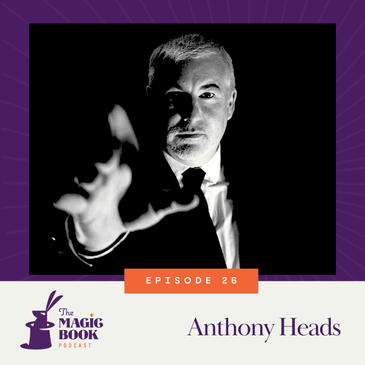
Sweden's leading "paranormalist" Anthony Heads discusses his two books: "Practical Paranormal Performance" and "Live Storytelling for Magicians."
Adrian Tennant [00:00:00]:
Coming up in this episode of The Magic Book Podcast.
Anthony Heads [00:00:02]:
With the right story, you can elevate a trick into a miracle. Something which people not just have their minds blown, but they will feel something and then they will remember meeting you.
Adrian Tennant [00:00:17]:
You're listening to The Magic Book Podcast, conversations about classic and contemporary books that teach, illuminate and celebrate the art of magic. I'm your host, Adrian Tennant, and a lifetime student of magic and mentalism, occasional performer and longtime book collector. Thanks for joining me. Today, my guest is Anthony Heads, Sweden's leading paranormal illusionist and mentalist. Originally from the UK, Anthony has spent more than 20 years in the Swedish entertainment industry as a performer, screenwriter, lecturer and consultant. He founded the Stockholm Ghost Walk in 2004 and in 2009 turned to full-time performing, and through his own production company has created and toured many original theatrical mentalism productions, including the Spirit in the Glass, Project: Mind Control, Paranormal, and The Red Show. As a consultant, Anthony has designed illusions for the Gothenburg English Studio Theatre's production of Jeremy Dyson and Andy Nyman's Ghost Stories, and he's served as creative consultant to the Swedish mentalist Henrik Fexeus since 2020. Anthony is the author of two books, both distributed by Stevens Magic Emporium: “Practical Paranormal Performance,” published in 2024 with a revised edition in 2025, and “Live Storytelling for Magicians,” published in January of this year with a foreword by a friend of The Magic Book Podcast, Dr. Larry Hass.
[MUSIC]
Adrian Tennant [00:02:00]:
Anthony, welcome to The Magic Book Podcast.
Anthony Heads [00:02:04]:
Well, thank you very much, Adrian. Thank you and hello to everyone listening wherever you are.
Adrian Tennant [00:02:08]:
Anthony, you do not come from a traditional magical background. Can you tell us a little bit about the road that brought you to this work?
Anthony Heads [00:02:19]:
Yeah, I suppose it would be a bit of a roundabout journey that I've taken. I mean, as always, it all starts from childhood and I wasn't really into magic. I did love, though, mysteries, you know, unsolved things. I was reading books that had everything from UFOs and ghosts and spontaneous human combustion, the Bermuda Triangle, you know, I was really fascinated by the idea that this world could actually hold things which were still unexplained. And that love of stories of the unknown, that just kind of grew with me. So even as a kid, I would make up my own stories and stand in front of the class and tell them these stories, often about ghosts or mysteries or whatever. And the teachers encouraged it. I was just in love with stories.
Anthony Heads [00:03:01]:
I loved telling people stories. And it wasn't until much later in my life when I became an adult and I was working at different things, I realized that I seemed to be able to tell stories which people could relate to. The only magician I ever saw live when I was a kid was Paul Zenon.
Adrian Tennant [00:03:15]:
Oh yeah.
Anthony Heads [00:03:16]:
And I think that was about 35 years ago in a little seaside town in the UK. And I pestered my mum to buy the little booklet that he printed out afterwards. And I learned how to tie a cigarette in a knot and things like that. But that was basically where magic stopped for me. There was a TV show, The Masked Magician, and I watched a bit of that, but I never really got into magic theory, I never got into cards. I was more interested in how people felt through the spoken word or just basically just talking to them, telling them a story. And so for me, I preferred making people feel something unusual rather than just amazing people. And so eventually that's what turned into guided walks, it turned into scripts, it turned into stories, and it turned into mentalism and paranormal performance.
Anthony Heads [00:04:04]:
So I certainly don't approach any of this like a magician and I think that's what makes it different and what makes it stand out, basically.
Adrian Tennant [00:04:11]:
You moved to Sweden in the early 2000s and founded the Stockholm Ghost Walk in 2004.
Anthony Heads [00:04:19]:
Yes, I did.
Adrian Tennant [00:04:20]:
What gave you the idea for a ghost walk?
Anthony Heads [00:04:23]:
I can give you two specific reasons why it happened. And again, stories. I love stories and I've got this wild imagination. And every time it comes to the autumn, you know, to me it's the perfect time of year. And then you hear the rain tapping on the window, you hear the leaves rustling outside. And to me it just, it fires up that childhood imagination. So when I moved to Sweden, there's a beautiful medieval old town in the middle of Sweden and it's cobbled streets and it's narrow alleyways and there's wrought iron gates and old fashioned lanterns hanging from the walls, casting these ridiculous shadows. And ghost walks were a thing in the UK.
Anthony Heads [00:04:59]:
They were everywhere, they were two a penny. But there wasn't one here. And I thought, “Why is nobody thought to do a ghost walk here?” There was one guy, I'll be honest, he'd written poetry about the history of Sweden and so he was walking through the old town telling people these poems and stories. But it wasn't a traditional ghost walk in the sense that maybe our listeners here would understand a ghost walk to be. So I thought, “It's strange that nobody's ever done one.” Now if we rewind a little bit back to when I was at university in London, my girlfriend at the time, she was studying journalism and she was supposed to do a report on a ghost walk. And so she had contacted Richard Jones, who does the original London ghost walk, and she'd arranged to follow along with him, but she was sick that night. And so through a pure twist of fate, I went along and recorded his entire ghost walk on a little recorder so she could do a report on it.
Anthony Heads [00:05:48]:
And I met Richard, and I thought it was very fascinating. And I loved the story aspect. He did one or two little magic tricks in there as well, to kind of emphasize a few things. We all ended up back in a haunted pub. And, you know, people could buy fish and chips for an extra £5 or £10 or whatever it was. And I just loved the whole experience. I loved everything. And it was completely unexpected.
Anthony Heads [00:06:11]:
So it wasn't until years later in Stockholm, I thought, “Why has nobody done one of these? This would be perfect.” And then I thought, “Why don't I do one of these? Because it just brings together everything that I love. The environment, the stories, the creativity. I get this outlet for these stories. I knew a little bit of magic, so maybe I could do something.” And so it was basically just a meeting of two worlds with this blank canvas, because it didn't exist here. Nobody knew what a ghost walk was. And people laughed at me when I told them I was going to do it.
Anthony Heads [00:06:43]:
Who would want to pay to hear ghost stories? And now there is a ghost walk in every town in Sweden, in every castle. I started the industry, which to me is amazing. I mean, you know, it existed in other countries before, but I still remember people looking at me going, “Why would anybody want to do that?” And here we are, hundreds of thousands of guests later, and, yeah, because people love hearing stories. So, yeah, that's why I did it.
Adrian Tennant [00:07:09]:
Well, when we were preparing for this interview, you did say to me that the ghost walk really was where you discovered your natural skill for script writing and storytelling. And, of course, the power that a good story holds. When did you first realize that the story itself was doing the heavy lifting rather than any specific effect or moment?
Anthony Heads [00:07:34]:
I think, if I'm honest, when I started doing the ghost walks, for example, I couldn't do them in Swedish because my Swedish wasn't good enough. So I was writing stories in English, but for people who had English as a second language. So I really had to think about, “What am I saying? How am I saying it? How can I distill it down to still have the same impact or to deliver the message that I want without being superfluous, without complicating it?” So what is the element of a good story? So when I was writing the script, when I was creating these stories, all based on historical fact and obviously with myth and legend, it made me realize that this story has to really hit home. It has to carry everything. It has to carry the message, it has to carry the emotion, it has to carry the connection. Because I can't rely on linguistics and I can't rely on nuance, and I can't rely on all those little tricks maybe we can do in the English language. Because Swedish is a much simpler, straightforward language.
Anthony Heads [00:08:36]:
So I realized then and there when I was writing these stories, I would think that didn't have the impact that I expected. Why not go back, rework it, rewrite it, and talk to some Swedes, “Why didn't you understand that bit? What was wrong about that or what was right about that?” And that's when I realized that just by getting the words right, by meaning the correct thing, by delivering it in the right way, I don't need to show them amazing magic. I don't need to amaze them with an effect. Whatever they've got in their minds is much more powerful than anything I could show them at my fingertips, especially someone who's not from a magic background. So that's when I understood that these stories are making people think. It's making them become engaged. It's making them use their imagination. They're filling in the blanks so I could show them something, but that means that I'm already making up their minds for them.
Anthony Heads [00:09:33]:
If I just tell them and let their imagination do the rest of the work, then the story becomes so much more powerful and it becomes individual for every single person who's listening to it as well, because they use their own references, they use their own imagination, their own history, their own background to fill in the rest of the story. So it was definitely there on those walks that I realized, “Hang on, this is a very powerful thing. And for some reason, I seem to be able to do it quite well.” So much so that people, even though there were Swedish walks available, they would say, “No, we want to come back on the English one because we want to hear you tell the stories again.” So that was a positive thing.
Adrian Tennant [00:10:09]:
Anthony, in 2009, you made the leap to performing mentalism full-time.
Anthony Heads [00:10:16]:
Yep.
Adrian Tennant [00:10:16]:
Now, for anyone listening who's contemplating that same jump from part-time to professional, having made that decision, what were the early years like?
Anthony Heads [00:10:28]:
Well, the completely honest answer – because I like to be completely honest – is turbulent and terrifying! I need to rewind a little bit because I'd had the company since 2004 when I first started doing the ghost walks. But then when our first child came in 2008, I left the walks, somebody else took over the company, and I went and got a full-time job because I needed to bring in money for the baby. But then after a few years of doing that, I was miserable working in an office environment. There was no creativity, there was no outlet for this thing I was trying to do. So luckily my wife just said, “Stop doing it and run your own company again. Go back to working full-time.”
Anthony Heads [00:11:06]:
And by that point I was learning much more about mentalism. I was doing private things on the side. So it was a case of, “Right, this is what I want to do now. I want to be a mentalist, but my speciality is paranormal performance. I want to be that mentalist who knows about the world of the paranormal.” So I thought, “Yeah, here we go, I'm going to be a famous mentalist. I'm going to go full-time.” And there was just no business, there was nothing.
Anthony Heads [00:11:31]:
It was really difficult financially. It was very tough. Nobody knew who I was. Nobody cared either. And trying to do this thing in a country where nobody knew what mentalism really was, nobody cared about paranormal performance. Especially now I was trying to angle it towards corporate groups where there was more money. They were just like, “Who are you?” and “Don't ever call me again!”
Anthony Heads [00:11:51]:
So it was really turbulent in the beginning, but I just kept on going at it. And a few times I had to put it on hold and go back and get a job. Especially when the second child came and then it was like, “Okay, I need really to focus on making some money so we can get by.” So, yeah, I say from 2010 is when I called myself a full-time mentalist. But I would say it wasn't really until 2013 when I was completely financially independent of having to do anything else. I could say, “Yes, now I've done it, now it's making money, now I am up and running and I don't need to do anything else.” So it was incredibly scary. And luckily I had a very supportive wife, a very patient wife, as I always tell everyone.
Anthony Heads [00:12:32]:
But, yeah, you have to make that leap at some point. And I could only do it because I had that kind of stability behind me. My wife saying, “It'll be fine, we'll be okay.” And luckily, we'd never really lived on two salaries at the same time. It was always one of us was studying, or one of us was working. So even when I then started doing this full-time and there wasn't much money coming in, we still managed to get by because we were used to living on quite a low income. But now, obviously, it's taken a different direction. But the first few years were turbulent.
Anthony Heads [00:13:01]:
Very much so. I wouldn't lie to anyone and say, “Oh, it's really easy from day number one, off you go!” You know, of course it's not going to be that, but everyone has to start somewhere. And if I had have stayed doing what I was doing in an office job, it would have been the end of me. I needed to get this out, I needed to find some sort of creative outlet. And luckily, yeah, luckily, it worked.
Adrian Tennant [00:13:25]:
In your first book, “Practical Paranormal Performance,” you explain that you've deliberately distanced yourself from the magic community. You did not attend magic conventions, you are not a member of The Magic Circle, and you have actually turned down numerous television opportunities. Anthony, can you walk us through your thinking on that?
Anthony Heads [00:13:50]:
Absolutely. And it sounds strange, doesn't it? Because, I mean, when you distill it down, of course I'm a magician. Mentalism, obviously it's a type of magic. However, one of the things which I've always been convinced about is there is a differentiation between mentalism and magic. And in order to sell to the public what I am trying to sell and the way I want it to be perceived and the way I want people to experience it, then I had to distance myself from trickery. And this was a very active decision. Now, I'm not trying to be unethical. I'm not trying to trick anybody into thinking that I'm a real psychic or that I am a real clairvoyant, because I don't do any of that.
Anthony Heads [00:14:30]:
But I need to distance myself from the world of magic and tricks, because especially here in Sweden, magic isn't taken very seriously. It's children's entertainment – or the other end of the scale is it's grand illusion. That's it. So if anyone called me a magician, there was only two things they could really call me and that was a children's magician, in which case they're not interested – I'm just a child entertainer. Or I'm a grand illusionist and they expect leather pants and Harley Davidsons disappearing, you know, that's it. Basically, there's nothing else. So I thought, “Well, then I can't be that. I have to be someone else.”
Anthony Heads [00:15:06]:
“I have to be something else.” Even though the word mentalism is kind of understood now, when I started out, it wasn't. Nobody had any idea what a mentalist was. So this active decision was, “No, I can't be in conventions. No, I don't want to be in The Magic Circle. I don't even want to speak to other magicians.” Because what I am doing in my mind – and it's a complicated place up there – but in my mind it's something completely different.
Anthony Heads [00:15:33]:
I'm not approaching this from the angle of tricks, I'm not approaching this from the angle of normal method. I'm not approaching this from any classic magic background. I have an idea, I have a feeling, I have a goal, and however I have to get there, I want to forge my own way of getting there. And then if later on, if it turns out that someone says, “Oh, but what you did was this,” or “What you did was that,” fine. But it was the natural journey for me to get there. So it's only very recently that I've actually started moving, I should say in more magical circles. But not in Sweden, not at all. Okay, internationally, yes, in the US, in the UK, I'm doing this podcast now, but in Sweden, nothing.
Anthony Heads [00:16:16]:
I have not done anything because I need that distance. When people see my performances, they wouldn't say it was a magic show. I've written quite extensively about, you know, the mentalist's applause. I don't expect applause all of the time because what I'm doing seems genuinely real. They believe that these things are happening in this room and we've done it together. But who are they applauding? The spirits, you know, the good energies? So for me, the applause comes for the whole group. It's, “Look what we did together.”
Anthony Heads [00:16:45]:
“Let's give ourselves a round of applause.” Rather than me standing on the stage and saying, “Aren't I wonderful? Please give me lots of applause.” So the idea was that even though this is a magical discipline, I am not a magician. Purely semantics, but also because I need that distance. And whether you agree with me or not is neither here nor there, because this is what works for my goal. And I do think there's a big difference between the two.
Adrian Tennant [00:17:11]:
If you're enjoying this episode of The Magic Book Podcast, please consider leaving a rating on Spotify or a review on Apple Podcasts. You can also follow The Magic Book Podcast page on Facebook. Thanks, Anthony. Let's talk about your first book, “Practical Paranormal Performance,” originally published in 2024 and revised in 2025. Now, you've written that you spent over a decade performing this material before you considered putting it on the page. So I'm curious, what finally convinced you that this was a book worth writing? And I also wonder, who did you imagine the reader would be?
Anthony Heads [00:17:58]:
Great questions, both. I don't even know, really, who I expected to read it, if I'm honest with you. I didn't think anybody would be interested because it's such a niche thing that I do. But it was such a long and hard journey. So much trial and error, a lot of expense, a lot of energy, countless amounts of time and energy and effort to get where I wanted to be. And so after I did it all, and I realized what I'd achieved, and I realized how far I'd come and the audiences I was getting and the response I was getting, I suddenly thought there was nobody really doing this when I started doing it. Yeah, of course, there's some classic literature, there's Eugene Burger, things you can read, and there was some Lee Earle stuff. But I couldn't really find anybody doing what I was doing.
Anthony Heads [00:18:45]:
And then once I'd done it, I thought, “You know what? Maybe I should write what I've done. Because this might help someone. I don't know who, but it might help someone.” So I just basically started writing down what I had done. Why I think like I do. So the book “Practical Paranormal Performance” isn't basically just a diary. And it's not just a list of effects. It's basically my entire approach to what I do.
Anthony Heads [00:19:10]:
And there's, you know, “I think like this because of A, B and C”or “I do like this because of A, B and C.” And I put the book together, and then I put in some effects that I do in my shows. But also I put in some food for thought, some little extra things I put in. And all of a sudden, at the end of the book, I thought, “What about everything else? What about the stuff that nobody tells you about? What about how to write a technical rider or what a script looks like, or how an FX script looks? What are lighting cues?” All these things that take so much time for a beginner to learn or to understand. I thought, “Well, I know it, so I'm not going to gatekeep it.” I'm not one of these people who says, “Oh, no, you have to have a special password to learn the secrets.” No! Come and learn the secrets. So I put it all into one book and I showed it to a few people.
Anthony Heads [00:20:07]:
And the response I got back was incredible, with people saying, “We've never seen this much honesty. We've never seen this information. We've never had something like this before.” And I'm not very good at patting myself on the back. You know, you keep your head down and you work and you go through it. But this was the first time I thought, like, “Oh, maybe I'm actually doing something of value to the community. Maybe something which other people can use.” And so as it was, I thought it might be for anybody getting into paranormal performance. But as it turns out, all sorts of magicians have been reading it.
Anthony Heads [00:20:39]:
They're getting back to me saying how much they've enjoyed it because it's teaching them a different mindset. That paranormal stuff isn't just another type of trick. It isn't just something else you can drop in around Halloween. “Oh, I'm going to do a paranormal trick.” It's about a different mindset if you want to do this in a very convincing and genuine way. So I didn't know who was going to read it. Turns out a lot of people and it turns out that it's been really, really helpful. So I'm very proud of it.
Anthony Heads [00:21:06]:
Actually. I really didn't think it was going to have the impact which it has done. So, yeah, I'm very proud of it. Yeah.
Adrian Tennant [00:21:13]:
Now, in the book, you outline your two show model. On one hand, the commercial paranormal-themed show that plays in conventional venues, and on the other, the real experience, which is something quite different. Anthony, can you describe the difference between those two formats and why you decided you needed both?
Anthony Heads [00:21:37]:
Well, the easiest answer, why I needed both was financial. Simple as that. Because the real experiences are very intense and they're very intimate and they're really fun, but they don't make much money because the groups are smaller and there's a lot getting into it. If you read in the book, you'll see how we build them up. You know, there's a certain amount of investment in room rentals or equipment rentals or basically just the cost of running a show, even if it's only for one night. But it gives me a chance to experiment. It gives me a chance to do things I've always wanted to do, push things a bit further, get right to the edge. So the real experiences are fun.
Anthony Heads [00:22:12]:
But the idea behind two shows was purely financial because when I started working full-time, I thought, “Right, where do I make money? How can I pay the bills? How can I keep food on the family table?” And I immediately jumped to corporate work. Because corporate work, you make more money, but it's vanilla, and it's dull, and it's bank nights. You know, corporate mentalism is, yeah, it's a beast of burden. But I had this idea of “What if I could do paranormal performance for corporations? What if I can make it so different and unusual, but still acceptable to a company, to a company who want to come and do something?” So I had the idea of creating these paranormal-themed shows, but selling them as conference entertainment or a conference activity. So I basically found as many different haunted venues as I could. Castles, stately homes, hotels who were also offering conferences. And I said to them, “Okay, I've got this product, I've got this show, which people can do…”
Anthony Heads [00:23:11]: “They'll stay in-house. They're not going off anywhere. You can sell a couple of drinks beforehand, sell a couple of drinks afterwards. All I need is a conference room or a suitable place in the building. And I can base the show even on your venue. Tell me the history of your venue and I'll give them this show.” And it just worked. And so the corporate bookings were the ones which bring in the money and they keep the company rolling and they give me my income.
Anthony Heads [00:23:39]:
And then the real experiences are for when I think, “Right, what do I want to do?” And those are the ones where I get to really use my imagination. And in the real experiences, I mean, you know, I've had people faint, people crying, people running for the door, people. I had one woman vomit. But there was so much energy and expectancy and tension and I don't really do anything scary. But again, going back to the story and their imagination, we were in an old basement of an old school and I built up the story so much that even though people have bought a ticket for something, you see, you need that suspension of disbelief. So they bought a ticket for something. But I was able to create the environment where they'd forgotten that this was a ticketed thing.
Anthony Heads [00:24:20]:
All of a sudden we're in this basement and there's this horrible story that's happened and stuff's happening all around them. And it gets so intense and so real that they forget. It's like they're in their own movie. They forget that this is a ticketed thing and, you know, everything is scripted. But I'm ad libbing and I'm so relaxed with it and my delivery, it doesn't feel like a show. You know, I make people sign a disclaimer before to make sure they won't sue me in case they lose sleep. And that's purely just to build up more tension. So, yeah, the whole point of doing the two shows was in order to cover all my creative bases, but also to make sure that there was money coming into the company.
Adrian Tennant [00:24:59]:
Well, you write very vividly about the very first real experience you ever staged in a 1600s cellar restaurant in Stockholm's Old Town with just eight participants.
Anthony Heads [00:25:11]:
Yeah.
Adrian Tennant [00:25:11]:
So could you give us a flavor of what happened that night?
Anthony Heads [00:25:14]:
Oh, I could talk about that night for hours and hours. For me, it was exciting because it was the very first time that I was putting all of these ideas into practice. Mentalism ideas, special effects that I had built myself, ideas that I just had that I wanted to try. And also the first time where I had a group in a control environment. I knew the people who owned the restaurant, so they were happy to give me the keys. So I gathered everybody there whilst the restaurant was still open and you had the ambiance and the noises and the restaurant was full of diners. I specifically said to them, restaurant owners, “Please don't clean. Don't go around and do the mopping of the floor and the vacuum cleaning, because that will take us out of the excitement.”
Anthony Heads [00:25:55]: “Just let the restaurant slowly empty, and as it empties, we'll let you know, the people drift away until all of a sudden we're by ourselves.” And that's what they did. And basically, I had the guests themselves help me set up the evening, because this is something I do all the time. If you turn up to something which is staged and ready and set up, then there is some sort of preparation behind it. There's some sort of structure, and you automatically know, “Okay, somebody has set this up.” But if I have those guests and say, “Right, we need a table. Could somebody help me get a table?” And they help me carry the table into the space.
Anthony Heads [00:26:31]:
“We need nine chairs now. Could somebody grab nine chairs? Here we go.” And then they're helping me build this experience. All of a sudden, this isn't a curated thing. It's an organic thing. I had them gather different trigger objects, different things from around the room we could use to maybe call the spirits. And some of those were genuine things which the restaurant did have. Some of them were things I may have brought with me and left hidden here or there, you know? And so I had this idea of what was going to happen.
Anthony Heads [00:26:56]:
I knew the script, I knew that different experiments, the different things we try and do as the evening was going on, but I had no idea how they would react. I didn't know if they were going to buy it. I had no idea if they were going to laugh. I had no idea if they were going to be bored, I had no idea. But we sat at this table just with candles, and you could hear the sounds of the restaurant and the kitchen cooling down. There were bangs and clangs coming from different places. And I mean, you know, this was a very old cellar, so there was creaking and groaning and the atmosphere was perfect. And I just started telling them about what people had reported seeing there.
Anthony Heads [00:27:32]:
Bringing out some old photographs, bringing out some documents and literature. Nothing too much, nothing too over the top, but just enough to give something to touch and something for them to feel. And then we just started doing a few little experiments, pendulum work a little bit with call and response sessions. There was a lot, but basically all I had done was curated the process so that it would gradually increase and increase and increase. So it felt as if the activity was becoming more intense. Nothing scary, but real. And they're not expecting me to do tricks. They're not expecting me to do anything.
Anthony Heads [00:28:07]:
So anything that happens is something else, you know. Just before midnight, we started a call and response session asking if anybody was there. And I gave somebody a dice and they shook it in a cup. And we didn't look at what number had been chosen. And we asked the spirits, “If there is somebody there, give us a sign what number is on the dice.” And then we got these four loud bangs on the drain pipe outside of the building. It's a cast iron drain pipe, you know, just four loud bangs.
Anthony Heads [00:28:39]:
And that was it. Everyone jumped and screamed that it was terrifying. And we looked in the cup and the dice said four, and that was it. We're not talking high tech, we're not talking, you know, electronics everywhere. We're just talking about being in the right environment, in the right mood, with little nudges in the right direction. And by the end of the evening, they were completely convinced that everything was genuine, that I hadn't done anything. It was just we had a real, genuine experience.
Anthony Heads [00:29:05]:
And at the end of it, they asked when they could come back and do it again. So that was my very first attempt at doing this. They were shocked, they were scared, they were nervous, they were excited. And I realized that if you do it right, you can actually sit back a little bit and let them do it themselves. They'll start to look for coincidences or connections which you haven't even given them. They'll just find it themselves. One thing, which I did there, actually, now that I remember, when they were coming in, I certainly didn't take their coats or there was nobody else there to say “Hang up your coats” or whatever, you know, the restaurant was still open. There was just a cloakroom.
Anthony Heads [00:29:41]:
“Go and hang up your coats.” And so by the time we were the only people in the room, obviously, or in the building, ours were the only coats left in the cloakroom. And you had to walk past the cloakroom to get to the bathrooms. So it was quite unnerving later on when somebody came back and said that all of our coats were now in a big pile in the middle of the floor. “Oh, my God. Has that happened, really? Let's go and have a look. Let's go and take a photograph of that paranormal phenomena and see if we can get to the bottom of that.” It's about the genuineness of the experience, not curating it to feel like a show, but making it feel like it is really happening.
Anthony Heads [00:30:15]:
So I never claim to have any special powers. I always say to people, “We're going to try to recreate things which other people have tested before” or “things I've read about, and we'll try and have this experience together.” I don't give a disclaimer, but I'm very careful to make sure that people don't believe that I'm really psychic or clairvoyant.
Adrian Tennant [00:30:34]:
There's a concept at the heart of the book that you call ‘creating the bubble.’
Anthony Heads [00:30:39]:
Yeah.
Adrian Tennant [00:30:40]:
Could you take us inside that idea and explain how the bubble extends from the venue and the lighting all the way down to how you carry yourself on the day of the show?
Anthony Heads [00:30:54]:
Yeah. A lot of people have been talking about the bubble as if it's some, you know, amazing concept that nobody's ever thought of before. It's just what I call it. I'm sure everyone has their own idea of what it is, but I call it the bubble. And that is if I want people to believe what I'm doing, if I really want them to buy it, I don't want them to sit there and just go, “Oh, this guy's good at doing these mind reading tricks or whatever he's doing.” I want them to really buy it. Then I have to really buy it myself. I have to believe it genuinely 100% that what I am doing is real.
Anthony Heads [00:31:23]:
I form a dual reality in my own head. I know that what I'm doing is not real, but I convince myself it is. So all of my reactions are genuine, all of my excitement is genuine. Everything I do, I want to feel like they feel and I want them to see me as a person who is experiencing this genuinely. So that feeling for me starts in the morning. When I wake up on the day of a performance or if I'm going to go and do something, I'm in my own little bubble. And in that bubble is where the show exists. It's where that world exists.
Anthony Heads [00:31:58]:
It's where I exist. It's where these possibilities exist. Outside of that bubble is reality and phones and meetings and kids and all that kind of stuff. But inside that bubble is where my reality is being a mentalist and a paranormal performer. So when I'm shaving myself in the morning, I shave myself a little bit more slowly, a little bit more carefully, because I am a person who somehow knows more about the universe than just a regular person. I'm not normal anymore. I dress myself with a little bit more care. And when I'm at the venue, I sit a little bit straighter than I normally do.
Anthony Heads [00:32:42]:
I've got quite bad posture generally. But when I'm at the venue, I will sit a little bit straighter. I'll walk a little bit slower. My movements are a little bit more gracious. The venue, the venues I'm in, I curate them as much as possible to make sure the temperature is right, the smells are correct, the level of the lighting is correct, the background sounds are correct. I make sure that when they're greeted, if they are greeted, that they're greeted by somebody who is in the correct frame of mind to be in my bubble. They're not greeted by somebody who's stressed or somebody's just ripping tickets. Every single step has to be curated or thought about to keep them in the right psychological frame of mind.
Anthony Heads [00:33:24]:
The props I am using, they have to be the correct props. The language I am using, the pacing of the script, the tone of voice, every single thing has to be within that bubble. That's why I don't even have intermissions or pauses in any of my shows. I keep them there. I don't let them out because outside is the real world. And I'd be a fool to let them out of this bubble because then they'll check their phones, “Oh, has the babysitter sent a message?” Or “what time was that bus we have to get?” And all of a sudden they're not there anymore. They're not involved with me.
Anthony Heads [00:33:56]:
So when I've got them there and they're in the bubble, then I can do whatever I want and anything is possible. That suspension of disbelief, they're willing to buy it because they're there with me. They're not outside my bubble observing me, which I think often happens with magic. And it often happens, especially in Sweden anyway, with middle-aged men, they don't want to be fooled, they don't want to be taken in. They lose a little bit of their alpha male thing. But it happens quite a lot where you hear Swedish guys saying like, “Oh yeah, you know, those people are idiots, but I'm cleverer than they are.” And I don't want them to have that. I want them to be in it. I want them to be consumed by it.
Anthony Heads [00:34:35]:
And afterwards, when they leave, they can go, “Oh, well – no, I mean, I didn't really believe it.” But at the time when they're in there, I can see in their eyes that they believe it. They're questioning reality, they're buying it. So from when I get up in the morning to when I go to bed, whatever I have to do, I will do to make sure that that 90 minutes that we have together is for them, genuinely powerful and moving. And I've got them inside the bubble. Even down to, you know – if it is a ticketed event – even down to the wording on the tickets, even down to the font on the ticket, down to, you know, any contact they get whatsoever with the venue or with myself. I want to make sure nothing is incongruent with the goal. Adding little things on the tickets, saying people of a nervous disposition should not attend or there is an age limit.
Anthony Heads [00:35:29]:
It's whatever gets them a little bit more in the correct frame of mind for when I am about to receive them. So it's all basically just curated. If you can think that this will help, that this will add to something, then that's in the bubble. You do it. But if it's not going to help, then forget it, don't do it, do something else instead. So to me, it is about the wholeness. I kind of gaslight myself into believing that it's all true and in order for them to believe it, I have to believe it. And that's what the bubble is.
[MUSIC]
Adrian Tennant [00:36:04]:
Just a reminder that you can be notified when new episodes of this podcast are published by subscribing to the email alerts. You'll find all the details on the podcast website at TheMagicBookPodcast.com, which is where you can also find transcripts plus accompanying blog posts with summaries, timestamps, and links to resources mentioned in each episode. Anthony, your second book, “Live Storytelling for Magicians,” was published in January this year and carries a foreword by Dr. Larry Hass, who was my guest on a previous episode of this podcast.
Anthony Heads [00:36:43]:
Yeah.
Adrian Tennant [00:36:43]:
Larry notes in that foreword that to his knowledge, “No other book in the literature of contemporary magic analyzes the process of getting presentational ideas out of our heads onto the stage.” So, first of all, why do you think that is? And what made you the person to write this book?
Anthony Heads [00:37:08]:
Well – well, that's a really good question. I don't know why. Basically, what I realized was when I did start having connections with the magical community and I did start talking to people that everybody called themselves a ‘storyteller’, or you see magic clips on YouTube or wherever you happen to see them, and the comments say, “What a wonderful story. It's amazing magic, and I love the story.” And I was looking at them all thinking, “There's no story there. There's window dressing, and there is setting, and there is staging, but there's no story.”
Anthony Heads [00:37:43]:
And I realized that quite often in magic, what we call storytelling isn't really storytelling. It's basically words tacked onto a magic trick. And I suddenly thought, “Well, maybe there isn't any guide to this, or maybe it's just a step which is skipped over.” I think people buy a trick, think it's amazing, and they learn the trick, and then they put it into a show, and they think, “How am I going to introduce this?” So “I'll come up with a story.” And nine times out of ten, that story is, “When I was a child, I learned that I could do this …” or, you know, and you go, “Oh, this story again.” Okay, but it's still not a story. It's just words. It's framing. And I thought, “But why aren't people putting more effort into their stories”? A story doesn't have to be long and complicated.
Anthony Heads [00:38:32]:
It doesn't have to take over the show. A show doesn't have to be 90 stories and 10% magic, but it can be so much more powerful and meaningful, and it can carry so much more weight if you just talk about it in the right way. And you've only got to look at people like, for example, Eugene Burger, and you look at, you know, his Gypsy Thread routine or something like that. The story can't exist without the effect, and the effect can't exist without the story. They're so perfectly matched, they carry each other. And that is how you put a story into magic. And so I thought, “You know what I'll do? I'm gonna write down my process.” This is my process of how I get ideas from my head onto a page, into story form, but then into script form and then onto the stage.
Anthony Heads [00:39:20]:
Because any book about writing a story, it's for people who write for a living. It's writing stories, novels, writing poems, whatever. And that's where the process stops. Then you send it off to the editor and they mix it all around and there you go. But for us, that's just basically halfway through because you've written the story, right, fine. But that's a story. But that's not how you should say it on stage.
Anthony Heads [00:39:42]:
That's not how you should present it. That would be how it would be in a book. And it's a bit like if you listen to an audiobook of a novel, you hear it, you understand it, but you can tell that what you're listening to is the reading of a written story. There is still a process we need to add on there, which is getting the story from written form into spoken form, and then getting it from spoken form into script form to then apply it to magic. And I think that's where a lot of people stop. Basically they write their story, and then they don't really think about turning it into a script or turning it into the correct form to marry it with magic. So that is what I did. And I think, think getting praise from Larry, him saying that as far as he knows, this is the only thing that does that.
Anthony Heads [00:40:32]:
I was really surprised that nobody else had done this before. But to me, it just felt like an obvious thing. Like, “Well, of course you have to go through all these steps.” Any magic trick that a magician buys, they have to go through the steps of learning the trick and learning the moves and learning the sleights and learning all of this. But it seems they don't really do that for the story side of magic. I think also there was a bit of a discrepancy here because when people think of storytelling in magic, they think of long-form, long-winded stories. And that's not at all what it has to be. A story can be 30 seconds, but there has to be certain elements in that story which people who aren't used to writing literature or people who aren't used to crafting stories might skip over. And so this book is basically a guide, a manual to getting that idea down onto the page, into a script, onto the stage.
Anthony Heads [00:41:28]:
I go through the different types of storytelling which are common in magic, what they're used for, when they're used, and when they're misused. You know, I tell people also about the stagecraft of the story, using their voice, using the stage, putting in their information, again, that maybe some people should know and they're so far down in their careers that now they're too scared to even ask. You know, it happens sometimes where you've done so much, you think, “Oh, my God, I can't ask anybody what's ‘downstage’ and what's ‘upstage’ because I'll look like a fool”. You know, it happens all the time in magic, where people say, “Oh, you know this thing by so-and-so,” and everyone nods sagely, “Oh, yes, oh, yes, I know.” And I think, “You don't know. I don't know. And half of you don't know because we're too scared to ask for appearing foolish or unknowledgeable!” Because we're supposed to know everything about it. Apparently the whole point of this was, “Look, this is going to help you.”
Anthony Heads [00:42:20]:
“It certainly helped me. It's what I do when I tell my stories. And it's going to help you boil down what is the essence of your story, how do you tell it, how you're going to get it onto the stage in conjunction with magic.” So, yeah, I wouldn't say that I'm the only person who could possibly write this book, but I may appear to be the only person who's been bothered to do it. I don't know.
Adrian Tennant [00:42:41]:
In the book, you share that when you start a new script, you begin with how you you want the audience to feel, not with what you want them to see or experience. That inverts how a lot of performers work. Anthony, what makes that a better approach, do you think? Or at least one that works best for you?
Anthony Heads [00:43:04]:
Yeah, I'm not sure if it's better, but I always go back to the very famous quote from Maya Angelou, which is, “People will forget what you tell them, they'll forget what you show them, but they will never forget how you made them feel.” And there's the word right there. I want them to remember how I made them FEEL. So when I'm writing out my shows, when I'm creating something, I draw on a piece of paper a kind of waveform. I mean, people are going to go, “What? This guy's off his head!” But basically, I draw a waveform which I call the roller coaster, and I have a case. I want to feel, hopefully, I want them to feel despair, I want them to feel challenged, I want them to feel scared or whatever, and I build up the show in terms of emotions and feelings. And so then I think, “Okay, so I want them to feel scared here,” let's just say, “So how do I make them feel scared? What's happened before? What have they experienced? What can I add? When can I add it to make them feel scared?” And so once I know why I want them to feel scared, then I can go back to think, “How do I do that? How do I make them feel scared? What buttons do I need to press? What psychological things do I need to do to make them feel what I want them to feel?” So after that, whatever effect I want to do, whatever I need, whatever tool I need to make them feel, that is the tool I will use.
Anthony Heads [00:44:26]:
And it doesn't have to be anything gimmicked, it doesn't have to be the latest and the greatest, it doesn't have to be an expensive trick, it doesn't have to be wild electronics or special effects, it can be anything. Whatever I need, whatever is the right tool for the job. Rather than buying something really expensive and amazing and then trying to find a way to crowbar it into a show and then find a reason for having it, and then coming up with a few lines as to, “I found this in an attic.” Like, it for me, it's the destination which is important. So if I want them to feel a certain thing, whatever I need to do to get them to feel it is what I'm going to do. And it can be the simplest of effects, it can be just a word, a touch, a feeling. It doesn't have to be trick- or effect-orientated. So for me, I always start with, yeah, “What do I want them to feel?” Because if you think about any magic trick, what do they feel? Hopefully they feel amazed.
Anthony Heads [00:45:25]:
Good. And what other emotions have your audience felt? They've been amazed at that and they'll be amazed at that. And they'll be amazed at that. Well, great. But what else have they felt?
Anthony Heads [00:45:36]:
Have they felt excitement, nervousness, trepidation, grief, you know, even in a big, dangerous stage illusion. And we've got circular saws and we've got flames. They're not really scared, are they? Because you're on tour, you've done it 50 times already, you're going to do it 50 more times. They're not genuinely scared. So for me it's what do I want them to feel and how do I achieve it? And the very last thing I do is actually choose the effect which I will be doing in that particular routine, because if I've got everything else right, then the effect will work and doesn't have to be super, super, mind-blowing, magician-fooler, reputation-maker. It basically just has to be the thing which gets the job done.
Adrian Tennant [00:46:22]:
There are some themes that run through both of your books: Believability, stage presence, attention to detail, and making it feel “real.” Looking at the two books side-by-side now, what do you hope a reader takes away from having read them as a pair, that they wouldn't have got from reading either one alone?
Anthony Heads [00:46:45]:
Well, they are two different types of books. They're both very practical. So I hope the thing which people take away is the practicality of doing this, of keeping it manageable. But actually, now that you've just asked that, I think I would say, yeah, I hope people understand the importance of WHY you're doing it is much more important than what you are doing. ,Because the why gives substance and connection, and that's what humans love. We love connection. We want to feel connected to something. And if they understand why you're doing it, then they will connect with it. And so I think throughout both of these books, I've been talking about, you know, thinking about why you're doing something using your own mind and deciding why you're showing them what you are showing them, rather than just stringing together a list of the latest and greatest.
Anthony Heads [00:47:41]:
And so I think the whole point of both of the books is just putting more thought into why you're showing somebody something and what that could mean and then how much more powerful it could be. There's a little line I've got in the second book, you know, with the right story, you can elevate a trick into a miracle, something which people not just have their minds blown, but they will feel something, and then they will remember meeting you. I've seen a lot of magicians do a lot of card tricks, and I couldn't tell you what any of them were called, and I couldn't tell you, you know, who they were. But I certainly remember when Paul Daniels did his TV special. It was 1987, Halloween special. And I remember the way I felt watching that. And that feeling has never left me. And so I really want that to come through in these books.
Anthony Heads [00:48:38]:
And I really hope people understand that. Don't just do a trick because it's amazing or cool. My very first show that I ever did that I got paid good money for, I just took objects from my house. I went to a thrift store and I just pulled some old stuff. None of it was gimmicked. None of it was tricks. None of it was bought effects.
Anthony Heads [00:48:57]:
It was me. It was stories, it was a few utility devices and just regular things. So because I was already thinking about, “It's not what they're gonna see. It's not what I'm gonna do, it's why I'm doing it. Why is this cigarette case that I'm holding up important? Why am I holding it with reverence? Why do I put it down gently rather than just throw it down onto the coffee table?” Because my actions mean something. So I hope that's what they get from these books, that there's a lot of fun to be had. But it's so much more interesting if you just put some thought into it and not just rinse-and-repeat magic that you've seen many, many times before. So I don't want to come across as pompous or “I know better than you,” that's not what I mean.
Anthony Heads [00:49:47]:
But I call myself, you know, a paranormalist because it's a different beast, it is a different way of thinking. And I often think that is the difference between magic and mentalism as well, that it's a different way of thinking. We can both do the same effects, but we approach it in a different way, we handle them in a different way, we see them in a different way. So, yeah, I hope the books make people think a little bit more about what they are doing.
Adrian Tennant [00:50:16]:
You're a very busy full-time professional, but you will be lecturing at Doomsday in the UK on May 15th and 16th. For listeners who are unfamiliar, can you tell us a little about the event and what you're planning to share in your lecture?
Anthony Heads [00:50:33]:
Yeah, I've never been to Doomsday before, this is my first time. So I actually don't really know what to expect. But from what I've heard, it's a really good time, it's a really good weekend. It's a bit boisterous, there's a lot of fun, it's not so serious. It's a bizarre magic convention. I've only ever been to the East Coast Spirit Sessions in South Carolina, which is also a bizarre magic convention. But it's not really because it's for bizarre, it's for seance, paranormal, mentalism – it's basically the ‘other’ category.
Anthony Heads [00:51:01]:
So that's quite reserved actually in the States. Apparently Doomsday is its slightly more wayward cousin. Nick, one of the guys who was the organizer there, I know Nick and he invited me to lecture based on the feedback I've received from the books and doing lectures in the States and stuff. So he's promised me a good weekend. I don't know what that means, so we'll find out. But basically the lecture, which I'm going to be doing, is one that I call “Making A Living From The Dead.” And it's basically how I turned it into a financially viable state to be able to exist full-time on doing paranormal mentalism, the business model behind it, but also, you know, quite a bit of what's in the first book in “Practical Paranormal Performance.” I'll be talking through the steps and my thinking, but it's basically an insight into my world because nobody really knows who I am because I've kept my head down and my mouth shut and I've just worked.
Anthony Heads [00:51:55]:
So this is a chance for me to present my work and hopefully they'll enjoy it. The lecture's been well received in the States. Hopefully it will be in the UK as well. So it's going to be an interesting insight into what I do, how I do it, why I do it that way and give people a chance to. Yeah, to know that it is possible to do this as a full-time job. I think Doomsday is a mixture of hobbyists, part-timers. There are one or two professionals who will be there as well. There are some famous names that turn up every now and then, very famous names in mentalism and magic.
Anthony Heads [00:52:26]:
I can't guarantee anyone's going to be there, so it's going to be fun. So I'm going to get over there and talk, and hopefully, yeah, hopefully, have a great weekend.
Adrian Tennant [00:52:36]:
Well, this is The Magic Book Podcast. So Anthony, what is your most cherished book – or books – and why?
Anthony Heads [00:52:46]:
I've been thinking a bit about this because when it comes to magic books, there is really only one book that I can really say shaped and changed the trajectory of my career. And that to me is cherished. Not because it is filled with amazing information or not really because it's got the gravitas and everyone in the magical community should own it, but because it was the first magic book that when I opened it, it spoke to me and I realized I was on the right track because the author had written it in such a way where I realized that my thinking was correct but nobody had ever expressed it to me that way before. I realized that I was thinking the way this guy was thinking. And this was a successful guy. And there's so many times when I found myself saying yes, exactly. And that book is “The Artful Mentalism of Bob Cassidy, Volume 2, Fundamentals.”
Anthony Heads [00:53:43]:
Say what you want about Bob as a character or as a stage persona. I only ever spoke to Bob a few times and we exchanged emails, but basically it was for me to say to him, “Thank you, thank you.” Because for the first time, I realized that I'm on the right track, as it were. And we did exchange messages backwards and forwards before his untimely death. But that was the book for me, really kind of spurred me on and it cemented a lot of ideas in my head. So, yep, for me, the magic book is “The Artful Mentalism of Bob Cassidy.” However, I have a little caveat here. If it could be any book, and it doesn't have to be a magic book, if it could be any book, there is a compendium of horror stories called “Tales of Terror.”
Anthony Heads [00:54:30]:
And I love that book because every autumn, I'll sit in an armchair and I'll drink a glass of port, and I'll read something from “Tales of Terror.” And that book has come with me to every single corporate gig I have ever, ever done. It's ungimmicked. It's just a genuine book, with a foreword by Boris Karloff. But I use it for book tests. I use it for predictions, I use it for stage dressing. And it's falling apart now.
Anthony Heads [00:54:57]:
The spine's falling off it. And I love it. I love the smell of that book. I love the feel of that book. I love the stories in that book. If I lost it, I would be heartbroken. So it's a part of who I am. I talk about this quite a lot, the difference between terror and horror.
Anthony Heads [00:55:15]:
Horror. I don't like horror. I don't like horror because it's too in-your-face, it's too obvious. Horror is seeing the murderer. Terror is hearing the footsteps on the stairs. And that is a big thing in all of my shows and my thinking. I want them to be terrified. I want it to be terrific, but I do not want them to be horrified.
Anthony Heads [00:55:40]:
And it should not be horrific. There is a difference, because nobody wants their audience to go home horrified. And so to me, that book is a perfect example of what I mean, every story fills you with terror and it titillates you and it brings those emotions to the surface. And so I'll happily sit in an armchair and read that book from cover to cover, drink some port, have a little bit of cheese, and feel sophisticated. I mean, I've had the book for 35 years or something. I don't know. A long, long time.
Anthony Heads [00:56:14]:
Yeah. “Tales of Terror” and “The Artful Mentalism of Bob Cassidy.”
Adrian Tennant [00:56:20]:
Anthony, for listeners who want to follow your work, attend a show or see you lecture, what's the best place to find you?
Anthony Heads [00:56:28]:
Well, obviously you've got social media, you know, Instagram and Facebook with my name, Anthony Charles Heads. That way you get to see what I'm up to. It will be hard to see a show unless you live in Sweden and even then they will be in Swedish. So it's a steep learning curve before you come and see one of my shows. But apart from that, yeah, I'll be lecturing at Doomsday. I will be going back to the East Coast Spirit Sessions in South Carolina in January next year. I may be visiting Poe's Magic Conference in Baltimore. There may be a chance of doing some shows in the States, actually, work visa-permitting, but it's a bit of a process as well.
Anthony Heads [00:57:04]:
I've been invited to play a few theatres but the logistics of it and the cost of it … so if there is anybody listening who has their own theater and they want to put on a paranormal mentalist, let me know. So if you want to see me, it'll be one of the lectures. So yeah, if you want to keep up with me, it's social media. Check out the books or come to one of the lectures if you get the chance.
Adrian Tennant [00:57:24]:
And for folks who would indeed like to purchase “Practical Paranormal Performance” or “Live Storytelling for Magicians,” how can they do that?
Anthony Heads [00:57:32]:
Well in the States, in the US the easiest way is through Stevens Magic Emporium. I have a great relationship there with Mark and he has both of those books. So that is the quickest and easiest and cheapest way to get them in the States for everybody. In Europe and the UK they are both available on Amazon and you can get them sent directly to you. So yeah, that's where you'll find them both.
Adrian Tennant [00:57:56]:
Anthony, this has been a wonderful conversation. Thank you so much for being my guest on The Magic Book Podcast.
Anthony Heads [00:58:04]:
Well, thank you. It's a pleasure to be here. It's great to talk about these things. It really is something which is close to my heart and something I really do care about. And I really hope people enjoy the books as much as I enjoyed writing them. So thanks Adrian.
Adrian Tennant [00:58:17]:
You've been listening to The Magic Book Podcast. In this episode we explored Anthony Heads's unusual path into mentalism, building one of the most distinctive paranormal performance practices in Europe. We talked about why he resists the label of magician, the two show model at the heart of “Practical Paranormal Performance,” the concept of creating “the bubble,” and the practical craft of live storytelling that anchors his second book, “Live Storytelling for Magicians.” You'll find a transcript of this episode on our website at TheMagicBookPodcast.com along with a blog post with timestamps and links to resources we mentioned. Now, if you'd like to be notified when new episodes are published, please subscribe to our email alerts. All the details are on the website, and if you have a question or would like to suggest a topic or a guest from a future episode, you can reach me at adrian@themagicbookpodcast.com. Thanks for listening to The Magic Book Podcast. I've been your host, Adrian Tennant. Until next time.
Adrian Tennant [00:59:28]:
Goodbye.