
Introduction
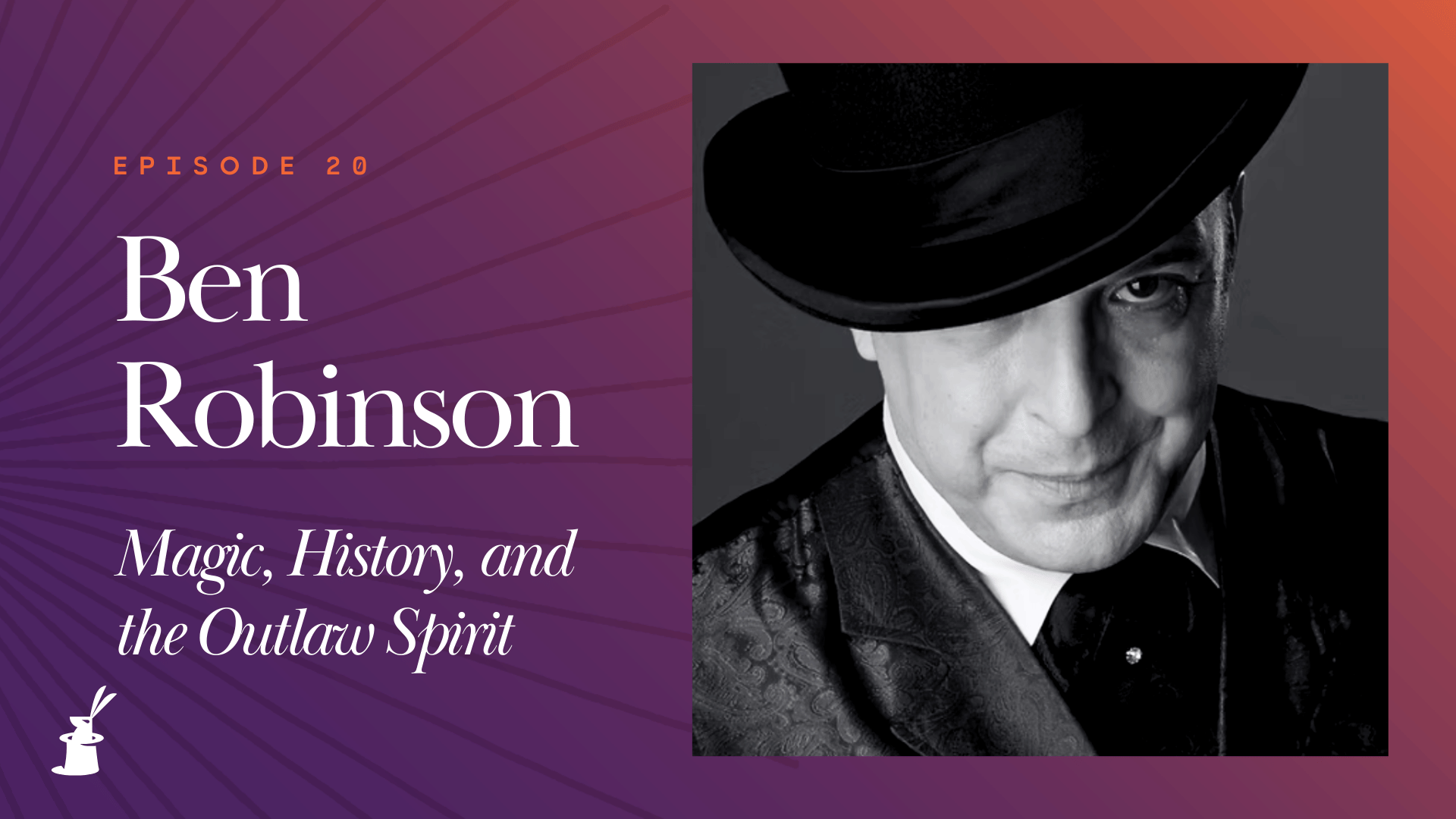
Ben Robinson's first glimpse of magic came not from a stage performer arriving with fanfare, but from a rerun broadcast. In July 1968, watching television on his living room floor, Ben found his calling in an unexpected place: the moment after The Beatles concluded their appearance on The Ed Sullivan Show. What followed was Fred Kaps, a three-time world champion magician, and in that instant, a young boy's entire future crystallized.
"It sounds like PR, but it's not. It's the truth. I saw what he did. I turned to my mother and I said, 'That's me.' I just had a vision very far in the future of my, dare I say orientation."
That vision has sustained him for fifty years. From his debut in 1974 to today, Ben has performed nine different one-man shows across twenty-five countries, entertained more than three million people, and authored fifteen books that have fundamentally shaped how we understand magic's history, practice, and philosophy. His journey, from that moment on a living room floor to becoming one of magic's most respected historians, reveals something essential about the art form itself: that magic is never merely about tricks, but about the artfulness with which people deploy them.
The Apprenticeship of Wonder
Ben Robinson's path into magic followed a predictable yet transformative pattern. At age seven, he walked into his local library and asked if they had any books on magic. The librarian produced John Mulholland's 1963 “Book of Magic,” a tome so thoroughly branded that John Mulholland's name appeared roughly fifty times on the dust jacket alone. Ben began reading it, and three years later, by the time he turned ten, he knew with absolute certainty that magic was his calling. "By then I knew, 'Yeah, this is exactly right. This is what I do,'" he recalls.
But Ben didn't learn magic in isolation. His education came from an extraordinary lineage of professional magicians and historians. The authors he studied as a young amateur, which included John Mulholland, Milbourne Christopher, Jean Hugard, and John Scarne, were not merely trick exposers; they were storytellers who understood magic's deeper architecture. What intrigued Ben most was not the mechanics of illusions, but the drama embedded within them. When John Mulholland described performing the Four Ace effect for Meyer Lansky's armed crowd, or when Milbourne Christopher revealed he had performed in seventy-two countries, these narratives transcended simple instruction. They showed Robinson what it meant to be not just a magician, but a professional one: someone who understood geography, history, and human psychology.
Beyond the authors in his books, Ben cultivated real friendships with magic's living legends. Bob Weill, who directed the legendary bullet catch for both Ted Annemann and later for Ben himself, became a mentor and correspondent. John Booth, a Unitarian reverend who penetrated Tibet when it was closed to Westerners, impressed Ben not merely with his magic accomplishments but with his intellectual rigor and historical documentation. Professor Eddie Dawes, the biological chemist turned magic historian, eventually became one of Ben's closest collaborators. These relationships, built through letters, visits, and shared manuscripts, formed the foundation of Ben's understanding that magic history required not just enthusiasm, but scholarly discipline.
The Bullet Catch and the Birth of a Historian
Ben Robinson's first major book, “Twelve Have Died,” emerged from what he describes as a "crazy idea." Here was an unknown performer, gigging in bars and clubs across New York City, proposing to write about the most dangerous illusion in magic's repertoire, an illusion that had claimed actual lives. The audacity alone might have guaranteed rejection. But Ben understood something crucial: he had to prove himself.
"I had the idea of writing a book about the bullet catch. I think, 'Well, you know, I'm nobody, but these are the best historians I know of and it doesn't hurt to ask, "Hi, would you take a look at my manuscript?"'"
The book took two years to research, conducted in the pre-Internet era through what amounted to an endless stream of correspondence. Every day brought letters from the likes of David Price, Bob Parrish, Eddie Dawes, and John Booth. Ben's research methodology was meticulous: he conducted original research before approaching these giants, then asked them to verify his findings. The strategy worked. Both Eddie Dawes and John Booth signed on as editors, a decision that elevated the project from a curious amateur's passion into a genuine historical work. “Twelve Have Died” was published in 1986, and Robinson had become a historian.
The CIA File and Three Decades of Detective Work
Ben Robinson's second and perhaps most ambitious project began in 1977 when he read a New York Times article buried in the Church Committee hearings. The bare-bones story: a magician had been hired as a consultant to the CIA. Ben had a vision: one that would consume the next thirty years of his life.
"I again, like 'Twelve Have Died,' although this is 11 years earlier, I again had a vision, somewhat in my head of 'There's a much larger story here.'"
The research for “The MagiCIAn: John Mulholland's Secret Life” took an unusual turn in 1997, when Ben was curator of a major auction of Milbourne Christopher's collection. Among the lots that failed to sell, unsold items were offered to Ben. Within those file boxes came an extraordinary discovery: John Mulholland's CIA file. It was, Ben recalls, profoundly unsexy: pages without headers, documents that were puzzles unto themselves. Yet within those papers lay the key to unlocking decades of cryptic correspondence and hidden operations.
To understand the intersection between magic and intelligence work, Ben had to educate himself in the world of Cold War espionage. He consulted with Keith Melton, founder of the International Spy Museum, and developed an understanding that magic and spycraft share something fundamental: the ability to solve intractable problems through misdirection and creative thinking. As he observed, intelligence agencies once hired magicians to work on problems that seemed unsolvable precisely because magicians could make elephants disappear and catch bullets in their teeth. The CIA had a real problem during the Cold War, and they believed a magician could help solve it.
When “The MagiCIAn” finally appeared in 2008, nearly thirty years after Ben first sensed the larger story, it fundamentally changed how the magic community understood one of its most influential figures. Ben had done what few historians manage: he had chased a shadow and brought it into the light.
Philosophy and the Work That Must Be Done
Ben Robinson's philosophy of magic, articulated in his autobiography “The Outlaw Hero,” rests on a provocative concept: that truly significant art comes from attempting what has never been done before. He credits Picasso's statement, "We do the work that must be done" - not the work we want to do, but the work that necessity demands.
This philosophy has guided his choices throughout his career. When tasked with creating a spectacular illusion for a gubernatorial appearance, Ben didn't resort to merely pulling top hats from a box. He engineered a collapsible six-sided frame that could vanish instantaneously, creating something he'd never seen before. Years later, he discovered that Blackstone had used an identical solution in 1932, evidence that the great illusionists think alike across generations.
Ben's most recent book, “MAJIKAL: 40 Stories of True Wonder,” collects pieces left over from his other works: observations about art, film, intelligence, and magic that didn't fit elsewhere. The title itself is deliberate. “Majikal,” Ben explains, is an actual dictionary word meaning "beyond the beyond." For Ben, one of the defining goals of a magician is to deliver something ineffable.
"One of my goals as a magician is to give the audience a sense of wonder, which can also be called a sense of transcendence. This is why we entertain, right? You go to see the magic show or the comedian or the opera singer or the acrobat or the circus. Why? To, you know, maybe take the heat off of all those bills you have to pay for an hour or two, you can revel in artistic perfection."
On Documenting Magic's Past
When asked about the responsibility of historians and writers to document magic's legacy, Ben becomes passionate about the problem of misinformation. The pre-Internet era meant that unverified stories could calcify into accepted fact. Even something as specific as the claim that Houdini performed the bullet catch, although demonstrably false, has persisted in popular culture and even in major films.
Ben insists on verification through multiple sources. "Everything in the book has been checked, rechecked, and verified by three sources," he notes about his work on John Mulholland. This meticulousness extends to his broader philosophy about what magic history should encompass.
The history of magic, Ben argues, is not about tricks or even people in isolation.
"The history of magic is not tricks, it's not people; it is the artfulness with which people deploy these things."
This understanding transforms how we might read magic's past. It means documenting not just Houdini's escapes, but the social context that made him possible. It means understanding Adelaide Herrmann not simply as a performer but as a woman heading a show for fifty years—a significant cultural achievement. It means recognizing figures like the humble "40-Milers" who never traveled far from home but maintained professional careers doing magic, contributing to the art even if they never achieved international fame.
Ben praises historians like David Price, whose “Magic: A Pictorial History of Conjurers in the Theater” grants equal weight to traveling superstars and local performers. In so doing, David Price created a more truthful account of magic as it existed in the lived experience of audiences. Ben also celebrates Henry Ridgely Evans, who captured the golden age of magic from 1880 to 1920, documenting what happened rather than merely celebrating the famous.
The Books That Made Him
When asked to identify the magic books that have most influenced him, Ben moves through three clear favorites, each representing a different aspect of his intellectual development. John Scarne's works and the technical treatises by Jean Hugard and Fred Braue established the foundation for understanding magic as a craft. These books demonstrated that magic could be discussed with rigor and context, that a trick performed for Meyer Lansky's armed retinue meant something different from a parlor effect.
David Devant's “Woes of a Wizard” (1902) spoke to Robinson on an emotional level. The book, written before David Devant's partnership with Nevil Maskelyne, documents the tribulations and failures of a working magician: the missed cues, the forgotten audiences, the nights when no one showed up. Ben saw his own struggles reflected in David Devant's honest accounting.
But his greatest treasure is Henry Hay's “The Amateur Magician's Handbook “(1950). Published under the pen name of June Barrows Mussey, who served as John Mulholland's secretary and librarian, the book synthesizes the best of magic technique with philosophical wisdom about presentation. Ben considers it, along with nearly every other serious magic historian he's spoken to, the most influential book in magic's latter half of the twentieth century.
"In one book, you have a technical treatise where you're really learning the right way to do a French Drop or a Shuttle Pass or De Manche Change or the Ash Pass. "Oh, my God. I have seen performers devastate audiences with that."
The Jobbing Magician
Ben Robinson's career has embodied what Paul Daniels once called him: a "jobbing magician." Unlike performers who slot into specific market niches—birthday party magicians, school show specialists, opening acts, Ben's approach has been to remain generalist. Every show is different. Every context presents new challenges. The same illusions that work in a nightclub must be adapted for the base camp of Mount Everest, where Ben performed at 18,000 feet for an international audience of mountaineers, or for a corporate stage, or for a theater full of paying customers.
This philosophy of constant adaptation and challenge has shaped how he views his life's work. He has caught bullets in his teeth. He has performed magic in twenty-five countries. He has written books that changed how the magic community understands itself. And yet, Ben maintains a certain humility about achievement. When asked what comes next, he resists the temptation toward complacency.
Looking Toward Film
After fifty years as a professional magician, Ben is beginning to explore a new medium. He has completed a film in which he performs as Zorro, throwing knives dangerously close to another performer's face, an effect he doesn't believe has been executed in cinema before, despite the character's legendary knife-throwing abilities. The meticulous work of professional filmmaking, with cinematographers and makeup artists and legal teams, fascinates him in ways that touring shows no longer quite do.
When asked about his future plans, Ben is refreshingly honest about his own evolution. "I don't want to sound jaded, but I've already caught bullets in my teeth. I've been to Mount Everest. I think I've worked with some really great people," he says. Yet he remains productive, still writing for VANISH Magazine, still collaborating with publishers like Paul Romhany.
As for the decades of carrying heavy Anvil cases across the globe, the endless hotel rooms and travel logistics, Ben has begun to question whether that life still calls to him. But the work itself, the pursuit of creating moments of wonder and documenting the history of those who came before, remains as vital as ever.
That seven-year-old boy watching Fred Kaps on a television rerun, the one who turned to his mother and simply said, "That's me," - that kid is still driving the magician and historian, still chasing the work that must be done.
Books and Publications Mentioned
Ben Robinson's Works:
“Twelve Have Died” (1986)
“The MagiCIAn: John Mulholland's Secret Life” (2008)
“The Outlaw Hero” (autobiography, 2020)
“MAJIKAL: 40 Stories of True Wonder” (2024)
Classic and Influential Texts:
“Mulholland’s Book of Magic” by John Mulholland (1963)
“My Life of Magic” by Howard Thurston (1929)
“Woes of a Wizard” by David Devant (1902)
“The Amateur Magician's Handbook” by Henry Hay [June Barrows Mussey] (1950)
“Scarne On Card Tricks” by John Scarne (1950)
“Expert Card Technique” by Jean Hugard and Fred Braue (1940)
“Magic by Misdirection” by Dariel Fitzkee (1945)
“Neo Magic” by Sam Sharpe (1932)
“Magic and Showmanship: A Handbook for Conjurors” by Henning Nelms (1969)
“Magic: A Pictorial History of Conjurers in the Theater” by David Price (1985)
“The History of Conjuring” by Henry Ridgely Evans (1928)
“Secrets of Conjuring and Magic” by Robert Houdin (Original in French 1868, First English Translation 1877)
“Fabulous Destinations” by John Booth (1950)
Publications:
VANISH Magazine (associate editor, regular contributor)
The Linking Ring (contributor)
The Sphinx
Gibecière
Resources
Listeners interested in exploring more of Ben Robinson's work and the intersection of magic history, intelligence work, and the philosophy of wonder should visit Ben’s website at https://www.illusiongenius.com/
Timestamps
00:02:21: Fred Kaps on The Ed Sullivan Show sparks Robinson's interest in magic
00:03:40: Understanding "orientation" and the magic bug
00:04:22: Ben visits library and discovers John Mulholland's “Book of Magic”
00:05:16: Early mentors: Mulholland, Christopher, Hugard, and Scarne
00:08:02: Meeting Bob Weill and learning about the bullet catch
00:09:53: John Booth: Unitarian reverend and magic historian
00:10:45: Eddie Dawes and his influence on Ben's research
00:12:18: Eddie Dawes's response to “Twelve Have Died” manuscript
00:13:26: Research challenges in the pre-Internet era
00:14:39: Watson grant and studying street magic in India
00:17:20: Discovering Mulholland's CIA connection in 1977 newspaper article
00:19:11: The importance of making research goals
00:22:55: 1997 as curator of Christopher collection auction
00:24:29: Finding Mulholland's CIA file in unsold auction lots
00:25:29: Keith Melton and the intersection of magic and spy tradecraft
00:27:35: How the CIA used intelligence to solve problems
00:28:05: The real story behind Mulholland and the Cold War
00:29:57: Picasso's philosophy: "We do the work that must be done"
00:30:47: Knife throwing insurance and professional filmmaking
00:31:56: Performing magic at Mount Everest base camp (18,000 feet)
00:32:18: The "jobbing magician" philosophy
00:33:52: Stories inspire MAJIKAL
00:36:04: MAJIKAL means "beyond the beyond" and the goal of transcendence
00:37:00: The magician as archetype and trickster
00:39:36: The historian's responsibility to document magic truthfully
00:40:27: The problem of hype and misinformation in magic history
00:41:55: Pinetti's handwritten letters and original research
00:42:47: Historians as "pallbearers of what happened"
00:43:29: David Price and the importance of the "40-Milers"
00:45:19: How Houdini legitimized magicians
00:46:09: Adelaide Herrmann and the need for historical detail
00:47:06: B.F. Keith Vaudeville programs and Nate Leipzig
00:49:01: The untold stories waiting to be documented
00:49:49: Engineering a Tip Over Trunk for top hat pyramid illusion"
00:52:45: Performing at The Magic Castle 60th anniversary
00:54:06: Ben 's most cherished books: Thurston's “My Life of Magic”
00:55:27: David Devant's “Woes of a Wizard” and the magician's tribulations
00:57:09: Henry Hay's “The Amateur Magician's Handbook” as greatest treasure
00:59:19: Fifty years as a professional magician
01:00:23: Twenty Anvil cases and the weight of touring
01:01:41: Recognizing a unique talent for putting things together
01:02:27: Moving toward film projects rather than live shows
01:03:05: Reflecting on catching bullets and reaching Mount Everest