Introduction
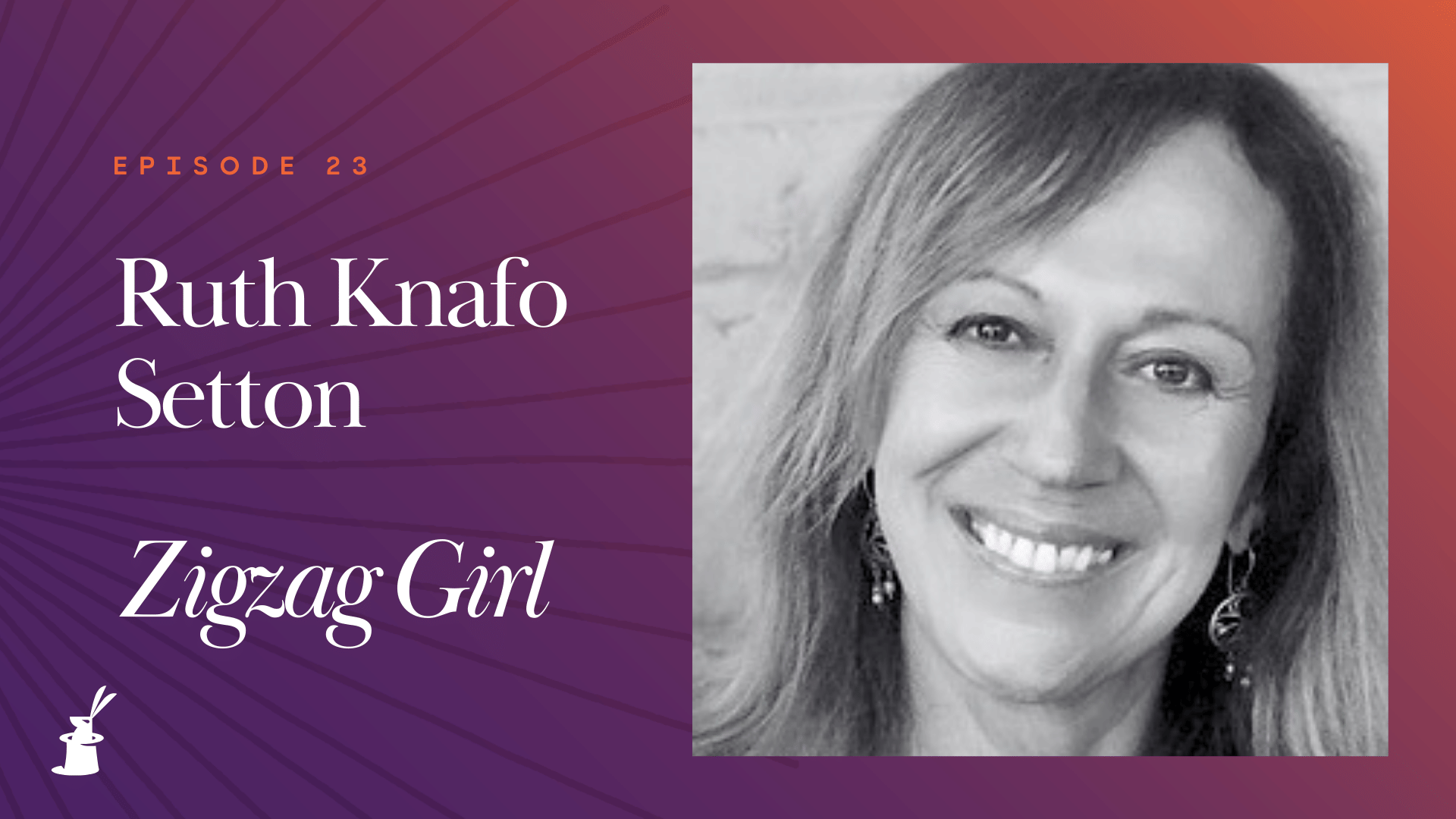
There is a kind of magic that refuses to stay on the stage. It spills into the street, into the imaginations of those who witness it, and, if a writer is paying close enough attention, onto the page. Ruth Knafo Setton has spent a lifetime pursuing exactly that kind of magic: as a scholar, an essayist, a student of some of the art's most revered practitioners, and now, at last, as a novelist.
Born in Morocco and previously a professor of Jewish Literature and Creative Writing at Lehigh University in Pennsylvania, Ruth has spent nearly two decades immersed in the world of performance magic, learning from legends including Eugene Burger, Teller, Max Maven, Jeff McBride, and Luna Shimada. She has presented multiple times at Jeff McBride's Magic and Meaning Conference in Las Vegas, and her 2009 essay "Sisters of Magic and Mystery" has become an influential piece on women's roles and representation in the magic world. All of that learning, all of those years of watching and wondering and writing, has now found its fullest expression in "Zigzag Girl," a noir-tinged feminist thriller set in Atlantic City's haunted magic underworld. Published in the UK in late 2025 and arriving in the United States on March 2nd, the novel is already a finalist for the International Thriller Writers Award for Standalone Book of the Year, winner of the Grand Prize in the Screencraft Cinematic Book Competition, and recipient of First Prize in the Daphne du Maurier Awards for Mystery and Suspense.
A Rooftop in Morocco
Every origin story in magic begins with a moment of wonder. For Ruth Knafo Setton, that moment didn't happen in a theater. It happened on a rooftop in Morocco, in the hands of her grandfather.
He was a man who grew roses, wrote poetry, and played the oud. He also kept two large cages of homing pigeons on his rooftop terrace, and he never locked the gates. The birds always returned. One afternoon, he and the young Ruth painted their wings red, blue, and yellow, then set them free together. Standing at the edge of the roof, they watched the colored birds ascend and heard the people below on the street stop in wonder. People talked about it for years afterward. Ruth never forgot it either.
"The kind of magic that he did was the kind that spilled from the stage to the street."
It is the kind of magic she says she has been following and searching for her entire life: magic without boundaries, magic that turns a corner and appears without warning in the real world. Her grandfather died before she could ask him what that afternoon had truly meant. But the image stayed. Before she ever met a professional magician, she had already been reading tarot cards for a living for years, drawn toward mystery without fully understanding why. That painted afternoon on a Moroccan rooftop had seeded something that would only fully bloom decades later.
The Silenced Siren
Ruth's thinking about magic has always been inseparable from her thinking about women's voices. Few pieces of writing in the magic community have explored that intersection more rigorously than her 2009 essay, "Sisters of Magic and Mystery," which grew partly out of a university course she designed, one she called ‘Sirens and Mermaids’ research she created as a formal excuse to investigate something she found herself genuinely haunted by.
What she discovered at the ancient site of the Pharos Lighthouse in Alexandria, Egypt, upended her assumptions about one of Western culture's most persistent mythological figures. In the myths that accumulated around that lighthouse, sirens were not seducers or monsters but guides: bird women who sang sailors safely to shore and carried the souls of the dead to the underworld, singing each person's life story as they went. Ruth explains: "I think the idea of the siren, that symbol of the siren, this woman whose voice is both life and death, light and dark, that it was a way to try and control that voice, to say it's evil."
When men stopped their ears against the siren's call, she argues, the fear was not of seduction. "I think the fear was of the words she was saying. She was speaking truths about death, about what happens after life."
That essay also took direct aim at a phrase she had heard repeatedly in her early years studying magic: the claim that woman is magic and man performs magic, a sentiment that male magicians offered her as a compliment. She rejected it then and she rejects it still.
"Almost by giving her this awesome, you know, power, it's dehumanizing her. If she's more than human, it's almost the same as saying she's less than human."
It is a thread Ruth would follow all the way to her novel.
A Magician Walks onto the Page
Ruth did not seek out magic. Magic found her — through a novel she couldn't finish and a character she could not get rid of.
She was working on an untitled manuscript set in Israel in the 1970s, a dual-time narrative about a troupe of actors in Jerusalem staging a film about the ancient Maccabeans. The past and present kept interweaving. And then, without explanation or invitation, a nameless, functionless character began appearing on the set. She tried to push him aside. He kept coming back.
"I followed him on the page," she says, and she followed him all the way to a Jerusalem theater where mimes, jugglers, and performers gathered. She started calling him The Magician in her mind. She put aside the rest of the manuscript. She went on Google, searched "Magician, '70s, Israel," fell headlong into the world of Uri Geller, and then, by one of those providential accidents that only seem accidental in retrospect, came across a newspaper article about a professor in her own town who was teaching a course on the philosophy of magic. She contacted him. They met.
"We ended up sitting over coffee for 3 hours talking. And by the time I left, I had a friend and a mentor."
That professor was Larry Hass. He became her guide into the magic world, and through his conferences at the college she met Eugene Burger, Jeff McBride, George Parker, John Carney, and Jamy Ian Swiss. She audited his course. She stopped writing the Israel novel. She had discovered something she knew would change everything, and from then on, she says, "there was just no turning back."
Eugene Burger and the Capital-M Mystery
Of all the figures Ruth encountered in her years of study, Eugene Burger stands apart. She describes his presence — warm, funny, possessed of a voice that worked on her like a spell — with unmistakable affection. But what he taught her has proven more lasting than any single encounter. Ruth explains: "He taught me that magic is not about fooling a spectator. It's about creating an emotional experience for the spectator."
He also taught her to look for the difference between mystery with a small 'm' and Mystery with a capital 'M': performance that goes deeper than surface entertainment into something she aligns with Lee Siegel's formulation: "Magic is religion with a 2-drink minimum." He taught her, through his own late-career practice of paring scripts down to their essence, that economy in language is itself a form of power.
Eugene Burger also gave her the metaphor she uses to describe her own relationship to the magic world: as he wrote, magic is a house with many rooms. Ruth found her room not on the stage but at the desk, pen in hand.
"I'm a storyteller who uses magic, who wants to become as powerful as a magician on stage on the page, using words to weave my spell and using my pen as a wand. In a sense, that's my goal."
It is a goal she has been working toward, consciously or not, since the afternoon her grandfather set those painted pigeons free over the rooftops of Morocco.
Atlantic City and the Ghost Light
"Zigzag Girl" is set in Atlantic City, and the choice of location was anything but arbitrary. Ruth grew up visiting the Jersey Shore, watching the city transform and decline and reach again for reinvention. She had originally planned to set the novel in Las Vegas, but then she visited Atlantic City and felt something different, something in that ancient boardwalk where traces of old painted letters still bled through fresh paint, where the ocean waits at what feels like the end of the world.
Her thinking deepened when she learned about Atlantic City's largely forgotten wartime history. During World War II, the US Army took over the city and transformed it into Camp Boardwalk, converting the grand old buildings into Army barracks, officers' clubs, and a hospital called the Thomas England Hospital built into the bones of a Quaker rooming house called Chalfont Haddon Hall at what is now Resorts Casino, the first casino on the boardwalk. On a tour of that building, Ruth was taken to the 13th floor and into a small haunted theater. A ghost light burned at center stage in daylight. The theater had two full walls of windows. It held around 300 seats. She stepped onto the stage and looked out through those windows.
"I didn't have to be told it was haunted. I knew it. I felt it inside me. That was where I first felt Cleo West, my World War II magician, because it's like she was standing behind me on the stage."
That theater became the model for the fictional Black Widow Theater in the novel. The real history of Benny Goodman, Frank Sinatra, and all the stars who came to entertain the troops; the soldiers and amputees who filled those wartime seats, gave Ruth the bones of a world she could build upon. The spirit, she says, is still there.
Noir With Hope
"Zigzag Girl" wears its genre allegiances openly. Ruth is a self-confessed lover of film noir, drawn to its shadows and its sparing light, to the way its characters run toward a streetlamp at the end of an alley only to watch it go dark before they arrive. The biggest lesson of noir, in her reading, is simple: you cannot escape your past.
But the version of noir Ruth practices carries a personal modification. Classical noir is relentless in its downward pull. She loves the darkness but cannot end there.
"I call it 'noir with hope' because I want the light. To me, dark and light work together."
You feel the dark more acutely, she argues, when there are moments of light to measure it against.
That same resistance to the purely passive applies to the novel's feminist perspective. The shift began with a personal experience: being sawed in half. Lying in the box, she realized that the magician above her would never know what she was feeling at that moment: that his story and her story were entirely different. She thought about how many times she had seen the traditional version of that narrative: the magician with the top hat and the wand, and the woman acted upon rather than acting. "I can really explode this story," she thought, "make the female be the active agent rather than the one acted upon."
The Zigzag Girl and the Question of Identity
The illusion that gives the novel its title, Robert Harbin's Zigzag Girl, in which a standing woman is divided into three sections and her middle pushed sideways, was the perfect metaphor. "The idea of identity being slippery, I like that." The cover art, which Ruth praises, shows a woman in three pieces arranged out of sequence, a visual argument that identity can be shifted, displaced, and reassembled.
And the question at the center of the novel is precisely that.
"The whole story in 'Zigzag Girl' circles around one question: Who are you? Or who am I? Every single person in the novel, all the main characters, need to find out something about themselves."
Ruth’s protagonist, Lucy Moon, a 27-year-old magician and part of a female performing trio called Rebel Magic, carries her own complicated relationship with the sawing illusion, particularly the classic closed box she compares to being buried alive. Lucy fears the box.
But Cleo West, the 1940s magician performing every night for wounded soldiers at Thomas England Hospital, taught Ruth something more layered about the same effect.
"For Cleo, a woman who was abused in many ways, every night she's sawed in half, she's killed, and then she rises triumphant."
For Cleo it is a nightly triumph over death. For those amputee soldiers watching her, it is something else again: a suggestion that being broken doesn't mean being destroyed. The same illusion, read from different positions, yields entirely different meanings. That duality is at the heart of what Ruth is doing throughout the novel.
Lucy herself was inspired by the female magicians Ruth had the good fortune to meet, interview, watch, and spend time with over her years of study, among them Luna Shimada, Joan Dukore, Kayla Drescher, Connie Boyd, Carisa Hendrix, Frances Marshall, and Abigail McBride. When she began creating the specific illusions Lucy and her troupe would perform on stage, Ruth drew encouragement from a magician she met early in her studies, who told her: "If you can imagine it, Ruth, we can make it happen." It was, she says, a freeing thing to hear.
Thin Places and the Pine Barrens
For the novel's moments of heightened perception, moments where Lucy can see and experience events from the past, Ruth reaches for the Celtic Irish concept of "caol áit": thin places, where the past seeps through into the present so that a person is never quite anchored in a single time. She experienced this herself on Atlantic City's boardwalk, where she would hear voices when she pressed her hand against old walls or paused on the boards. Long after writing a first draft of the novel, Ruth learned from a former Atlantic City police officer that the voices may not have been imagination at all. He described an underground community that had once existed beneath the boardwalk itself, a hidden world of which she had known nothing.
The novel also reaches into the Pine Barrens of New Jersey, a landscape of dead and living trees standing side by side, of mysterious sounds, of million undeveloped acres less than an hour from the boardwalk but seemingly an eternity away. At the heart of that landscape is the Jersey Devil, a creature born human, according to legend, who transformed into a monster and surfaces every fifty years or so to terrorize the living. What moved Ruth most was not the monster but the transformation at its center, and the echo she found in a much older story: the Lenni Lenape, the Native American people who first inhabited those barrens, spoke of a spirit called the Mesingw, a spirit of transformation.
"It kind of is the background to everything I think about with magic - the feeling of transformation."
It was in that graveyard, in the dark, with the ground seeming to move beneath her feet, that she says "the dark heart of my murderer just burst forth, and I knew what I needed to write."
Authentic to the Bone
One of the novel's most distinctive qualities is its refusal to fictionalize the institutions and landmarks of the magic world. FISM, the IBM Lifetime Achievement Award, the Magic Lounge in Chicago, the Broken Wand ceremony, Genii magazine — they are all present by their actual names. The choice was deliberate and, to Ruth, essential.
"That was critical for me. It was very simple so that someone like you could read that book and think, 'She's not faking it. She knows what she's talking about.'"
The quickest way to lose a reader, she argues, is a mistaken crucial detail. Lucy Moon and the gang exist in a world that a magically aware reader will recognize as real.
That authenticity also drove the novel's path to publication. During the pandemic, Ruth had parted ways with her agent and was taking long walks while listening to podcasts. One of those podcasts, "Two Crime Writers and a Microphone," hosted by UK crime writers Luca Veste and Steve Cavanagh, stayed with her. When she later learned that Black Spring Press had launched a new crime series curated and edited by Veste, she sent a letter on the strength of that connection alone. Luca Veste read the book and loved it. "Zigzag Girl" will be released and distributed in the US by Simon and Schuster.
Most Cherished Magic Books
Ruth entered magic through books, and her shelves reflect the breadth of a reader who has absorbed the literature of the art as thoroughly as any performer. The first magic books she read were "The Books of Wonder" by Tommy Wonder, and she still keeps a quote from that book at her desk. She describes it only in Tommy Wonder's own words: "The highlights will give you the shadows. The shadows will give you the method. And the method will give the dream to your audience."
"Magic and Meaning" by Eugene Burger and Robert Neale remains a book she returns to constantly. And "The Death and Resurrection Show" by Rogan Taylor, a used copy, hard to find, has stayed with her because of the image at its center: the magician as a keeper of wonder through time, a shaman figure who holds that role across centuries.
"I just love that image of a magician as 'a keeper of wonder,'" she says. "That's a book that affected me a lot."
Among more recent titles, she mentions with particular warmth the work of Charles Greene III on Ionia, a book she discovered through The Magic Book Podcast (Episode 11), and considers the work of someone who has already become a friend, though they haven't yet met, and Connie Boyd's "The Power of Magical Women" (Episode 21)
Looking Forward
A sequel to "Zigzag Girl" exists, at least in outline. Ruth is currently working on two projects simultaneously. One is a historical thriller that goes back into the past. The other is a second Lucy Moon book, one she hadn't planned on until a vision for it arrived. She is not ready to discuss either in detail; "I can't talk about either one because they're both so fresh in my mind, but I am working on both."
In the meantime, the US publication of "Zigzag Girl" on March 2nd will be accompanied by a blog tour, podcast appearances, and events including ThrillerFest in New York in May and AWP in Baltimore in March. Ruth's website, RuthSetton.com, carries up-to-date information on events and reviews, and her free monthly Substack newsletter at ruthsetton.substack.com is intended, she says, as a source of inspiration for writers, artists, magicians, and creatives of all kinds.
In her acknowledgments, she quotes Teller — "I love to wallow in magic" — and adds her own agreement. Asked what it is about wallowing in magic that has kept it such a constant in her life, she points to something she recognizes in nearly every magician she has ever met:
"Not a closed mind, not even thinking outside the box. There's no box."
It is, she says, a free way of looking at the world, a sense of possibility that she responds to so deeply that she dedicated the novel "To the magicians." From the rooftop in Morocco where the painted pigeons took flight to the haunted theater on the 13th floor of a Casino in Atlantic City, the magic has always known how to find her. "I don't see any sign of it stopping."
Books and Publications Mentioned
Ruth Knafo Setton's Work:
"Zigzag Girl" (Black Spring Press / Simon and Schuster, 2025/2026)
"Sisters of Magic and Mystery" essay (2009)
Magic Books Cited by Ruth:
"The Books of Wonder" by Tommy Wonder (1996)
"Magic and Meaning" by Eugene Burger and Robert Neale (1995)
"The Death and Resurrection Show" by Rogan Taylor (1985)
"Ionia: Magician Princess Secrets Unlocked" by Charles Greene III (2022)
"The Power of Magical Women" by Connie Boyd (2025)
"Net of Magic: Wonders and Deceptions in India" by Lee Siegel (1991), source of the quotation "Magic is religion with a 2-drink minimum"
"A House with Many Rooms" by Eugene Burger, originally published in Genii: The Conjuror's Magazine, Volume 58, Number 9, July 1995; reprinted in "Eugene Burger: From Beyond" by Larry Hass, Ph.D., Theory and Art of Magic Press (2019)
Resources
Listeners interested in exploring Ruth Knafo Setton's work can visit:
Website and events: https://www.ruthsetton.com
Substack newsletter: https://ruthsetton.substack.com
"Zigzag Girl" (available March 2nd on Amazon, Barnes & Noble, and major online retailers)
Timestamps
00:03: Teaser: Ruth on being a storyteller who uses magic
00:23: Introduction to Ruth Knafo Setton
01:43: Awards and US publication date for "Zigzag Girl"
02:15: Earliest memories of Morocco and the grandfather's rooftop
03:19: Painting the pigeons' wings and the magic that spills from stage to street
04:08: Returning to Morocco for the grandfather's funeral; professional mourners and the siren connection
05:24: Sirens as bird-women and guides at the Pharos Lighthouse in Alexandria
07:01: "Woman is magic, man performs magic" — and why Ruth rejects it
08:43: First encounter with performance magic
09:26: The unnamed magician character enters the Israel novel
10:02: Discovering Uri Geller and finding Larry Hass
11:06: Auditing the philosophy of magic course; meeting Eugene Burger and others
11:57: What Eugene Burger taught her about Mystery with a capital 'M'
13:38: Finding her place in the magic world as a storyteller, not a performer
15:40: Why Atlantic City and not Las Vegas?
17:23: Atlantic City's World War II history; Camp Boardwalk and Thomas England Hospital
18:17: The haunted theater on the 13th floor of Resorts Casino; discovering Cleo West
20:00: Weaving noir elements into "Zigzag Girl"
21:30: "Noir with hope" and the interplay of dark and light
22:11: Shifting the gaze: Lucy Moon as the active agent
23:33: The Zigzag Girl illusion as a metaphor for identity
24:37: Lucy Moon and Rebel Magic; the female magicians who inspired her
26:31: Robert Harbin's illusion and the duality of Lucy and Cleo West
27:49: Lucy's fear of the closed box
28:12: Cleo performing for wounded soldiers at Thomas England Hospital
29:29: Why real magic references matter: authenticity over fiction
31:31: Thin places, magical realism, and the voices under the boardwalk
34:16: The Pine Barrens, the Jersey Devil, and the spirit of transformation
37:08: Lucy Moon's female archetypes and Jersey girl magic
38:57: The surface story and the shadow story; masks and the whole picture
40:53: Journey to publication and connecting with Black Spring Press
42:25: UK reception and the Crime Writers Association
43:03: Upcoming US events: ThrillerFest, AWP, and the book launch party
43:54: Most cherished magic books: Tommy Wonder, Eugene Burger, Rogan Taylor
45:29: Charles Greene III on Ionia and Connie Boyd's "The Power of Magical Women"
46:13: Sequel plans: two new projects in progress
47:09: Where to find Ruth and purchase "Zigzag Girl"
48:01: What "wallowing in magic" means; the dedication "To the magicians"
49:25: Closing remarks