Introduction
He was thirty-four years old, a young assistant professor of philosophy, and his five-year-old son had just fallen asleep on the couch. On the television screen, David Copperfield was performing. The boy slept. The father woke up. That accidental, late-night moment of television watching would eventually cost Dr. Lawrence Hass his academic career and give him a better one.
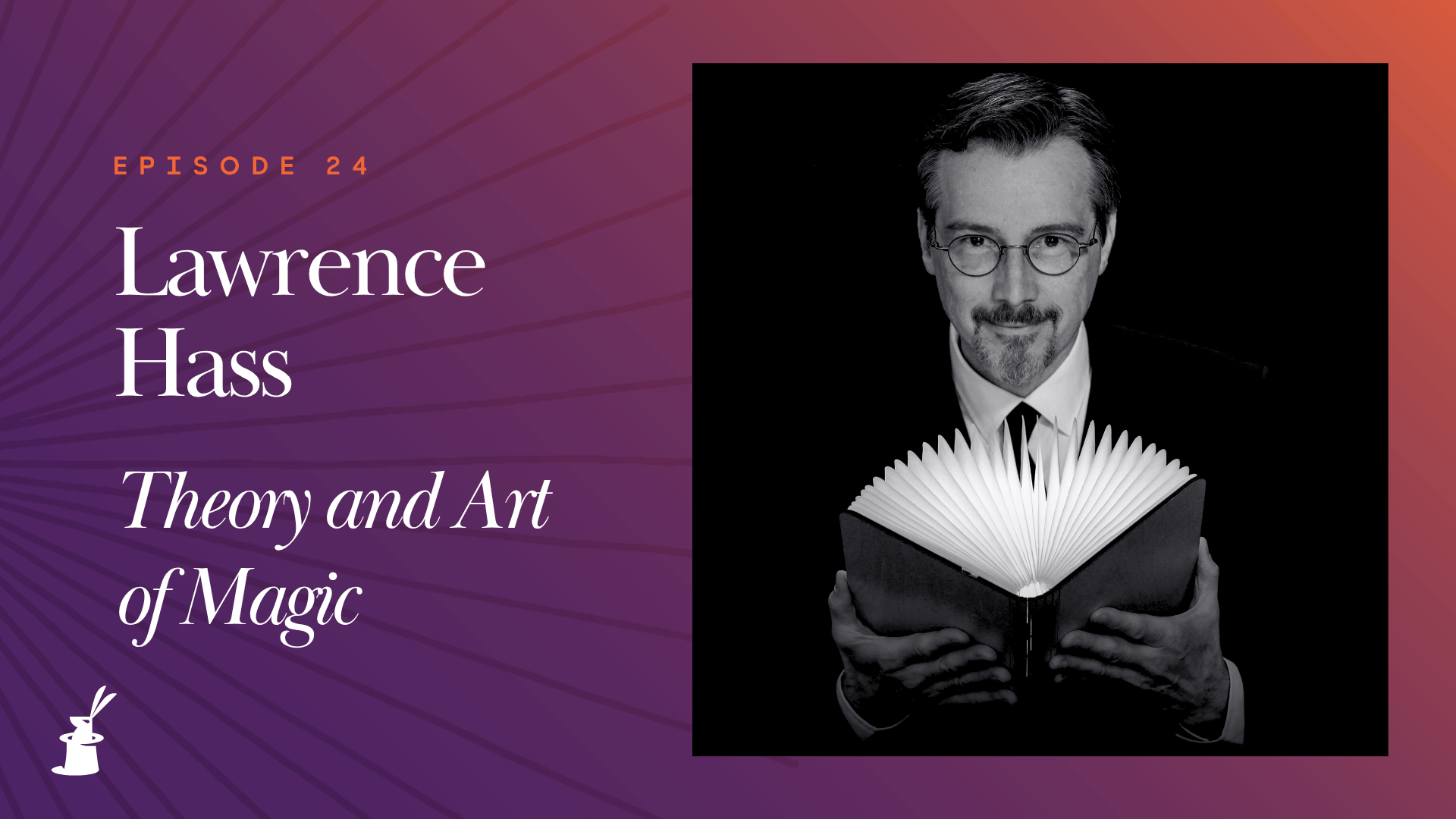
Today, Larry Hass is a philosopher, performer, author, publisher, and the dean of McBride's Magic and Mystery School, which the BBC has called "the most prestigious magic school in the world." His Theory and Art of Magic Press has produced some of the most intellectually serious and beautifully made books in contemporary magic, including works by Eugene Burger, Robert E. Neale, Jeff McBride, and others. His own writing, more than fifteen books translated into nine languages, has earned him a reputation as one of the most thoughtful voices in the field. And earlier this year, he released what may be his most ambitious project yet: "The Ross Johnson Legacy: Hard-Hitting Mentalism," launched at a special event at the Magic Castle in Los Angeles.
This conversation traces the full arc of that journey, from a philosophy classroom in suburban Pennsylvania to the slipcase-and-cloth pages of a premium mentalism book that three decades of friendships, secrets, and performing experience made possible.
A Different Kind of Beginning
Most magicians can tell you exactly which trick caught them, which uncle, which Saturday morning show. Larry cannot. Magic didn't call to him as a child or a teenager. His art was music. He performed and studied as a musician through his young adult years, and it wasn't until he sat down to watch that Copperfield special in 1993 that the needle moved.
"I woke up, I really did, to the fact that magic was an under-theorized art form."
The insight was quintessentially philosophical. Here was a performing art practiced at the highest level, and the critical tradition had almost entirely ignored it. As a phenomenologist, his academic specialty was the French philosopher Maurice Merleau-Ponty, and Larry was trained to notice exactly this kind of blind spot. He didn't just become interested in magic. He became interested in why no one had thought seriously about it.
That philosophical impulse led, a year later, to the creation of the Theory and Art of Magic program at Muhlenberg College, where Larry was on faculty. His goal was deliberately elite: bring in only the best magicians, including David Blaine, Jeff McBride, Juan Tamariz, and Teller, and demonstrate that magic performed at the highest level deserved to be taken seriously as an art form. "I think one reason magic is undervalued is because in magic, people often associate the art form with the least practitioners," he says, describing how a bad card trick from "Uncle Bob" at a family reunion colors the public's entire perception of the field. His program was a direct rebuttal to that association.
What surprised him was how readily the top tier responded. No one turned him down. Teller sat in a classroom with twenty young magicians. Every visiting master proved to be generous and passionate about the importance of what they did. Larry filled notebooks.
The Book That Changed Everything
It was in Chicago, during that first summer after the David Copperfield special, that the second great catalyst of Larry's magical life appeared in his hands. He had been making regular pilgrimages to Magic Inc., the legendary shop run by Jay Marshall, buying tricks and going home, only to find himself stacking up props with no framework for turning them into anything meaningful.
One day, frustrated, he said as much to the person behind the counter. The response was direct: "Oh, don't buy tricks, Larry. Oh, no. You want to buy books, because that's really where you learn about this art." And then, a small brown booklet was placed in front of him: Eugene Burger's "Intimate Power."
"I took that home, and I read it, and WHOA! I finished it, and I read it again, this time with pen in hand, and I read it again, and it was like Eugene was answering all my questions about this."
As it happened, Eugene lived in Chicago and performed every Thursday and Friday night at Biggs restaurant. Larry called ahead, gathered his family, and went to dinner. Eugene came to their table and performed for twenty minutes. The friendship that began that evening, grounded in their shared philosophical temperaments, would become the defining professional relationship of Larry's life.
Defining the Art
Years of performing informed what became Larry's working definition of magic, later delivered in a TEDx talk at SMU: "The artful performance of impossible things that generates delight and wonder." It reads like a philosopher's formulation, but Larry is emphatic that it came from the stage, not the study.
The first half arrived early. Magicians create impossibilities. That much was clear. The second half took longer, and it came from watching audiences. When a piece of magic truly lands, something physical happens in the room. "Their eyes would open, their faces would open, their jaws would open," he says. The definition grew to include that energy because he kept witnessing it.
It also sharpened his thinking about failure. A magician who finishes a routine and leaves the audience thinking and figuring has not done the job. "My goal in magic, and the goal I share with our magic students, is you don't want them thinking and figuring at the end of the show, you want them to be, 'Wow!', eyes wide open, face wide open, feeling the excitement that magic brings."
Related to this is a concept Larry has written about in his newsletter: verisimilitude, the fragile believability that holds a performance together. He draws directly on his theatrical training, noting that in magic, as in theater, the audience must be willing to make believe. That agreement is easily broken, and magicians are often the ones who break it. "The bubble can often break because magicians aren't trained in theatrical elements like character and movement," he explains, pointing to the reckless use of humor as a particularly common offender. A joke that punctures the spell, rather than enhancing it, can bounce an audience out of the show entirely.
Killing the Professor
By 2010, the tension between his two lives had become irresolvable. Larry retired early from academia to become a full-time professional magician. His memoir essay about the experience carries a subtitle of characteristic wit: "How I Used Magic to Kill My Professor."
He doesn't minimize what that change required. Decades of work had gone into his academic career, the Ph.D., the international reputation in phenomenology, the teaching. "It was a shift in identity," he says simply, "a major shift in my identity from being a professor and a scholar to being a performing artist." That shift took time and, he notes without embarrassment, therapy. The financial reality was equally concrete: no annual salary, only income when working. His daily life changed entirely. Where he had spent his days in libraries, he was now at Home Depot, accumulating supplies to build props and rehearsing in a studio.
"As much as I love philosophy – I'm still a philosopher – as much as I love that, I love magic more."
A Publisher With a Purpose
The publishing platform grew organically alongside the performing one. After finishing his first book, "Transformations," and hearing that commercial publishers had long pipelines, a friend offered a simple suggestion: publish it yourself. Larry taught himself the business and did exactly that. But early on, he made a decision that would define what Theory and Art of Magic Press became.
"Theory and Art of Magic Press has never been about just publishing whatever comes across my desk. It's publishing magic books that are within my vision of educational elevating of magic as an art form and by people who I've learned deep things about magic from."
The press, in other words, is a form of gratitude made physical. Bob Neale was the first outside author, and eight books followed. Then Jeff. Then Eugene. Now Ross. Each choice was personal: "It's kind of a way of saying 'thank you' to my teachers."
Collaborating with Jeff on "The Show Doctor," which expanded Jeff's acclaimed MAGIC Magazine columns into a major book with more than 45,000 words of new material, taught Larry something he has applied to every project since. The question of how to translate another performer's instincts onto the page without overwriting them has a simple answer. "It's not about me. This book is not about me. This book is about Jeff." That reminder, he says, mutes every temptation to insert himself into the text.
The physical production of a serious magic book operates, as Larry describes it, like an orchestra. Manuscript, editor, cover designer, interior layout artist, printer: each instrument requires a skilled player. "It's my job to conduct the orchestra, but I can't play all the instruments." For the Ross Johnson book, the final two months involved daily communication with one member of that orchestra or another. He knew early that the book wanted to be a hardcover. The slipcase and cloth covering arrived later, almost inevitably. "I realized, 'No, that's not good enough for Ross. This is his legacy book.'"
The Secret Commission
Before any of that could happen, there was Eugene. Before his passing in 2017, Eugene called Larry out of the blue, healthy at the time, with a request: would Larry document his unpublished professional repertoire in two posthumous books, with two conditions? The books would appear only after Eugene's death, and Larry was not to speak of the project to anyone beforehand.
Larry kept the promise absolutely, with one exception. His wife, also a close friend of Eugene's, was permitted to know. For everyone else, including Max Maven and Jeff McBride, friends who could have been invaluable collaborators, silence.
He understands now why Eugene imposed the condition. The prospect of spending years fielding questions about when the books were coming, and by extension when he would die, was simply not something Eugene was willing to endure. But keeping the secret had a real cost. "Keeping something really secret from anybody is hard," Larry says. "We're not really built to do that. We're built to share."
What Eugene was actually commissioning became clear when Larry went through his records. He had approximately fifty-four or fifty-five items, routines, interviews, and essays, that had never been published. When Eugene saw the list, his response was pure Eugene: "Far out!" Sitting together in Chicago in the summer of 2010, they realized there were two books, not one. Three days followed of Eugene teaching Larry his methods, Larry filming everything and making backups of backups.
"I was like a child at Christmas or a kid in a candy shop, as Eugene is teaching me his incredible material."
Editing Eugene's scripts required almost no intervention. Eugene's performing texts went through ten, eleven, twelve drafts before settling into what Larry calls a "locked" condition. They were impeccable. Eugene had also, with characteristic foresight, explicitly empowered Larry to make adjustments as circumstances required. Larry treaded lightly. The comma faults were cleaned up. The rest was left alone.
The Reluctant Legend
The third great collaboration in Larry's publishing story began with a dinner that Eugene engineered and a suggestion that neither of its recipients were ready to hear.
Ross is, as Larry puts it, one of three world-class mentalists he has seen in his lifetime, alongside Max Maven and Derren Brown. Ross spent sixty years performing for Fortune 500 corporate clients and deliberately staying out of the magic subculture's spotlight. His secrets were his livelihood. He wasn't sharing them.
The introduction came through Eugene in the late 2000s, over lunch in Chicago. Ross and Larry got along despite, or perhaps because of, their differences. "I'm kind of sunny and Ross is a little more wry, perhaps even I wouldn't say sarcastic exactly, but dark. He sometimes has a dark and dry sense of humor." Then, one evening after a Mystery School mentalism masterclass, the three of them were sharing a glass of wine when Eugene leaned over to Ross with a quiet disclosure. He explained that Larry was already writing two books to be published after his death. Then he added: "and you should have him write yours too!"
Both men were immediately uncomfortable. Larry had enough on his plate. Ross wasn't ready to part with a lifetime of working secrets. "But the idea kind of got in Ross and it kind of got in me."
Larry never pushed. By 2018, Ross had warmed enough to allow filming. By 2022, after seeing the quality of the Eugene Burger posthumous books, they formally committed to moving forward. Ross had reached eighty. He was still performing. And he had come to accept that releasing the book while he remained active was something he could live with.
To capture Ross properly, Larry engaged Chicago filmmaker Michael Caplan to produce a professional three-camera shoot of Ross's full evening show, "A Funny Thing Happened... Tomorrow," at the Rhapsody Theater. Both Larry and Ross had independently reached the same conclusion: a book about Ross without footage of Ross would be insufficient. So much of what makes his performances work happens between the routines, in the cumulative architecture of a show that builds toward an explosive ending. The film had to exist.
Larry watched the finished edit go to Ross with genuine anxiety. "I sat there realizing, 'Oh my God, he might hate it!'" He didn't. Ross loved it. That, Larry says, was a very good day for the project.
A Night at the Magic Castle
The book was launched officially on March 8th at the Magic Castle in Los Angeles, with Michael Weber hosting a 75-minute presentation featuring both Larry and Ross before an audience of sixty magicians. At the center of the evening, Ross performed one of the routines from the book, a mind reading piece that the assembled crowd, not yet having read the book, had no framework to process.
"Sixty magicians were there with their jaws hanging open."
The standing ovation was loud and immediate. Books were sold. All three men signed copies. For Ross, the reception carried particular weight. As Larry puts it: "He feels that his life work has just been received."
Magic, Mentalism, and the Line Between Them
One of the conceptual gifts of the collaboration, for Larry, was a clarification of his own artistic identity. He had always advertised himself as a magician but performed routines he thought of as mentalism. Working alongside Ross, absorbing his philosophy over years, changed that.
The distinction, as Larry now frames it, is this: magic is about impossibilities that generate energy, delight, and wonder. The "Wow!" of astonishment. Mentalism, in the classical sense, is about mystery. It pursues the thrilling shock of genuine not-knowing: "What just happened? I don't know what happened." Ross and Max both operated in that second register, creating experiences of deep mystery that could be thrilling, even disturbing.
Between those two poles sits what Larry and Ross call "mental magic," routines that use a psychological or mental frame but are really performing impossibilities rather than mysteries. They are going for ecstasy, not enigma. Larry now places himself firmly in that category.
"I'm a magician and proud of it."
His hope for "The Ross Johnson Legacy" is that it does something specific for the field. Over time, the tendency to adopt what others do without examining foundational principles can lead performers to drift away from the roots of the art. "Classical mentalism is not about astonishment. It's about mystery." If the book provokes that conversation, he says, that would be enough.
Looking Forward
With the book delivered, Larry describes experiencing something he hadn't felt in years: mental space. New work is beginning to surface. He is returning to Spirit Theater material that he and Eugene developed together, seance show work that went dormant after Eugene's passing. He is presenting at the Magistrorum Conference in September in Irving, Texas, and contributing to ongoing Mystery School programming.
In May, he is launching an online course through the Mystery School called "Write and Publish Your Magic," designed to share what he has learned about the craft of writing for and about magic performance. Over decades, magicians have approached him with that question, "How do I do this?" and he is finally formalizing the answer.
His newsletter, published every other month at TheoryandArtofMagic.com, continues to be what he set out to make it: "high content, low sales." That promise, kept consistently over seven years, has built a community through word of mouth.
For a man who woke up to magic while his son slept through a television special, the work of honoring that awakening has taken the form of books, performances, friendships, and now, finally documented, the lifetime secrets of one of the finest mentalists alive.
Books and Publications Mentioned
Works by Lawrence Hass and Theory and Art of Magic Press:
"The Ross Johnson Legacy: Hard-Hitting Mentalism" by Ross Johnson, co-written and edited by Lawrence Hass (2026)
"Eugene Burger: Final Secrets" by Eugene Burger, posthumous work edited by Lawrence Hass (2021)
"Eugene Burger: From Beyond" by Eugene Burger, posthumous work edited by Lawrence Hass (2019)
"The Show Doctor" by Jeff McBride with Lawrence Hass (2012 hardcover, 2015 paperback)
"Transformations: Creating Magic out of Tricks" by Lawrence Hass (2007)
Books Larry Cherishes in His Personal Collection:
"The Experience of Magic" by Eugene Burger (1989)
"Intimate Power" by Eugene Burger (1983)
"The Books of Wonder" Volumes 1 and 2 by Tommy Wonder (1996)
"Spirit Theater" by Eugene Burger (1986)
Resources
To purchase "The Ross Johnson Legacy: Hard-Hitting Mentalism" visit: www.theoryandartofmagic.com
To subscribe to Lawrence Hass's newsletter and find information on upcoming courses: www.theoryandartofmagic.com
To explore McBride's Magic and Mystery School and its bi-monthly 'Museletter': www.magicalwisdom.com
Timestamps
00:00 Introduction to The Magic Book Podcast
01:01 Guest introduction: Lawrence Hass
02:37 Larry's unconventional path into magic
03:51 Creating the Theory and Art of Magic program at Muhlenberg College
05:36 Guest lecturers and learning from top magicians
07:28 First encounter with Eugene Burger and "Intimate Power"
10:15 Defining magic: "The artful performance of impossible things that generates delight and wonder"
12:17 The importance of audience experience and the Maya Angelou principle
13:54 Verisimilitude in performance: the fragile soap bubble
15:59 Transitioning from academia to full-time magician in 2010
20:09 The role of publishing in honoring mentors and teachers
22:58 Collaborating with Jeff McBride on "The Show Doctor"
25:39 The orchestra behind a serious magic book
28:32 Criteria for selecting manuscripts to publish
30:16 Eugene Burger's posthumous works: the secret commission
35:04 Working through Eugene's unpublished material
37:07 Editing a wordsmith's scripts with a light hand
39:02 Overview of "The Ross Johnson Legacy"
41:03 Meeting Ross Johnson and the introduction by Eugene Burger
43:46 The years-long journey to create Ross's book
46:06 Filming Ross's full evening show at the Rhapsody Theater
48:15 The book launch at the Magic Castle
53:58 What "The Ross Johnson Legacy" hopes to do for mentalism
54:26 Resetting ideas about classical mentalism
56:51 New projects and creative directions
01:02:00 Where to purchase "The Ross Johnson Legacy"
01:03:56 Magic, mentalism, and mental magic: drawing the line
01:06:38 Closing