Introduction
He never had the magic uncle, the trick set under the Christmas tree, the late-night spell of a syndicated Saturday morning special. As a child in the UK, what fascinated him were not vanishing coins but vanishing ships. The Bermuda Triangle. UFOs. Ghosts. Spontaneous human combustion. He read voraciously about anything that suggested the visible world might be holding something back. He stood in front of his classmates and told them stories about the unknown, and the teachers encouraged it. That was the beginning, although nobody in the room could have guessed what it would eventually become.
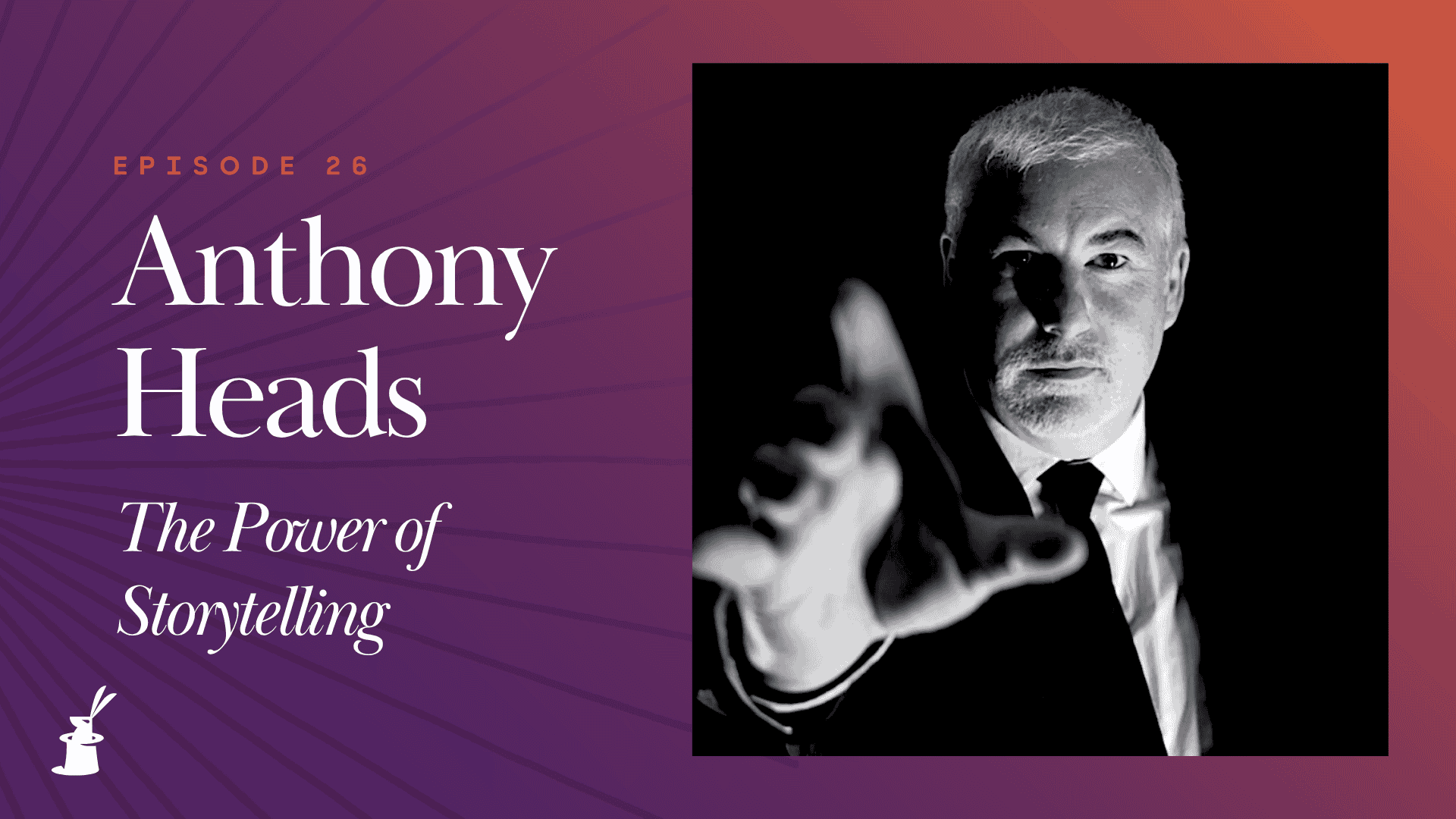
Today, Anthony Heads is Sweden's leading paranormal illusionist and mentalist. Originally from the UK, he has spent more than two decades in the Swedish entertainment industry as a performer, screenwriter, lecturer, and consultant. He founded the Stockholm Ghost Walk in 2004, turned to full-time performing in 2009, and through his own production company has created and toured original theatrical mentalism productions including The Spirit in the Glass, Project: Mind Control, Paranormal, and The Red Show. As a consultant, he has designed illusions for the Gothenburg English Studio Theatre's production of Jeremy Dyson and Andy Nyman's Ghost Stories, and he has served as creative consultant to the Swedish mentalist Henrik Fexeus since 2020. He is the author of two books: "Practical Paranormal Performance," published in 2024 with a revised edition in 2025, and "Live Storytelling for Magicians," published in January of this year, with a foreword by Dr. Larry Hass.
This conversation traces the long, deliberately unconventional path that brought Anthony to this work, the philosophy behind both books, and the craft of building experiences that audiences feel rather than simply watch.
A Different Path
Most magicians can name the trick that captured them. Anthony cannot. The only magician he ever saw perform live as a child was Paul Zenon, in a small UK seaside town some thirty-five years ago. He pestered his mother into buying the booklet Paul handed out afterward, and learned to tie a knot in a cigarette, but magic effectively stopped there. He never read the classic literature, never picked up cards, never absorbed the theoretical tradition.
What he absorbed instead was the sense of the unexplained. He made up his own ghost stories and stood in front of his class to tell them. Years later, working at different jobs as an adult, he noticed something about himself that had quietly persisted from those classroom days. He could tell stories that people connected with.
"I preferred making people feel something unusual rather than just amazing people."
That preference, sustained from childhood through adulthood, eventually translated into guided walks, scripts, theatrical productions, mentalism, and paranormal performance. It also explains why Anthony has so consistently held the magic community at arm's length. He did not arrive through magic. He arrived through stories.
A Ghost Walk in the Old Town
In 2004, Anthony founded the Stockholm Ghost Walk. The idea grew from two threads, separated by years and connected only by his own attention.
The first was Sweden itself, the medieval old town in the centre of Stockholm with its cobbled streets, narrow alleyways, wrought iron gates, and old-fashioned lanterns casting ridiculous shadows on the walls. To Anthony, autumn in such a place was an irresistible setting, the kind that fires up a childhood imagination. Yet no one was running ghost walks there. The format was familiar in the UK, where they were two a penny. In Sweden, it did not exist.
The second thread came from a fortunate accident years earlier. While Anthony was a student in London, his then-girlfriend was supposed to follow Richard Jones on his original London ghost walk for a journalism assignment. She fell ill the night of the walk. Anthony went instead, recorder in hand, and discovered that he loved the whole experience: the storytelling, the haunted pub at the end, the small magical touches Richard used to punctuate the history. That memory lay dormant until Stockholm reawakened it.
When he proposed the Stockholm walk, people laughed. Who would pay to hear ghost stories? Now, hundreds of thousands of guests later, ghost walks exist in towns and castles across Sweden. Anthony's was the one that started the industry there.
Discovering the Power of Story
The ghost walks were where Anthony discovered something about himself that he had not yet articulated. He could not lead them in Swedish, his Swedish was not strong enough at the time, so he wrote them in English for an audience whose English was a second language. That single constraint forced him to strip away every flourish, every linguistic shortcut, every nuance an English-speaking audience might forgive.
What emerged was a working theory of story. He could not rely on linguistics or fluent wordplay, so the story itself had to do everything.
"This story has to really hit home. It has to carry everything. It has to carry the message, it has to carry the emotion, it has to carry the connection."
When he watched audiences respond, he noticed something else. Their imaginations were doing more work than anything he could show them. If he simply told the right thing in the right way and let them fill in the blanks, the experience became personal. Each listener finished the story themselves, drawing on their own references and history. The result was a deeper engagement than any visual spectacle could produce. Even on nights when Swedish-language tours were available, guests came back specifically for the English ones.
Going Full-Time
In 2009, Anthony left office work behind and committed to mentalism full-time. He does not soften the description. The early years were "turbulent and terrifying."
He had founded his company in 2004 around the ghost walks, but when his first child arrived in 2008, he stepped back, handed the company to someone else, and took a full-time job for the security. After a few miserable years, his wife told him to leave it and rebuild his own practice. By 2010 he was calling himself a full-time mentalist. The financial reality did not catch up to the title until 2013, when the company was finally self-sustaining and he no longer needed outside work to keep the household running.
Two things made the transition possible. The first was a wife who, as he points out repeatedly, was both supportive and patient. The second was a household already accustomed to one income at a time, whether through one of them studying or working, which made the lean years bearable. He is candid about the alternative.
"If I had have stayed doing what I was doing in an office job, it would have been the end of me."
Why He Is Not a Magician
In "Practical Paranormal Performance," Anthony writes openly about an unusual decision: he has actively distanced himself from the magic community. He does not attend conventions. He is not a member of The Magic Circle. He has turned down television opportunities. The reason is not philosophical aloofness. It is strategic, and it is rooted in the cultural perception of magic in Sweden.
In Sweden, he says, the word magician maps onto two narrow images: the children's entertainer and the grand illusionist with leather pants and disappearing motorcycles. Neither served the work he wanted to do.
"I have to be someone else. I have to be something else."
So he built a separate identity. No conventions, no Magic Circle, no fellow magicians, at least not at home. Internationally, that has begun to shift. He is now lecturing in the United States and the UK, and recording podcasts like this one. But in Sweden, the distance remains, and remains deliberate.
He is careful about something else as well. He does not claim genuine psychic powers. He is not pretending to be a clairvoyant. The point of the distance is not deception. It is positioning, the freedom to present what he does without the framing the word magician would impose. When his audiences applaud, he prefers they do so as a group, recognizing what they all just experienced together rather than thanking him for a clever trick.
Practical Paranormal Performance
By the time Anthony sat down to write his first book, "Practical Paranormal Performance," he had been performing the material for more than a decade. He had no clear sense of who would read it. He had a strong sense of what he wished had existed when he started.
"It's basically my entire approach to what I do."
The book is not just a catalogue of effects. It is the architecture of his practice: why he thinks the way he does, how he constructs his shows, and the working principles he has built up through trial and error. He also added something he had not seen elsewhere: the practical material that beginners struggle to find anywhere. How to write a technical rider. What a script looks like. What an FX script looks like. What lighting cues are. The kind of stagecraft information that nobody hands out, but everybody needs.
He thought it might be useful for paranormal performers in particular. The actual readership has surprised him. Magicians of all stripes have written to tell him they have absorbed something different from it: a mindset shift rather than a technique transfer. Paranormal performance, in Anthony's framing, is not just another category of trick to drop into a Halloween set. It is a different way of thinking entirely.
The Two-Show Model
At the heart of the book is what Anthony calls his two-show model. On one side are the commercial paranormal-themed shows, marketed as conference entertainment to corporate clients in haunted venues, castles, stately homes, and conference hotels. On the other side are what he calls the real experiences: the intimate, intense, smaller-scale events for ticketed audiences willing to spend an evening with him in something closer to a séance than a stage show.
The reason for the dual structure was financial. The corporate work pays the bills. The real experiences allow Anthony to push the work to its edges, to experiment, to pursue what he genuinely wants to do. Audiences have fainted. Audiences have cried. One audience member vomited. He insists he does not do anything overtly scary. The intensity comes from atmosphere, story, and the audience's own imagination filling in everything he leaves unsaid.
The First Real Experience
The very first time Anthony staged one of these intimate events was in a 1600s cellar restaurant in Stockholm's Old Town, with eight participants. He still talks about that night with the energy of someone who only recently lived through it.
He gathered everyone while the restaurant was still serving. He asked the owners not to clean or vacuum, to let the room slowly empty around them, so that the transition from public space to private séance felt organic rather than staged. He had the guests themselves carry in the table and chairs. He had them gather objects from around the room to use as triggers for the spirits. Some of those objects belonged to the restaurant. Some he had quietly brought with him and placed in advance.
The script was prepared. The reactions were not.
He told them what people had reportedly seen there. He brought out old photographs and documents, just enough to give the imagination something to touch. They tried pendulum work and call-and-response sessions. The atmosphere built. Just before midnight, with someone shaking a die in a covered cup, Anthony asked aloud whether anyone was present, and whether they could indicate the number on the die. Four loud bangs sounded from the cast iron drainpipe outside the building. The cup revealed a four. The room erupted.
Earlier in the evening, while everyone was settling in, the participants had hung their coats in a small cloakroom on the way to the bathrooms. Late in the night, someone passing through reported that all the coats were now in a pile in the middle of the floor. The group went to investigate, photograph, theorise.
"It's about the genuineness of the experience, not curating it to feel like a show, but making it feel like it is really happening."
By the end of the night, the guests were asking when they could come back.
Creating the Bubble
At the heart of Anthony's working method is a concept he calls the bubble. Other performers may describe similar things by other names. He simply uses his own.
The bubble is what he steps inside on the day of a show, and what he hopes to bring his audience inside as well. To make them believe what is happening, he has to believe it himself. Not in the literal sense. He knows what he is doing is not real. But internally, for the duration of the work, he convinces himself otherwise.
"I form a dual reality in my own head. I know that what I'm doing is not real, but I convince myself it is."
The bubble begins early. He shaves more slowly in the morning. He dresses with more care. He moves more deliberately. His posture, ordinarily not great, becomes more upright when he arrives at the venue. The temperature, the lighting, the smells, the background sounds, the wording on the tickets, the typography on the tickets, all of it is curated. Everyone the audience encounters before the show, including the ticket-takers, must be in the right frame of mind so as not to puncture the experience before it begins.
He does not include intermissions in his shows. Audiences who step outside the bubble check their phones, think about babysitters, remember the bus home. Inside the bubble, anything is possible. Outside it, almost nothing is.
"I kind of gaslight myself into believing that it's all true and in order for them to believe it, I have to believe it. And that's what the bubble is."
Live Storytelling for Magicians
Anthony's second book, "Live Storytelling for Magicians," was published in January and carries a foreword by Dr. Larry Hass, a previous guest on this podcast. Larry observes in that foreword that, to his knowledge, "No other book in the literature of contemporary magic analyzes the process of getting presentational ideas out of our heads onto the stage."
Anthony's diagnosis of why no one had written it is straightforward. Most of what magicians call storytelling, he says, is not actually storytelling. "It's basically words tacked onto a magic trick."
He hears the same refrain in YouTube comments and convention conversations: a clip plays, viewers praise the wonderful story, and Anthony watches and sees no story at all. There is window dressing. There is staging. But the essential architecture of a story, the elements that make it work as a story, is missing. A surprising number of routines lean on the same single setup, the magician describing how he learned to do this when he was a child, and call that storytelling.
The book is meant as a working manual for magicians who would like to do better. It walks through the process of moving an idea from a rough concept on the page, into spoken script form, and finally onto the stage in conjunction with a magic effect. Most books on writing, Anthony notes, end where ours need to begin. They prepare a manuscript for an editor. We need to prepare a script for a stage.
He also addresses the unspoken vocabulary problem in the field. Performers far enough into their careers can be too embarrassed to ask basic stagecraft questions, like which way is upstage, for fear of appearing unknowledgeable. The book includes that material too, openly and without condescension.
Starting With Feeling
When Anthony begins a new script, he does not start with what the audience will see or do. He begins with how he wants them to feel. The orientation is anchored in the line attributed to Maya Angelou: "People will forget what you tell them, they'll forget what you show them, but they will never forget how you made them feel."
He sketches a wave on a piece of paper, what he calls a roller coaster, and maps emotional states along it. Despair here. Challenge here. Fear here. Once the emotional shape of the show exists, he reverse-engineers everything else. What does the audience need to experience to feel scared in this section? What scene precedes it? What method, gimmicked or not, will deliver that feeling most cleanly?
The effect itself is the last decision he makes, not the first. It does not need to be the latest release or the most expensive prop. It needs to be the right tool for the job. Anything else, however clever, is window dressing in costume.
"With the right story, you can elevate a trick into a miracle, something which people not just have their minds blown, but they will feel something, and then they will remember meeting you."
What the Two Books Offer Together
Looking at the two books side by side, Anthony hopes readers absorb a single connecting principle: why you are doing something matters more than what you are doing.
The why is what creates substance. It is what builds connection. Audiences want to feel connected to something, and they will connect with a performer whose intentions are clear to them, even unconsciously. A trick stripped of intent is a trick. A trick in service of something is an experience.
The first show Anthony was paid well to perform contained no gimmicks at all. He used objects from his own house and items from a thrift store. The work was carried by intention, by language, by the reverence with which he held a cigarette case. The audience did not know the difference. They felt the meaning he had loaded into the room.
Doomsday and What Comes Next
In May, Anthony will lecture at Doomsday in the UK on the 15th and 16th. He has not been before. From what he has heard, he describes it as the slightly more wayward cousin of the East Coast Spirit Sessions in South Carolina, the séance and paranormal-focused convention he has visited in the United States. His lecture, called "Making A Living From The Dead," draws partly from “Practical Paranormal Performance” and walks through the business model behind sustaining a full-time career in paranormal mentalism.
Beyond Doomsday, he is returning to the East Coast Spirit Sessions in January, may attend Poe's Magic Conference in Baltimore, and is exploring the logistics of performing in the United States. The work visa, as he notes, is its own production challenge.
Cherished Books
For a podcast about magic books, Anthony's most cherished magic title is “The Artful Mentalism of Bob Cassidy, Volume 2: Fundamentals.” He is clear about why. It was the first book he opened in which he found his own thinking already articulated by someone successful, someone who had made the work pay. He and Bob exchanged messages before Bob's death. The exchange, for Anthony, was largely thanks.
If asked for any book at all, magic or otherwise, Anthony reaches for a horror compendium called “Tales of Terror,” with a foreword by Boris Karloff. He reads from it every autumn, with a glass of port and some cheese. He uses the same physical copy for book tests, for predictions, and for stage dressing at corporate gigs. The spine is falling off. The smell, the weight, the stories all matter to him. The book has been with him for around thirty-five years.
It is a fitting object through which to understand his philosophy of fear. Anthony makes a careful distinction between horror and terror.
"Horror is seeing the murderer. Terror is hearing the footsteps on the stairs."
He aims for terror. He never aims for horror. "Nobody wants their audience to go home horrified."
Where to Find Anthony's Work
Anthony's books, “Practical Paranormal Performance” and “Live Storytelling for Magicians” are available in the United States through Stevens Magic Emporium, and in the UK and Europe through Amazon. He can be found on Instagram and Facebook under his full name, Anthony Charles Heads. His shows in Sweden are performed in Swedish; for international audiences, the lectures are the most accessible point of entry.
For a performer who started by telling ghost stories to schoolmates and ended up establishing an entire category that did not previously exist in his adopted country, the through-line is consistent. The story carries everything. The effect is the last thing chosen.
Books and Publications Mentioned
Books by Anthony Heads:
“Live Storytelling for Magicians” by Anthony Heads, with a foreword by Dr. Lawrence Hass (January 2026)
“Practical Paranormal Performance” by Anthony Heads (2024, revised edition 2025)
Books Anthony Cherishes:
“The Artful Mentalism of Bob Cassidy, Volume 2: Fundamentals” by Bob Cassidy (H&R Magic Books, 2013)
“Tales of Terror” with a foreword by Boris Karloff (The World Publishing Company/Tower Books, 1943)
Other Works Referenced:
“Ghost Stories” A one-act horror stage play written by Jeremy Dyson and Andy Nyman, first performed in 2010 (Nick Hern Books, 2019).
Eugene Burger's Gypsy Thread routine is described in "Eugene Burger: From Beyond" (Theory and Art of Magic Press, 2019)
Resources
To purchase "Practical Paranormal Performance" or "Live Storytelling for Magicians" in the United States: www.stevensmagic.com
To purchase either book in the UK and Europe: www.amazon.com
To follow Anthony Heads on social media: Instagram and Facebook under Anthony Charles Heads
Information on the Doomsday convention in the UK (May 15 and 16): https://darkartefacts.com/product/doomsday-gathering-xv/
Timestamps
00:00 Introduction to The Magic Book Podcast
01:00 Guest introduction: Anthony Heads
02:19 An unconventional path: childhood fascination with mysteries and the unexplained
03:15 The only magician Anthony saw live as a child: Paul Zenon
04:19 Founding the Stockholm Ghost Walk in 2004
05:36 The accidental London ghost walk that planted the seed
07:34 Discovering the power of storytelling on the walks
10:09 Going full-time as a mentalist in 2009
13:25 Why Anthony actively distanced himself from the magic community
17:58 “Practical Paranormal Performance” - writing the first book
21:13 The two-show model: corporate work and the real experiences
24:59 The very first real experience in a 1600s Stockholm cellar
30:34 Creating the bubble
36:43 “Live Storytelling for Magicians” and Larry Hass's foreword
42:41 Beginning with how the audience should feel
46:22 What the two books offer when read together
50:16 The Doomsday lecture and other upcoming appearances
52:36 Most cherished books: Bob Cassidy and “Tales of Terror”
55:15 Horror versus terror
56:20 Where to find Anthony's work
57:24 Where to purchase the books
58:04 Closing