
Introduction
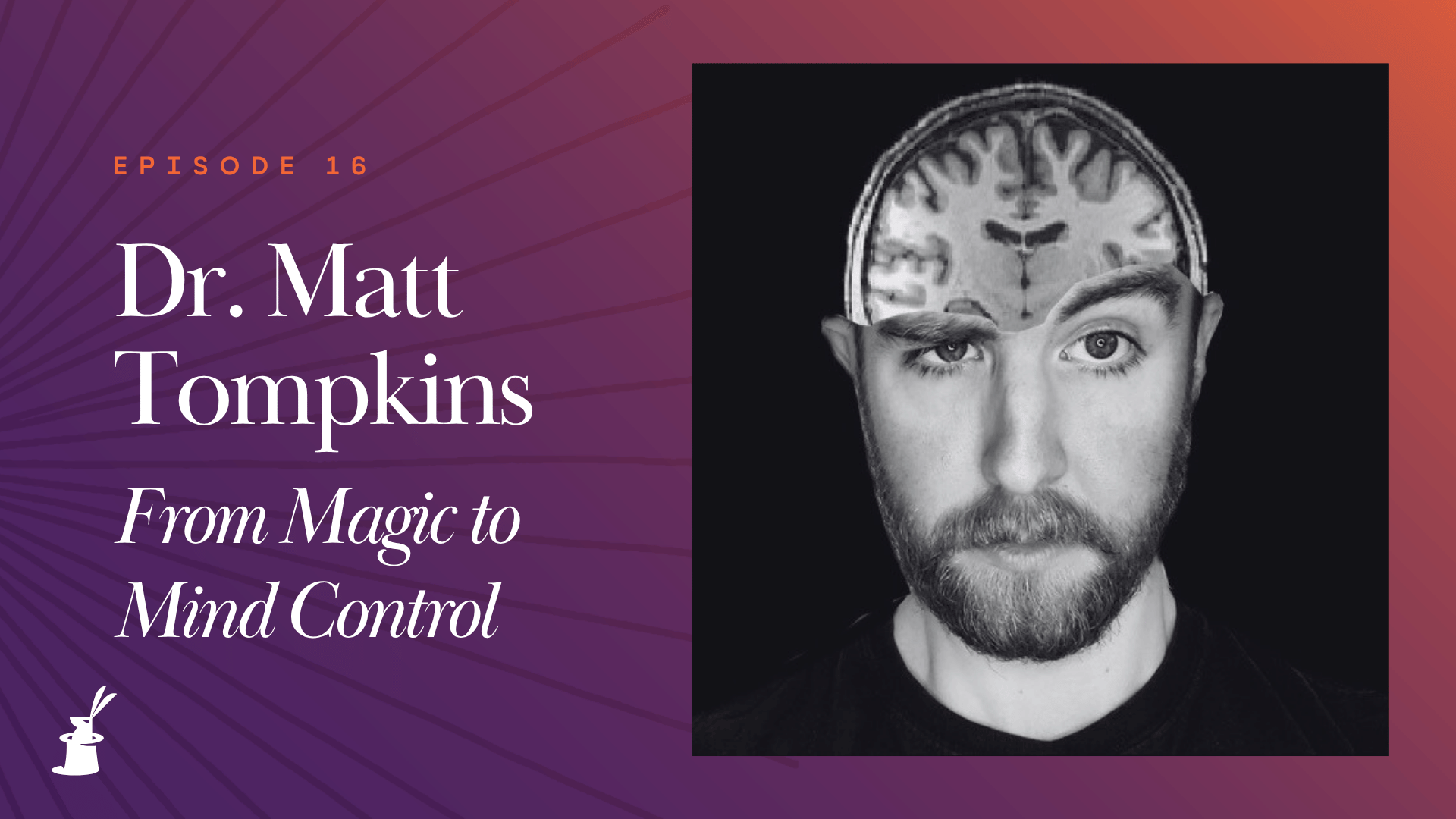
The intersection of magic and science might seem like an unlikely pairing, but Dr. Matt Tompkins has built a remarkable career exploring exactly that connection. As a postdoctoral researcher at Lund University's Department of Cognitive Science in Sweden, Matt designs what he playfully calls "fake mind control technologies" while conducting groundbreaking research at the crossroads of magic and psychology.
Matt's unique position as both a professional magician and experimental psychologist offers fascinating insights into how our minds work, and how they can be fooled. During our conversation on The Magic Book Podcast, we explored his journey from childhood performer to respected researcher, his acclaimed book "The Spectacle of Illusion," and his current work using mentalism techniques to study emerging AI and neurotechnology.
The Psychology Behind the Performance
Matt's introduction to magic followed a familiar path - seeing a performer at a state fair around age 12 or 13. But it was a sword swallower named Johnny Fox, who had studied under Slydini, that captured his attention with a beautiful routine involving silver dollars.
"The thing that really caught my attention was the coin falling up, which many of your listeners might know as a muscle pass. And that really got my attention as a kid."
This early fascination led Matt to teach himself coin manipulation and eventually to J.B. Bobo's "Modern Coin Magic," which became his practical foundation. While performing semi-professionally through university, Matt was studying biology with plans for medical school. However, a pivotal moment came when he had to choose between another semester of organic chemistry or switching to psychology to work in a visual cognition lab.
The decision proved transformative when Matt began noticing striking parallels between magic demonstrations and psychology experiments on human perception. This observation would shape his entire career trajectory.
The Invisible Gorilla Revelation
A defining moment came when Matt encountered Dan Simons' famous selective attention study, the invisible gorilla experiment. For those unfamiliar, participants watch a video of people passing basketballs and count passes made by players in white shirts. During the action, a person in a gorilla costume walks through the scene, yet approximately 60% of viewers completely miss it.
"As a magician, the idea that people can fail to detect something that's plainly visible, not necessarily that surprising, although magicians are often very surprised by the gorilla. But this overall concept that you can do things invisibly when people's attention is otherwise engaged is very much parallel to a lot of the ideas of misdirection that magicians have been talking about since, you know, time immemorial."
This revelation highlighted how magic and psychology explore similar territory from different angles. The gorilla experiment demonstrates "inattentional blindness" - our tendency to miss unexpected events when focused on a specific task. For magicians, this principle underlies much of what we call misdirection.
Historical Perspectives on Deception
Matt's doctoral thesis, "Observations on Invisibility," combined empirical research with historical investigation of the relationship between magicians and psychological researchers. This work revealed that performers often understood psychological principles long before scientists formally recognized them.
A perfect example is change blindness - the difficulty people have detecting alterations in visual scenes. While psychology identified this phenomenon in the mid-1990s, magicians had been exploiting it for nearly a century through effects like the Prince's Card Trick, published in T. Nelson Downs' "The Art of Magic" in 1909.
"What's interesting is magicians have understood that principle at least since the early 1900s. And so what this tells us is not necessarily the magicians understood how the attention operated, not mechanistically, what was happening on a cognitive level, but they understood that it was possible in a way that, like I said, visual scientists, almost 100 years later, didn't believe that it was physically possible."
The initial resistance from the scientific community was so strong that researchers were told their experiments must be broken - there was "no way people would be that bad at seeing changes this major."
Choice Blindness and the Power of False Reasoning
At Lund University's Choice Blindness Lab, Matt works with techniques that extend change blindness into decision-making. In their elegant experiments, participants choose between two photographs of faces based on attractiveness. Through simple sleight of hand borrowed from gambling moves and black art principles, researchers sometimes hand participants the photo they didn't choose.
The results are striking: participants not only fail to notice the switch but proceed to justify in detail why they made the choice they actually didn't make.
"All of the explanations have to be post hoc and they have to be illusory because it isn't the choice that they made. The choice was made for them without their knowledge. And so when they come up with those reasons, those reasons are purely fabricated. But what's interesting is they don't notice this."
Even more remarkably, transcripts of real choices versus forced choices are indistinguishable - there are no reliable tells that differentiate genuine reasoning from fabricated justifications.
Simulating the Future with Magic
Matt's current research takes an audacious approach to studying emerging technologies. Rather than speculating about how people might react to future AI and neurotechnology, he creates convincing simulations using mentalism techniques.
"My elevator pitch for the research ... when people ask me what my job is, I say, 'Oh, I design fake mind control machines for the Swedish government.'"
These experiments involve telling participants they're interacting with advanced systems that can predict their actions, read their minds, or control their behavior. Using classic mentalism methods - often techniques dating back to the 1880s - Matt creates compelling evidence of these fictional capabilities.
"Effectively what we're doing is a séance in a lot of traditional ways. Except instead of saying that we're talking to dead people, I'm saying we're talking to a fictional algorithm."
The deception rates are remarkable - 97 to 98 percent of participants, including computer scientists and technology experts, fully believe they've experienced genuine AI capabilities. This allows researchers to study authentic reactions to future technologies rather than hypothetical responses.
The Persistence of Timeless Deceptions
One of Matt's most striking observations concerns the enduring effectiveness of historical deception techniques. When discussing spiritualism and séances with media, he frequently encounters dismissive attitudes:
"A recurring thing is that people will be dismissive when you talk about, like, you know, scientists trying to talk to dead people in like the turn of the century... they'll say, 'Oh, but that was, you know, so long ago. Like, we're so much more sophisticated as a society. Now, none of those tricks would ever work on a modern educated audience.' That's why they always work right?"
This insight has important implications for our relationship with emerging technologies. Despite our perceived sophistication, the fundamental ways our minds process information remain largely unchanged.
The Science of Magic Association
Recognizing the value of collaboration between performers and researchers, Matt helped found the Science of Magic Association (SOMA) in 2015. The organization brings together academics from psychology, philosophy, and history with performers and magic historians to advance understanding in both communities.
"The idea behind SOMA is very much related to that. It's how can we create a dialogue and create kind of mutual beneficial relationships? How can we move science forward with these ideas... And also how can we enhance the appreciation and maybe move things forward design-wise a little bit with people in the performance sphere?"
SOMA conferences have featured luminaries like Raymond Teller (of Penn and Teller), and the field has exploded from fewer than 20 academic articles on magic before 2005 to well over 200 today. The collaboration addresses natural tensions between communities with different goals and methods.
"The Spectacle of Illusion"
Matt's book emerged from an exhibition at London's Wellcome Collection, transforming his doctoral research into accessible stories about the historical relationship between magicians, fraudulent mystics, and scientists. The work draws heavily from the Harry Price Collection at Senate House Library, which Matt recommends to any magic enthusiast visiting London.
The book explores how performers and researchers have long grappled with questions of perception, memory, and belief - themes that remain remarkably relevant as we navigate an era of artificial intelligence and synthetic media.
A Treasured Historical Document
When asked about his most cherished magic book, Matt chose something unexpected: "The Possibilities of Mal-Observation and Lapse of Memory from a Practical Point of View," published in 1887 in the Proceedings of the Journal of the Society of Psychical Research.
This study, conducted by Richard Hodgson and S.J. Davey, represents perhaps the first formal psychological investigation of magic illusions. The researchers created fake séances, inviting witnesses who then wrote detailed accounts of what they remembered. Comparing these eyewitness reports to the known, choreographed events revealed systematic errors in perception and memory that wouldn't be formally recognized by psychology for decades.
"What's really interesting is you get all of these things that would not be really accepted into psychology for sometimes more than 100 years. So you get gorilla-style results, right? Like where people would fail to detect pretty significant elements of the method."
The study sparked intense debate, with Alfred Russel Wallace, co-author of the theory of evolution, arguing that the documented errors were so consistent that the medium must have possessed genuine supernatural powers and that the report was merely a cover-up.
Looking Forward
Matt's work demonstrates how magic continues to offer unique insights into human psychology and our relationship with technology. As artificial intelligence and neurotechnology advance, the principles that have long governed effective deception remain surprisingly relevant.
His research suggests the importance of what he calls "cognitive humility" - recognizing that even experts can be deceived under the right circumstances. This awareness becomes crucial as we navigate an increasingly complex technological landscape where distinguishing reality from simulation grows ever more challenging.
The collaboration between magicians and scientists through organizations like SOMA points toward a future where these ancient arts of deception help us better understand both the capabilities and limitations of human perception and reasoning.
Connect with Dr. Tompkins and SOMA
To learn more about Matt's research and the Science of Magic Association, visit his personal website at https://www.matt-tompkins.com/. The Science of Magic Association can be found at scienceofmagicassoc.org, where you can sign up for their newsletter to receive updates about virtual events and their next international conference, tentatively planned for Paris.
Matt's work reminds us that in our rush toward technological sophistication, the fundamental principles of human psychology remain beautifully, stubbornly unchanged - and magic continues to be one of our best tools for understanding them.
Timestamps
00:04: Historical Attitudes Toward Séances and Deception
00:42: Matt Tompkins’ Early Experiences with Magic
04:25: Performing Semi-Professionally and University Life
05:38: Transition from Medicine to Psychology
07:33: The Invisible Gorilla Experiment and Selective Attention
13:54: Graduate Studies at Oxford and Communicating Complex Ideas
16:03: Integrating Magic Performances with Academic Lecturing
18:26: The Origins of "The Spectacle of Illusion" Book Project
21:13: Magicians’ Early Understanding of Change Blindness
26:40: The Choice Blindness Lab at Lund University
28:31: Choice Blindness Paradigm in Action
30:56: Using Mentalism to Simulate AI and Neurotechnology
37:35: Deception Rates Among Computer Scientists and Tech Skepticism
41:42: Cognitive Humility in Face of Emerging Technologies
43:59: Founding of the Science of Magic Association (SOMA)
46:05: SOMA Conferences and Academic Advancements in Magic Science
49:05: Bridging the Gap: Performance Magicians and Academics
52:59: Challenges with Accessing Magic Literature
53:08: Matt’s Most Cherished Magic Books
55:00: Early Scientific Investigations into Magic and Perception
Books and Publications Mentioned
"Tricks with Coins" by T. Nelson Downs (1902)
"Modern Coin Magic" by J.B. Bobo (1952)
"The Art of Magic" by T. Nelson Downs (1909)
"The Invisible Gorilla and How Our Intuitions Deceive Us" by Daniel Simons and Christopher Chabris (2011)
"The Spectacle of Illusion" by Matthew Tompkins (2019)
"Experiencing the Impossible" by Gustav Kuhn (2019)
"The Psychology of Magic: From Lab to Stage" by Gustav Kuhn and Alice Pailhes (2023)
"Modern Magic" by Professor Hoffman (1876)
"The Possibilities of Mal-Observation and Lapse of Memory from a Practical Point of View" by Richard Hodgson and S.J. Davey published in the Proceedings of the Journal of the Society of Psychical Research (1887)
Resources
Matt Tompkins personal website: https://www.matt-tompkins.com/
Choice Blindness Lab at Lund University, Sweden: https://www.lucs.lu.se/research/choice-blindness-lab/
Studies
"The Phantom Vanish Magic Trick" (co-authored by Matt Tompkins): https://www.frontiersin.org/journals/psychology/articles/10.3389/fpsyg.2016.00950/full
Selective attention test video by Daniel Simons: https://www.youtube.com/watch?v=vJG698U2Mvo
Library Collections
Harry Price Collection at Senate House Library, London: https://www.senatehouselibrary.ac.uk/our-collections/historic-collections/harry-price-library/
Key Researchers and Organizations
Science of Magic Association website: https://scienceofmagicassoc.org/
Gustav Kuhn: https://www.magicresearchlab.com/copy-of-news-media
Richard Wiseman: https://richardwiseman.wordpress.com/
Stephen Macknik and Susana Martinez-Conde, so-authors of “Sleights of Mind: What the Neuroscience of Magic Reveals about our Everyday Deceptions”: https://www.sleightsofmind.com/about-the-authors/
Ron Rensink: https://www2.psych.ubc.ca/~rensink/
Tom Stone: https://www.tomstone.se/en
Cyril Thomas: https://www.researchgate.net/profile/Cyril-Thomas-4
Anthony Barnhardt: https://www.anthonybarnhart.com/
Anomalistic Psychology Research Unit at University of Goldsmiths: https://www.gold.ac.uk/apru/
Exhibition
Wellcome Collection exhibition on magic and psychology (2019) - https://wellcomecollection.org/