
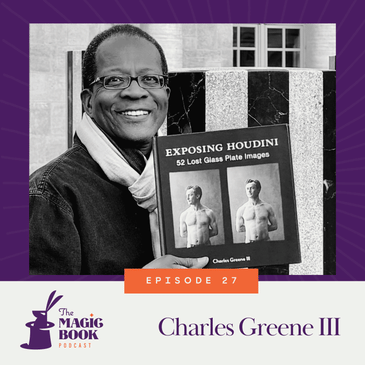
Charles Greene III discusses his "Exposing Houdini," featuring 52 lost Houdini glass plate negatives traced from an abandoned Ohio safe deposit box.
Adrian Tennant [00:00:04]:
Coming up in this episode of The Magic Book Podcast...
Charles Greene III [00:00:09]:
It is stunning that we know so much about Houdini. There are stacks and stacks of books about Houdini, yet 100 years after he died, a cache of unknown images would just appear. That's stunning. I mean, that's amazing. Which makes me wonder, of course, are there more?
Adrian Tennant [00:00:27]:
You're listening to The Magic Book Podcast, conversations about classic and contemporary books that teach, illuminate, and celebrate the art of magic. I'm your host, Adrian Tennant, a lifetime student of magic and mentalism, occasional performer, and longtime book collector. Thanks for joining me.
[FADE MUSIC] My guest today is making a return visit to the podcast: Charles Greene III is a corporate magician, magic historian, collector, and author, whose previous books include the biography "Ionia: Magician Princess Secrets Unlocked" and "A Complete history of Friedländer Lithography." Charles is the founder of MagicPosterGallery.com, a member of the Society of American Magicians, a Gold Star member of the Magic Circle, and the only American member of the Paris-based Magic History and Collections Association. His new book, “Exposing Houdini: 52 Lost Glass Plate Images,” was officially launched first in Paris, and then at the recent Magic Collector Expo. Charles’s book contains a previously unknown cache of glass plate negatives of Harry Houdini spanning the years 1903 to 1911, being published in the centennial year of Houdini's death. Appropriately, “Exposing Houdini” features a foreword by renowned Houdini historian John Cox, plus newspaper accounts of the day, and dozens of images that have never before appeared in print.
[MUSIC]
Adrian Tennant [00:02:06]:
Charles, welcome back to The Magic Book Podcast.
Charles Greene III [00:02:10]:
I am so thrilled to be back. Adrian, thank you so much for this chance.
Adrian Tennant [00:02:14]:
When we last spoke, you had published the Ionia biography and the Friedländer book and you were deep into research on Charles De Vere and Frank Godsol. Houdini was not on the agenda at all. So before we get to the plates themselves, when did you first become aware that this collection existed?
Charles Greene III [00:02:36]:
So, in early September of 2024, I simply knew that there was an auction in Ohio, a week-long auction of things that had been abandoned in safe deposit boxes from banks and the like. In a group of a hundred, I don't know how many auctions were going on, but in a group of a week-long sale of lots of different items, there were two lots that were Houdini-related, and they were listed as photographs that have pictures of Houdini. And that's all I knew from the photograph.
Adrian Tennant [00:03:14]:
On the auction website, you couldn't see the full contents. So could you talk us through your decision to get on a plane to Ohio on the strength of that listing alone?
Charles Greene III [00:03:28]:
So the listing photograph on the website, which is public – and I want to let everyone know that several key collectors knew of this listing that I eventually saw – so it really wasn't a surprise, it wasn't an unknown. But I looked at the listing and I saw someone holding up glass plate negatives, one for each listing that showed Houdini. Now, of course, it's a negative, so you're looking at the reverse. You're looking at black as white and white as black. And then there were a bunch of boxes on a cardboard box. So it's hard to tell really what you were getting, what was there. And I realized that I don't know what's there, but if I don't see it, I will never know what's there.
Charles Greene III [00:04:13]:
And the next step is it could be something that's not really important. It's maybe only one or two glass negatives of Houdini. And then the rest is, you know, ducks, pigs, chickens, and everything else. Or it could be something really special. And that's what made me get on the plane. Because I've learned that if you want to find out, you have to go, you have to see it, you have to touch it, you have to smell it, you have to be in the room.
Adrian Tennant [00:04:38]:
You drove out to a small auction house about an hour from Columbus, and you requested the two lots, and they brought them to you one tray at a time. When you lifted that first glass plate out of its box and held it up to the light, what were you actually looking at? And how quickly did the scale of what was in front of you start to sink in?
Charles Greene III [00:05:01]:
So please understand, I'm taking an early morning flight out of Washington, D.C. to Columbus, Ohio. I love Columbus, but in Columbus, then I have to take a car to this city called Newark, Ohio, about an hour outside of Columbus. Small little town, lovely little town, but terribly small. And when I get there, I'm in this auction house. It's a combination of several buildings.
Charles Greene III [00:05:25]:
Eventually, I get to the right spot. There are auctions going off in different rooms and people collecting items from different auctions. And in this room there are many, many counters and displays. And the room is filled with things that you might find in a safe deposit box, such as coins, rings, documents, watches, jewelry. I request the two lots, they bring them to me one at a time. The first lot comes out in a cardboard tray, and there are all of these glass pools, plate negative boxes with labels on the top, some have handwriting on them, some do not, but they're definitely old. I open up the first box, set the top aside, pick up a glass slide by the edge, look at what I see, hold it up to the light, and I'm amazed by what's there. Then I do that with a second one.
Charles Greene III [00:06:19]:
I'm amazed again. A third one, I'm gobsmacked. And it keeps going, because these are images that I'm familiar with. And once again, these are negative, so I'm looking at them in the reverse. So some things are not as clear as when they are in positive. But I'm realizing that these are images that had never been seen of Houdini. And these are images of him in the Milk Can. And I'm going to go through what's in all of the two lots.
Charles Greene III [00:06:48]:
The first images of him in the Milk Can, him in a position of the Water Torture Cell that's never been seen. Him with Bess and Houdini and Bess on the ship of the Malwa, which has never been seen. It documents a lot of their travels on the Malwa. When they were going from Marseille down to Australia. When they stop in Port Said and they spend the night there, and they're surrounded by all these people who are watching magic tricks and Houdini’s watching magic tricks at that stay. Pictures of when they're in Ceylon, Sri Lanka. And then there are other images. The first images of when he's in Germany, when he's there in 1903, and England.
Charles Greene III [00:07:28]:
And there are photo shoots and professional shots, but then there are also casual shots. It was an amalgamation of a lot of different times and space, but I knew that these were all special. And the more I looked at them, I realized that no one has seen the majority of these images, ever.
Adrian Tennant [00:07:49]:
You went to Ohio with the intention of recording whatever you found, but you only had the auction preview window. Can you explain how you captured the images?
Charles Greene III [00:08:01]:
Well, when I went to the auction house, there were two things I did before I went to Ohio. The first, of course, was to ask my wife about this and the thought of my just going on a plane to Ohio and just looking at a few things for an hour or so, and it might come to nothing. She said “Yes.” So I went, and the preview — I'm not sure how long the preview window was at the time — but I called the auction house in advance and I asked them two very important critical questions. One, “Can I see these items if I come to Ohio?” They said “Yes.” The other item I asked them was, “If I come to Ohio.”
Charles Greene III [00:08:40]:
“May I photograph the items when I'm there?” They said, “Yes.” Perfect. So I talked to some friends of mine who work for the Library of Congress in the Print and Publication Division and the Poster Division. I said, “I have no idea what I'm doing, but I believe I need to be prepared to shoot photographs of glass negatives as they are in a room, as I find them, I can't take them out, I can't take them off property. Whatever situation I wind up in, I've got to shoot these to the best of my ability. What do I do?” They gave me some great information, they gave me essential information, and that's how I was able to record and shoot photographs of these glass plate negatives. And my intention really was not to own them or to get them, but to record what was there in that room. Because I thought these images, if they've been abandoned, have been lost for a long period of time, and if I don't see them, they may be lost again for another long period of time. They may go to another box hidden in some collector's, you know, collection.
Charles Greene III [00:09:52]:
Just like, you know, that scene in Raiders of the Lock Ark where we have the ark, but it's somewhere in all this warehouse and we'll never know. We'll never know these things exist. So that was my thought. I need to see these, I need to document these, I need to share these with the magic community.
Adrian Tennant [00:10:08]:
Now I just want to make something clear, because I think I assumed otherwise myself originally: you didn't come away owning the plates?
Charles Greene III [00:10:17]:
No, I only have the image, I have the images. No one knows who bought all the images of the negatives and where they have wound up.
Adrian Tennant [00:10:25]:
Once you had captured those images, the research really began. You found a 2018 Potter and Potter lot that contained seven other glass negatives obtained directly from Houdini. Can you walk us through some of your detective work, Charles?
Charles Greene III [00:10:42]:
Well, there was a lot of detective work and I need to say from the very start, I am not a Houdini expert. Of course, as a magician, Houdini has been in my life and in my work since I started in 19… long ago! And so I know to go to the Houdini experts and fortunately a lot of them are my friends. So I contacted John Cox immediately. I contacted some other people as well. And it really was a collaborative situation, especially with me and John where we worked together on this. I shared things with him, he gave me lots of information. I shared things with other people.
Charles Greene III [00:11:22]:
They gave me lots of information. Potter and Potter is really a resource, an amazing resource for all of magic, because in their catalogs, there's a wealth of information. Not just the pictures, not only the pictures and the images, but what Gabe [Fajuri] writes in the notes and the ‘thank-you’s. You need to put these pieces together. But it's there, and it's like a Smithsonian, really, for magic, because you can do deep research in those catalogs and in the information that he makes publicly available. So it came from a lot of sources, and I had to do a lot of work. Another source that I used was the archives of different libraries and different private collections as well, because the associated images are out there. They're in books, books in my collection, your collection.
Charles Greene III [00:12:17]:
And what I realized, as I started doing the work, was that a lot of the images that were in this collection in Ohio were – I'll call them the B roll. You know, it's harder to refer them as something else. But, you know, when you shoot a lot of images, especially for video, you have the A roll. It's all your key shots of the stars. But then you're shooting a B roll, which is kind of like background. And I think the best way to describe it is really in the past with 35 millimeter film. You would shoot a lot of film, and then you would get a contact sheet, and you would go through your contact sheet and you'd say, “No, no, no.”
Charles Greene III [00:12:55]:
You circle one in red with “Yes, this is what we want.” And then you would discard the other images. Well, back in the day of glass plate negatives, there was no contact sheet. So you would shoot multiple negatives and then finally decide, “Oh, this is the image that we want.” You'll set up your shot, you'll get the light, you'll expose a film. You'll expose, excuse me, not the film. You'll expose the image. And then you'll decide later on, “we want this image, not this one.”
Charles Greene III [00:13:25]:
So, for example, with the first images of the Milk Can escape in Atlantic City: one, it's being shot outside and they shoot one image. The first one is when Houdini is fully dressed and he is on a carpet. Well, he's in a bathing suit, but dressed in a bathing suit on a carpet. Then the next image is they pull the carpet away and he's standing like to the left of the can. Then he's to the right of the can, and he's behind the can and he's poking out of the can. And those are all the B images that we didn't get to see. And then we see the iconic images which are also in this collection that we know so well.
Adrian Tennant [00:14:00]:
Well, let's trace the chain of custody, because this is a story in itself. We know the plates belong to Houdini and that he gave them to Joseph Dunninger. After Dunninger, the trail gets murky. Can you walk us through how these images travelled from Dunninger's home in New Jersey all the way to an abandoned safe deposit box in Ohio?
Charles Greene III [00:14:25]:
One of the things that we don't know is where these slides came from. From whose safety deposit box did they come? So we know that they definitely belong to Houdini. We know that they were given to Joseph Dunninger. Joseph Dunninger passes away. They then become the provenance, the ownership of his wife, Billie and then after that, it gets a bit mysterious, because after Dunninger dies, there's a man in Canada. I'll refer to him simply as Richard.
Charles Greene III [00:15:01]:
Richard finds out about this collection, that is the Dunninger collection, He makes his way to New Jersey. He's invited down by Mrs. Dunninger to come to the house and stay in the house over a period of, let's say, two to three years. He's in the house for some times as long as a month, maybe more, sometimes less. But he makes trips back and forth between Cliffside Park, New Jersey and Canada during these times. When he does return to Canada, I've spoken to different people who knew him as a friend and said that he would bring back gifts to Canada for them that he would say came from the Dunninger house, given to him by Mrs. Dunninger at that same time as Richard is in the house. As time goes on, the daughter of Joseph Dunninger [Maxine] and her husband come back to the house and they say, “Oh, we noticed that certain things are missing.”
Charles Greene III [00:16:01]:
“Things don't look right.” And basically they force Richard out of the house and they kick him out. So to their view, certain things were taken from the house that should not have been taken from the house. Certain things were missing. We don't know if Richard had all these slides, but we do know that he did show some slides to a friend of his and asked that friend to hold onto a set of slides for a period of time and then took them back two years after that fact. We also know that Richard was very much involved with a man named Joe Tanner, and that Joe Tanner published a catalog of escapes and different items that featured some of these images - also that featured glass negatives as well as featuring prints of the glass negatives.
Charles Greene III [00:16:53]:
So there's a lot that connects them. There's no direct line, there's no smoking gun. But there's a lot of connection that most likely it's Richard, who passed away early. He died of a heart attack in Canada unexpectedly. That it would seem logical that someone of that time period, that age who passed away quickly had these slides and this is where they came from, and they were abandoned and left after a period of time.
[MUSIC]
Adrian Tennant [00:17:22]:
If you're enjoying this episode of The Magic Book Podcast, please consider leaving a rating on Spotify or a review on Apple Podcasts. You can also follow The Magic Book Podcast page on Facebook. Thanks. [MUSIC FADE] Charles, the earliest images in the book come from a 1903 studio session in Holland. And these are the famous loincloth photographs that had been misdated to 1899 in print for decades. Talk to us about the responsibility that comes with getting these dates and locations right.
Charles Greene III [00:17:58]:
Well, I think all correction matters. And something I'm very conscious of is that we live in a day of computer technology. We just are stepping our toes into the age of artificial intelligence. We have so much power in our hands, at our fingertips, on our phones that people just 10 years ago and certainly 30 and 50 years ago, did not have. So I'm always aware that people like Milbourne Christopher, Eddie Dawes – I'm going to miss so many names, I could go on forever – Charlie Reynolds, Walter Gibson. They all had to look at the actual thing in place.
Charles Greene III [00:18:37]:
If they were going to go to a newspaper, they had to go through every single newspaper. If they were reading the book, they had to read every single page. And you had to go to the place that had the book that you wanted to read. And you could be missing out on something else. Today, we have access to so much information that it's easily understood how far photographs of any time period. But photographs of Houdini were misdated or misnamed for the place. It's so easy to do. I had difficulty, even with all of the things available to me, of placing certain photographs. And it became frustratingly maddening because how can I not find this out? But yet I knew if I continued with all the access that we have today, I would find it out once again.
Charles Greene III [00:19:24]:
It goes back to a lot of collaboration with a lot of different people, but you need to be as correct as you possibly can be with dates and locations, because they matter.
Adrian Tennant [00:19:36]:
Staying with the loincloth photographs, I wondered how viewers in the early 1900s would have perceived them in Europe. Eugen Sandow, a strongman who many consider the father of modern bodybuilding, had largely normalized the near nude Athletic male body. But in America, the Comstock Act and the respectability mania of the Keith Albee vaudeville circuit made the same imagery much riskier. Charles, how did Houdini's transatlantic image management play out in the materials that you've studied?
Charles Greene III [00:20:13]:
Well, back then, it was shocking to see a man's bare chest. And with these photographs, the photographs that are on the cover of the book, they actually show his belly button. But when the photographs were actually printed back at that time, that was cropped so you did not see his belly button. You know, a belly button was just too far! And to consider that, in that day, when people went bathing, men had bathing outfits, bathing costumes that were basically short-sleeve unitards, and that's what they wore. And of course, women were even more dressed to go bathing. So it was quite shocking to see a man with a bare chest. There are some photographs of him where he is barely in a loincloth and he's heavily shackled.
Charles Greene III [00:21:02]:
And you see the reverse, his backside fully exposed. They were quite shocking for that day. And even today, you know, there are some places, as I consider the book, there are some places I cannot take the book. I could not give this book to a child. You know, this book is not appropriate for the children's section of a library because there are pictures which might be considered, even in 2026, as being just a bit too far for that audience.
Adrian Tennant [00:21:32]:
Let's move to Atlantic City in the summer of 1908, and the first photographs ever taken of the Milk Can Escape. What did it feel like to be looking at the moment a signature illusion entered the village for the very first time?
Charles Greene III [00:21:51]:
Well, it was amazing. It was great to think that, you know, this has been captured. And I have the moment of when it was captured, because Houdini was in front of this piece of glass and the photographer was on the other side of the piece of glass, and in between them was this sheet of glass. And it still exists. And it's in my hands. These are glass items. They're terribly fragile. In a heartbeat they could break and be lost forever.
Charles Greene III [00:22:23]:
And it's that fragility that really, dare I say, hammered home to me, because the fact that they have existed for more than 100 years as a complete set is astounding.
Adrian Tennant [00:22:41]:
Just before the Milk Can sequence is the image of Houdini with Harry Kellar, also on the Atlantic City boardwalk, in June 1908. Kellar had given his farewell performance only weeks earlier. What does that image tell us about their friendship?
Charles Greene III [00:23:00]:
I think whenever another magician, especially one like Kellar, who's a statesman of magic, who lived a full life in magic, goes to visit another magician, that's really quite the moment. I know that with all of my years in magic, I've been able to visit people who were much younger than me or people who I've tutored, and it's always been a special time. I think that Houdini meeting Kellar is important because it really is a transition of ages. You know, Kellar was one kind of magician, Houdini was another. And that moment, to have it capsulized in a photograph is really, really special. You know, one of the things about these photographs, when you start to look at each one, is that you can see that it's an outside photograph. You know, you can see that they're on the beach.
Charles Greene III [00:23:49]:
You can see an edge of the beach when you look at the slide itself and just their situation. And think about how this was set up of Kellar coming in from living, as I understand, in Atlantic City at the time, arranging to meet with Houdini, the things that they talked about. That must have been a special moment. And it was a moment that was the beginning of ‘a beautiful friendship,’ as they say at the end of Casablanca, that lasted many, many years until Kellar's death. And I'm sure that at the end of Kellar's life and when he passed, that Houdini felt a real loss for that friendship, because they stayed in touch over that entire period of time. And Kellar was very, I'd say, enamored with Houdini and was very supportive of Harry Houdini.
Adrian Tennant [00:24:32]:
November 1908 brings us to London and the Suffragette Challenge. Now, the UK Suffragette movement was generally more militant than its US Counterpart, taking direct action like arson and widespread property destruction. But your book also reproduces two recipes from a Suffragette cookbook. What does that add to our picture of Houdini, and the world he was moving through?
Charles Greene III [00:25:00]:
Oh, there's a lot to unpack here. So I do need to say that those two recipes are from the Suffragette Cookbook, but those two recipes are Houdini's recipes. It's one of those things that I noticed after the book was done. Out of the thousands of things you have to do with a book, it's like, “Oh, that little notation was not mentioned in the book.” So those are actually Houdini's recipes for deviled eggs and scalloped potatoes. I've not made them yet, but I will make them, I promise you, because I love to cook. The Suffragettes were an Important movement. Getting the vote for women was a critical thing.
Charles Greene III [00:25:38]:
And with many things that needed to change in society, violent means sometimes are used to make those things happen, to get noticed, more than just giving speeches and handing out pamphlets. So the Suffragettes were definitely a known entity in Europe as well as in the United States. When they offered the challenge to Houdini, I'm sure he thought, “Well, you know, I may be a part of this cause, or if I can give them maybe some publicity, this would be a good thing.” And so he allowed these, I believe it's six women, to tie him up in a wet sheet challenge at the Oxford Theater. And, of course, he did escape.
Adrian Tennant [00:26:18]:
One image in this collection has probably my favorite detective story attached to it. You were convinced it showed one of the Australian bridge jumps. You put it out to collectors, and then a single detail in the picture sent you to an entirely different continent.
Charles Greene III [00:26:36]:
So when he's doing the jump into the Yarra River off of Queens Bridge, I believe there was another image that was a shot of a crowd by a riverbank watching something. And this was the hardest one to pinpoint as to where it was from because there was no real order of slides. They were just all in a mix of boxes. And I thought, “Well, surely he's doing all these bridge jumps in Australia. This is perhaps the view at the Yarra River.” And so, once again, using technology that we have today and the resources and friends out there that we don't know that we have, I took this photograph and put it on a Facebook group for Australia – actually several Facebook groups in Australia – and I said, “This photograph was taken in Australia in this date at the Yarra River, Houdini jumping. And I need more information about what the building is in the background.”
Charles Greene III [00:27:40]:
And I would probably say I got several hundred responses. Most of them said, “No, I don't really think it's Melbourne. I think it's in a different city.” It's maybe not in Australia. Some people said, “Yes, it definitely is in Australia, and it's in Melbourne, and here's the reason why.” And then eventually, I looked deeply and closely at every single element of the image, and the writing was in English, so that really didn't help me out too much. But then I noticed that there was one tugboat in the picture in the river. And I looked at the name of the tugboat, and the name of the tugboat was the clue that I needed, because then I started looking online once again, searching through records, searching through archives of newspapers from that time period, of the name of this tugboat.
Charles Greene III [00:28:32]:
And it turned out the tugboat was licensed and bought and used in the Philadelphia area. So then I realized I'm on the wrong continent. I am so far off! This is not in Australia; this is in somewhere around Delaware, New Jersey, Philadelphia area, Pennsylvania area. And it turns out that Houdini did a bridge jump off the Market Street Bridge. But there are no photographs of this position that's been printed before. So once again, kind of that concept of contact sheets or the B roll, there's an image of him jumping off the Market Street Bridge that are in a couple of books, including the Walter Gibson book.
Charles Greene III [00:29:12]:
It's now in “Exposing Houdini.” But the other side of it is an image of people watching him jump. People in the river who are watching him on their little canoes. And then there's this tugboat. And once again, another element that's in the book is I was able to use contemporaneous articles from that time period. And I was able to find an article that talks about the event and talks about this specific tugboat being in the water. And when Houdini jumps, he's pulled out of the water and goes onto this tugboat. And there's all these pieces coming together using the technology of Facebook, Facebook groups, archives from newspapers, archives from Australia that makes the puzzles all fit.
Adrian Tennant [00:30:00]:
Charles, you follow Houdini on that long sea voyage to Australia by way of Port Said and Ceylon. And in Australia, your book documents the Yarra River jump in 1910, the homage to William Davenport at Rookwood Cemetery, the Domain Baths dive, and the flights that made Houdini the first man to fly the Australian continent. Now there is an important location nuance around those flights. Can you explain?
Charles Greene III [00:30:31]:
Well, just as you mentioned earlier, about dates and if they matter, and I believe they matter greatly, locations also matter. The flight that really put Houdini on the map, that made him the first man to fly on the continent of Australia, as being awarded as that to make the first successful flight as such – or flights, because you had to do three of them – was just outside of Melbourne in Diggers Rest. And that's where the monument is to that accomplishment. Later on when he goes to Sydney to perform, it's advertised that he will do flights at Rose Hill, but that was not a part of the original accomplishment. And in Rose Hill was the last time that he actually flew because he flew in Melbourne. He had flown in Germany before, but he had flown on the continent of Australia at Diggers Rest and then at Rose Hill. And then after that he never flew again.
Adrian Tennant [00:31:22]:
The final chronological chapter is the 1911 Water Torture Cell, which Houdini called “The Upside Down.” He wrote that it was the climax of all his studies and labors. So what do the new images reveal about the device or the early performance that we didn't previously know?
Charles Greene III [00:31:45]:
The photo that's in the book is really interesting. And again, it goes to this thing of you need to see not just one single photograph, but you need to see the others. So in print, I'll call them A, B and C. There's a photograph A where he's being lowered into that Water Torture Cell in that scene. Then there's image C that we know about, where he's upside down in the Water Torture Cell, his arms are crossed, and he's just hanging there by his ankles. Well, in these newly discovered images, there is image B right in the middle. And what we notice by looking at all three of them together is that this is a moment of rest. First, the Water Torture Cell has no water in it.
Charles Greene III [00:32:29]:
He's being photographed. He's going to be in there for some time. So you don't fill it with water because he's going to be there for a long time as they shoot the right photos. In the image B, that's in “Exposing Houdini,” his arms are against the bottom of the Water Torture Cell and he's pushing himself up. So when you look at the example C and the example B, in example B, his ankles are higher in the photograph than they are when he's just hanging by his ankles. So he's literally holding himself up, taking the full weight of his body off his ankles, putting it on his hands and arms as he's taking a breather between shots. And that's one of those moments that you can only figure out once you see the other images. And then once you figure it out, it's like, “Wow! That's a lot of strength to push yourself up, to be confined like that, water or no water, that's quite the human task.”
Adrian Tennant [00:33:30]:
The appendix includes Houdini's April 1909 visit to Charles De Vere at his country house in France. De Vere is, of course, the subject of an upcoming biography that you're working on. What did it feel like to discover that the same glass plates you flew to Ohio to photograph would also feed into the De Vere project?
Charles Greene III [00:33:53]:
Well, I think there are many facets to the story, and one of them is just about photography. You know, I learned so much about this process of glass plate negatives, of wet negatives and dry negatives, and why one was a development and why one was better. The dry plate negatives were better. But then there's also this thing of Houdini as a photographer. There's a photograph of Houdini in the book where he's in a train station with a group of people, including his family, and he's holding a camera. Well, there was a rabbit hole I was going to go down to find out what that camera was. What was the camera that Houdini was holding? Once again, I went back to Facebook and I put in a bunch of questions through many different photo groups.
Charles Greene III [00:34:35]:
I received hundreds of notices. And eventually someone came back and said, “It's the Hawkeye number four version from Kodak.” So I knew the exact camera that he had in his hand. So then we have Houdini as a photographer, as well as being the one who is photographed, and that kind of changes the vision. And Houdini took many photographs, and he took the camera with him. And then just know that he took a camera, maybe not the exact same one, but a camera with him when he went to visit Charles De Vere and his wife, Julia Ferrett, who was Okita. That's fascinating to me that, you know, there are these shots of Houdini and Charles De Vere are most likely taken by Okita. Then they go to the backyard, they're using the same camera, and Houdini's taking a photograph of Charles De Vere.
Charles Greene III [00:35:23]:
Then he takes one of Okita, then Okita takes one of them. I think photography is an amazing thing. And today we walk around with our iPhones and we shoot thousands of photographs, and they don't have the same speciality, the same spark, the same uniqueness as in the past. But capturing moments is an important thing. And I think that seeing how Houdini captured moments and was very thoughtful in the moments that he captured is an important thing to know.
Adrian Tennant [00:35:54]:
Another appendix piece is the 1914 photograph taken aboard the S.S. Imperator with Theodore Roosevelt. The original shows seven people, but Houdini had it altered to remove five of them, leaving only himself and the former President. Now, we have to remember this is long before Photoshop; this is image manipulation in the service of personal mythology. What does it tell us about Houdini as a self-promoter?
Charles Greene III [00:36:25]:
Well, it's obvious that Houdini was always a self-promoter. He was always at the center of every photograph. He was in control of that. He was very thoughtful of that. But then, once again, it goes to what we all do and what many of us do in this day and age, throughout, all throughout history, we all like to be the center. And if you go anywhere today, you'll see many people who are being photographed, photographing themselves, to put them in the center. Then we use, of course, today, technology, artificial intelligence. We use Photoshop to take the other people out.
Charles Greene III [00:36:57]:
With AI, you just circle that person who's off to the edge and they're gone. So it's something that we take almost for granted, that we use constantly, every single day. Back in Houdini's day, it was an effort, because you had to have the glass negative. You had to take it to an expert who knew how to manipulate the slide and create a development from a new image of that and then finally have it printed. So it was a lot of work. Many people did not do that. But Houdini was very focused on what he wanted the photograph to accomplish. And nothing said more that “I am important” than to be photographed next to a former President of the United States.
[MUSIC]
Adrian Tennant [00:37:43]:
Just a reminder that you can be notified when new episodes of this podcast are published by subscribing to the email alerts. You'll find all the details on the podcast website at TheMagicBookPodcast.com, which is where you can also find transcripts plus accompanying blog posts with summaries and timestamps, and links to resources mentioned in each episode. [MUSIC FADE] Charles, John Cox wrote the Foreword and helped you identify some of the photographs. How did your collaboration with John work in practice?
Charles Greene III [00:38:16]:
John Cox is a wonder. There are many other people in magic who have been very generous and helpful. John was open to every situation. I'd met John before. We had talked about other things before, but he was very willing for everything and all to happen in collaboration with this book. This book would be less than if John Cox had not been involved. John Cox is the living expert who is accessible, friendly, and giving and still working on his own projects at the same time. So he has asked me if some of these images could be used for his future projects.
Charles Greene III [00:38:58]:
And of course, I said yes, because my thing is to share this information as widely as possible so that it goes on into the future. You know, these images are 100 years old, and we are celebrating the 100th anniversary of Houdini's death. And I hope that these images will remain in the public domain for another hundred years, long after we are gone.
Adrian Tennant [00:39:20]:
At the very back of the book is a section you call the Houdini Photo Challenge. There's one image that even the most knowledgeable experts cannot identify. Tell us more.
Charles Greene III [00:39:32]:
Well, I think everyone should buy the book, “Exposing Houdini”! But you don't need to buy the book to work on this challenge. I call this the Houdini Photo Challenge. If you can solve this, someone will get a prize. To the first person who solves this challenge, you'll get something that is unique, I promise you. Here's the situation. Of all the photographs, there's one photograph in the book that no one has identified. The date, the location, the setting.
Charles Greene III [00:40:02]:
It is Houdini. He's on a board. Maybe a diving board at a public pool, an outdoor pool. The pool might be fed by ocean water, maybe not. There are buildings in the background. There is some structure, so there are hints. But many people have looked at it, and they cannot figure out where it is. And for full clarification, the original glass negative is owned by Jessica Jane.
Charles Greene III [00:40:35]:
So already Jessica Jane has looked at it and tried to figure it out. Has not. John Cox has already looked at it before I knew about it and has not figured it out. I've publicly put this photograph out there. The photograph is in “Exposing Houdini.” So far, no one has figured out this Houdini challenge yet. It's the greatest Houdini Photo Challenge. So I hope someone does figure it out, because I'd love to give them something special.
Adrian Tennant [00:41:01]:
In your Provenance and Questions section, you invite the reader to help resolve some lingering questions. The handwriting on one box reads “Houdini in Atlantic City” and “Houdini in can, first photo,” consistent with a Dunninger box dated 1906, even though Houdini did not appear in Atlantic City until 1908. What responses have you been getting since the book was published?
Charles Greene III [00:41:30]:
Well, so far, the book has only been out for, at this point, two weeks. It was launched in Paris in April. April in Paris was a good time to launch a book. And then it was launched in America at Bill Smith's Magic Collector Expo. So approximately 200, 300 people have the book, but they haven't had time to go through everything. John Cox and I went over some of these details, and he said Houdini was famous for not accurately dating items. So the fact that this is 1906, but it was really 1908, it's perfectly fine. You know, that's within the realm of what Houdini did as a regular course.
Charles Greene III [00:42:13]:
Also, when we go through dating, some things, as we're looking at handwriting, we're trying to figure out, “Well, who actually wrote what? Did Houdini write this at the time, or did someone later who had these slides write that information?” So we don't really know.
Adrian Tennant [00:42:29]:
Charles, what has been the most surprising aspect of the story of these glass plates?
Charles Greene III [00:42:36]:
It is stunning that we know so much about Houdini. There are stacks and stacks of books about Houdini, yet 100 years after he died, a cache of unknown images would just appear. That's stunning. I mean, that's amazing. Which makes me wonder, of course, are there more? Are there more? And I'm very used to posters and the limited number of posters where there used to be thousands of posters printed, and today we have maybe sometimes 100 examples, but sometimes only two. And sometimes people think they only have one. And I say the best way to find out if a poster is really one of a kind is to put it on the Internet and say, “This is the only one in the world.” And you'll soon find out, “No, I've got one in my closet.”
Charles Greene III [00:43:27]:
You know, you have the information, you put it out there. Someone's going to say, “Oh, you know, I've got one of those.”
Adrian Tennant [00:43:34]:
The European launch of your book was in Paris, and the U.S. Launch was at Bill Smith's Magic Collector Expo in Newark a couple of weeks ago, which seems fitting since New Jersey is your home state, the place where you first fell in love with magic.
Charles Greene III [00:43:50]:
Oh, I love New Jersey. I gave people a lot of ribbing and information about New Jersey. It is the Garden State. Although where we were in Newark is not the most picturesque of the Garden State. But I grew up, was born and raised in Hackensack, New Jersey. My first magic books that I received were from the Johnson Public Library. That's where I learned about Houdini.
Charles Greene III [00:44:11]:
It's where I saw Dale Penn on the cover of Boys Life magazine in 1976. And to me, that's where I grew up magically. I saw Dai Vernon there and his last lecture tour. One of my best friends, John Henderson, I met there through magic. New Jersey is just magic home. I met the Zarrows. So many things. And of course, after that, I also would go into Tannen's, into New York City to go to Tannen's every Saturday, and saw the great magicians there.
Charles Greene III [00:44:38]:
David Roth, Sal Stone, Darwin Ortiz, very young as I was young at the time, Richard Kaufman. So that area is just magic to me. It's home. I love it.
Adrian Tennant [00:44:49]:
Let's talk about the publishing of “Exposing Houdini.” This was a remarkably tight turnaround: you went from a phone call with your printer to a finished book in just a matter of weeks. Can you tell us about that sprint?
Charles Greene III [00:45:05]:
I'd worked with Friesens for the Ionia book and I called them just saying – this is like in December, I think, or maybe even January – I said, “You know, I'm thinking about doing another book and you know, I just have some basic questions about paper and size.” And my tech specialist, my sales specialist, he said, “Okay, I'm going to ask you some questions. When do you want the book?” “Oh, well, I want to have the book for the Expo in the beginning of May, “Oh well, then here's your timeline.” Because we're working solo. It's like, I don't have any timeline, you know, I don't have a budget, I just pay for stuff. He says, “Here's your timeline. We need six weeks to print the book and we need the files at the beginning of that six week period.” Like, oh, so then I need to have the book finished, designed, created by that time period. Oh, that means I have the month of February to have a book designed!
Charles Greene III [00:46:03]:
So we must have been like in the second week of January because then it's like, “Okay, I'm going to a couple of different designers and I have to tell them I've got this project.” I'm not really a designer myself. “So I'm going to give you a lot of stuff and you're going to have to work some things out for me and with me. But I need to have the book done by February 28, the shortest month of the year. That's our deadline. If you can't do it, that's fine, but I need it. By then, anything else is a failure.” And I had one designer who said, “Yes, I can do this.”
Charles Greene III [00:46:34]:
“I'm actually going to New Zealand on March 1, so I have to have it done.” I said,”Great, you'll have some extra spending cash as you go.” And she – Jessica [Rosenkranz] – did a fantastic job. She works with Jim Hagy, which is how I was introduced to her. She does the PM2 publications. She went to RISD. She was fantastic in working with me as being a non-technical person, just saying, “I don't know what that means,” you know and just, “can you help me out here?” She kept me online.
Charles Greene III [00:47:02]:
She only had to play bad cop one day through one phone call. It was all good. So I just sent her three copies of the book today with a long note of thanks and appreciation. But it's been a wonderful project and really I'm at the start. You know, this has pushed me to a lot of things. I was able to do things in France and launch the book over there, I was able to do interviews in French, which was like a higher bar for me to cross over. So it's pushed me, it's made me grow. And we are just at the start because literally the book is just getting out there now, especially in America, during this first couple of weeks. And we still have October, which is the big Houdini month coming up, you know, at the end of the year.
Adrian Tennant [00:47:45]:
Well, at the beginning of this conversation, I mentioned the other projects you were working on the last time we spoke. How are those coming along?
Charles Greene III [00:47:53]:
Well, the one project that I'm working on is the book about Frank Joseph Godsol. He's the brother-in-law of Ionia. But more importantly, During World War I, he became a multimillionaire, became the Dreyfus case – the Alfred Dreyfus case – of America. So he was persecuted basically for being a Jew in America. He was thrown in prison. France was trying to extradite him back to France and make him stand trial and possibly execute him. He did get out of those charges and he took his millions in 1919, invested in Goldwyn Pictures, became vice president, eventually kicked Samuel Goldwyn out of his own company. Thus, Godsol became president of Goldwyn Pictures.
Charles Greene III [00:48:37]:
And then in 1924, Frank Joseph Godsol created, negotiated, and signed the merger papers that formed MGM: Metro-Goldwyn-Mayer. So there's no magic involved. But from an American history standpoint, and even European standpoint and Jewish relations standpoint, it's a critical book that's never been written. And that book had to be put aside because I had to get the Houdini book, “Exposing Houdini” out before the Magic Collector Expo. The other book that's in the pipeline is Charles De Vere and that will be a compendium that will go along with the Ionia book. It's looking like it's going to be an illustrated history of Charles De Vere because I have so many visuals starting with sketches of Charles De Vere's parents and Charles De Vere as a young lad who's probably less than a year old. I'm in contact with Charles De Vere's granddaughter in Paris. We have lovely conversations.
Charles Greene III [00:49:37]:
We've had wonderful dinners. She doesn't know a lot about her family. I know more about her family, the De Vere family, than she does. But it's been a wonderful relationship and I want to give this book about her grandfather to her. So that's one of the projects that's top of the list.
Adrian Tennant [00:49:56]:
So, Charles, where can listeners find “Exposing Houdini” and your other titles?
Charles Greene III [00:50:02]:
Well, “Exposing Houdini” is available at ExposingHoudini.com, so if you go to ExposingHoudini.com, you'll be able to see “Exposing Houdini.” You'll be able to see the Ionia Book, the book about the complete history of Friedländer posters. It's all available and straightforward and you can have your copy very soon after you order.
Adrian Tennant [00:50:25]:
As always, it's been a pleasure talking with you, Charles. Thank you very much for being my guest again on The Magic Book Podcast!
Charles Greene III [00:50:34]:
Well, it's a pleasure to return. You always do a great job and I've listened to many of your other podcasts and it's always a pleasure when I'm in my space and I can listen to your voice and to your guests. So I hope that you continue this for many, many episodes into the future.
Adrian Tennant [00:50:52]:
Thank you Charles. Appreciate it. [MUSIC] You've been listening to The Magic Book Podcast. In this episode, Charles Greene III returned to share the remarkable story behind “Exposing Houdini.” A cache of previously unknown glass plate negatives of Harry Houdini that he traced from an abandoned safe deposit box in Ohio to the mentalist Joseph Dunninger. We followed Houdini from the 1903 studio session in Holland through the first photographs ever taken of the Milk Can Escape, the Water Torture Cell, and the long voyage to Australia. A hundred years after Houdini's death, Charles reminds us that the historical record is never quite closed and that the rarest of images can still be waiting in the dark for someone curious enough to go and look for them. You'll find the transcript accompanying this episode on the website at TheMagicBookPodcast.com plus a blog post with a summary, timestamps and links to the resources we discussed.
Adrian Tennant [00:51:53]:
If you have a question, or would like to suggest a topic, or a guest, for a future episode, please contact me: adrian@themagicbookpodcast.com. Thanks for listening to The Magic Book Podcast. I've been your host, Adrian Tennant. Until next time, goodbye.