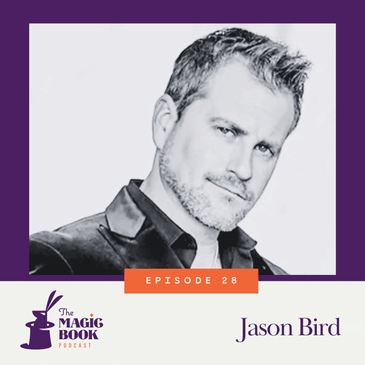
Las Vegas magician and Masters of Illusion performer Jason Bird discusses "Strolling for Dollars," his guide to making a good living doing walkaround magic.
Adrian Tennant [00:00:04]: Coming up in this episode of The Magic Book Podcast.
Jason Bird [00:00:08]: I wrote the book because I wanted to show people that you don't have to have 200,000 Instagram followers. You don't have to be famous, you don't even have to have TV credits. You can still go out there and still make a good living doing magic. And that's why I wanted to give them the blueprint to do that.
Adrian Tennant [00:00:27]: You're listening to The Magic Book Podcast, conversations about classic and contemporary books that teach, illuminate, and celebrate the art of magic. I'm your host, Adrian Tennant, a lifetime student of magic and mentalism, occasional performer, and longtime book collector. Thanks for joining me. My guest today is Jason Bird, a Las Vegas-based magician, mentalist, and keynote speaker. With more than 25 years of professional experience, Jason has logged over 9,400 shows across five continents, headlined at Bally's Jubilee Theatre, and appeared on the CW Network's Masters of Illusion. Through his company, Jason Bird Productions, he performs for Fortune 500 clients including Google, Adobe and Caesar's Entertainment. Today we'll be discussing his book, "Strolling for Dollars: How You Can Make A Living Doing Close Up Magic," published in September 2025, with a foreword by Jeff McBride. [MUSIC] Jason, welcome to The Magic Book Podcast.
Jason Bird [00:01:40]: Well, it is so good to be here with you, Adrian. I'm so glad that we were able to connect so we could do this. This should be fun.
Adrian Tennant [00:01:48]: Well, now, you grew up in Wisconsin and began learning magic at the age of eight. What first sparked your interest?
Jason Bird [00:01:58]: I saw a book at the library. I might have even been younger than 8, maybe even 7 or. But I still remember the particular book at the school library was called, "So You Want To Be A Magician?" And I was like, "That's kind of interesting." So I flipped through the book, learned some of the simple kind of tricks that were in it, and started showing family and friends and really liked it. But then, you know, as most kids do, you kind of move on to other things. So I started playing sports and playing a trumpet and girls happen ... and, you know, and I just kind of forgot about it and just kind of grew out of it, just like most kids do. And when I was about 15 years old -- this would have been like late 90s when [David] Copperfield was at his peak. And I think he, it was one of his TV specials.
Jason Bird [00:02:47]: And I remember watching it and I was like, "Oh, I remember when I used to do magic," I was like, "that was kind of fun." So I just kind of picked it back up and they just happened to be starting a Young Magicians Club in my hometown. And so I joined and very quickly realized this was something I was really good at and started doing shows at my schools and different places like that. And by the time I turned 17, I knew this is what I wanted to do. And then when I turned 18, I said, "Mom, Dad, I'm moving to Vegas, because that's where all the magicians live." Which is the words every parent wants to hear: "I'm moving to Las Vegas!"
Adrian Tennant [00:03:26]: Well, as you mentioned, you were professionally performing by 15. Now, I'm curious, as a teenager, what books were you reading?
Jason Bird [00:03:37]: Oh, that's -- that's a great question. So I still remember the very first book I ever bought. There was a magic shop in Las Vegas called The Magic Mansion, and lots of magicians that you've probably heard of have worked that counter over the years, and it was literally right across the street from UNLV. So the deal I made with my parents is that they would let me move to Las Vegas if I went to law school. So that's what I did. So I was a Pre-Law Major at UNLV, and I went into that bookstore and I bought ...
Jason Bird [00:04:10]: ... It was kind of the first magic book that I bought with my own money. It was "The Royal Road to Card Magic," which is, I mean, to this day, might be the best overall card magic book, in my opinion, that's ever been written. But I started reading that, and cards were the first thing that I really got into, learning how to do all the sleights and, you know, the Pass and all the different moves. I just -- I loved it. I just loved the practice of it, getting good at it. And then when I realized I kind of wanted to start doing more stage kind of stuff in addition to close up, that's when I got Jeff McBride's "Art of Card Manipulation" and learned how to do all the card productions. And I kind of got to know Gary Darwin a little bit.
Jason Bird [00:04:52]: So I got his book on illusions that don't cost a lot of money. You know, stuff that you can build with cardboard boxes and do a lot of black art kind of stuff. And so those were the kinds of books that I was kind of reading. But at the same time, since I was in Vegas and I was just so immersed in it, I didn't really have to read about it. I got to see it. I got to go see all the people at all the shows, and that's what kind of ignited that. Everything for me was just getting in the atmosphere and being in that environment and getting to rub shoulders -- or rub elbows -- with everybody you could think of.
Jason Bird [00:05:26]: When I look back on it, it's insane. The kind of the people I got to know when I was 19 years old, that I'm like starstruck now thinking about it as much as when you're a fresh 19-year-old just moving to Vegas, so.
Adrian Tennant [00:05:41]: Well, as you mentioned, you were 18 when you told your parents you were moving to Las Vegas.
Jason Bird [00:05:46]: Right. That's when I came out to my parents - as a magician!
Adrian Tennant [00:05:53]: I wonder, Jason, when you arrived on The Strip, did the reality match how you imagined what Vegas would be like?
Jason Bird [00:06:01]: Oh, that – that is a devastating question. In some ways yes, and in some ways no. It's larger than life. And I remember my first apartment I lived at in one of the worst neighborhoods in Las Vegas. And one of the giant billboards was for Lance Burton's show because that had just come to the Monte Carlo. And so I would literally open up my window and there's my hero's like billboard sitting right there. So it was good motivation.
Jason Bird [00:06:35]: It's the business side of things, I think, that catches most people. You know, you really do have to treat it like a real business. And I think that when you're a kid and you're like, "Oh, I'm just going to be a famous magician, if I'm good enough, it'll happen." And I think that hurts a lot of people because it takes more than just being good. I know lots of magicians that are good, better than ... I would even say better than me, and they struggle with it, you know, finding a way to make a living at it.
Adrian Tennant [00:07:05]: Your first major professional engagement was at Caesar's Magical Empire, which was an immersive attraction at Caesar's Palace.
Jason Bird [00:07:14]: Yep.
Adrian Tennant [00:07:15]: In your book's introduction, you describe walkaround magic as a kind of jazz, alive and unpredictable. What did performing nightly in that environment teach you?
Jason Bird [00:07:29]: Well, first of all, looking back on it, they were crazy to hire me, a 19-year-old kid. I was competing against some of the best magicians, literally, in the entire world. But it taught me how to up my game. This wasn't just working the local restaurant in my hometown and doing card tricks table to table. This was for people that have paid a lot of money to go to this multi-million dollar attraction. So it really made me up my game as far as, like, how I need to present myself, how I need to do better magic, you know, all those kinds of things. So that would be the first thing that I would say was kind of it.
Jason Bird [00:08:07]: The other major thing is getting to do your act or getting to do a show or getting to perform night in and night out is so invaluable. For four years, I did a couple different acts. Some of them had birds, some of them didn't. But I performed at the Aladdin, which became the Miracle Mile. And I did my act six times a day. And you get good fast. And that's another thing I like about walkaround magic is that, you know, you could go do Double Cross or The Invisible Deck or whatever, you might do that 20 times in one night. Whereas if you're an illusionist, you know, you can only practice The Sub Trunk, so many times, you know, so you just get good fast.
Jason Bird [00:08:49]: And it's like an accelerated kind of winnowing program that it's like, "Okay, I've said this joke 20 times now, and nobody's ever laughed at it. Maybe I need to take it out." Or "People keep catching me. I flash on this one move." And so it just compresses the timeline of how you can get from like an okay magician to a good magician to a great magician. You know, it just shortens that whole curve, getting to perform every night.
Adrian Tennant [00:09:17]: Well, during that period, you got to watch other performers, including Jeff McBride, The Pendragons, your hero Lance Burton, and Mark Kalin and Ginger.
Jason Bird [00:09:28]: Yeah.
Adrian Tennant [00:09:28]: I'm curious, what lessons did you carry over from watching those performers into your own work?
Jason Bird [00:09:37]: It was mainly the professionalism of it, and especially getting to see them over and over again. So when I was working there, I would, every chance I got, I would go sneak into either the close up magic room, which was called The Secret Pagoda, I would go sneak in and see Daryl and some of the best close up magicians. And then I would go over into The Palace of Mystery, which is a bigger theater. And getting to see people do their act over and over again, it made me realize that even the seemingly unscripted moments that happen during a show are scripted. Like, you know, I'm blown away every time I go and see Mac King, because he makes it seem like this is the only show he's ever done where this particular weird thing happened. And then when you see him five times and you're like, "Wait a minute, that happens every show? That's brilliant!" It makes it seem spontaneous, but the spontaneity is rehearsed.
Jason Bird [00:10:33]: And that. That was a big lesson for me.
Adrian Tennant [00:10:35]: Jeff McBride wrote the Foreword to your book.
Jason Bird [00:10:39]: Yep.
Adrian Tennant [00:10:39]: And in it, he quotes his mentor, Eugene Burger, calling strolling magic "the most intimate theater in the world."
Jason Bird [00:10:49]: Yeah.
Adrian Tennant [00:10:49]: Now, Eugene was, of course, also a prolific author and probably the most cited by guests on this podcast. Did Eugene's thinking shape the way you approach strolling?
Jason Bird [00:11:04]: It did. I knew Eugene, and we would hang out from time to time, but I'm definitely closer with Jeff, like -- his wisdom, he's so good at carrying forward, like, Eugene's wisdom. And Eugene Burger's book, "Magic and Meaning" changed my life, changed how I looked at magic. And it really took it from being like a puzzle or, you know, something, like, to figure out or just like, "Oh, we're just having fun and I'm just fooling you." And he really made me about how can I infuse some meaning into what I'm doing so that it's not just these simple things that we're working with. They're actually metaphors for larger things. And that changed my thinking about magic.
Jason Bird [00:11:48]: And that's some of my favorite magic, where it's like it is a magic act, but it's almost like the magic is secondary because it's a piece that's trying to tell you something. And magic just gives you that, like, kind of direct line right to your source, to your audience. But that was one of the major books for me was "Magic and Meaning," which, if you have not read that book, anybody listening out there, you have got to read "Magic and Meaning." It's not very big, and it's wonderful.
Adrian Tennant [00:12:16]: Well, you write that you didn't set out to be famous; you set out to be paid. Why do you think those two things have often felt like their in tension?
Jason Bird [00:12:27]: Oh, man. You know, when I was 18, I definitely wanted to be famous. When you're at that age, you think that fame equals money. That's partly why I wrote the book, because I wanted to show people that you don't have to, you know, have 200,000 Instagram followers. You don't have to be famous. You don't even have to have TV credits. You can still go out there and still make a good living doing magic. And that's why I wanted to give them the blueprint to do that.
Jason Bird [00:12:55]: But that was the main thing, is noticing as the years go by and like, "Wait a minute, this guy is such a good magician. Why is he struggling so much?" Or on the flip side, sometimes I'll see people that are ... I'm like, "Oh, the magic is not very good. Like, how did he just get that big contract at this, you know, whatever?" I was like, it seemed unfair to me on some level. We always like to think we live in a meritocracy where it's like the best people are going to make the most money. And it's just not the case. I had children very young, so I needed to make money.
Jason Bird [00:13:29]: So that's where I kind of made the switch to be like, "Okay, I could try to get into maybe some of these shows or whatever and not make a lot of money." But then it's hard to support your family. So that's why I turned to doing strolling magic where the money was just more consistent, the money was better, it was easier to get into. You know, you don't have to buy a Levitation or, you know, all these different expensive things. The bar to entry is so much lower to start making a living doing magic by doing close up walkaround magic. And so that was what originally pushed me into doing that.
Adrian Tennant [00:14:07]: [MUSIC] If you're enjoying this episode of The Magic Book Podcast, please consider leaving a rating on Spotify or a review on Apple Podcasts. You can also follow The Magic Book Podcast page on Facebook. Thanks, Jason. "Strolling for Dollars" runs to over 580 pages of hardcover. And you've described it as the blueprint you wish you had when you were starting.
Jason Bird [00:14:35]: Yep.
Adrian Tennant [00:14:35]: In an era when many performers with your kind of knowledge would default to a video-based course or maybe a streaming masterclass, you chose to write a book. So why a book?
Jason Bird [00:14:50]: There's still something, I don't know, I think it's the romantic poet in me that still that thinks of print as the end all, be all. To be honest, part of it was mainly that I didn't want my work to be pirated. I didn't want this to be like a PDF that people could just all of a sudden pass around. And now it's on every Torrent stream everywhere and if you just looked hard enough, you could find it. So there's something that I like about the fact that you have to be holding this book in your hand to get the information from it. I like that aspect of it. And I'm just, I think I write how I talk.
Jason Bird [00:15:28]: I haven't ruled out maybe doing a video kind of series, but I really did -- when I put it out, I said, "I don't want to be one of those people that's like, 'Oh, get my book' and then the book kind of teases you a little bit and then it's all to sell some big long course that's $2,000 or something." I want it to be like, "No, I want this to be everything you need from beginning to end if you are thinking about doing this at this level." I always wanted to be an author. So I just sat down and some of it was just ease that -- it was just easier for me just to sit in my bed on a cruise ship, you know, all the ships rocking back and forth, and I was able to write. Rather than set up a camera and do all the production stuff to do a video course.
Jason Bird [00:16:11]: But like I said, I might turn some things maybe into some video lessons kinds of things. But it'll all be stuff from the book. And I always promise myself that I'm not gatekeeping anything like it is all inside of this book.
Adrian Tennant [00:16:27]: Got it. Well, your book is structured in three parts.
Jason Bird [00:16:31]: Yeah.
Adrian Tennant [00:16:31]: Part one is The Show. Part two is The Business. And part three is what you've dubbed Pro Talk: 12 transcribed interviews with working magicians that provide insights into contemporary performance. Jason, when did you decide to include those interviews?
Jason Bird [00:16:51]: It was part of a way of kind of giving back because I know so many good magicians in Las Vegas that you've never heard of because they're quietly just making a living, making a good living doing walkaround magic. And that was part of my way of proving that that point of you don't have to be Shin Lim or you don't have to be whoever to make a living doing what you love, what you want to do. And so part of who I approached was just kind of like friends that I kind of knew they weren't Vegas people like David Penn and Caroline Raven. And, you know, some people that I knew were good and were friendly, so I could ask them to do it. But then some of them were people that you've never heard of. But I know that they've done more magic at Las Vegas magic gigs than just about anybody that probably is famous that you would have heard of. And I wanted their insight to be in the book because we've had discussions over the years and jam sessions, and I mean, these are truly gifted, brilliant people, and they're very good at what they do. And I just thought that their wisdom has to be in the book to go along with mine.
Jason Bird [00:18:00]: And one of the things I found fascinating by doing that is, number one, I learned a lot when I got to hear these people talk about their experiences and the things that work for them and don't work for them. So it was a treat for me personally. But then also, it's interesting when you read through everything, that sometimes you hear the same piece of advice over and over again, you know, and so that should be a little red flag for you. Like, "Hey!" Like almost everybody has said, let's say, "Get your suits tailored" or, you know, something like that, like, where it's like a piece of advice where it's like, "Okay, everybody has said that, so I'm gonna pay attention to it." And then the other fascinating thing was the opposite.
Jason Bird [00:18:37]: I'll have one of the magicians that were like, "Oh, I never -- I don't even print business cards. I don't do business cards at all." And then I'll have somebody else to be like, "I still print business cards, and this is how I use them." I've actually got one back over. I got new business cards printed up after some of the interviews that I did. And now I do a trick with my business card. So it gives them a reason to kind of hold on to your card.
Jason Bird [00:19:00]: But it was the differences between the advice that I just thought fascinating. So it just proves that even among the professionals, you still have to find what works for you. Yeah.
Adrian Tennant [00:19:10]: Well, let's talk about that lineup for a moment. The 12 contributors you have include Brett Barry, who's a mentalist, Paul Draper, whose book "On Second Thought," has just been published as we're recording this.
Jason Bird [00:19:22]: I know. I'm so glad I beat all of their books!
Adrian Tennant [00:19:27]:
Joan DuKore, Collin Foster, Greg Gleason, Chris Hanna, Brian Irwin, Derek Ostovani, David Penn, Caroline Ravn, Shimshi, and Rob Weinstock. How did you choose those particular 12, and how did you go about gathering material rich enough to merit a chapter each rather than, you know, a quick quote?
Jason Bird [00:19:50]: That's a good question. I mean, the main thing for me is I wanted to use people that obviously I wanted to get people that I knew were good. So that was the first thing is I knew they needed to be good walkaround magicians. And for 99% of them, this is from doing dozens of gigs with them, like Rob Weinstock and Collin Foster and Joan DuKore. And Paul and I have done tons of gigs together. So that was my first thing is I wanted to have watched them work and know that they're good. And also with those kinds of names that I just felt it's unfair that their names kind of don't get talked about because, again, they're just quietly making their living doing this.
Jason Bird [00:20:30]:
And I kind of wanted to get their name out there, and they. It blew me away. Not a single person I asked if they would contribute to my book said no. They were all very, very gracious about it. And some people I knew, I follow Caroline Ravn. We've never met in person, but we've talked before. A few times. So I asked her to do it.
Jason Bird [00:20:51]:
David Penn and I are friends, but not close friends or anything, but I just kind of took a flier, "Hey, would you be willing to do this?" And literally every single person that I asked just agreed to it. And it blew me away just how willing they were to help me out with a little project and give their wisdom. Because magicians are pretty secretive. So there was even some parts during the interviews I was like, "Wow, I can't believe you actually just said that. I can't believe you gave away that little secret." So it's a great way to learn literally from the best. Almost like reading their personal diaries of the best advice that you're not going to read it anywhere else because they're pretty tight-lipped about stuff like that.
Adrian Tennant [00:21:32]: Sure. Well, regular listeners may recall that Caroline Ravn was a guest on a previous episode of this podcast.
Jason Bird [00:21:39]: I listened to it. It was great.
Adrian Tennant [00:21:41]: Well, her book, "The Business side of Show Business" sits adjacent to yours in some ways. From your side of the conversation, what struck you about her perspective when you interviewed her?
Jason Bird [00:21:55]: She had some great ideas. She blows me away with her networking ability. That was one thing that I learned from her interview is how to get in those circles, how to network, how to talk to people. You got to break out of your comfort zone and you just got to start. But her way of just some of her thoughts about looking at whatever magazines happen to be sitting, you know, at the thing. It just little nuggets of wisdom like that, that I'm so thankful that she would give up those kinds of things, but that she's just got that real go-getter, she's always-on and very entrepreneurial. And I think that's kind of the second part. Whether you like it or not, you kind of have to develop that skill in yourself because you're essentially a small business owner now, you know, so it's a lot to take on.
Jason Bird [00:22:44]: And if you're not good at it, hire people that are good at it so that you can just concentrate on the stuff that you like doing, like, you know, performing and stuff. So in a nutshell, she's a go-getter. And I really like that.
Adrian Tennant [00:22:58]:
She certainly is. Well, as you know, there is a deep canon on technique, on history, on theory, and on presentation, but the number of books about the business of magic by comparison is small.
Jason Bird [00:23:10]: Yeah.
Adrian Tennant [00:23:11]: So, Jason, when you sat down to write, was there a comparable book already out there? And if so, did you read it or deliberately avoid it?
Jason Bird [00:23:22]: I mean, that's the reason why I wrote the book that I did is because there is such a dearth of material on how do you make this work as a living. You know, the only thing that, in my mind -- and I have not read it, so I can't totally speak to it. And again, I did it for that reason. Cause I didn't want it to color what I was writing. Cause I just wanted to write my experience -- but Jamie D. Grant's "The Approach" is the one that I hear other people compare the book to.
Jason Bird [00:23:51]: It's, you know, not exactly as big as my book. There's some pluses and minuses with each one. I know he couldn't have talked more than I did about things, you know, to have such a big book on the subject. I heard his book is great. There's no feud or anything going on. I've heard it's a great book, but I just, I haven't read it.
Jason Bird [00:24:09]: And that was probably the closest thing to what I was trying to do. In fact, this is kind of some inside baseball, but I had originally, because I've got a pretty good relationship – Vanishing Inc. has released a couple of my products. I invented the Money Morphosis, where the dollar bill folds into a butterfly. That came out a few years ago. So I did that through Vanishing, Inc. So I know those guys.
Jason Bird [00:24:32]: I love them. I came to them when I said, "Hey, I have a book. It's about halfway written." I said, "I really want you guys to publish it. Because, you guys, I love the way you publish your books, and I'd love to get you behind it." And they said, "If you had called three weeks ago, we would do your book." But they said, "We just bought the rights to 'The Approach.' So I was like, "You gotta be kidding me!"
Jason Bird [00:24:57]: So in the end, I think it worked out better for me because it was a lot of work setting up a website and a Shopify store. And, you know, again, the business side of stuff that you don't realize you need to do. But in the end, I wouldn't change a thing. I look at it as that saved me from something to be able to do it on my own.
Adrian Tennant [00:25:18]: Your book carries a notable endorsement from Ken Weber, the author of "Maximum Entertainment," who said your book is – quote: "Dripping with the kind of advice only known to those who are out in the trenches getting it done."
Jason Bird [00:25:32]: Yep.
Adrian Tennant [00:25:33]: How did Ken come to read the manuscript? And what was it like getting that particular nod given where the two editions of his book sit in the literature?
Jason Bird [00:25:43]: Well, that was part of why I did go to him is because it's one of my most revered books on magic. And it's so funny how it's like, it's really not a magic book, but it's still one of the best books a magician could possibly read. And it has more of that real-world advice of stuff that most magicians don't think about. You know, they'll sit and they'll agonize over their, you know, Double Lift and, you know, and their fingernails are dirty or something is off about them and it's ruining things. So his book really opened my eyes with a lot of stuff like that. I had lots of respect for him. I had met him and this was a total fluke. But it was at Magic Live, and it was, I think, two or three Magic Lives ago.
Jason Bird [00:26:30]: And I was walking around the dealer's room because I had no idea what Ken Weber looked like. And I just happened to be at Joseph Gabriel's booth. He does these beautiful paintings of different magicians and things like that. And Ken Weber was standing at his booth. And Ken Weber introduced himself to Joseph Gabriel. And he's like, "Hi, I'm Ken Weber." And I was like ...
Jason Bird [00:26:53]: My eyes just, like, bugged out. So when he was done talking with Joseph and I pulled him aside and I said, "Hi, Ken." I said, "I just want you to know, like, you have one of my favorite books." You know, again, you can barely call it a magic book, but "You have one of my favorite books on performing entertainment that I've ever read." And he was so gracious. He was like, "Oh, thank you so much." I don't even know if we exchanged information at that point, but we took a selfie together. And then when it came time, I tracked him down somehow, but I sent him that photo of us at Magic Live just to jog his memory of like, "Oh, okay, this isn't just some crazy person."
Jason Bird [00:27:34]: So I sent him the selfie and then sent him the manuscript for it. And I was like, "It would really mean a lot to me at that point." Nobody had really read the book. Nobody had given a blurb for it. Nobody had, you know, there was still nothing. And he was so kind for him to write that after he read it, that I was like ...
Jason Bird [00:27:55]:
I'm like, giggling a little bit. The fact that he said that about my book, like, it means that much to me. And he was the first one that really gave it, I think, some legitimacy. So when people started reading it and they were like, "Oh, if Ken Weber says this is a good book, maybe we should take a look at this." And so, yeah, that's that story. Just happened to meet him. And it's not like he goes around with a name tag that says 'Ken Weber.' Like, if I hadn't just overheard him introduce himself to Joseph Gabriel, I would have never known that was him ever.
Jason Bird [00:28:26]: So it's just -- it's weird how those little tiny things, when you look back on it, ended up making such a big difference in your life.
Adrian Tennant [00:28:33]: Jason, your book is unusually candid on the financial side.
Jason Bird [00:28:38]: Yeah.
Adrian Tennant [00:28:39]: Pricing, negotiation, contracts, deposits, taxes, and insurance. Can you give us a realistic picture of what a working strolling magician can actually charge?
Jason Bird [00:28:54]: Okay, we're gonna leave Oz Pearlman out of this conversation only because I don't think that's a realistic goal for most people, is to make that kind of money. But good on him. He's definitely blown up, and he deserves everything he's getting right now. But if you're talking about just people that aren't super-famous and haven't been on The View and TV shows and stuff, I think part of the reason why people are hesitant to give it out is because everybody's situation is so different. You know, what I would charge would be totally different. And I get people that ask me, you know, all the time.
Jason Bird [00:29:31]: Some of my readers ... we have a very large Facebook group, by the way. It's called the Walkaround Warriors. If you want to do a search for it on Facebook, you don't have to have bought the book to join, but people are very open with their information and whatever. But I do get people that are like, "Oh, I live in rural Iowa. How am I supposed to ...?" You know? So sometimes they'll hire me as a consultant, and we'll really, I'll go through their specific situation to find out how it goes. But I would say just to give some numbers ...
Jason Bird [00:30:01]: I can't think of very many places that you shouldn't be making at least $300 an hour to do walkaround. If you were starting out, just getting going. But I was just hired. I'm flying to Chicago -- that's the other thing is when you get to a certain level, it almost doesn't matter where you live. So that excuse of like, "Oh, I live here, so this." Maybe in the beginning, you know, while you're building, that could be kind of a hindrance. But if you get good enough and really up your web presence and the content that you put out that people can watch, if you're good, they will fly you anywhere.
Jason Bird [00:30:39]:
So they're flying me to do one of the top -- I looked them up, they've argued in front of the Supreme Court. They're like one of the top law firms in the country. But plus expenses, $3,500 for two hours of walkaround magic. So that's a pretty good night, you know, so that's what's possible and that's what you can shoot for. I just did a show for Capriotti's. It's like a big sandwich shop in Las Vegas and they have lots of stores. So it was a show for all their franchisees.
Jason Bird [00:31:05]: So there was, was like, you know, their big corporate thing at the end of the year and they originally wanted walkaround magic. And I said, you know, "What if I did like a 30-minute stage show? And then I went and walked table to table?" And they were like, "Oh, that's such a great idea." And I was able to double my fee because they just didn't think about this. And I talk about this a lot in my book that you really do have to educate your clients like when they get you on the phone because how many of them have ever hired a magician before? Probably very few of them. So they don't know how it works. They don't even know what questions to ask sometimes. So you really do have to educate them with stuff like that. So that's why I'll always give them a few options.
Jason Bird [00:31:47]: Usually try to do A, B and C. "This is if I do just walkaround. This is if you want me to come in and do a stage show. And then this is if you want me to do both." And I'll give them kind of three different price points. Sometimes they just want the walkaround, sometimes they just want the show, whatever. But at least they have the information and you have the possibility of making more money.
Adrian Tennant [00:32:06]: Right.
Jason Bird [00:32:06]: You know?
Adrian Tennant [00:32:07]: Right.
Jason Bird [00:32:08]: I think sometimes people are hesitant to give numbers because they don't want people to know how much money they personally make. But I think sometimes it's just a hard question in general to answer because people are in different, you know, skill levels, they're in different markets. So it is kind of hard to give like a catch-all kind of answer for it. But that's the range that's possible. So I would say at least $250 to $300 an hour. I usually do a two-hour minimum. If you were just starting out, I know a lot of people start out by doing restaurants and working for tips and that's fine if you're Just starting out. But like, the advice I give is, try to get out of that business model as fast as you possibly can.
Jason Bird [00:32:49]: Because the problem is if you approach a restaurant and you say, "I'll essentially, I work for free. I'll just work for tips." The best that could happen is they love you, but now they think of you as a free magician that will just work for tips. So now if you try to go back and say, "Hey, I need $200 an hour or $300 an hour," all of a sudden now it doesn't seem like such a good deal anymore because that's what you went in on. So that's why I would try to go to another place and then pitch them with what your rate is. And it also frees you up. You can say, "I'll never ask for a tip."
Jason Bird [00:33:21]: "I'm not going to accost people, people, because you're paying me." And that's a line I use when I do my walkaround. If somebody tries to tip me, I do the whole, like decline it a few times and I go, "No, no, no, they paid me very well to be here. I appreciate your tip, but it's okay, you keep it." And I'd say four out of five times they insist and they make you take it anyway. And it's hard to turn down a hundred-dollar bill! So yeah, I'll take it. But yeah, it's funny, when people first meet you, they carry that first impression with them for a long time.
Jason Bird [00:33:49]: So if you've approached them as "Just let me come in your restaurant and I won't charge you anything" and you know, "we'll see how it goes" or whatever, that kind of thing, maybe that works. Maybe that's how you get your foot in the door. I've seen that happen. So it's not that it doesn't work, but it now makes it a harder sell to try to get people to now pay you for something that they weren't paying you for before.
Adrian Tennant [00:34:14]: Well, there's a tension in any book like this between the time-sensitive material -- media platforms, marketing tactics, fee structures -- and the timeless material like performance psychology, ethics and relationships with clients. When you were writing, were you conscious of trying to build something that would still be useful in, say, 10 or even 20 years?
Jason Bird [00:34:42]: I absolutely did. That's why I lean more heavily into the things that I know are still gonna be relevant. You know, how to control your audience, what kind of effects to pick, like, you know, what kinds of tricks work well for strolling, which ones don't work that well for strolling, that kind of advice is going to be true in a hundred years, you know? And that's what I really wanted. So I do give some examples when you were talking about, like, the marketing part, I don't get too in the weeds about things like Facebook ads or that kind of stuff too much just because it does change so quickly that it would be hard to keep up with everything. But I think even with my marketing advice, I do think if you just change the name of the platform, you know, whatever it happens to be in five years, I think that the general information will still be applicable, that you need to have a good package, a good promo package. You need a good video that, you know, makes you look good. Having the testimonials and having the audience shots of everybody freaking out and clapping. And that's timeless that you're going to need those no matter what the platform that it happens to be showing on.
Jason Bird [00:35:52]: So I did keep that in mind to answer your question, when I did write it is I wanted it to be evergreen, that it doesn't just, you know, die out.
Adrian Tennant [00:36:02]: Just a reminder that you can be notified when new episodes of this podcast are published by subscribing to the email alerts. You'll find all the details on the podcast website at themagicbookpodcast.com which is where you can also find transcripts, plus accompanying blog posts with summaries, titles, timestamps, and links to resources mentioned in each episode. Jason, you've recently been working on a new intimate stage experience for an audience of around 60 to 70 people. After more than 25 years performing everywhere from the Vegas Strip to cruise ship theaters, what does that parlor format let you do that neither the big stage nor strolling allows?
Jason Bird [00:36:48]: Because I wanted to do something that I was kind of in control of from beginning to end. You know, strolling magic is so much fun because it's always something different, it's always something new. But the one thing that hurts my heart when I do strolling magic is that it always feels too short. You know, it's like you're going in like a Ninja and you're showing like the best stuff that you've got. But it always felt like they never really got to know me personally. And I kind of wanted an opportunity to do that with without having to do like a huge, you know, illusion show, which I have done before. I kind of wanted the best of both worlds. So I wanted something that seemed intimate enough that people would really feel like they got to know you. But a little bit more production value, a little bit more pizzazz, you know, like, I do more parlor-type size things, you know, that you wouldn't do strolling or walkaround.
Jason Bird [00:37:46]: But they're still great to do for a parlor-type situation. And I'm having a blast doing it. I'm excited about the program. "The Parlor of Impossibilities" is the name of the show, so anybody wants to Google that. But it's been fun. We've got a few hotels that are definitely interested in it. I've done it a few times now, sold out shows. So we're at this point, we're just trying to find a schedule that works so that it can be every Saturday night or every other Saturday night or whatever it happens to be.
Jason Bird [00:38:18]: But I'd be the first one to say, like, I'm totally basing the entire business model off of Steve Cohen's "Chamber Magic." I just think it's a brilliant way to do it, how to handle it. I like the fact that it's real classy. So I have a dress code for my show. So I wanted it to be like a night out. Like, it's real theater, you know, instead of just magic tricks. I want it to be a show.
Jason Bird [00:38:40]: So my show has an arc from beginning to end that kind of tells a story loosely throughout the show. And I'm a storyteller. Look up it's an act called "Mr. Kindness." And I did it on stage at Masters of Illusion at Bally's. I call it the only bird act that logically makes sense of why you would be producing birds to begin with. And it's for this old woman sitting on a park bench.
Jason Bird [00:39:03]: And I end up doing magic, making these birds appear that then start eating the bird seed that she's throwing down because she's lonely. And so I make these pigeons appear. And I won't give away the ending, but it's my personal favorite piece of magic I've created. I'm very proud of it. So Mr. Kindness is the name of that one, and you can find that online.
Jason Bird [00:39:23]: But I did that on the TV show, and I did it in the live Masters of Illusion show every night.
Adrian Tennant [00:39:29]: You write in your book that, quote, "good magic leads to more magic."
Jason Bird [00:39:33]: Yeah.
Adrian Tennant [00:39:34]: And you describe paying it forward by referring gigs to other magicians. Is the magic community as collaborative on the ground as you'd like it to be?
Jason Bird [00:39:45]: First of all, you picked up probably my favorite line of the entire book. That was one of those lines, like anybody who's ever written Anything. You'll just be stream of consciousness kind of writing something. And when that line came out of my pencil that good magic leads to more magic, I was like, where did that come from? It felt like one of those shocks from the universe that I was like, "Of course, the more people see good magic, those are people that are more likely to hire magicians in the future." So it's creating more opportunities. And I wanted it to feel like that because it is cutthroat, especially in Vegas. I'm not gonna lie.
Jason Bird [00:40:25]: There are people that will, you know, they'll smile at you in your face and stab you in the back as soon as you turn around if they thought they could get ahead somehow. So you do have to be careful with stuff like that. But on the other hand, when you find those people that are your people, when you find people that are really good, hold on to them, nurture those friendships, stay in touch, do whatever you got to do. I've gotten so many gigs to kind of more directly answer your question. It happens a lot more than you think. You get double-booked. "I can't do it that day. I'm on vacation."
Jason Bird [00:40:59]: "I'm this, that, and the other." And I've booked out over, I mean, at this point, hundreds of gigs to other magicians. And then I've been the backup to all of my friends that don't do it. So it's almost like when you were talking about paying it forward. That's kind of what it is. Like, if, you know, I'll throw a gig, you know, this way, and now you're kind of in good with them, so the next time that they need you to cover, they'll just call you. So I kind of have my stable of magicians that I know can go out there and do a great job.
Jason Bird [00:41:30]: Obviously, I want to have my clients still be happy. It can be a little tricky sometimes. They're hiring you, and then it feels a little bait-and-switch. But at the same time, at that point, if they like you, they're going to trust your opinion on things. So if they say, "Well, okay, if you say this guy or this girl is good, then we're going to take a look at them." And then, yeah, you referred [them to] it, but it's just just more fun. That's the other thing.
Jason Bird [00:41:53]: It's just more fun to collaborate than it is to compete. It's just, at least for me, I like having friends and not competitors all the time, at least.
Adrian Tennant [00:42:03]: Well, the book opens with you describing watching Jeff McBride and others perform at Caesar's Magical Empire night after night.
Jason Bird [00:42:12]: Yep.
Adrian Tennant [00:42:13]: Twenty-five years on, Jeff has now written the Foreword to your book.
Jason Bird [00:42:19]: Yeah.
Adrian Tennant [00:42:20]: Have you had a chance to reflect on that arc together?
Jason Bird [00:42:24]: It's pretty mind-blowing. I was hanging out at his house. Just not too long ago, Greg Gleason came over. He happened to come over right when I was over there. He gave me a new trick that he just came out with, which is very good. It's called World Traveler. It's almost like The Invisible Deck, but with a plane. It's really good if anybody wants to check it out.
Jason Bird [00:42:43]: You're welcome, Greg, for plugging your trick during my interview. But anyway, so we were sitting there, and we did have a long conversation about it and how it's crazy how full circle it all comes. Like, this is the guy that I literally spent hours and hours and hours, like, rewinding my VHS videotapes, you know, trying to do all the card manipulation stuff. So here's this guy that I've literally watched spend hundreds of hours of my most formative years, like, watching, and now I'm sitting in his living room, and we're talking about his contribution to my book. It's very humbling. I'm so honored. I'm so glad he did it again. I think that was another name that helped give legitimacy to a project that people might not have probably never heard of me.
Jason Bird [00:43:27]: Maybe they saw me on TV or so, but I'm definitely not a household name in the magic community. So I think having him write the Foreword really helped a lot of people take it seriously, you know, to be like, "Oh, if Jeff says it's good." And actually, he went above and beyond that. He named it his book of the year for 2025. So that made me feel really good, because there's lots of good magic books, but he called it the book of the year, so that was. That was great.
Adrian Tennant [00:43:54]: Well, this is The Magic Book Podcast, so I have to ask Jason, what is your most cherished book -- or books -- and why?
Jason Bird [00:44:07]: Oh, man. I mean, "The Royal Road to Card Magic," that first one, that's always going to have a special place in my heart. The other one that leaps to my mind is "Greater Magic." The opening lines, those opening sections of "Greater Magic," I think are the most beautiful, most eloquent, heartbreaking, and poignant passages on anybody writing magic that I've ever read. You know, where he talks about the parade and he's describing magicians, but he's kind of going through time as it happens. And I almost don't want to ruin the way he ends it. But essentially the last man will know no more than the first because it began in mystery and it will end in mystery.
Jason Bird [00:44:55]: It's just such a heartbreakingly beautiful, beautiful piece of writing. So I have a copy of that book and it's not cheap, but my wife got it for me one year. It's one of my most cherished possessions, is my copy of "Greater Magic."
Adrian Tennant [00:45:11]: Okay, Jason. For listeners who'd like to purchase a copy of "Strolling for Dollars," where can they find it?
Jason Bird [00:45:18]: Okay, jasonbird.store. That's where all the goodies are. That's where the book is. There's a few other things on there that I would highly recommend taking a look. So I have a product on there called The Pro Gig Toolkit. And it's not very much money, but it's pretty much all the PDFs, they're all editable. You can edit all the PDFs, but it's a sample contract. It's email scripts for how to make, you know, your introduction to, like, a new client.
Jason Bird [00:45:46]: It's checklists that you can use for when you're leaving for a gig. And you can check off everything you need to do. There's all these different. It's all the unsexy stuff that nobody likes doing, you know, all the paperwork and all that kind of stuff. And I did it for you and it's all beautiful. It's the stuff I actually really use. And it'll save you a lot of heartache. And like I said, for how little money it is, I think it's the best value of anything on the site.
Jason Bird [00:46:13]: And then I've got some fun stuff. I've got a collection of big magic posters. They're high dpi, they're like really high quality. I print them when I do my evening show, I print them 4ft by 5ft so they're like real big. They look like the big vaudeville, you know, posters. And I put those around the room and it just gives that the atmosphere, you know, of that old timey Victorian kind of room. So that's on there. There's the old magic book collection that's on there.
Jason Bird [00:46:40]: That's not very expensive. So there's some other fun stuff that you can look at. But the two big ones are the book itself, obviously. And then The Pro Gig Toolkit is, I think, worth every penny. And I've had everybody say it. They're like, "This was the best thing that we bought was this Pro Gig Toolkit because it just saves you so much time."
Adrian Tennant [00:46:57]: Well, for anyone who wants to follow your work more broadly.
Jason Bird [00:47:01]: Yeah.
Adrian Tennant [00:47:02]: Corporate keynotes, the cruise ship dates, the new "Parlor of Impossibilities," where is the best place to find you online?
Jason Bird [00:47:11]: My main website is JasonBirdProductions.com, so that's where I send all of my clients. So if you want to see like what a good professional website looks like, just don't steal too much of it. But, but that's my main portal into everything. And then of course I'm on Instagram, @Jason Bird Magic and all that kind of stuff. But Jason Bird Productions is kind of like my hub and Jason Bird Store. That's all. Everything to do with the book, so that sends you off to the book and then you know, there's some other places to go.
Jason Bird [00:47:41]: But that's like the nerve center of everything is JasonBirdProductions.com.
Adrian Tennant [00:47:47]: And finally, Jason, I understand there may be a second book in the works. What can you tell us about it?
Jason Bird [00:47:54]: Well, I'm gonna break the news here first. There is a second book in the works. You know, it's one of those things where I'm like, "Okay, I'm gonna put out everything I know about this." And then you finish the book and then you're like, "Oh, but I forgot to put that in." Or honestly, most of it has come from people's questions since reading the book. You know, they've read the book and then they're like, "Well, what about this?" And they asked a question and I was like, "Man, that's such a good question. That should really be in a book." So I've been teasing that.
Jason Bird [00:48:23]: So what I would recommend for anybody who's even remotely interested, go to JasonBirdStore. There's a pop-up to join my newsletter. And when you join my newsletter, I don't flood your email. I send out usually about once a week. And it's essentially pieces of the second book that I'm writing. I call it "Field Notes." And it's on a topic that either somebody brought up to me later and I said, "Yeah, I can't believe I didn't really talk about that in the book." So I've been doing these little magic grenades.
Jason Bird [00:48:55]: They're just on one topic. They're only like 10 pages each one these Field Notes, but they're all on one particular topic and hit really hard on it. So I've been giving away one of those a week, but I've got over 50 of them now and I think that's going to be my second book, which I don't think I'm going to print. I think I will actually do a PDF for that one. It's a lot of work to print a book, but I have a big enough collection of all of those Field Notes and I think it's enough to do like an e-book. It won't be as expensive as the first one because I don't have to print it, so I think it'll be worth it. But people can get kind of sneak peeks of it if they join my newsletter right now. You can get some of the good info already.
Adrian Tennant [00:49:37]: Good to know.
Jason Bird [00:49:38]: Yeah.
Adrian Tennant [00:49:39]: Lovely conversation. Jason, thank you so much for being my guest on The Magic Book Podcast.
Jason Bird [00:49:45]: It has been my absolute pleasure and honor. Thank you so much for having me on.
Adrian Tennant [00:49:52]: You've been listening to The Magic Book Podcast. In this episode we learned about Jason Bird's journey from a small Wisconsin town to the Las Vegas Strip, his formative years as a teenage strolling magician at Caesar's Magical Empire, and the thinking behind "Strolling for Dollars," his comprehensive field guide for professional close up performers. We explored his editorial chapter choices, the 12 practitioner interviews that anchor the book's third section, and the relatively small number of books his work joins. I hope you enjoyed this conversation about craft, business and what it actually takes to build a life in magic. You'll find a transcript of this episode on our website at TheMagicBookPodcast.com along with a blog post containing a summary, timestamps and links to resources we mentioned. If you'd like to be notified when new episodes are published, please subscribe to our email alerts. All the details are on the website. And if you have a question or would like to suggest a topic or a guest for a future episode, you can reach me at adrian@themagicbookpodcast.com. Thanks for listening to The Magic Book Podcast. I've been your host, Adrian Tennant.
Adrian Tennant [00:51:09]: Until next time, goodbye.