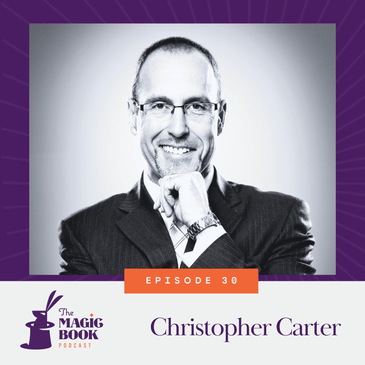
Chicago-based mentalist Christopher Carter discusses "In the Spotlight," named Penguin Magic's Book of the Year, which collects 28 routines and essays from a 35-year career across college campuses, corporate stages, and cruise ship theaters. Christopher explains why the Q&A act is so effective in mentalism, describes the Mental Interview at the heart of his approach, and explores the handling of stage danger in Staple Gun Roulette, choosing a risk that is real without being mortal.
Adrian Tennant [00:00:02]:
[MUSIC] Coming up in this episode of The Magic Book Podcast.
Christopher Carter [00:00:06]:
Mentalism is about the play that goes on inside the mind. Q&A largely fulfills the stereotype, or really the paradigm, something that's deep in the spectator's mind when they watch a mind reading show. They expect to see minds being read.
Adrian Tennant [00:00:24]:
You're listening to The Magic Book Podcast, conversations about classic and contemporary books that teach, illuminate, and celebrate the art of magic. I'm your host, Adrian Tennant, a lifetime student of magic and mentalism, occasional performer, and longtime book collector. Thank you for joining me. [MUSIC ENDS] My guest today is one of the busiest working mentalists in the United States, and someone I had the pleasure of watching perform in person just a few weeks before we recorded this interview. Christopher Carter has spent more than three decades on stage, from college union ballrooms to Fortune 500 boardrooms, cruise ship theaters, and international stages. He's the recipient of the Dunninger Award and the Milbourne Christopher Award. And he holds the unique distinction of being the only performer ever to sweep all the major Campus Activities Magazine awards in a single year. This year, he added Penguin Magic's Book of the Year Award and the Psychic Entertainer Association's Dave Lederman Memorial Award for Creativity in Mentalism.
Adrian Tennant [00:01:33]:
Distilling 35 years of professional performance into 28 routines and a set of essays, Christopher's book is called "In the Spotlight." [MUSIC] Chris, welcome to the Magic Book Podcast.
Christopher Carter [00:01:47]:
Well, thank you very much, Adrian. I'm excited to be here.
Adrian Tennant [00:01:51]:
What drew you toward the mystery arts in the first place? Was it magic first or was it mind reading?
Christopher Carter [00:01:57]:
No, it was definitely magic. I don't think at a young age when I really got interested in it that anybody was particularly following mind reading at that time. You know, people of my generation in the United States were mostly drawn into it by a man named Marshall Brodien, who created a TV Magic Set and TV Magic Cards. And that hooked me. But context is everything, isn't it? I mean, I was a socially awkward kid, and now I had something cool that I could do that people were interested in. And I hung on that as a crutch to give me just a little bit of a bump in status.
Christopher Carter [00:02:32]:
And from the very first moment I saw a trick, I was hooked. I was absolutely hooked. And by 10 years old, when my parents finally gave me my very own TV Magic Set, I had no doubt in my mind that I wanted to be a professional magician. Not at all.
Adrian Tennant [00:02:50]:
Well, a specific moment you write about in the book, about seven years after you received that magic set, is watching Glenn Falkenstein perform his blindfold Q&A act at a convention. Partway through, a joke he made gave away the method. Why did knowing how it worked make you want it more rather than deflating it?
Christopher Carter [00:03:14]:
Well, that has a lot to do with my experience while I was watching it and not knowing how it was done. Because I had no experience at all with mentalism other than to have read a few very basic books of some mental magic tricks. And I had read that there was such a thing as cold reading, which I just assumed meant that, you know, in the act of talking to somebody, you could size them up and begin to tell. Well, I had decided that Glenn Falkenstein, who was doing a blindfold question and answer act, was clearly the greatest cold reader on earth, because he was telling people details about themselves that they could not possibly know. And although I didn't believe it was psychic abilities, I thought, "This man has insight." Now, I won't go into detail as to what the joke is - it is in my book - but it just revealed everything.
Christopher Carter [00:04:03]:
And I'm honestly surprised it didn't reveal everything to the entire audience because it was very much a light bulb over the head moment for me. I mean, I was going out of my mind with amazement, but I wasn't the only one. The audience was deeply, deeply impressed. And so when I found out how technically simple, or I really should say theoretically simple, because I know now having worked with a blindfold Q&A for many, many years, that technically it's actually considerably more difficult. But theoretically, the principle behind how it operates seems as if it should be really simple. And I found myself just flabbergasted that people would have that kind of powerful emotional response to something that was so fundamentally simple. And that tickled something in my mind. That was really it.
Christopher Carter [00:04:57]:
So, you know, why did it not deflate me? Because I saw its power and I wanted a piece of that. I wanted a piece of that so bad. So I went and I worked on it and I created my own version of it. And I was 18 or 19 years old and nobody took me very seriously and it wasn't as powerful as his. And I spent the next several years trying to figure out, "What the heck am I doing wrong?" I eventually figured that out. But yeah, why? Because of the power.
Adrian Tennant [00:05:24]:
You took an unusually academic route for a performer, a double major in Business Administration and Theater at Illinois Wesleyan, and then a PhD program in Theatrical Movement at Michigan. Chris, what made you pursue the study of performance formally rather than just going out and doing it?
Christopher Carter [00:05:46]:
I was a very bookish kid, and I was also maybe a little bit more timid than I should be. I wanted to be a professional entertainer. I told everybody I wanted to be a professional entertainer, but very well-meaning adults said, "Well, that's pretty tough. Maybe you want something else. What can you do?" And I was excelling academically. I ended up getting out of undergraduate with a 4.0 average. I took the GRE and got nearly perfect. And so a bunch of theater programs were just offering me money.
Christopher Carter [00:06:17]:
If I'd had to pay for it myself, I wouldn't have done it. But really, it was a very kind and well-meaning mentor who was one of my professors who suggested it. And my attitude honestly was, "Why not? Sounds as good as anything." It was either that or move to Paris and study movement theater from one of the theatrical miming teachers in Paris. That's what I kind of really wanted to do, but I was way too timid to do it. So for me, it was the safe harbor.
Adrian Tennant [00:06:46]:
In 1990, you made a decision to pack the academic career away, move to Chicago, and launch what became Carter Entertainment. What finally made you choose the stage over the lecture hall?
Christopher Carter [00:07:01]:
Several things. One was watching my professors interact with the academic administration and realizing that this was a very weird little closed bubble. I enjoyed playing scholar for four years. It was a thrill. But I saw the limitations of it as a way of life. It's very insulated. Academics at that level is kind of incestuous. It's one idea feeding off another idea, and they're very close together.
Christopher Carter [00:07:26]:
And all of a sudden peoples' ideas just get weirder and more detached from the real world. On the other hand, I was in magic and I was performing magic to make extra money to get myself through graduate school. And I could see the power and the immediacy of the emotional reactions you get from doing magic. Now, in those days, the study of what at that time would've been called 'New Vaudeville' had a lot of cachet in the academic world. So I had an opportunity to dabble in the study of that anyway, which gave me more opportunities to perform. It gave me a certain level of credibility, and I began to get in my head that, "Yep, you know, I bet I could do this. Other people are doing it, they're making a living." And so that was part of it, just watching the way my teachers went and increasing my exposure.
Christopher Carter [00:08:11]:
The other part was simply knowing that I don't play well with others. I collaborate well, but I don't like having somebody be my boss. I hate it. And I knew that was always going to be a problem for me. And so if I were to really be happy, I would have to be my own boss. And this was the only thing I could think of to do. You know, the great thing about being young - and I went into graduate school straight out of undergraduate, so I was young - is you don't know what you can't do and you don't believe you can't do it.
Christopher Carter [00:08:42]:
So it was, you know, it was the perfect time in life. I quit, I moved to Chicago. I thought I was gonna be a close-up magician. And in very short order, I realized I had absolutely no idea what the hell I was doing. But I was eager to learn and I was diving in. So it all worked out.
Adrian Tennant [00:08:57]:
Eugene Burger is a name that comes up on this show probably more than any other. Now, you knew him well in Chicago.
Christopher Carter [00:09:05]:
Really well. Yeah.
Adrian Tennant [00:09:06]:
Where does he sit among your influences?
Christopher Carter [00:09:10]:
As an influence on the shape of my performance, pretty limited. As an influence on the shape of my craft or my artistry and on my person, huge. Absolutely huge. So I moved to Chicago in 1990, and being a young magician in Chicago, and I had a car and Eugene didn't, Eugene would frequently make a kind of a tacit agreement with young performers with cars, that "If you kind of act as chauffeur for me, you can get access to all of these famous magicians who come and visit me." It was never stated, but it was part of his mentorship. So I got to hang with Eugene a lot and hang with him while he was being visited by the greats - because everybody came to talk to Eugene. And I got to see in particular how he interacted with an actual lay audience, which is really different from how a lot of people imagine him. There was a particular bar or lounge that he would perform at, and I would visit him and I would just sit and watch him and work those things.
Christopher Carter [00:10:16]:
And Eugene was, in my opinion, the greatest sit-down close-up magician ever, that I have ever seen. Not because of the technique, but because he could immediately build a bond between him and the other people. It was how he connected. That was the magic of what Eugene was doing. So what I got was an opportunity to see somebody who thought about his magic really deeply, who was really focused on connecting and engaging with humans, and eliciting emotional reactions out of them, and who also was incredibly kind and giving. And all three of those things had an enormous impact on me. As far as like a process for doing, I was never one of Eugene's students. I was just a fly on the wall, but I'd rather have been a fly on the wall with him than anybody else because he was an enormously kind, giving, thoughtful person who could, if you asked, give really insightful criticisms, but also gave them in a spirit of kindness.
Christopher Carter [00:11:24]:
So all of those things, I think shaped who I am and what I do more than any particular lesson about how to do the magic.
Adrian Tennant [00:11:33]:
Well, the previous episode of this podcast featured Scott Martell discussing his book, "Mr. Fingers: The Magic of Irv Weiner." Chris, like Irv, you built your reputation on the college circuit. That market has changed a great deal from the days when it was the backbone of a touring performer's calendar. What changed?
Christopher Carter [00:11:57]:
Well, I'm gonna backtrack a little bit and say to anybody, if you want a really great book on magic, get that one, "Mr. Fingers." You can buy mine too, mine's great. But that is one of the best books on magic I've had in years. So what has changed? What has changed is it is no longer the backbone - or even potentially the backbone - of a performer's calendar. A perfect storm of politics and demographics ended up working together so that budgets got cut. You know, a young Gen Z audience has been weaned on screens, and it's much more difficult to get them to participate in live campus cultural events. That may be changing now, but that was a big thing, especially post-COVID.
Christopher Carter [00:12:42]:
So you've got COVID, you've got national politics, and you've got demographics. Ultimately, the budgets shrank - to the point where the colleges and universities weren't willing to pay for live entertainment that wasn't pulling in an audience particularly. They're eager to have it in the very early part of a semester, and then after that they let it go. But there was a time when college campuses were about the closest thing left over to Vaudeville that we had. And there were many, many potential performing venues, whether it be a large show or they had coffee house entertainers, a large state university. could have a different entertainment offering per week. Smaller universities might only have one per semester, but there were many opportunities.
Christopher Carter [00:13:28]:
And in those days, I could easily do 200 days a year.
Adrian Tennant [00:13:32]:
Wow.
Christopher Carter [00:13:32]:
I could easily get booked. I couldn't easily do 'em. It actually was pretty hard. That's gone. In a way, it's sad because it was really a great experience for me. Imagine being able to hone your act night after night after night - that is a great gift to somebody - and have a new fresh audience every single night. I wish that on everybody, but the opportunities for that are so few these days.
Christopher Carter [00:13:58]:
And the other aspect was it was really an opportunity to make a lot more money than I ever expected to make, to the point where it was like a siren song. It drew me, you know, there were other directions I could have gone, but I didn't take them because I was making so much money. And then, you know, over the course of a few years, it just essentially collapsed. But, you know, I grew out of it as well. A big problem with the college campus market is the performers get older, but the audience stays the same age.
Adrian Tennant [00:14:26]:
Yeah, I hadn't thought of it like that. Irv was famous for carrying very few props with him. You use the phrase "packs flat, plays big" as a discipline. How has traveling light shaped your artistic choices?
Christopher Carter [00:14:42]:
I want to definitely stress that it's not necessarily a good artistic choice. I think in theory, the best artistic choice would be to have some prop be the size it needs to be. Nevertheless, I think creativity thrives in the vicinity of constraints. I think there's actually a great deal of research to suggest that's true. That's been my experience. And if you are going to be traveling day in, and day out, to new cities, you really can't take a lot of stuff with you. It just can't be done. So you're right, it forces you then to think, "How can I take this small thing and make it accessible to a very large audience?" And I think that exercise is incredibly helpful because it forces you to look for theatrical techniques, things like premise and effect structure and pacing and stagecraft, how to use the stage, how to use the space.
Christopher Carter [00:15:40]:
How to create an image in the audience's mind of what's going to happen. I think that ultimately unleashed me as a performer. It shaped a lot of the things that I do without me expecting it. So I think on the whole, it was really beneficial.
Adrian Tennant [00:15:57]:
[MUSIC] If you're enjoying this episode of the Magic Book Podcast, please consider leaving a rating on Spotify or a review on Apple Podcasts. You can also follow the Magic Book Podcast page on Facebook, thanks. [MUSIC ENDS] Chris, your book, "In the Spotlight," took thirty-five years to arrive, and you describe the material in it as your 'bread and butter' - work you still perform today. What prompted you to write the book?
Christopher Carter [00:16:26]:
Well, point of fact, not all of it is material that I still perform today. All of it is material I have done, and all of it is material I have done for at least a season on the road. So it really is road-tested. But a number of the effects in there remain my core and have been my core since nearly the very beginning. The Tossed-Out Deck, for example, was the very beginning of my career. And although it's certainly evolved since then, has grown.
Christopher Carter [00:16:58]:
I think a few things. First of all, it's crucial to share only those things that you actually understand. And for me, the repetition of performing them is a big part of my understanding. Now, I have friends, for example, who are, I would say, inventors rather than performers, and they understand the technical aspect of it. But for me, I can't separate the two. I have to understand the performance, and how it integrates with the technical aspect - because each feeds the other. So I didn't want to write about something that I didn't deeply understand. And the other is that I have this idea that theatrical theory, or in this case, magic theory, is only valid to the degree that it's embedded in performance. There are lots of books on theory, and what that ultimately is, is some sort of prescription.
Christopher Carter [00:17:51]:
"Here's how you should get up and perform your show." But if you've not derived that from successful performances, it's fantasy. That's all it is. So I think theory is valuable only to the extent that it emerges from performance. The original document of theatrical theory was written by Aristotle in, let's say, 350, 400 BC, and it's called the "Poetics." And what Aristotle is doing is he's describing what's successful in the plays that he's watching.
Christopher Carter [00:18:27]:
He's not fantasizing about what could be good. He's looking at plays, seeing that they're successful, and thinking, "What makes them good?" Well, it's the same thing in our own work. If you want to derive a theory that informs the rest of your performance, it really ought to come out of successful performance.
Adrian Tennant [00:18:44]:
Well, in your introduction, you do write that the books you enjoy most are books of magic practice rather than magic theory, and that far fewer of those have been written by mentalists for mentalists. So, Chris, is that the book you set out to write, the one you wished you'd had?
Christopher Carter [00:19:03]:
Absolutely. That is the book that I intended to write. And based on feedback from readers, I think I mostly succeeded.
Adrian Tennant [00:19:10]:
Mm-hmm.
Christopher Carter [00:19:10]:
Whenever you write something, you're acutely aware of where you didn't hit the mark, and you will get feedback to tell you, particularly from your editor, in my case, editors. And it's horrible. It feels awful. But it's good learning. Yes, that's exactly what I wanted to do. So I've done some videos and the videos are, you know, "Here's me doing the trick," "here's how you do it." And in the context of explaining the “How you do it,” I try to share a little bit about what makes it tick, why I made my decisions. But I don't think you can do that as effectively on video as you can in a book, because a book allows you to dig deeper, focus on the concepts that informed your choices, and elaborate on them a little bit.
Christopher Carter [00:19:54]:
And that's what I tried to do. Now, if you look in the book, you won't find that I do that with absolutely every effect. And the obvious reason for that is not all of them remain my current performance material. And those things that go back a lot farther, my memory of what really makes them tick is a little dimmer. I still think they're great tricks, but for various reasons, they didn't stick around with me in it from performance to performance. So where you will get the most of this kind of thing I'm talking about is in the core material. It's really obvious when you see it, you can't miss it. And I would say about eleven routines in there really share this type of descriptive ability.
Adrian Tennant [00:20:39]:
I want to explore an idea that runs right through your book, the notion that mentalism is radio, which plays out in the theater of the mind. Chris, what do you mean by that?
Christopher Carter [00:20:50]:
First of all, just a simple observation that Dunninger, for example, worked on radio. The Piddingtons worked on radio. Wouldn't surprise me if Koran worked on radio. I'm pretty sure that Maurice Fogel worked on radio. Why do these people succeed on radio? Because you don't need visuals, but you do need to create a picture in the mind of what's happening. So you need a kind of narration that sets up the premise, you know, gives you a good exposition of what's going on, that frames the challenges and constraints behind what's happening. So I recall vaguely that the Piddingtons did something with people in a submarine or submersible.
Adrian Tennant [00:21:27]:
Yeah, Lesley was in a diving bell.
Christopher Carter [00:21:30]:
What a great premise. You don't need to see anybody in a submersible. You simply need somebody to say, "Alright, now we're going down. We're completely cut off." And it still works. In fact, I think in many ways it's more effective because those pictures that you create in your imagination are so much more vivid and emotionally loaded. They come out of all of your personal experience. Well, mentalism has been given by its very structure this wonderful gift that it operates on that level.
Christopher Carter [00:22:01]:
It doesn't require the visuals. Now, visuals, they're fine. They can work. I'm not suggesting that somebody pay no attention to visuals. What I am suggesting is it's not fundamentally about the visuals. It is about the play that goes on inside the mind. Magic can be this way too.
Christopher Carter [00:22:22]:
I think of so many comedy magicians who do very small tricks, and what they have to do largely is sort of narrate. Imagine you have two people up on stage and they're doing the Egg Bag. What's the commentary? "Look inside the bag. Do you see the egg inside the bag? Touch it. Do you feel the egg?" Why are they doing that? Because the audience can't see it. Those people are proxies for the audience. So this type of process exists in magic that would be otherwise visual. But what I think is so great about mentalism is it's fundamental to the art of mentalism, and something that is so important, a component of it.
Christopher Carter [00:22:56]:
Why wouldn't we exploit it?
Adrian Tennant [00:22:58]:
Well, you actually tell a story about your father growing up on radio and being disappointed by television because the pictures were never as vivid as the ones in his own imagination.
Christopher Carter [00:23:09]:
Yeah. You know, I was so stunned when he told me that because I was a child of TV. I had a TV in my room, probably a poor decision on my parents' part, but I did. And I watched way too much. I watched everything. And when he said that, I went, "Oh, come on. How could that possibly be?" And then I started to listen to radio from his generation, and I fell in love with it, just as I fell in love with stories. I had a great grandmother who loved to tell stories, and so I grew up with a keen appreciation of storytelling.
Christopher Carter [00:23:42]:
And I began to see that that's exactly what's happening. Radio is storytelling, and storytelling is able to go through your ears directly into your mind, and into your heart, and in your soul. And I think that's what makes mentalism so exciting. It can do exactly the same thing through exactly the same processes.
Adrian Tennant [00:24:01]:
Well, anybody who's read the book knows that you think pretty deeply about how you script a performance. You're constantly editing. Do you think that goes back to those influences from your grandmother and your father?
Christopher Carter [00:24:13]:
Maybe. I hadn't ever thought about that. You know what I really think it goes to is I'm not a particularly great improviser. I'm not terrible. But I'm not great. I do collect everything that's happened through improvisation, and I think improvisation's fundamental to my method of scripting. But I keep everything that's good and I throw out everything that's bad. The other thing I think that really impacted the way that I script and my passion for editing is working with college students and realizing that we had incredibly — I hesitate to say 'limited attention spans' because that sounds so disparaging.
Christopher Carter [00:24:50]:
And what it really is, is people with a sense of urgency. "Get to it, get to it." And I knew that I needed to create a pace. And the best way to create a pace would be to study fiction or theater or movies or plays that are really vividly plotted, that are energetically plotted. And what do they do? They get rid of everything that doesn't support the premise.
Christopher Carter [00:25:17]:
And that's what I'm passionate about. I'm very, I would say, what's the word? Maybe 'anal retentive.' I'm hyper-focused on establishing "What is this trick about?" And then I will do everything I can to eliminate everything that does not support that premise. And I think that comes largely from knowing that I needed a sense of forward momentum in the show. And I'm pretty confident that people who see my show get that sense. There's a sense that we're moving forward. I don't think you have to, you know, have a really specific stated direction to get that sense either.
Christopher Carter [00:25:51]:
I mean, it doesn't have to be obviously in the form of a play or a narrative, but not having that, I think, is the death of mentalism. It just wanders around, it meanders. Nobody wants to watch something meander.
Adrian Tennant [00:26:05]:
When I saw you perform at The Magic Studio in Orlando just a few weeks ago, the whole room leaned in from the very first moment. And of course, you write about traffic flow, about audibility, and about using the whole room. How much of that leaning in is engineered, and how much is instinct?
Christopher Carter [00:26:26]:
Impossible to separate them at this point because the instinct grew from the practice. I would say it's pretty much all engineered, but now I can come up with new material and do it without having to think that hard about it. I was lucky in that I had an opportunity to really dig in and study theatrical movement and how to use a stage. I think that makes an enormous difference in a performance. You know, a performer who knows how to hold a mark and show confidence and comfort within the space is automatically compelling. I'll give you an example. I was watching a TED Talk from a minister of education in England [Sir Ken Robinson], and he's now passed away. He had a hugely successful TED Talk [Do schools kill creativity?]
Christopher Carter [00:27:11]:
He's a very quiet speaker. He's not a bombastic big speaker, but the moment he starts to talk, he compels the audience to watch him. And a big part of that comes from how he uses the stage. He doesn't wander. He stops, he talks, moves to a new spot, stops, he talks. And in the process of doing that, he looks 100% comfortable in his skin. And, you know, you don't have to be big and bombastic, but you do have to look like you belong there. So a lot of that really came from practical study.
Christopher Carter [00:27:47]:
The other aspect of that I really think comes from this editing that we were talking about. You know, the show moves forward. I don't like lulls. I just hate procedure with a passion. You have to have it in mentalism, but you want it to disappear. And I work really hard to make that happen.
Adrian Tennant [00:28:06]:
Well, I also realized, of course, that many of the moments that I thought were ad-libs were in fact part of your script.
Christopher Carter [00:28:14]:
Because you saw them in the book, right?
Adrian Tennant [00:28:15]:
Yeah.
Christopher Carter [00:28:16]:
Most of those were scripted through my main process of scripting, which is iterative. Just do it, record it. I said earlier that I'm not a particularly good improviser, but I'm not awful at it. And every once in a while I will say something that turns out to get a good reaction and I will remember it. I used to record everything. I don't so much anymore, but I do remember if something — I toss in something and it works - what's going to happen after the show is I'm going to write it down and I'm going to think about how can I integrate that in a way that that happens again. Over the course of time, you build a performance.
Christopher Carter [00:28:54]:
And I guess that goes back to what's so great about the college market. I got to do it over and over again and build out those moments.
Adrian Tennant [00:29:01]:
Chris, you write that Bob Cassidy called the Q&A act one of the major effects in mentalism. And then you go further and say that to your mind, it is really the only effect. I think this is open to some misinterpretation, so can you clarify what you mean by that?
Christopher Carter [00:29:20]:
Well, it's intentionally open to misinterpretation. I wanted it to be provocative. I wanted to hear people stand up and go, "Well, no, that's not true." So let me do clarify. First of all, What Bob Cassidy meant by a major effect is not at all what I really mean when I say that not only is Q&A a major effect, in some ways it's the only effect there. What Bob Cassidy meant by something being a major effect is it involved the entire audience. Everybody in the audience could be part of it. So he gave as an example Q&A, of course, psychological projections, you know, the 37 or the circle and the triangle.
Christopher Carter [00:29:54]:
And he gave a few others. So what he meant was that this will involve everybody. What I mean is that Q&A largely fulfills the stereotype or really the paradigm, something that's deep in the spectator's mind when they watch a mind reading show. They expect to see minds being read. Their view of how it happens, I think, is that it's something like Mel Gibson in the movie 'What Women Want.' That you're walking down the street and you hear people's thoughts, that you can literally look at anybody and there you go. Now, theatrically, the biggest problems with this are that if you actually walked out on stage and started to do that, let's say you could even do it for real, nobody would believe you. It would be so far-fetched that they would go, "Trick, trick, trick."
Christopher Carter [00:30:42]:
So you actually have to spend some time building the credibility for the audiences then willing to take that leap. And the other is, of course, that we can't actually do it. We can't just step out and "Pop, pop, pop." The closest thing we can get in mentalism, I believe, would be the two-person Second Sight act, which is very, very close to that. And the next closest would be Q&A. But once you were moving in Q&A, it does have that effect that you're just, "You're thinking this, you're thinking this, you're thinking this. Hey, wait a minute. You were thinking this."
Christopher Carter [00:31:13]:
So what I really mean by I think it's the only effect is I think it is what the audience wants to see out of a mind-reading act.
Adrian Tennant [00:31:24]:
Well, in the book, you make a distinction between reading minds and reading papers. You observe that the audience doesn't care how you get the information, but only that you know it. So the real work is in what you call the Mental Interview. Chris, what is that?
Christopher Carter [00:31:43]:
Well, I'm gonna step back to this issue of the audience doesn't care how you get it. They care in this sense: they don't wanna know how it's done. It must be deceptive. There are certainly people who would say with regard to the question-answer act, for example, that they don't care about how you get the questions. They could stand up and ask you. They're only concerned about the answers to the questions. And that's true in a very, I think, very limited sense if they're looking for actual psychic advice.
Christopher Carter [00:32:09]:
They don't care. But if you're purporting to be a mind reader and telepathy is part of it, the one essential, they do care that they don't know how you know. So that part is important. What is the Mental Interview? The Mental Interview is a process to kind of give life to that idea. Because the thing is, for my approach, I do have to have people write things down. And I want that to be a component, but I want then to create this idea that at least from time to time we can go past it. That's just the start. And then we are going to transcend that and just start to pick up thoughts.
Christopher Carter [00:32:47]:
The other aspect of the Mental Interview is it's a way for me to frame mind reading that allows it to have an emotional component, where you're impacted, and affected, and you're amused, or shocked, or you have fun with the thoughts that you're getting. Because I think that's really missing in an awful lot of mentalism is this idea that you're in any way actually interested in the content. Now, again, we're still revealing thoughts. I don't want to suggest that that part is not part of it, but it needs to be given some level of humanity. And so the Mental Interview is a way to do it. So what the Mental Interview is in a nutshell is the idea that you're going to concentrate on things and I'm going to start to have a conversation with you, sort of a Twenty Questions with you about it. And some of what I will get comes from our actual verbal back and forth, and then some will come from flashes of what I would, I guess, call mental or psychic insight.
Christopher Carter [00:33:43]:
So I'm asking you some contextual questions and then, "Oh, wait a minute, you just showed me." So that it's an interview process that bumps back and forth between verbal and telepathic. And I just think that's, for my money, that's more fun. It's more compelling and people get a much bigger kick out of it, partly because the audience members feel a little bit more listened to than they would otherwise.
Adrian Tennant [00:34:08]:
You write in the book that you love card tricks, but are wary of mental card effects.
Christopher Carter [00:34:14]:
Yeah.
Adrian Tennant [00:34:15]:
And that doing more than one in a show means, in your words, you're just doing card tricks. What's the thinking there?
Christopher Carter [00:34:23]:
Observation. Again, it's just my sense of what an audience feels. There was a very, very esteemed and - in my opinion - genius mentalist who opened his routine with probably half an hour of card tricks. And I used to see him in comedy clubs all the time. And I listened to the audience and they said, "That was a nice card trick." They were brilliant card tricks, just freaking brilliant card tricks. And the audience was entertained. So I think it's a great demonstration that you can absolutely entertain people, but they didn't read to them like mind reading or even mental control.
Christopher Carter [00:35:00]:
I think you can do mental card effects. I just think when you start to rack them up, they end up being just dismissed as card tricks. I open with the Tossed Out Deck, and I can pretty much guarantee you that somebody's gonna say, "Oh, he opened with that card trick," even though it feels very much like body language reading. It feels as close to body language reading as I can get, but there's still gonna be audience members who say, "Oh yeah, he opened with a card trick." I think you're just fighting uphill, and I don't like to fight uphill. I like to make things simpler. So I think when you start to do multiple card effects or card routines in a show, it's gonna start to feel like you do card tricks. And that's just based on my observation.
Adrian Tennant [00:35:40]:
Right. One standout routine in your performance that I saw is undoubtedly the Staple Gun Roulette. Now, in discussing your handling of the danger theme more generally, you argue that many effects in which the performer's life appears to be on the line don't actually work theatrically because nobody really believes you'd die for a gig. Chris, can you walk us through that thinking?
Christopher Carter [00:36:06]:
Yeah, absolutely. You do something every night that would seem to defy your life. Let's say you're an escape artist, or in this case, a mentalist, and you are risking your life nightly with, let's say, the real Russian Roulette. Unless you are a very rare personality type, very rare performer like Maurice Fogel.
Adrian Tennant [00:36:28]:
Mm-hmm.
Christopher Carter [00:36:29]:
Here's what the audience is probably thinking. They're probably thinking one of two things. Number one, "You do this every night, obviously it's a trick." Or number two, "You're really taking a risk, therefore you're weird, you're stupid, you're an idiot. What the hell? Why would anybody do that?" Either one has the potential, I think, to be really alienating. I like to find kind of a center of absurdity in some of the things that we do on stage, and that element of danger has a level of absurdity. Why on earth would we do something like that? And so I like to lean into it. So my belief is that you can actually make a more compelling demonstration if you choose a risk that isn't mortal, but is real, people would actually buy that you might be willing to do that.
Christopher Carter [00:37:20]:
And one of the things that allows you to do is actually have a little bit of fun with it, make some jokes about it. The other thing that it allows you to do is really bring the audience in, to have them believe deeply, "Oh yeah, you're taking this risk." And I think that I've achieved that with the staple gun routine.
Adrian Tennant [00:37:37]:
You certainly have. It's fantastic. Another effect is A Kiss On The Hand, and in the book, you talk about the fact that you kept your original write-up but then added a note explaining that you no longer stage it exactly as written because expectations around gender and gender identity have changed. Chris, why was it important to you to show that evolution on the page?
Christopher Carter [00:38:04]:
Well, first of all, let's talk about what the trick is. You have five people up on stage. I originally staged it with only women, and you had people in the audience - men - who wrote down the name of the first person that they kissed or first crush. It's been a long time since I wrote it. And they were written down into pieces of paper, crumpled up into a bag. And each of those five women who are sitting on stage takes one of those crumpled pieces of paper, holds it out. Now, one man has been brought up as a target.
Christopher Carter [00:38:34]:
He's the one who's going to concentrate on his first kiss, which is one of those that's being held by the women. So the women are holding their hands out. They're asked to close their eyes. He is then asked to imagine that he's kneeling in front of his real first kiss and he's raising her hand to kiss it. And as this happens, I tell the women on stage, one of you is going to feel your hand start to raise.
Christopher Carter [00:38:58]:
And one of them does indeed - their hand starts to raise. And it turns out that she's holding onto the name that he was thinking of. Sounds great, right? But in a modern college campus, if I do that, there's gonna be a lot of women that go, "How come you gendered it? Why did you use only women? You could have women or men." And I began to realize that's right. Times have changed. Maybe they've not changed for every audience, but they certainly changed for my primary audience.
Christopher Carter [00:39:26]:
And it's sort of a cliché, the man raising the woman's hand. But, you know, my audience doesn't live in that cliché anymore. They live in a very different world. So why did I write that? Because it's really crucial for our routines to reflect contemporary reality. We cannot see them as fixed. In fact, that's the one great thing about performance art. It's not fixed. It shouldn't be.
Christopher Carter [00:39:52]:
If it is, it's dead. And great director Peter Brook wrote a wonderful book ["The Empty Space,"] in which he identified what made art dead. And that's the primary thing. It simply doesn't reflect a connection with the modern world.
Adrian Tennant [00:40:07]:
Well, during this interview, and of course across the book, you keep returning to the word 'premise.' You say if you can't state clearly what an effect is about, it can't be clear to the audience. Chris, how did you arrive at that as your organizing principle?
Christopher Carter [00:40:22]:
Yeah, well, how I arrived at it as an organizing principle was observing what I was doing that worked out well. And that's true for almost everything that I have in the book. Just by way of example, I elaborate on a number of principles that can help you focus your Q&A feedback of information. All of that came from actually just watching me on video and going, "What am I doing?" Because I would fall towards certain specific patterns and I just identified, I named those patterns. Well, it was the same thing with premise. I began to realize that I was trying to make it clear that the audience understood what the heck the trick was about, and that very often I would literally tell them, "I'm about to project an image into this person's mind of something that doesn't exist," or "I'm going to try to make you say only what I want you to say and nothing else." I'm actually saying what's about to happen. What makes that so helpful is that it automatically sets up a conflict between me and the audience.
Christopher Carter [00:41:24]:
In fact, sometimes you can invite them to fight back. Conflict is great. Conflict draws interest. But the other thing it does is clarify. So now I know what to get rid of, if it's not about that. So what qualifies a premise? Number one: it should be made in a simple declarative sentence. And number two: it should be stated in the form of "I want to" or "I'm going to try to," because those are the things that I hold on to.
Christopher Carter [00:41:51]:
"I'm going to try to" means it might not work, and that's great. That adds conflict too. Conflict is always good. So that's what I mean by premise. If I can state it clearly, and I don't have to literally state it verbally, but if I can't state it clearly, I know for a fact the audience is never going to state it clearly.
Adrian Tennant [00:42:09]:
The essay "Thinking About Reveals" argues that the reveal is not the important moment, it's the build towards it that is.
Christopher Carter [00:42:18]:
Yes.
Adrian Tennant [00:42:19]:
So is that a hard lesson for younger, less experienced performers to accept?
Christopher Carter [00:42:24]:
It seems extraordinarily hard just based on the performances I've seen on video. I believe that overwhelming process is the death of mentalism, but here's where process does matter - the theatrical process - of how you receive the thoughts. The audience is interested in that. Let's say that you are an Olympic high jumper, and what is going to be that moment? Well, that moment is going to be that vault up in the air where you go over it. That's the fulfillment of a process. But if the audience doesn't see that process, they don't buy it. You know, we need to see you push off and run and take that leap.
Christopher Carter [00:43:06]:
It's the same thing in mentalism. If you jump to the reveal without theatricalizing how you're getting it, you have no show. It would be like throwing all your clubs in the air and saying, "Hey, that's juggling, oh yeah!" It doesn't work." So yeah, I do see a lot of young performers who are having a hard time grasping that. The process in this sense, the theatrical process is where the show is. The reveal is the expression of the process, and it can't be an expression of something that doesn't exist. So we need to dig in, focus on that process.
Christopher Carter [00:43:42]:
I think every mentalist would do really well to decide for themselves, "How does it work? What does it look like?" And then commit to it because as actors, you've gotta commit to something. You've gotta make a choice, and if you never make that choice, nobody is interested.
Adrian Tennant [00:43:59]:
It's back to the premise again.
Christopher Carter [00:44:01]:
Yeah.
Adrian Tennant [00:44:03]:
[MUSIC] Just a reminder that you can be notified when new episodes of this podcast are published by subscribing to the email alerts. You'll find all the details on the podcast website at themagicbookpodcast.com, which is where you can also find transcripts plus accompanying blog posts with summaries, timestamps, and links to resources mentioned. [MUSIC ENDS] Chris, performers often talk about reinventing themselves more than once across a long career. Where do you feel you are in that arc right now?
Christopher Carter [00:44:39]:
I'm probably about two-thirds of the way through the last invention. The first invention was inventing myself as a mentalist. You know, I intended to be a close-up magician, and I realized that I really loved being on stage. So I asked myself, "What is believable or probable for me?" In those days, you could either be a big illusionist or you could be a comedy magician, and neither was probable for me. So I was way too bookish for the comedy magician, and I just, I had actually worked for a big illusionist and I knew I didn't wanna try that. I mean I had bruises, I would come away with bruises. But I had been dabbling in mentalism, so I reinvented myself at that point. I let go of everything that was connected to magic.
Christopher Carter [00:45:28]:
I no longer participated in any magic organizations. I got no more magic books. I simply did not associate with magicians for at least twenty years, and I did that very intentionally because I found that when I was working with magicians. I was part of the magic community. I was just always finding myself drawn into an attitude of, "Here's the latest, I better try this, I better try that." And it was always a world of comparison. And you can't invent yourself when you're busy comparing yourself to other people. So that was the biggest one.
Christopher Carter [00:46:00]:
And now post the college campus years, and as I get a little older, I realized that the entertainment world is pretty unforgiving for older performers. The buyers are all at this point millennials moving on to Gen Zs. They have this idea that performers of my generation are out of touch, and you know what, they're probably a little bit right. What could I do that would extend my shelf life and also fulfill a real itch that I've always had? which is I love teaching. And so that's where I moved into corporate speaking. So now I do a kind of a hybrid of corporate entertainment and really what I would call high-content speaking. Why did I do that? Because 200 days a year on the road is exhausting. I would rather have something where somebody pays me enough to go in the night before, but also because I love a new challenge and I knew that I wasn't going to have an ongoing shelf life that would take me toward retirement if I stuck with the same old thing.
Adrian Tennant [00:46:59]:
During that performance at The Magic Studio, you told the audience at the very start, that no electronics were used to achieve what they were about to see. Two of the routines in your book, Ringtone and Digital Prediction, do use everyday technology quite openly. So I'm curious, where does technology belong in mentalism?
Christopher Carter [00:47:23]:
Boy, is that going to get me in a lot of trouble, Adrian! Oh my gosh. Hmm. Openly. Here's my first thing: openly. Covert electronics. I hate 'em. I do not like it at all.
Christopher Carter [00:47:36]:
Now, lots of people are using covert electronics. I don't care what they do. They can do whatever they want. For me, I loathe it, especially those that actually allow you to kind of dig into a person's personal life. I hate apps with one exception. Toxic+ is freaking cool. The reason that is so cool is because it is done openly. And everybody participates in it.
Christopher Carter [00:48:03]:
So yeah, I don't have a problem with the technology being used openly. "I made a recording. Ta-da!" What I have a problem with, with a few exceptions, is it being the crutch that allows you to accomplish what you need to do. Now, this is for me, but it's also a broad observation. I find that in most performers, it makes them dull. It inhibits their real creative expression. I was about to say 'creativity,' and then I decided to say 'creative expression' because I think that's the better way to put it.
Christopher Carter [00:48:35]:
It makes them lazy. Now, it doesn't have to. There's no requirement that technology would allow it, but that is what it does, in my opinion, in most circumstances. The other, of course, is, you know, just the issue of potential failure. Now, I am spitting into the wind on this. There's no doubt about it. Technology is coming whether I like it or not. Bear in mind, I'm about to turn 61 years old.
Christopher Carter [00:48:58]:
I get to be a curmudgeon. I'm happy to be a curmudgeon. I'm also perfectly thrilled with all the young performers who do whatever they want. I really don't have a problem with it. So let's just say I'm wearing some of this as a little bit of a costume. And I also think, where are we going? We're getting to the point where literally everything you can do as a mentalist can be attributed to some sort of technology. Of course, eventually we'll come to where everything you do as a magician can be attributed to some sort of technology. At some point, our audiences are literally going to be plugged in mentally to the web, and reality will have no actual meaning anymore.
Christopher Carter [00:49:34]:
Luckily, we're not there yet. And so I'm gonna stick to cards and pencils as long as I can.
Adrian Tennant [00:49:39]:
Well, you've watched mentalism evolve over the past 35 years. With pretty much everyone having mobile phones and AI increasingly prevalent, what still excites you?
Christopher Carter [00:49:52]:
Because everybody has mobile phones and does interact through their mobile phones, I really think as much as I've badmouthed technology, that it does make a lot of sense to engage with that technology. But again, I think in a much more overt way. So there are certain effects where somebody can visit your Instagram. I've actually, I like that. I think that's great. So having made some bold pronouncement, I can easily think of a variety of exceptions to it. I think technology is going to the point where covert communications are going to be so commonplace that almost everything you do can easily be ascribed to them.
Adrian Tennant [00:50:32]:
Hmm.
Christopher Carter [00:50:32]:
And I deal with that in my show by, for example, saying, "Look, I understand this is what you think," and I appeal to artistry, And integrity. I really do. I've actually refined this over the years, but how I've been saying it lately is: "I found that there are certain types of people in every audience who will gladly state an opinion about how things are done, even when it's clear they don't have the slightest idea what they're talking about. I call these people husbands." [Laugh] "One of the things they think is that maybe somebody is hiding out talking to me through little earpieces. And I want to make this very clear. Everything that's about to happen is between your mind, their minds, and mine. I use no outside communication of any form."
Christopher Carter [00:51:17]:
And I will offer whatever money, I'll offer $10,000. But more important, this is the product of 36 years of my life. And I want you to know that it matters to me. And so I will toss it out as a matter of artistic integrity. I've actually found that works really well. One of the things I've discovered is that people really like a sense that they're dealing with a virtuoso. They want to feel like this person is a genuine master of their craft. And if you can actually just straightforward say, "You know what? Sure, there are shortcuts that could get you here, but I don't believe in that because I have integrity."
Christopher Carter [00:51:56]:
I actually think a lot of people will, number one, believe it, and number two, really like you because of it. But I probably should say, don't say that if it's not true.
Adrian Tennant [00:52:05]:
Right. Be authentic. "In the Spotlight" received great reviews, was named Penguin Magic's Book of the Year, and you won the Psychic Entertainer Association's Dave Lederman Memorial Award for Creativity in Mentalism. Chris, what has the response from the community meant to you?
Christopher Carter [00:52:25]:
A lot. A whole lot. You know, I was invisible to the community for many, many years, although I had been a member of the PEA for many years. But even before I became a member of the PEA, I was invisible to the community. I was out working like crazy, but none of them knew me. And it didn't really bother me at that time. But there came a point where I said, "You know, I've actually grown really proud of my work and it would really make me happy if people whose opinions I respect actually thought the same." And so it does.
Christopher Carter [00:52:56]:
It means everything to me. As far as like broader celebrity goes, that's never mattered to me. But being regarded as something of value by people who I think are of value, that mattered a lot to me. So yeah, it was, it has been a really wonderful ride.
Adrian Tennant [00:53:15]:
The first printing of "In the Spotlight" sold out, and I understand that a second printing is now available. Is that a straight reprint, or does it now incorporate changes?
Christopher Carter [00:53:28]:
It's mostly a straight reprint. It does incorporate some changes. I crowdsourced changes. "Folks, what are my screw-ups here? "And then I gave those to the editors, and to my knowledge, they fixed them. But if I said we found all the errors, you know what's gonna happen, right? We're gonna get, "Hey, you forgot this" and "you forgot this" and "you forgot this." Oh my gosh, you read, you proofread, you do it again, and then somebody emails you, "hey, what about... ?" It's an awful feeling because honestly, I don't wanna look at this book ever again. I really don't. I have no interest in cracking it open and reading any aspect of it.
Christopher Carter [00:54:06]:
If you were to ask me how many times I've actually read it, 60, 70. I mean, you know, I've read it to the point where it just is a blur. And I can't find these things anymore because my brain just shuts off. So yeah, we crowdsourced as many of them as we could find, hopefully fixed them. So at least I think the big stuff is fixed.
Adrian Tennant [00:54:30]:
Chris, this is The Magic Book Podcast, so what is your most cherished book - or books - and why?
Christopher Carter [00:54:38]:
Hmm. Books get cherished for different reasons. "13 Steps to Mentalism" is cherished because of its comprehensiveness. I love the idea that old things can be made new, and that's what's so glorious about 13 Steps. Everyone these days looks at the books like that and goes, "Oh, they're so dated." No, they're not. No, they're not. Not if you don't want them to be, anyway.
Christopher Carter [00:55:03]:
If you want to take one of these things and update it and make it current, any performer - whoever - who had enough motivation could open that and find an act that looked completely different from everybody else's act, could update it and bring it. So I think that's wonderful. Other books, anything by my friend Joshua Quinn just tickles me deeply because he's so bloody clever.
Adrian Tennant [00:55:28]:
Mm-hmm.
Christopher Carter [00:55:28]:
I don't find myself doing any of his stuff, but it always opens my mind to possibilities. Bruce Bernstein's material always stands out in my head. In fact, I think that he's probably the greatest single creator of mentalism that's alive today. I use more things based on or derived from Bruce Bernstein ideas than any single performer. And if people were to get the book "Unreal," which I just heard recently has been out of print for some time, when these things go on eBay and people pay top dollar, most books are not worth the top dollar. But his is, you know, if somebody's charging you hundreds and hundreds of dollars, get it. It's worth it. “Al Koran’s Professional Presentations," because he did all the work and everything in there is something that was his.
Christopher Carter [00:56:15]:
And so you're going to find some little kernel, some bit of insight in there that lets you into his brain. So those rank among some of my favorite books. Those are a few possibilities.
Adrian Tennant [00:56:27]:
Yeah, a great mix of classic and contemporaries right there. Chris, if folks want to follow your work or find out where you are performing, what are the best ways to do that?
Christopher Carter [00:56:38]:
Well, depends on which part of my work you wanna follow, but most of our listeners here are going to be magicians. The best way to do that is to follow me on Facebook. And if you have purchased my book, I have a forum on Facebook, a private Facebook group with the same title as the book, "In the Spotlight." You will have to answer a qualifying question, which is, really easy. But Facebook for me at this stage is mostly for talking to the magic community. The other part of my work, my corporate work, you can't follow. You know, I don't say "I'm gonna be here, I'm going to be there." LinkedIn would be the way to find me.
Christopher Carter [00:57:13]:
And I will talk about past clients, but I'm never gonna tell you what's coming up. As far as public shows, I don't have very many of them. And I do have a Facebook fan page that goes back a little bit, but I don't feed it. So if you want to follow it, please do, but it's not going to get you anywhere. Just friend me on Facebook.
Adrian Tennant [00:57:31]:
And Chris, what's next for you?
Christopher Carter [00:57:34]:
Oh, good question. What's next for me is less in mentalism and more in speaking. I have gone back to my roots of that academic world in which I realized that I was working with young people who were really uncomfortable standing up in front of a group and being themselves. And I have folded that into my speaking. My speaking topic is professional or executive presence, and it's really showing people how to own a room and hold a room. And I particularly love working with emerging leaders. So what's new or forward for me is not going to be in the world of magic.
Christopher Carter [00:58:12]:
If it is something that's artistic, it's really storytelling. I've become an extremely Avid storyteller in my business speaking and also amateur storyteller. And I participate in storytelling events all the time. And so rather than developing new mentalism effects, I'm just creating new stories.
Adrian Tennant [00:58:30]:
This has been a great conversation, Chris. Thank you so much for being my guest on The Magic Book Podcast.
Christopher Carter [00:58:37]:
My pleasure. I love talking about magic and I love talking about mentalism, and I like to talk about it to people who have an audience of intelligent listeners too. So it's terrific.
Adrian Tennant [00:58:48]:
[MUSIC] You've been listening to the Magic Book Podcast. In this episode, we learned how a 17-year-old Christopher Carter watched Glenn Falkenstein read minds in a convention hall and walked away changed. We traced his path from a PhD program in theatrical movement to a one-way move to Chicago and the launch of a 35-year performing career.
Adrian Tennant [00:59:12]:
We explored the philosophy at the heart of "In the Spotlight," that mentalism is radio and plays out in the theater of the mind, and why the Q&A act is so affective. And we heard why the build toward the reveal often matters more than the reveal itself. You'll find a transcript of this episode on our website at themagicbookpodcast.com, along with a blog post containing a summary, timestamps, and links to resources. If you'd like to be notified when new episodes are published, please subscribe to our email alerts. All the details are on the website. And if you have a question or would like to suggest a topic or a guest for a future episode, you can reach me at adrian@themagicbookpodcast.com. Thanks for listening to The Magic Book Podcast. I've been your host, Adrian Tennant.
Adrian Tennant [01:00:05]:
Until next time, goodbye. [MUSIC ENDS]