
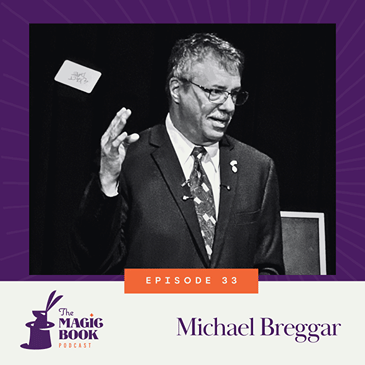
Michael Breggar has spent nearly twelve years writing the "Auto-Magic" column in The Linking Ring. His book, "Know Brainer," published by H&R Magic Books, collects more than 35 routines of comedy mentalism. Mike recalls the sitcom Martian who sparked his interest in mind reading, explains how Groucho Marx inspired his comedy Q&A act, and makes the case for building every routine in three acts. He also shares how he is reviving The Phoenix, the classic magic magazine, inside VANISH.
Adrian Tennant [00:00:03]:
[MUSIC FADES IN] Coming up in this episode of The Magic Book Podcast.
Michael Breggar [00:00:07]:
You don't want the process to become the focus of the trick because then it becomes boring. And way, way too many self-working tricks are like that. Way too many. And, you know, you'll see reviewers say, “Oh, there's too much process for me to actually like.” Well, that's because the presentation wasn't structured well enough.
Adrian Tennant [00:00:24]:
You're listening to The Magic Book Podcast: conversations about classic and contemporary books that teach, illuminate, and celebrate the art of magic. I'm your host, Adrian Tennant, a lifetime student of magic and mentalism, occasional performer, and longtime book collector. Thank you for joining me. [MUSIC FADES OUT] My guest today has spent nearly 12 years making the case, one month at a time, that magic with minimal sleight of hand can be clever, layered, deceptive, and above all, entertaining. Michael Breggar writes the award-winning "Auto-Magic" column in The Linking Ring, the journal of the International Brotherhood of Magicians. He's the author of 9 books, a member of the Magic Castle and of the invitation-only Fechter's Finger Flicking Frolic. And in a recent development we'll discuss, the editor of a revived edition of The Phoenix, one of the most beloved magic periodicals of the 20th century. Before all that, he spent close to 30 years in life sciences management consulting and taught at Temple University's Fox School of Business.
Adrian Tennant [00:01:35]:
His new book collects more than 35 performance-tested routines of comedy mentalism across 474 pages with introductory contributions from Marc DeSouza, Marc Salem, Marc Paul, and Mark Strivings. Published by H&R Magic Books and generating rave reviews, it's called "Know Brainer". [MUSIC] Mike, welcome to The Magic Book Podcast.
Michael Breggar [00:02:02]:
Thank you, Adrian. It's really a thrill to be here. It really is. I've loved the podcast from the beginning. I think it's very different, honestly, from other podcasts that are out there.
Adrian Tennant [00:02:12]:
That's very kind of you to say. I really appreciate that. Now, in "Know Brainer", you trace your fascination with mind reading to a 1960s sitcom character, Uncle Martin, on “My Favorite Martian.” You could see how the levitation worked, and you knew the mind reading was really just actors saying their lines. Why do you think that mind reading aspect of the show resonated with you?
Michael Breggar [00:02:37]:
It just seems so real. With the levitation, he points his finger at things and, you know, you hear that weird noise. And, you know, the string is always there, or in your mind's eye, the string is always there, but the actor's just doing the lines. I guess these were really good actors. that were doing it, and they really pulled it off. Ironically, Bill Bixby, who played the co-star to Ray Walston as the Martian, Bill Bixby, maybe 20 years later, became the magician in the TV series. “The Magician.” And he supposedly lived in The Magic Castle and performed on the stage and in the parlor and solved crimes in his downtime. But as a kid, I watched the show, and the mind-reading stuff just blew me away.
Michael Breggar [00:03:22]:
All Uncle Martin had to do was rub his temples, and sort of like a quasi-Annemann pose, right? And as he was rubbing his temples, he was able to read the minds of Mrs. Brown and Detective Brennan and other characters that came and went during the course of the series. I thought, “Oh, this is really so cool. Can this be done for real?” Now, at the same time, Mark Wilson had his “Magic Land of Allakazam” on Saturday mornings, which I watched rigorously. And at least in Philadelphia, following Allakazam was “Here Comes Mr. Wizard.” I always called it “Mr. Science” because I have a routine where I spoof it.
Michael Breggar [00:03:58]:
“Here Comes Mr. Science.” And, you know, I found the science stuff as fascinating and as amazing as the stuff Mark Wilson was doing. But when Mark Wilson did mental magic types of things, it wasn't the Uncle Martin rub-your-temples type of mind reading. It was obviously a trick or a routine, and it was terrific. That engaged me. But the Martian just rubbed his temples and he was able to pick up the thoughts of those people that are passing by. And I said, “I want to do that!”
Michael Breggar [00:04:28]:
“I want to figure out how that's done.” And it's kind of silly when you think about it. Even then when I thought about it, I thought, “How is it done?” The actors reading scripts, they had pages in front of them that they memorized or read off of cue cards. Maybe that was the gimmick that they used. You know, no billet tears, no clipboards, nothing fancy. Their gimmick was the script. And they pulled it off, at least to this kid growing up in Philadelphia.
Adrian Tennant [00:04:52]:
Well, as a teenager, you became, in your own words, a weekend habitué of Kanter's and Jack Chanin's magic shops in your native Philadelphia.
Michael Breggar [00:05:02]:
Yeah.
Adrian Tennant [00:05:03]:
Where you couldn't afford much, but you loved the books. And among your earliest purchases were Tanner and Dean's “The Mentalist” and Tannen's reproduction of Annemann's “The Jinx.”
Michael Breggar [00:05:15]:
“The Jinx,” yeah.
Adrian Tennant [00:05:16]:
Mike, how did those books shape your approach?
Michael Breggar [00:05:20]:
Well, as I started to read them, and I bought other stuff there too, as a typical teenager would. Jack Chanin's place was about a block and a half away from Kanter's store. Kanter's store reminded me of a jewelry shop. You'd walk up a flight of stairs and there was a brightly lit room with glass cases. And instead of having watches and rings and stuff like that, it had all the vases and it had cards and that stuff. But on the back wall, there were racks of books. And now we say, and certainly with your podcast, you know, there's so much more that you can get out of an investment in a book than you could possibly get out of a single trick. Because books, you're buying ideas and you're buying thinking and you're buying certainly tricks and routines, but there's a whole lot of other stuff that was in there.
Michael Breggar [00:06:07]:
So I tended to spend a lot of time with that back wall where the books were. Jack Chanin's was different. Jack Chanin's was a prototypical Northeast magic shop run by an old grizzled magician. He was always nice to his customers, but he was quite the old grizzled wizard. And he would tell you what he wants you to buy, as opposed to you telling him. But he would spend time with you, especially the kids, to make sure that you knew what you were doing when you bought the trick, that you bought a trick that was right for you, nothing too simple for you. You're ready for something bigger and better. I don't know.
Michael Breggar [00:06:45]:
I just had, for some reason, a better experience at Kanter's. And back in those days when there was a proliferation of brick-and-mortar magic shops, in addition to the kids that would come in on the weekends, the old-timers would come in and they would sit and they would talk shop. And they would mostly ignore the kids because the kids used to recognize them at some point and walk up to them and say, “Oh, can I have your autograph?” And it's like, “Get away, kid, you bother me.” Or “Can't you see I'm talking to my friend?” But once they started to see you on a regular basis and knew that you really had interest in the love of magic, that's when they would take you under their wing a little bit, and they would tip some secrets and tip some thoughts and tip some ideas. The sort of stuff that is in the books but is not in going and buying a single trick from the shelf. And it's quite ironic too. In the Philadelphia area, there were 2 other teenagers who I used to see all the time, and we would nod at each other. We never really were friends, but we would nod at each other in recognition.
Michael Breggar [00:07:45]:
And it wasn't until decades later, I'm talking 1,000 years of decades later, when I came to know that one of these guys was Marc DeSouza, and another one of these guys turned out to be Marc Salem, who had a different name at the time. But, you know, it was that Kanter's kids connection, I think, that brought us together in the end. And, and since then, Marc Salem and I have become friends. Marc DeSouza and I are very, very close personal friends. Families are friends, and it's a very good relationship. And me and Adrian, he's— this is a guy who's a walking encyclopedia. He knows everything that was ever written, every trick that was ever made, and probably knew every magician who performed in the '50s and the '60s and '70s and '80s. And he's a good guy, and he's just an all-around really, really nice person.
Michael Breggar [00:08:35]:
So yeah, I owe a lot to those Saturdays and the love of the magic. The first things that I got: a Diamond Penny. I bought a U.F. Grant ... it was called Cat's Eye. It was a little red plastic box with a marble. You open up the box, and he'd put the marble. in the box and you'd close the lid and the marble would penetrate the bottom of the box.
Michael Breggar [00:08:55]:
And then you'd open up the box again and show that there's no holes. And so I bought that there. I bought a U.F. Grant Blindfold, which was, I guess, as close to a purchased product of mentalism that I got at that time. And I first bought “The Mentalist” and thought it was the coolest thing I've ever read. Oh man, I have such fond memories of sitting on the floor of my bedroom where I would usually do my comic book rituals. And reading something with actual typewritten words in it, and “The Mentalist.” And the weird thing is, while I could see myself performing all these things, I don't think youngsters, teenagers—I sound like an old crotchety man like Jack Chanin—I don't think those ages and mentalism really mix.
Michael Breggar [00:09:41]:
There's a bit of sage wisdom that I think has to be deployed along with mentalism, whether you're doing it seriously or whether you're doing it comedically. You know, a teenager being able to read minds. I mean, that's a scary thought for everybody, including the teenager possibly. But I was just floored by it. I think the ESP card tricks resonated the most with me at the time because that was the type of mind reading and maybe some of the prediction tricks that I could see myself doing as a young teenager or in my middle teens. I did try a Q&A once at summer camp. Bombed terribly because again, who was I? I was a kid, right? And, uh, it just didn't work. I … maybe I didn't rehearse it right.
Michael Breggar [00:10:29]:
Maybe I … I screwed up the use of the clipboard, but it was just, it was terrible. But we all need those terrible performance experiences, don't we? They make us stronger. It doesn't kill you. It makes you stronger, right?
Adrian Tennant [00:10:41]:
Right. Somewhere along the way, you developed an interest in nearly or completely self-working tricks. And your "Auto-Magic" column in The Linking Ring began with a skeptical question. At the time, your inbox was full of ads for so-called world's greatest self-working tricks.
Michael Breggar [00:11:02]:
Yeah.
Adrian Tennant [00:11:02]:
So you wrote to the I.B.M. asking whether anyone was actually checking those claims. So Mike, what happened next?
Michael Breggar [00:11:11]:
Oh, be careful what you wish for is the moral of the story. You know, here we are in my 12th year of writing "Auto-Magic". You know, the time span between my time at Kanter's and the early years with “The Mentalist” and “The Jinx” and reading that stuff, we're talking, again, we're talking decades. And it was probably, I would say, 2010, somewhere in that vicinity. So I was a partner at a very, very large international consulting firm, and I was spending a lot of time on projects, well, on the road. I was on the road all the time. I was spending a lot of time in New York City on projects, which was cool because then I also had access to Tannen's. You know, in the evenings, I'd go back to the hotel and I'd sit in the lounge and I would have a hamburger and fries and a Diet Coke, and I would do my personal email as well as my office emails.
Michael Breggar [00:12:02]:
And in my personal emails, there would be 100 emails and 75 were promoting the latest and greatest trick, and it's self-working and it's easy to learn and blah, blah, blah. And I'm thinking, “You know what, not everything self-working can be that easy to learn.” In fact, I always found tricks that are self-working were the hardest things to perform because the patter - if you didn't pay attention to the performance, it became very ritualistic, and it seemed like it was a trick based on math or a trick based on, I don't know, the mechanics of a gaff deck or a gaff something or other. And, you know, I came to the conclusion there really wasn't such a thing as a self-working trick, no more than there is a thing as a self-working magician, right?
Adrian Tennant [00:12:46]:
Mm-hmm.
Michael Breggar [00:12:47]:
So yeah, so I, I kind of had a passing email friendship with Sean Farquhar, who was president of the I.B.M. at the time. And that night it was 11, 12 o'clock at night. I'm still in the lounge and I just, I shot him out an email and said, “This is crazy. Somebody ought to curate these things. I don't know whether that curation should be part of your review section or not, but somebody ought to do it.” So Sean's response is, “Great idea. I'll send it along to Sammy Smith, the editor.” And then Sammy got in touch with me the next day and said, “You know, that sounds really good.”
Michael Breggar [00:13:22]:
“Give me three,” you know, “shoot me 3. Let's see what you can do.” It's like, “Wait a minute!” But I was intrigued by it, Adrian, and I had so many tricks that I had put together myself a long time ago, and I felt one of these days I'd want to show them off and explain them to people and put them in manuscript form. But I really didn't have that kind of technical writing experience. I thought the magazine thing would help if this ever happened. So the following week, again in New York City hotel lounges at night, I took 3 ideas of tricks that I had done for many, many years. So I wrote those 3 pieces up.
Michael Breggar [00:14:02]:
I kept to the 1,200-word limit, and I called the column “The Pencil Dot,” because if anybody who does card tricks, I figured, would know what the pencil dot means. You know, it's a little tiny scratch that you make on the white edge of a playing card to help you figure out where you are and, you know, give you a sense of managing the deck with the controls that you're doing. So Sammy gets back to me after I send him the articles and he says, “Two of the 3 are really good. The second one I'm not quite sure about.” The second one was a principle as opposed to an actual routine. He says, “People are gonna wanna see routines.” I also had like commentary in there. Like the first paragraph was a little commentary.
Michael Breggar [00:14:44]:
He said, “Spend more time talking about the trick than the commentary.” And I said, “Okay, fine.” Again, I didn't know what I was doing. I had to rely on him to help me with this. “So come up with a new title.” That took a while to think of. And I think it was the following week, again in the lounge with the Diet Coke and the burger, when it hit me, the pun of ‘automatic’ - “Auto-Magic.” And it would be “Auto-Magic.” And I retitled the 3 articles that and sent it back to Sammy and had my corrections in there.
Michael Breggar [00:15:17]:
I tightened it up a little bit. bit less on commentary on the top, except the first article I thought introduces the whole column. So, and honestly, Adrian, I thought this would last maybe 10 months to a year. I thought it'd be good for 10 articles. I didn't think I could come up with any more ideas, even though I developed lots and lots of tricks in the past. I really didn't think that I could do it. So sent in the 3. Once that was there, I really struggled to figure out what article number 4 is going to be.
Michael Breggar [00:15:46]:
And it literally took me months. And then outta nowhere, I got an email from Jon Racherbaumer who said, “Congratulations on the column. I'm really loving the column.” I'm paraphrasing. He says, “this is gonna be hard at times to do as a monthly column, but keep at it. There'll be times your mind will be as blank as the page in front of you. Keep at it.”
Adrian Tennant [00:16:07]:
Hmm.
Michael Breggar [00:16:08]:
Again, he says, “There aren't that many of us left that are still doing this in this fashion.” So he likes my style. He says, if I didn't mind, he would, from time to time, get back to me and make some suggestions to help me along with style and foundational things. And that was great. And it wasn't from time to time, it ended up being every single month. Jon would write to me with notes. He'd send me his notes. But I, you know, started to hear from a lot of people.
Michael Breggar [00:16:36]:
And I'll tell you, being put on the shoulders of people that you stand on the shoulders of was super encouraging to me. And it made me work a lot harder at the writing. And I read lots and lots of articles to help me become a bit more cogent and a bit more concise. And along the way, Racherbaumer was a huge help. A little later on, I became friendly with Harry Lorayne. And Harry and I used to speak quite frequently. And he became a big help in helping me develop my voice as I wrote these things down. And Harry loved my humor.
Michael Breggar [00:17:13]:
So Harry hated it when anybody took one of his tricks and meddled with it, you know, tried to improve upon it or do this He really didn't like that, but he loved it when I did it because I had all these jokes that he says he wished he could have thought of when he was performing these things. So he'd let me get away with all sorts of stuff. And, uh, you know, he commented on the stuff, told me what worked, what didn't work. We would talk and a few ideas would go back and forth. And I gotta tell you, Adrian, I'd sit back and say, “Oh my God, I'm being tutored by Harry Lorayne and Jon Racherbaumer.” And I'm having discussions. I've talked to [John] Bannon and Simon Aronson and these other people. It's like, “Holy Mackerel! Where is this coming from?” So that gave me the impetus to keep on doing this.
Michael Breggar [00:17:55]:
And I look back in the beginning and you can see there was a real difference in style and approach, in language, in method as to how these things are displayed and described and the overall structure and pattern that I put through.
Adrian Tennant [00:18:13]:
[MUSIC] If you're enjoying this episode of The Magic Book Podcast, please consider leaving a rating on Spotify or a review on Apple Podcasts. You can also follow The Magic Book Podcast page on Facebook. Thanks. [MUSIC FADES] Mike, the monthly discipline of producing your column "Auto-Magic" for The Linking Ring eventually turned into 9 books. Your first 8 books were self-published.
Michael Breggar [00:18:39]:
Yes.
Adrian Tennant [00:18:40]:
For "Know Brainer", you handed the process to Charlie Randall at H&R Magic Books, a partnership that began at Fechter's Finger Flicking Frolic, the invitation-only close-up convention that you're a part of. I'm curious, what did working with Charlie change for you?
Michael Breggar [00:18:59]:
H&R is a class operation. Boy, Charlie and Richard Hatch, they really know what they're doing, Adrian. These guys have been doing magic book publishing, you know, for a long, long time. They know what works, they know what doesn't work. They know what sells, they know what doesn't sell. Charlie and I have developed a really good, friendly working relationship. And I would see him at conventions and see him at 4F [Fechter's Finger Flicking Frolic], and we'd chat a lot. And, you know, it was just a very, very good I think “Raiders of the Lost Card” had come out, and we were talking a bit about it.
Michael Breggar [00:19:31]:
And Charlie said, “Are you working on anything new? Because I'd like to do something with you.” And I said, “Well, that would be great. I would love to work with H&R.” And I'm thinking, Adrian, to have your name and your words associated with a class organization like H&R, I mean, how cool is that, right?
Adrian Tennant [00:19:48]:
Mm-hmm.
Michael Breggar [00:19:49]:
And I think it added a little bit of— a little bit of a spark. Well, it added a lot of legitimacy to the stuff that I did. So it was able to assuage my ego somewhat. But I was also thinking in terms of practicality. You know, when you're self-publishing these things, you are the writer and the editor and the layout person and the printer's helper and the distributor. And it's like, please, I didn't wanna do all of that. I was okay with just writing the books, but I'm a terrible proofreader by myself. I could read my manuscripts 1,000 times and on the 1,001st time still find typos!
Michael Breggar [00:20:28]:
I really needed somebody to give me that, I guess, that discipline. And Charlie, as publisher, would do all of that. And I said, “You would do the layouts?” He says, “Yeah, we do the layouts.” I said, “Well, if I sent you the pictures, you'd get 'em in the right spot and help me with the structure and the size. And 'cause - you know what - I would love to do a hardbound book. A nice hardbound book, you know, looks nice, that really is printed well and looks really nice. And I don't wanna worry about the distribution and I don't wanna worry about this.” And he looked at me, he says, “Well, that's what a publisher does.”
Michael Breggar [00:21:01]:
He says, “You give me the words, you give me the content, and we'll turn it into a book for you.” So we had this discussion. It was, well, this was at a 4F. And so that would've put it the 3rd week of April. I think it was 2 years ago, and I had already started to put this "Know Brainer" thing together. I don't even know if I was calling it "Know Brainer" at the time, but I wanted to do a book on comedy mentalism. I did one, it's a self-published one, “Influence-Enza,” that was comedy mentalism, but it was heavy on cards. This, I wanted to be able to do stand-up mentalism.
Michael Breggar [00:21:36]:
There'd be some card things in there because people still like card tricks, mentalism card tricks, but there would be a lot of things that could be done in parlor, stand-up, stage, a couple of things that could be done walk-around, some close-up stuff. And I finally, after bombing with my Q&A act as a kid, I finally, in the early 2000s, came up with an idea that became sort of my bread and butter Q&A piece, which I called "Know Brainer". But I never thought of that as using that as the name of the book. It's a comedy Q&A, but in any case, it's … working with H&R has been fantastic. They had all the dealings with the printers. Charlie sent me templates to use to put the text in the templates. I was just using Microsoft Word, right? I didn't know sizes and gutters and all the fancy printer language. And Charlie set me up with all that.
Michael Breggar [00:22:28]:
He managed it through the printers. And then you wait, you wait, you know, the galleys come in and you look at them and do your final corrections on that. And, and you're done. Cross your fingers and hope that the final product turns out, you know, what you think it was. Charlie got the demo books and I was just thrilled. He sent me pictures of it and I was just thrilled. I was just besides myself. It was like, “Wow!”
Michael Breggar [00:22:52]:
And he sent one of the early copies to me so I can have it home, put it on my bookshelf. And it's like, “This is awesome!” So was it easier to work with a publisher? Yes. Was it 1,000% easier? No. Still an awful lot of work involved. You really have to have your head about yourself and you have to focus to get things done. But I didn't have to worry about the typos and a lot of the proofreading because he did it. It was great.
Michael Breggar [00:23:20]:
And I didn't have to worry about distribution and the channels and postage and the cost and all these ridiculous things. Plus, as a publisher, he gets special deals in terms of printing that I could never get as an independent. Which is good too. So yeah, that's— it's a whole new different world, and he's already pushing me for the next book, which would actually be book 9.
Adrian Tennant [00:23:40]:
Got it. Well, "Know Brainer" opens with a question: is comedy mentalism even a thing? Now, your answer runs a whole chapter, and part of it is the observation that serious mentalists always look constipated, while entertainers who perform mental effects just seem happier. Mike, can you give us the gist of your argument?
Michael Breggar [00:24:07]:
Well, this goes back to Uncle Martin rubbing his temples. It goes back to Annemann. Right before Annemann was doing his reveals, he always looked like he had a migraine, at least from the drawings that were in “The Jinx” and a few other things. And you see that persist today. So that's what I meant as the constipated mentalist. Those people who take themselves very, very seriously as a mentalist. Listen, I think their technique and their method and their style and how they go about doing their work, I have no faults with any of that. And a lot of them that I think are quite boring, I think technically are just brilliant, conceptually brilliant. But I do have a challenge in the fact that magicians are entertainers.
Michael Breggar [00:24:51]:
So maybe we are— what's the old saying? “A magician is an actor playing the role of a magician.” So maybe it's “a magician is an actor playing the role of a magician as an entertainer” maybe. Maybe it should be expanded to that. You know, it's great. It's cool. He can read minds and it's kind of impossible what he's done, but it's like, “Okay.” So the mentalists who go out there and do the rubbing the temples, Annemann with a migraine headache, the constipated mentalist thing, I don't think they're having fun. I think they're performing.
Michael Breggar [00:25:25]:
I think they see themselves as serious. I think sometimes they believe their own press that they can read minds because the structure is certainly there. Well, I'm probably going to get into trouble with a lot of people from the PEA or other mentalist groups. But I also look at Larry Becker, for example, Richard Osterlind in the present, Lee Earle back in the day, and some of the others that are performing now. They've got sort of a mischievous look about them. And they will laugh, they'll tell jokes, they'll relax the audience. And when they relax the audience, you can see that it relaxes themselves. They are truly enjoying what they are doing.
Michael Breggar [00:26:03]:
Marc Salem's the same way. Marc Salem had long-running shows on Broadway and Off-Broadway, for crying out loud. And it was like a game for him. He really enjoyed the shows and the interaction with the audience. And that was a real eye-opener for me, Adrian, when I started to realize that the days of these serious mentalists, maybe even the serious non-tricksters, smiling magicians - nightclubs in the '50s. I don't know if it has its place for— it probably has its place for today. It's just another performing style.
Michael Breggar [00:26:34]:
But it ain't for me. It's not what I was looking at. And that was really what I was trying to impart in "Know Brainer". If you're going to learn to do mentalism, because mentalism has to involve the audience, you've got to have minds to read, right? It's not like doing a silent act on stage with The Miser's Dream where you just keep plucking coins outta the air or a rope trick. I mean, you need minds to read. And if you don't take advantage of that interaction between the audience, to me, that's what makes it entertaining, that it makes it fun for you. 'Cause you're meeting new people all the time. You're able to ask them a couple of questions and have a chat with them, become friends with a group of people, of strangers who you never met for, I don't know, 20 minutes, half an hour, 45 minutes, an hour.
Michael Breggar [00:27:20]:
And you feel real good about yourself and hopefully the pleasure that they had in the entertainment value that you delivered. So, I take that very seriously, which is kind of ironic, isn't it?
Adrian Tennant [00:27:34]:
Yes. You do write that a turning point in your thinking actually came from watching Groucho Marx on a TV quiz show called “You Bet Your Life.”
Michael Breggar [00:27:44]:
Yeah.
Adrian Tennant [00:27:45]:
Now, you realized the quiz was actually never the point. It was an excuse for Groucho to interact with people. How did that insight change the way you thought about presenting mentalism?
Michael Breggar [00:27:59]:
Well, I read an interview with Groucho. I don't remember this, but there was always a debate as to whether “You Bet Your Life,” Groucho's show, was a quiz show or was it a comedy show? And Groucho always said, “Well, I shouldn't have to tell you what it is. You know, if you're having a good time, it's an entertainment show.” He said it in a snarkier manner. It was certainly funnier than I just said it, right? But I didn't find that as a dichotomy at all. And it was, again, it was another eye-opening moment for me. Why does it matter what it is? Can't it be both funny, entertaining, and a quiz show, right? That quiz shows the suspense of the quiz show. I don't know if it was that suspenseful, but it was certainly funny and it was extraordinarily entertaining. And a lot of them are on YouTube.
Michael Breggar [00:28:44]:
And I have always encouraged people at my lectures and other people that I teach, and I do so in the book, people to take a look at YouTube and watch some of these episodes. First of all, it's not a chore, and you will be entertained by it. But see how Groucho approaches this thing, and understand that you're watching what was sold as a quiz show with comedy elements, not a comedy show with quiz show elements. That was real eye-opening to me when I started to think about it and say, “Well, why can't we do this too?” Why do we struggle and say, “No, I don't want to be a comedian.” “No, if I throw in some comedy or some jokes, it's going to dilute the power of whatever mental piece that I'm trying to do.” Magicians who do flat-out comedy work, like Carl Ballantine, it was all comedy, it was all jokes. The tricks were secondary, but he always ended his set with an unexplainable thing. He messed up everything, but that final piece was a real miracle, unexplainable thing. And he was hysterically funny and very entertaining.
Michael Breggar [00:29:46]:
Why can't you do that with mentalism? So that's why I also started to think, “Q&A. Why can't you do Q&A like Groucho did ‘You Bet Your Life’? Is it a Q&A piece? Is it a Q&A mentalism piece? Or is it a comedy interview type of thing? Why can't it be both?” And that's what made me start to think very seriously about doing this. And comedy is tough. “Comedy is a grim business,” as director Stanley Kramer once wrote. It's a difficult thing to do. to do, but I think if you have the foundational pinnings to do it and you take an approach and your presentation is structured so that the comedy is organic, you really only need to know just a handful of jokes and you would use them at appropriate times. You wouldn't use them all at the same time. So I'll tell you, Adrian, one of the biggest compliments I got when "Know Brainer" was first released came from a very famous magician who, if I told you the name, you would know, who is very serious in his approach.
Michael Breggar [00:30:44]:
And he said, “Well, I'm not a comedian. I don't know if any of these things are going to apply to me.” And a few weeks later, he called me on the phone and said, “I have to tell you, you made me realize I don't have to be a comedian to pull something like this off. I just have to listen. I just have to be responsive to the audience and listen to them as they go through their various reactions to the routines. I pick up on that, I tee off on that.” That is what Groucho did, right? He would throw a question out there, was a bit silly, a bit non sequitur at times, but he would listen for the response. Sometimes the response came from the audience and he would work off of that.
Adrian Tennant [00:31:22]:
Well, the book opens with essays from four performers you call your mentors: Marc DeSouza, who you mentioned earlier, Marc Salem, who you just mentioned, Marc Paul, who we haven't yet talked about, and Mark Strivings. Now, 3 of you were Saturday morning regulars at Kanter's decades before you became friends.
Michael Breggar [00:31:43]:
Right, right.
Adrian Tennant [00:31:44]:
What role do those four play in your work?
Michael Breggar [00:31:48]:
Well, we talked about DeSouza and we talked about Marc Salem, and by three, it was the 3 of us. It was two of them and me. Marc Paul and Mark Strivings. I think Marc Paul is one of the top performing mentalists that we have at this time. I think his tricks are designed with such … they're very clever. And his delivery of it, while it's pretty straightforward, it has comic moments, although it never pretends to be anything more than that. Marc gives you an uncanny, perhaps uneasy sense that he really can do this mind-reading, mentalism, telepathy stuff. And there were a couple of tricks that he had put together that I loved, but thought that they could be improved one way or the other.
Michael Breggar [00:32:36]:
And we— We started up an email conversation based on that. We had a Zoom call or two and discussed these things. And I told him there was one that I wanted to publish, but I didn't want to do it without his permission because it used a method directly from his approach. And he said, “No, absolutely.” He said that the skeletal framework might have been my method, but that was a method taken from this person and this person and this person. “So feel free to use it.” He says, “your approach is very different.” There's one trick that's turning out to be everybody's favorite in The "Know Brainer" called Un-Scene, which I started to think about after I saw Marc Paul perform an effect of his in one of his video lectures.
Michael Breggar [00:33:18]:
But, you know, Marc did it, I think, with 6 or 7 people, and he did it not with scenes. I use, as you'll see in the book, I use— I call them scene cards, and they're plaques that have a scene, like a movie scene, like in a restaurant, at a library, at the auto mechanic's garage. And I have 5 people from the audience randomly select the scenes and put themselves into it using all 5 of their senses, like they're acting students. And in fact, I use that pattern's background behind it. And as they do it, then I read their minds and, you know, tell them what scenes they're in. And that borrowed a lot from Marc's method. It borrowed from Larry Becker's. It borrowed from Jack Yates, a card trick of Jack Yates, believe it or not, and from a couple of other places that I was able to synthesize. And Marc said he loved it.
Michael Breggar [00:34:08]:
He loved the fact that you could do it with 5 people, maybe even 4 people, that you didn't have to do it with 6 people or 7 people. Adrian, he's such a good thinker, and he thinks in terms of effect and routine and structure. Mark's Strivings is another one: another brilliant thinker, and he's a great writer and he's a great teacher. And he's been doing this stuff first out of Arizona and then out of Colorado. Been doing this stuff for a long, long time. And he puts out a lot of ebooks with his thoughts. He does immaculate research on his ideas, which I think is very important. Those of you who are out there who wanna write, wanna put your tricks on paper and your ideas on paper, be willing to go the extra step and figure out the crediting As best as you can, there are resources out there to help you.
Michael Breggar [00:34:58]:
And Mark Strivings does all of that stuff, and we struck up a relationship at a MINDvention [mentalism convention] years ago. And it was like I introduced myself. He says, "Oh, I knew all about you, and you do all those great mentalism tricks with dice and this and that." And it was a meeting of two minds. So I see them as friends, and I see these guys as I guess they're my executive board. If I have an idea on something, I'll write the idea down and say, "Does this make sense to you? Am I overdoing it? Am I gilding the lily in parts? This is the method I was thinking of; is it too obvious? Is it not obvious enough? Can it be streamlined?” And I'll just throw those ideas out there. And it's kind of like sessioning, but not with a completed trick. You're sort of sessioning with the rudiments of the effect.
Adrian Tennant [00:35:44]:
Mike, I'd like to return to the book's titular routine, "Know Brainer", which of course is your take on the Q&A act. Now, many reviewers have noted that you build it in three acts, like a play. Why does a Q&A routine need that kind of structure?
Michael Breggar [00:36:03]:
Well, everything I do is built in three acts. Some are better built than others, but I've noticed that the tricks that I've had that have been very successful take on a three-act structure. And noticing that, I went to do research about it. And I am a huge proponent of what's been called the three-act structure. There's a classic book on screenwriting called “Syd Fields on Screenwriting,” and it just talks on and on about the three-act structure, which was developed by Aristotle thousands of years ago. And Aristotle's thinking was that any form of entertainment benefits from a multi-act structure. Initially, it was seven acts and 5 acts. I think it's Shakespeare with five acts.
Michael Breggar [00:36:47]:
Three acts is where we are now. Some movie reviews that you read say, you know, “The first act was really entertaining, but it really dragged in the second act. And I wasn't awake enough to know what was going on in the third act when it should be the most exciting.” Hitchcock always planned his movies very meticulously with the three-act structure. And basically what it means is there is a definitive beginning, a middle, and an end. And the beginning should be maybe 25 percent of the show or the act or the routine. And the end should be 25 percent. But the real meat is right there in the middle part, which is the middle act, 50 percent.
Michael Breggar [00:37:27]:
So if you think of the beginning in a, I don't know, a card trick, for example, you're coming out, you're doing your introductory comments, whatever the audience needs to know for the trick to start. That's the beginning. That's the first 25 percent. The end is that last 25 percent is, you know, “I found your cards!” The denouement. It's, you know, whatever happens. It's, you know, the card, the torn card is restored. It's that piece at the end.
Michael Breggar [00:37:53]:
It's the middle stuff where you're doing the process. And if you think in terms of three-act structure, you're thinking in terms of building off of each little piece. You don't want the process to become the focus of the trick because then it becomes boring. And way, way too many self-working tricks are like that. Way too many. And, you know, you'll see reviewers say, “Oh, there's too much process for me to actually like.” Well, that's because the presentation wasn't structured well. Or you'll hear some audience people saying, “Well, I don't know how it was done, but I do know there's some math principles involved in all of this.”
Michael Breggar [00:38:27]:
Well, if they're saying that, that's what they notice in the middle part, then they weren't following your story. Your story should be disguising that math, which— and if you can do that, you have a hell of a trick at the end.
Adrian Tennant [00:38:39]:
Mm-hmm.
Michael Breggar [00:38:39]:
So I'm a huge proponent of three-act structure. I go from a macro to micro on it. I will look at an act. If I'm given 20 minutes to do an act, say at The Magic Castle - 18 to 20 minutes, “What can I do in 20 minutes? And how can I structure it so there's a definitive beginning, definitive middle, and a definitive end?” And then say, “Okay, what can I put in there?” 3 tricks, 4 tricks, build them together. You know, “How do I structure this thing?” I look for texture. This is something DeSouza taught me a long time If you have tricks and you're looking at texture, the type of things that you're doing, that keeps it interesting. Otherwise, it seems to be the same thing over and over again if you're differing texture. That doesn't mean do a card trick and then a coin trick and then a trick with U.F. Grant, black art, and boxes.
Michael Breggar [00:39:26]:
You know, it just means you're not doing 3 renditions of Locate Somebody's Card. Maybe it's the story that makes it different, but the texture of it is very different along the way. Three-act structure. And pay attention to this. If you want to go back to the Aristotle book, I mean, if you Google “three-act structure in drama,” you'll see Syd Fields come up, and his book is excellent. Even if you never write a script, you can look through it and sort of figure out how to adapt it to magic. And I've lectured quite a bit on this.
Michael Breggar [00:39:59]:
In fact, 2 years ago, at 4F, I gave one of the ED Talks on three-act structure. And honestly, Adrian, half of the audience didn't seem to care, but a few of them came up to me. Boris Wild came up to me afterwards and said, “This was a lecture these guys really needed to hear.” And—that's great.
Michael Breggar [00:40:19]:
I thought about putting my thoughts in the monograph, taking the lecture and making it a monograph and putting that for sale somewhere. I also thought about splitting it and putting it into The Linking Ring. And I was told by the editor it would show up as an article, not as part of the column. I was trying to get out easy because writing the column for 12 years, that's draining, right? And I've run out of ideas. So listeners out there, if you have some really good tricks that are, let's call them sleight of hand instead of self-working, let's call them "Auto-Magic". If you have something like that, send it to me. We'll take a look at it and see if it's something that we can use. Please do me a favor.
Michael Breggar [00:40:57]:
I'll have more time to write books then!
Adrian Tennant [00:41:00]:
Mike, you make it clear that propless mentalism is not for you, but you also reject apparatus that looks like it was purchased at a magic shop. The effects in "Know Brainer" call for Lego bricks, paper plates, sweatpants, lottery tickets, and eggs, as well as cards and dice. So what do deliberately unglamorous props do for comedy mentalism routines?
Michael Breggar [00:41:29]:
Well, oh, Adrian, isn't it funny when somebody walks out on stage and he's wearing a nice suit, maybe has a pocket watch with the chain, and he looks like he's going to be out there reciting Shakespeare or sonnet or Yeats or something, and he pulls a chicken out of his pocket? I mean, that's, that's the, you know, the, the beauty of, uh, you know, it's just so incongruous as to what happened. So yeah, I don't mind people saying “You want to use props that look nice. Things that look organic,” and that's fine. I don't disagree with that at all. Listen, I love the tricks with boxes, and again, back to my Kanter days, he had the full line of U.F. Grant tricks, and I've got the Sucker Die Box and the Production Pagoda and a bunch of other things, and they're brightly colored with stencils of dragons and all sorts of cool stuff, and I love those things. I really do. But as a performer, it ain't me.
Michael Breggar [00:42:23]:
It's not what I do, you know. And propless, again, I give big kudos to the guys that do propless mentalism. Their methods and techniques are absolutely diabolical and very, very convincing and very, very deceiving. But it's just not for me. I will marvel over their ability to make it seem real, but I can't watch more than 10 minutes of it because I don't see the texture differences there, and I find it boring. After, I will always walk out and I'll scratch my head and say, “I just, I don't know how you did it. I think you were wonderful.” I will never say that “you bored me” to their face, but I don't find it entertaining because the texture isn't there.
Michael Breggar [00:43:05]:
Again, it's personal feelings. I don't mean to paintbrush the whole art that way. I want somebody to entertain me. I'm going to sit down in my seat and for the next half an hour or an hour or whatever, however long the show is, I want to have a good time. I want to laugh. I want to be able to shout out loud. I'm from Philly, so I want to cheer and boo. And, uh, you know, it's not good etiquette to do so, but I want to laugh.
Michael Breggar [00:43:30]:
When I give the performer my applause at the end, I want to say, “You earned this. You earned this because you really— you took me to a place that I didn't know that I could go to, and you made me forget about the world for a few moments, and you made me feel like a kid again with the wonders that you showed me. But you know You know what? You made me laugh. And I've had a really bad day or a bad week, and I really needed just to kick back and just laugh for a while.” To me, that's entertainment. And that's what I strive for, at least when I do my stuff, when I do my shows. So it's my philosophy and I'm sticking with it.
Adrian Tennant [00:44:07]:
Good.
Michael Breggar [00:44:07]:
At least until the next book.
Adrian Tennant [00:44:11]:
[MUSIC] Just a reminder that you can be notified when new episodes of this podcast are published by subscribing to the email alerts. You'll find all the details on the podcast website at themagicbookpodcast.com, which is where you can also find transcripts plus accompanying blog posts with summaries, timestamps, and links to resources mentioned in each episode. [MUSIC FADES OUT] Mike, "Know Brainer" was released at the end of May. Nick Lewin gave it 5 stars in VANISH International Magic Magazine and called it the best book ever written on comedy mind reading. And Rolando Santos, a former international president of the I.B.M., wrote that "Know Brainer" proves mentalism doesn't have to be performed, quote, “with the emotional range of a tax audit,” end quote. I love that. What has the overall response meant to you?
Michael Breggar [00:45:07]:
Well, thank you for bringing this up, Adrian, because you're reminding me I have to send the checks to these guys. I'm kidding, only kidding, everybody. When you work so hard on something, and it took me a little over two years to put this thing together, and it's a big book, right? I think I said at the start of the show, it's 474 pages, and with the covers and stuff, it's a big book. You know what it says to me? They get it. They're reading it, and if they feel this way, they get it. I never purport my methods to be anything that's difficult to do or challenging to do. But you gotta pull it off.
Michael Breggar [00:45:43]:
So the presentation is extremely important. And everything that I've been writing in the last probably 6 or 7 years, when I'm writing, I'm giving my actual script that I use. And "Know Brainer", it was … that was a no brainer for me because I wanted people to understand the structure of these things, that you don't need to memorize a Bob Orben joke book to go and do it. You just have to have a couple of things at the ready and set up the premise in a way where the responses from your spectators can be not only spontaneous, but lead into funny situations and opportunities to then throw in some humor. I wanted it to be natural, so you don't have to be a comedian, as that magician said to me a while back. So yeah, it means everything to me. It really does. And seeing the response that it's getting from around the world, it's just amazing.
Michael Breggar [00:46:35]:
It just— I don't know what to say. I can't be humbled enough. enough as to the response that I'm getting, and I can't be happier. They might never do any of these tricks, but they really enjoyed reading the book. I mean, that complements your skills as a writer, and boy, that means everything to me. It really does.
Adrian Tennant [00:46:51]:
Well, you've certainly been busy. You've been promoting the book with a series of shows and lectures, and at a House of Magic show in July, Paul Romhany and Nick Lewin joined by video to announce that you're reviving The Phoenix as a magazine within a magazine inside VANISH, with you as editor. Now, first of all, for any listeners who don't know the original, what was The Phoenix?
Michael Breggar [00:47:21]:
Well, Phoenix was a grand old magazine of magic. It was started by Walter Gibson and Bruce Elliott shortly after Annemann passed away and The Jinx stopped. And it was meant to pick up basically where The Jinx stopped. They wanted to continue. It's like, you know, “It's a shame Annemann's not with us anymore. It's a shame The Jinx won't be with us anymore. But rather than creating or calling it The Jinx and continuing under different editorship, let's do it this way and let's bring it back to what The Jinx was at the very beginning, before it concentrated almost strictly on mental stuff, which is to add some more magic back in there.”
Michael Breggar [00:48:03]:
So the right people, Walter Gibson, who was absolutely prolific and a really brilliant magical thinker and a magical writer, you know — I don't know how he found time to do all this stuff because he wrote just about all the scripts for the radio drama, The Shadow. He created the character of The Shadow — and I think they were publishing every other week. There was a Pulp Shadow magazine that came out where he wrote like a 70-page story in every one of these mag— where did he find time to do all this stuff? Any case, Bruce Elliott was an ad man and a magician and a great writer, and they took it upon themselves to create this magazine, which was really during magic's golden age of books and magazines, which was in the early 1940s to probably the late 1950s, beginning of 1960s. They said, “We're going to do this and we're going to try and do it as a weekly.” And it started out, I think, weekly and went to bi-weekly. But it was that type of frequency. Several times a month, you would receive a business-size envelope in the mail and there would be a 4 to 8 page manuscript in there.
Michael Breggar [00:49:09]:
That was the Phoenix. So the Phoenix contents was always a couple of tricks. And the people who wrote the tricks, that was edited by Gibson and Elliott. I mean, these were magicians whose shoulders we stand on today. You look at classic things like the Benson Bowl. It had its premiere in Phoenix. The Zarrow Shuffle started in the Phoenix. The rudiments of what became known as Paul Curry's Out of This World started in the Phoenix.
Adrian Tennant [00:49:39]:
Yeah.
Michael Breggar [00:49:39]:
In fact, it came from an idea that Walter Gibson had in the very first issue. The bit with the safety pins that Jerry Andrus put together, the idea with the Linking Safety Pins in the Phoenix. I mean, this classic stuff had its beginning, had its start in the Phoenix. I thought about what the Phoenix meant to me. It was a great resource. It was fun reading. The very first magic thing that I got, if you recall, was “The Mentalist,” which was a monthly publication of mental stuff. And then I went back and read “The Jinx,” which again was that type of periodical.
Michael Breggar [00:50:13]:
And then I'd sort of revived my interest in doing all this when I started writing The Linking Ring columns because I needed ideas. And I thought, “You know what, let me go back to see if I can uncover some of the gems from the old classic magazines, from Sphinx and The Jinx and Phoenix, moving into, you know, Hugard's, then going to Harry Lorayne's ‘20 Years of Apocalypse.’” For Harry Lorayne wrote every single word. I started to look at these things as not individual monthly or weekly publications, but as a book. You can find the compiled versions of all of these things somewhere, and a lot of them are very inexpensive. Go to get the electronic version, the PDF versions, pretty inexpensive to get the whole complete thing. And I read these from page one all the way to page 2,051 or whatever it was. And you started to get a sense of style, a sense of structure. And you'd get to the very last page, and you didn't want to read it. Like a good novel, you didn't want to finish the book.
Michael Breggar [00:51:11]:
The Phoenix meant a whole lot to me because there was such great material in there. And every issue had something they called the Back Room, which was Bruce Elliott's, Walter Gibson's chance to editorialize a little bit. Very much like Annemann's editorials in The Jinx. They weren't as garrulous. Lots of times, they would have, like, just tips and tricks in there. They would have a little bit of commentary. Sometimes they'd only have a little bit of writing room because there was a lot to write on the tricks. You know, it was a really, really cool publication.
Adrian Tennant [00:51:40]:
Yeah.
Michael Breggar [00:51:40]:
And for years I've been thinking about “How could something like this be revived? Would people want to get a newsletter, an 8-page newsletter by mail in their mailbox every 2 weeks, every 4 weeks? Would they rather just have it sent to them as an email, which I think has been tried? Would they rather not get it at all and wait until a bunch of it was compiled and buy it as a book?” I really wasn't sure of a way to do it, but I thought if you went back to the basics and said, “Yeah.” You know, the original idea, in fact, and I presented it to, let's call them an unnamed magic company at the time, was to have two parts. You would always subscribe to this New Phoenix Project, and the subscription would include the 8-page mailer that would be sent to you by mail every month in that year's subscription. And at the same time, there would drop on a website a couple of tricks from that particular issue, or some thoughts or some ideas would be demonstrated and taught on that. So it would be a combination of a written thing and a video. The way I always wanted to do it was each issue would have 2 or 3 tricks would be newly-worded versions of original stuff from the original magazine, and then one totally original piece that is in the style of the stuff that was written, that the great magicians wrote in the past. And the Back Room, I wanted to revive the Back Room. I had no idea what I wanted to say or what I wanted to editorialize about.
Michael Breggar [00:53:08]:
Nick Lewin, like Marc DeSouza, also knows everybody there is to know in magic and knew everybody and is extraordinarily well-read. And his eyes lit up at this. He said, “Well, you know, it's a gossip column. I'm great at that. It's like, I don't know that we want to have it as all but I think we can do something with it.”
Adrian Tennant [00:53:25]:
Mm-hmm.
Michael Breggar [00:53:26]:
You know, I was talking to Nick, and Nick says, “Oh, you know what? Paul Romhany would— he would love this idea.” So, started to speak with Paul, and he says, “Yeah, this is great. A great concept, a great idea.” We talked for a few months as to the best way to structure it. And we thought, “You know what? Let's just make it kind of a supplement to VANISH.” It would be at the back. You'd go through the whole VANISH magazine, and then in the back would all of a sudden, you know, the beautiful color and everything in VANISH, and all of a sudden, there's this … these gray pages. That would be the Phoenix trying to reproduce and replicate the feel and the style of what was in the magazine.
Michael Breggar [00:54:00]:
August was the first issue. For those of you who are historians or sticklers, I'm keeping to the original pagination. So the first issue of the Phoenix Magic Magazine, which is not a copyrighted name, the Phoenix Magic Magazine starts with number 1. Number 401. And I can't remember the exact page, but it's the continuation of the page. Karl Fulves edited the last 4 issues and gave that up to do his Pallbearer's Review. So whatever he ended up with that last issue, we just continued it for the next one. It's been great.
Michael Breggar [00:54:37]:
It's been fun. Uh, it's not a chore. It's just fun. It's fun to look at this old stuff and to read it in a new. The old magazines were never great at explaining or teaching the tricks. They gave you what you needed to know, left a lot to the imagination. They never gave you scripts to work with, just a couple of words to say where you needed to say certain words. A lot of the writers, they weren't great writers. They were great magicians and great thinkers, but they weren't great writers.
Michael Breggar [00:55:05]:
But there were some great writers along the way. So it's fun to take that understanding of their ideas and what they want to do and trying to update it a little bit and to put it in place and put it in something that has the simulacrum of the old journal.
Adrian Tennant [00:55:19]:
Well, Mike, this is The Magic Book Podcast. So what is your most cherished book or books and why?
Michael Breggar [00:55:27]:
Well, certainly “The Mentalist.” Going back to “The Mentalist,” — and I do reread it occasionally — there are basically only 2 years and a couple of issues published after that. And like a lot of the magazines of its time, probably 60 percent of it was really good and 40 percent of it was filler. But the 60 percent is really, really good. And there's some really good stuff, real clever ideas. And I just like the writing. I think Don Tanner got some really good writers, magicians who knew not only how to think, but how to put things on paper. So I do enjoy reading that.
Michael Breggar [00:56:01]:
And that was the first magic book, even though I didn't understand a lot of it as a kid. But other cherished books, I will go to the first real magic book that I got, Bruce Elliott's “Classic Secrets of Magic.” And Bruce Elliott again was the original editor of The Phoenix. So, you know, I read this now and I see the writing style that Bruce Elliott had in the magazine. But talk about classic secrets. The Spectator's Card is Produced, right? A chapter on locations. The Corncobs pipe, which you never see performed anymore, but it's a pretty cool piece to learn staging. Water, Water, Everywhere! A Rice Bowl type of thing.
Michael Breggar [00:56:38]:
The Peripatetic Paddle, which is a chapter on paddle tricks, which includes, by the way, Sachs' dice trick. So yeah, Bruce Elliott. And then another one I've had forever, which I absolutely love, is Harry Lorayne's “The Magic Book,” which isn't just Harry teaching card tricks, it's Harry teaching mostly close-up magic and then letting the reader decide, you know, do you like cards? Harry's got a lot more. You like coins? Harry has recommendations. You like some stuff with numbers? You know, he covers it all, and it's a great book, and it's written in Harry's inimitable style. And the book that seems to be a favorite of, like, everybody, “Scarne's Card Tricks,” and it's got some great stuff in there. Some things that were published for the first time. It's got Miraskill in there, which is a really interesting piece.
Michael Breggar [00:57:25]:
Miraskill was originally published in The Jinx, but it was picked up over here, the Stewart James trick. It's just, you know, all awesome, awesome books. Those are really my faves. “Mark Wilson's Course in Magic” has also been a very favorite of mine since it came out in the … I guess it was the mid- to late 1970s.
Adrian Tennant [00:57:42]:
If folks want to get a copy of "Know Brainer" or follow your work, what are the best ways to do that?
Michael Breggar [00:57:49]:
So, "Know Brainer", you can get at your favorite - and your least favorite magic shop. Online, brick and mortar. You can buy it direct from H&R. Charlie and Richard would be thrilled if you bought it directly from them. But it is available and it's available globally now. So, you know, you don't have to pay ridiculous fees in shipping and whatever to get it if you're outside of the US. So it is available everywhere. My other books are available.
Michael Breggar [00:58:16]:
If you want physical copies, you can go to Amazon. The only book that you can only get as a physical copy through me is the last one, “Raiders of the Lost Card,” which it's still print-on-demand, but I'm doing that through Lulu. And if people want it, they can just send me an email: mbreggarmagic@gmail.com. And happy to get the books out to them. Happy to sign 'em. You want to get "Know Brainer" from me, the $65 it would cost you everywhere else, I'll sign it for you and I won't charge you for shipping.
Adrian Tennant [00:58:49]:
So Mike, what's next for you?
Michael Breggar [00:58:52]:
So what's next? I am not being pressured, but I'm being asked about the next book. And I do have an idea for the next book, which is basically taking a small number of routines that I am working on now. They're in performance now to sort of get it to where I need to be. There are two routines that I'm particularly fond of that I would put in this book. And one of them I actually teach in the "Know Brainer" lecture because I almost put it in "Know Brainer", but I took it out at the last minute. So that would be in the new book that's probably going to be called “Deep Six,” because there's six effects, and I'll be going into deep dives as to how they work and why they work. And if you want to think of your own scripts on how to present it, keep these things in mind. So, it's in its formative stage, shall we say.
Michael Breggar [00:59:44]:
I'm not actually sitting down and writing it just yet. I'm exhausted, Adrian! Give me a break. You know, between two years for "Know Brainer", and then now picking up, you know, The Phoenix, and still dealing with 12 years of Linking Ring, you know, this is not what I thought retirement would be. was going to be. Not that I'm complaining.
Adrian Tennant [01:00:02]:
No, but if you want something done, ask a busy person.
Michael Breggar [01:00:06]:
That's true. That's why I ask you all the time how to get things done.
Adrian Tennant [01:00:10]:
This has been a great conversation. Mike, thank you so much for being my guest on The Magic Book Podcast.
Michael Breggar [01:00:17]:
Yeah, thank you, Adrian. Thank you so much for inviting me. This has been a blast. I really enjoyed the conversation.
Adrian Tennant [01:00:23]:
[MUSIC] You've been listening to The Magic Book Podcast. In this episode, we learned how a Martian sitcom uncle set an 8-year-old Michael Breggar on the road to mind reading, and how Saturday mornings at Kanter's Magic Shop in Philadelphia turned him into a lifelong student of the mystery arts. We heard how a skeptical question about self-working tricks became the award-winning "Auto-Magic" column, now in its 12th year in The Linking Ring. We explored the thinking behind "Know Brainer"— comedy that comes from the situation rather than the joke book— a Q&A act modeled on Groucho Marx's “You Bet Your Life,” and a three-act structure under every routine. And we learned why Michael is helping The Phoenix, silent since 1965, rise from the ashes in the pages of VANISH. You'll find a transcript of this episode on our website at themagicbookpodcast.com, along with a blog post containing a summary, timestamps, and links to the resources we mentioned. If you'd like to be notified when new episodes are published, please subscribe to our email alerts. All the details are on the website.
Adrian Tennant [01:01:37]:
And if you have a question or would like to suggest a book, a topic, or a guest for a future episode, you can reach me at adrian@themagicbookpodcast.com. Thank you for listening to The Magic Book Podcast. I've been your host, Adrian Tennant. Until next time, goodbye. [MUSIC FADES OUT]