
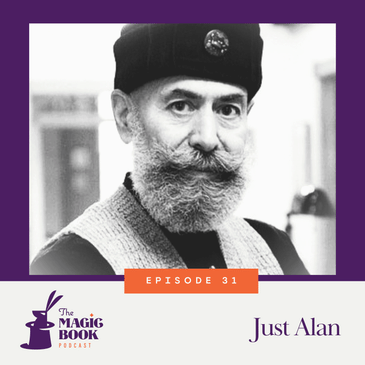
For more than six decades, Woodstock's resident magician Alan Eisenson, known professionally as Just Alan, has made magic from his own life. In this episode, we discuss "Just Alan - Not Just Magic," a limited edition book about Alan, written and illustrated by Jay Fortune. Alan explains what it means to transcend technique, describes how he decides where a true story ends and invention begins, recounts the making of The Sands of India, and reflects on a one-man show that never reached the stage.
Adrian Tennant [00:00:04]:
[MUSIC] Coming up in this episode of The Magic Book Podcast.
Just Alan [00:00:08]:
Let's get beyond the method of the trick. Let's get beyond just showing somebody a puzzle and frame it so you're giving people a magical experience. You're actually taking them on a journey, and the magic is the punctuation of the story, of the journey.
Adrian Tennant [00:00:31]:
You are listening to The Magic Book Podcast, conversations about classic and contemporary books that teach, illuminate, and celebrate the art of magic. I'm your host, Adrian Tennant, a lifetime student of magic and mentalism, occasional performer, and longtime book collector. Thank you for joining me. [FADE MUSIC] My guest today has spent more than 6 decades making magic that is unlike anyone else's. Born in New York City and raised in the Bronx, Alan Eisenson has been known professionally for most of his life simply as Just Alan. He was for many years the resident magician of Woodstock, New York, where he and his wife Juliette ran first one, then two stores, and where a magic department and a café became a daily laboratory for a body of work rooted in his own life. In 1997, Alan entered a 10-minute piece called The Sands of India into the Society of American Magicians National Stage Competition, having been told by 2 people he trusted that he could not possibly win. Well, he won!
Adrian Tennant [00:01:43]:
Alan is a longtime figure at Jeff McBride's Magic and Mystery School, a teacher of Kyodo, a practitioner of meditation, and a man who said that his aim in life is to travel from birth to death with the least possible angst. Alan's work is now collected in a limited edition book written and illustrated by Jay Fortune, edited by Dr. Larry Hass, with a foreword by Jeff McBride and an afterword by Brad Henderson. The book is called “Just Alan - Not Just Magic.” [FX] Alan, welcome to the Magic Book Podcast.
Just Alan [00:02:23]:
Thank you. Thank you so much for having me. I really appreciate your time and expertise.
Adrian Tennant [00:02:30]:
Do you remember how old you were when you first saw a magician or a magic trick being performed?
Just Alan [00:02:37]:
I was probably 9 or 10 when I saw some magic tricks, but that's not what got me. When I went to a new junior high school, there was a young fellow there who vanished a sponge ball. And just the way he did it with his hands. He was a kid, but he had all the ingredients of a magician. And it was that moment being right there in front of him. And that was the beginning of magic, magic, magic. When I was a kid, everything I touched had a magical possibility. And as I grew into who I was, heading toward magic, but I didn't really know.
Just Alan [00:03:25]:
I didn't really know where I was going. I didn't know what tools I had within me. Now, of course, I know how experienced I am, and I can look back and see by increments how I was a kid just doing magic tricks, and then I grew into a magician who was taking people on a magical journey.
Adrian Tennant [00:03:48]:
When did you start performing magic, and how did your career develop?
Just Alan [00:03:53]:
Well, at a very young age, I did birthday parties. I worked in some magic shows for the SAM and IBM when I was a kid. I always performed in front of people. Having a store, I mostly did private work. In my magic career, I didn't focus on booking conventions, even though I've done magic conventions. And I got to tell you that I really enjoy being around so many magicians and talking with magicians. But I had a wife, two kids, and things to take care of. And going to a magic convention is four or five days.
Just Alan [00:04:39]:
And the pay at a magic convention is not what you would call the top of the ladder. So I did mostly private work within a 50 or 60-mile radius that supplemented my store business. So I had a magic business, and I've always performed. I do close-up magic, I do parlor magic, and I do stage magic. From all my stage years, I was more of an act within a group. group of people. I've done fairs. I've set up booths for people at trade shows.
Just Alan [00:05:18]:
I've done all kinds of work. I've been in over 20 shows with Jeff McBride. We did shows in Kingston, New York. We did shows in Woodstock. So I'm a performer, but I'm not in the magical world of performing per se, even though I've made guest appearances. I've done some interesting work at rehabilitation centers for young people that are almost on their way to jail. This is one step before jail, and I've set up a program of magic as empowerment and made up little magic kits for each kid. And I have to say, I was pretty nervous the first time I walked into a facility where some of the kids are 6 foot 5 and built like Superman!
Just Alan [00:06:09]:
But when you start with the magic, kids are kids, and we had a great time. And some of these kids will use magic to open doors for the future, because magic is like that, you know? Magic is a tool that can get you to the head of the line, so to speak, if you use it in the right time, in the right manner. It's a tool that opens doors. So magic has opened a lot of doors for me.
Adrian Tennant [00:06:39]:
Alan, you've described yourself as a seeker. What are you actually seeking?
Just Alan [00:06:45]:
You know, it's interesting. I never knew what I was seeking, but now being a little older and reflecting back, I was seeking to become myself. And the truth of life and the transition from birth to death. I just wanted to see where I fit into the world, become who I actually should be, and surrender to that path. So I wouldn't say I'm actually walking around seeking things, but in the course of life, I'm trying to become my true self.
Adrian Tennant [00:07:26]:
Well, you were 16 when your father signed you out of high school. Looking back now, do you see that as a loss, or as the thing that made everything else possible?
Just Alan [00:07:38]:
I would have to say, from this point of view, at this age, it was the thing that let me become who I am. It was kind of a very strange thing. I was the only person in our entire family network that didn't complete high school. And I was the only person who didn't go to college. When my father signed me out of high school, my dad said, you know, Alan, you'll be successful at whatever you do. Your life's work will be finding out what that is. And that was the truth of it. He really gave me the freedom, and it wasn't easy being a young guy and separating from school friends and people that I knew and going off into the working world.
Just Alan [00:08:36]:
But it did help me to become who I am. I had plenty of jobs and I had plenty of time to think about each thing that I did. It put me into the world and let me experience the world. So I would say that was definitely the foundation of me becoming a successful person. And I don't mean successful only monetarily. I mean that I discovered who I was and what I was willing to do to become who I am. That was the path I was on. Really just to discover what turned me on, what made me feel amused, what made me want to work on things.
Just Alan [00:09:23]:
I could say that I'm really in touch with what I will do, what I won't do, and what I like to do.
Adrian Tennant [00:09:29]:
Hmm. Alan, in 1971, you took a year out and traveled around the world. India seems to have had a significant impact on you. What did India show you?
Just Alan [00:09:43]:
Well, I have to say, it's the most unusual place on Earth. Now, in 1971, there was no internet, there was no cell phone. Traveling around the world was a real adventure. And when I landed in India, it just kind of blew me away because you had to completely change your Western thinking. And enter into Eastern thought where people live their religion, where people got up every day and knew what caste they were in, and they were surrendered to their path. I was at the funeral pyres in Varanasi and watching the bodies being burned. Now, Varanasi is a city on the Ganges River, and it's a holy city where people actually go to die and have their remains burned on funeral pyres, and then their ashes put into the Ganges. And at that time, I carried a little Norelco tape recorder, and I had given my folks an equal one.
Just Alan [00:11:01]:
So I sent tapes back, and I taped a tape to my parents while watching the bodies being burned. And I said to my parents that I felt the people who had so much less than we had were much happier than we were with everything. And I hold that to be true today. When I went to places where people had very little food and certainly very little drinking water, people were always smiling. They found joy in their community, in their religion, and in their path. So I was just so impressed with India. One day when I went into a retail store that looked like it was very well established, and I asked the man how many years they've been in business, and he looked at me and said, “500 years.” So it was a culture that's 5,000 years old, actually older.
Just Alan [00:12:07]:
And they have temples to monkeys and temples to rats and temples to all the deities that they worship. It was just the most unusual place on Earth. And I was a young fellow, maybe I was 25. It kind of gave me the look that life is finite and you got to get on with living your life and finding a path that works, you know, for me.
Adrian Tennant [00:12:36]:
Hmm.
Just Alan [00:12:36]:
So it was a transitional time where it kind of hit me, even though, you know, we all know about life and death, but seeing so many bodies being burned and seeing so many people coming to Varanasi to die, just struck me about getting on with my own life.
Adrian Tennant [00:12:56]:
When you returned to the United States, you and Juliette, whom you'd met while traveling, and later became your wife, started a business that became a store in Woodstock selling all manner of things. Magic arrived almost by accident. Alan, how did that happen?
Just Alan [00:13:15]:
We did sell everything people didn't need, but things people really liked. We made a very European-styled store, and we carried everything from jewelry, stationery, fine cigars, chocolates, crafts. We really covered almost every category, but with items that were a little better, a little finer than most of the other stores in town. And we developed a reputation. And then as things would happen, there was a magic shop in Woodstock called Skulduggery. And Tom Heyman, who owned the store, used to come into my cafe and sit down and he would sketch things on napkins. And he was so talented, you'd want to frame each thing that he would sketch. Anyway, he wanted to stop his magic business.
Just Alan [00:14:16]:
He was ready to retire and asked me if I had an interest in his magic store. And it was like a lightning bolt hit me in that moment. And I took over and moved his inventory into our store, got the name of all the contacts of people that he dealt with. and opened a magic department in our store that I built up over many years. And I have to say, it was made in heaven. It was just a great… it was a great experience for me. And having the cafe and having tables, I attracted magicians from everywhere and took photos of all the magicians and put them under the glass on the tables and just had a swell old time. Hmm.
Adrian Tennant [00:15:09]:
Well, that store became something quite rare, a place where you could try an idea on real strangers day after day for years. What did having a laboratory like that do for your magic?
Just Alan [00:15:24]:
Needless to say, it was an extraordinary opportunity to try effects differently with different people and hone them down and create the kind of magic that I like to do, storytelling magic. It was a thrill. I loved performing at the main counter. And that's the story of how Werner Reich came into the store. I didn't know who he was. I was doing a little demonstration at the front counter, and after I was done, I kind of went back to Windexing and doing the things that I need to do in the store. And this fellow who introduced himself, Werner Reich, told me he just came back from a magic convention that did the kind of magic that I just performed at the counter. They did storytelling magic, and they were trying to find meaning in their magic.
Just Alan [00:16:26]:
And then he told me he learned his magic in Auschwitz prison camp from a magician named Nivelli, who had the bunk above his bunk. And I have to tell you, I was so moved by his story and him telling me about Mystery School. And I wasn't a person who went to a lot of conventions. I had a family. I had real estate. I had lawns to mow and things to do, and I didn't hang out much. Most of my life was taking care of property and inventory. And anyway, it just sounded so exciting, that mystery school that he called this convention, uh, that I spoke to Juliette, and we both decided that I would take off whatever time, if I got accepted, to Mystery School.
Just Alan [00:17:21]:
So I sent in for an application, and when I got the application— I'm not much for applications— The question they asked was, “Why do you want to go to mystery school?” And I said I wanted “to become one with my magic.” And what does that mean? To me, it meant I didn't want to have any separation; I wanted the magic to flow from me and not be a trick, but to be something magical that was coming from me that I was presenting. You know, this is how things go. I don't believe in luck, actually. I'm a fellow that believes that opportunities are always passing by and that we select opportunities. Sometimes we select good opportunities and sometimes we select bad opportunities, but anyway, I went for the opportunity of going to Mystery School and I was accepted.
Adrian Tennant [00:18:27]:
[MUSIC] If you're enjoying this episode of The Magic Book Podcast, please consider leaving a rating on Spotify or a review on Apple Podcasts. You can also follow The Magic Book Podcast page on Facebook. Thanks. [FADE MUSIC] Alan, the phrase at the center of your book and of a lecture you gave at Mystery School in 1998 is ‘transcending technique.’ What does it mean?
Just Alan [00:18:53]:
It means getting beyond the trick that you just bought at the magic shop. I don't like using the word ‘trick.’ I like taking a trick and turning it into a magical effect. And I like going beyond just the mechanics of a trick because no matter how skilled you are with cards, coins, silks, ropes, paper, nobody sees the method. So I'm saying, let's get beyond the method of the trick. Let's get beyond just showing somebody a puzzle and frame it so you're giving people a magical experience. You're actually taking them on a journey, and the magic is the punctuation of the story, of the journey. So you have to be creative.
Just Alan [00:19:47]:
You have to think, when you get a magical effect, what is it that you loved about that particular effect? And what is it that you can bring to the effect to uplift it? Can you bring music to it? Can you bring a script to it? Can you bring slides and video to it? And how do you frame it? I truly believe that if people personalize their magic, as I have in most of my magical effects, you're telling a story about you, your interests, your life, and you're bringing somebody into that story with you. You're not just saying, “Hey, want to see a trick? Want to see another one?” And actually, I rarely perform magic for friends or people that come to visit. If I do, I would do one beautiful magical piece, and that's it. Because most magicians do a trick, do another trick, do another trick, do another trick, do another trick. And what you're saying is, “Oh, forget that one. Let's see this one.”
Just Alan [00:21:00]:
“Oh, here's another puzzle for you.” Instead of bringing something that has meaning to the effect. So transcending technique is how you surround that magical effect to personalize it and to make it meaningful. So when the person leaves, they're not trying to figure out a puzzle. They're saying how engaging you were and how transcending that moment was. They're not thinking about how to figure out the puzzle of it. They're thinking about how you've connected with them.
Adrian Tennant [00:21:39]:
Your friend Frankie Lumia's favorite saying became your framework, VIA: Visualize, Internalize, Actualize. Alan, can you take us through what each of those means for a performer?
Just Alan [00:21:54]:
Well, first you have to visualize where you're going with an effect, and I am a firm believer in scripting and making a foundation for any effect that you want to happen. So visualizing, using fantasy, using your imagination, to visualize what it is that you want to do. And then you have to internalize it. You have to bring the visual fantasy into a reality by scripting it, by building the context that it lives in. And then you have to actualize it, which means you have to take all the scripting from the visualizing and all the creating from the internalizing and actualizing it, bringing it into the world and performing it. And, you know, I'm a great believer also in video. When I was young, when I was very young doing magic, there was no video. But video now is so handy because you can use your cell phone ...
Just Alan [00:23:11]:
… to video your work. So I believe that video is the great teacher. When I was young, we worked in front of mirrors, but the minute you walk away from a mirror, you can't remember every expression that you had on your face. You can't remember every move and the way you've turned your hands. When you visualize, internalize, and then you're in the actualized state, I'm saying record your work, sit back, and you may hate it. That's fine. Then you'll correct what you see. You should bring people that you know that you like into your work to help you.
Just Alan [00:23:53]:
You might have friends that are musical. You might have friends that are computer people. You might have friends that do things that you never even dreamed up that can help frame your work. But when you're visualizing, you should visualize work that has something to do with you and your interests. And when you're internalizing it, you'll believe it because it's you. And when you actualize it and see it and you film it, you'll know that you're doing work that you're going to enjoy doing because you're talking about things that you know. You're not making up some crazy story.
Just Alan [00:24:35]:
You're developing stories that work for you. Maybe you have a hobby and you can work your hobby into the story. Maybe you're at the beginning of a love affair. I don't know. Maybe you're going to work that into your story. But you must visualize, internalize, and then get off your seat and actualize.
Just Alan [00:24:56]:
You know, ‘VIA’ - it means ‘the way.’ It's really when they put ‘Via’ up on a street in Italy, it means the way, the way that you should think about your magic.
Adrian Tennant [00:25:09]:
I did notice that almost every routine you perform and describe in the book is drawn from your own life. Your Aunt Doris and the $2 bills, your father's trumpet, Africa and India. Was that a deliberate strategy, or did it simply turn out that way?
Just Alan [00:25:27]:
It wasn't deliberate. It's just, you know, my whole life in magic developed incrementally. When I started personalizing my magic and bringing my family into the stories, I can't tell you how it changed my delivery. When I showed a picture of my dad, or a picture of my mom and my Aunt Doris, and then developed a story that went along with the effect that I was trying to do. It developed over years, and then in maybe the last 20 years of my life, I've pretty much only done work that is personal to me.
Adrian Tennant [00:26:16]:
In your book, we learned that your presentation of the Needle Through Arm, which is described by Brad Henderson, was inspired by your travels in Africa. Can you tell us about that?
Just Alan [00:26:28]:
Well, I was hitchhiking around Africa. I hitchhiked 3,000 miles through Kenya and Tanzania. And one day I was sitting under a tree. I was waiting for a lift on a back road, very few cars passing by. And I started to notice that my arms were swelling, my feet were swelling. I started feeling my face, it was swelling. I didn't know if I got bitten by a toxic insect, if it was something I ate. I'm in the middle of nowhere, and I have to say that I'm concerned.
Just Alan [00:27:05]:
I'm very concerned. And finally, a truck is passing by, and I get up and I'm waving the truck down. And the truck driver speaks very little English, only speaks Swahili. I'm showing him my arms, my face, my legs, saying doctor, hospital. And he's motioning that there's a village, maybe 50 kilometers from where we are, and there's a doctor in the village. And this took a lot of hand signals and talking. Anyway, he lets me hop on the back of the open back of the truck and we get to a village and he's speaking Swahili to people in line at a hut where the doctor is seeing patients. And now I'm on the end of the line with goats, chickens, people, and I am the amusement of people.
Just Alan [00:28:05]:
I have a beard at the time. I had very long hair and I am so unusual. I'm white, everybody's Black, but everybody is nice and sweet. And I'm waiting my turn to get into the doctor's clinic, and maybe a half hour passes and it's my turn, and I get in and the doctor is picking her teeth with a hypodermic needle. And I am really freaking out. I don't know what's going on. Anyway, I leave the hut, I leave the doctor, I go out on the road, I go back to Nairobi, I hitchhike another lift back to Nairobi, and I go to the hospital and I get an antibiotic for whatever that was at the time. But the experience was so incredible to me.
Just Alan [00:28:58]:
I was working on a Needle Through Arm routine. And I just started developing the story about Africa and being in the hut. And now I did add some fantasy to the story that the woman doctor didn't talk to me, but I smelled a jar of liquid and it put me in a state. And anyway, I developed this whole story of Needle Through the Arm, and it was predicated on the experience of hitchhiking through Africa. And I started some years ago using voiceovers and slides. So I used my photos from when I was in Africa, and I used the voice of a very well-known artist who had a really incredible voice. And she told the story about her father, and I was her father in the story. And she's relating the story and I am pantomiming the needle through the arm routine.
Just Alan [00:30:01]:
So the thing that I want to say about all of these things is when I perform my magic and I'm telling true stories and maybe adding a piece here or there, it brings back such an emotional surge in me.
Adrian Tennant [00:30:18]:
In the book, there's also an effect called Dad's Trumpet. Alan, what were its origins?
Just Alan [00:30:25]:
You know, I had a studio that I have shelving and props and things lined up, and I bought these little discs in a container and they were sitting on the shelf. I can't tell you how many years. And then my friend Zelig Hammer, who was a Renaissance man, who made coins for the magic industry, and he made props for me over the years. He gave me a photo of Houdini, and I had just put it up on the shelf near these discs. And then one day, just, I don't know, things just come in increments. I started thinking about my dad and Houdini, and my father played a trumpet. “Oh, maybe my father could have played a trumpet for Houdini at the Hippodrome Theater because he was around when Houdini was around.” And anyway, I built another story about Houdini and my dad and working these discs into trumpet stops in my father's trumpet.
Just Alan [00:31:31]:
But the thing is, when I perform it and I take out a photo of my dad and then I take out a photo of Houdini and I'm entering into a story, not a magic trick.
Adrian Tennant [00:31:44]:
Mm-hmm.
Just Alan [00:31:44]:
When I show it to people, I just say, “You know, I found this cigar box in my dad's belongings when he passed away, and it's so interesting that here's my dad in 1927.” It takes people into a story, and then the magic just occurs down the line. I love telling stories about my family and it's been pretty good for me so far. So far, so good.
Adrian Tennant [00:32:12]:
In “Just Alan - Not Just Magic,” we learn that you really have no compunction about making up stories that feel true to you and are grounded in reality, but that fabricating too much can have consequences. So, Alan, where is the line?
Just Alan [00:32:30]:
The line for me is when it drifts off too far from the real facts. Let me bring up my Dad's Trumpet as an example. I made these little discs, stops in his trumpet. When you play a trumpet, there are little stops from when you press in on the notes. I've performed this effect for musicians for years in Woodstock, famous musicians. Nobody ever said anything about the stops.
Just Alan [00:33:03]:
But I created a lie about them, and I tuned them up, and I tell the story of how my dad tuned his instrument backstage for Harry Houdini. Well, my dad did play the instrument. My dad could have worked at the Hippodrome Theater, and I made up a story that seemed credible within the context of the story to make these discs feasible for the story. And I can't tell you how many times I've performed this effect. It could be 1,000 times. Nobody ever questioned about the stops because I tune them, I ring them. It just works. In my story about my Aunt Doris and the $2 bill, it's a true story.
Just Alan [00:33:55]:
My aunt did give me $2 for my birthday, every birthday ‘til I think I was 40 years old. And my mother did give me a $5 bill for my birthday. And when I saw that effect at a magic convention, I can't even remember what convention it was. Bill Pryor made the effect. And when I saw that effect, I knew in my mind that it would be something about my aunt and my mom. That happened almost instantly - which it rarely ever happens instantly, but I knew that it would be something.
Just Alan [00:34:31]:
So I put that effect into a wallet and I added some stamps to the wallet. The stamps are the only thing that's not true in the story. I say that my mom and my aunt collected stamps over the years, and then I make a transition from old stamps to new stamps. That was the only thing that wasn't true. Everything else in the story is absolutely true. So I try to base everything in truth, and then I have to still create a credibility for something that looks so odd. As in my father's trumpet, I created the trumpet stops.
Adrian Tennant [00:35:15]:
Hmm.
Just Alan [00:35:16]:
And it seems to be working okay.
Adrian Tennant [00:35:19]:
Yeah.
Just Alan [00:35:19]:
I love telling these stories. I love thinking about my mom and dad and my aunt. They were very influential in my life, and my father was always a believer in me. So when I tell that story, it has great meaning to me personally because I'm conjuring up my dad and I'm only sorry that my parents didn't live long enough to see the great accomplishments that I've made in my life.
Adrian Tennant [00:35:55]:
I'm sure they would be very proud.
Just Alan [00:35:57]:
I think so. Anyway, you can see how personal stories affect me. You can't replace the feeling that personal stories give you and the honesty you give to the person you're showing it to, it just creates something that's beyond description. I can't describe it.
Adrian Tennant [00:36:22]:
Well, let's talk about one of your signature routines, The Sands. You originated it as a work in progress for Mystery School, but went on to win the Society of American Magicians National Convention stage competition with it in 1997. Can you tell us how you developed the routine?
Just Alan [00:36:44]:
When I was a young fellow, I hung out at Lou Tannen's magic shop. And on Saturday, Lou closed the magic shop at 4 o'clock and everybody went down to the automat, which was like a cafeteria where you could put money in a slot and open the door and get a sandwich or a piece of cake. And all the magicians, the famous magicians, would sit around a table and session. And I was one of the kids that hung out in the background and watched all the famous magicians. But after they were done, I went to Hubert's Flea Circus down on 42nd Street. I was a kid who liked things that were unusual. And that day they had a performer. His name was Congo, and he was an African magician.
Just Alan [00:37:33]:
And he just ran around the stage with a galvanized bucket, a can of water, and some sand, beach sand. And he threw the bucket around the stage and banged things around and put water into the bucket and then threw sand in the bucket. And he took the sand out dry. Now, I'm a young kid. I'm into cards, coins, silks, ropes, and box tricks. Anyway, when he took the dry sand out, I was just floored. It was the most magical thing that I had seen in a long time. You know, I've seen a lot of card tricks, coin tricks.
Just Alan [00:38:13]:
This was something unusual to me. And I thought about it over the years. And many years after that, I purchased some sand and I put it on the shelf, and I thought about it a few times. And I did see other magicians doing Sands. They poured it in the water, they took it out dry. It didn't have Congo on the stage running around in that first thing of seeing something so magical. Anyway, I started thinking about what I would do with it, and the sand reminded me for some reason of India. You know, India was very sandy and there was a lack of good drinking water.
Just Alan [00:38:55]:
I had to be very careful in India. Anyway, I started thinking about the piece and maybe I wanted to do something for India. And I was looking at my shelves and I had some Japanese rice bowls and I had some brass jugs, and I just started thinking about the water, the sand, the bowls, the objects. And I'm a display guy. I worked on displays in a store my whole life, and as a young kid, I worked in retail stores. So I'm basically a display guy, and the way things look on stage and look, it means a lot to me. So I took all of these odd pieces and started putting them together. And then I started writing a script, and I wanted to work the rice bowls into the script.
Just Alan [00:39:49]:
So I use slides in this production, and I use a voiceover. Now, as I was putting the script together, I was looking for a voice, and I had a customer of the store, Robert Starer, who was a contemporary composer. And he was older. He may have been in his late 70s when I spoke to him originally. And just out of the blue, I called him up on the phone. I said, oh, “Mr. Starer, this is Just Alan, and I'm working on a magic effect, and your voice would be so perfect.” And he said, “Well, uh, I'm not sure.”
Just Alan [00:40:29]:
“Let's get together for coffee and let's talk about it.” And I'm developing the script. I'm getting together with him and I'm telling him about my idea that I have a story about India and a man on a train, and I'm going to do something with sand. And he's interested in what I'm saying. He's a creative guy. And he says, “You know, I'm older. I can only maybe do a couple of takes, but I'll go to the studio with you.” And so we had him, that was set. And then the bowls looked very Japanese. And Gail Carr, who works for our store manager, and she's a fine artist, and she painted my crest, which I use on most of my personal items.
Just Alan [00:41:18]:
She put gold crests on all the bowls so they look beautiful. And anyway, I wrote the brass jugs into the story, and the only thing that I needed was a glass bowl. And now my brother and Nancy, his partner in the early days, they would do editing for me, you know, put the periods, the quotations, change a word here or there. And I was over at their house and I said, “Oh, the only thing I need now is a bowl.” And Nancy went into the house and she said, “You know, Alan, when your mother passed away, I took this salad bowl.”
Adrian Tennant [00:41:55]:
“Oh my. That's perfect.”
Just Alan [00:41:57]:
So now my mom's salad bowl is in the effect. And so we're building the story, the script, and all of these items. I light incense at the beginning of it, so the place smells like incense. I decided to sit on the floor. I'm talking to Zelig Hammer. I need a table that I can collapse down and put together when I need it. I need a few places where I can steal what I need to steal. And Zelig is working with me and making the things that I need.
Just Alan [00:42:31]:
And Frankie, my collaborator, is helping me with the script. And we're going over the script, and we're starting to rehearse things, and it's starting to come together. And now I'm finalizing the script, and Frankie and I go get Robert Starer and take him to the studio so we can record. And I'm sitting on the floor and I'm pantomiming to him, “Go faster, go slower.” Anyway, we go through 2 takes and we take Robert home. And it's such a production to do these things, not only to write the script and get all the pieces together for the way they look on stage and— anyway, we get home and we listen to the tape and we love it. And now I start rehearsing to the actual length of the way he's talking and his enunciation, and I'm getting the slides to fit into the story, and it's just coming together. And we worked on it.
Just Alan [00:43:38]:
I can't tell you how long we worked on it. Uh, for a very— I don't remember, but it was a long time. And we had lots of sessions and Frankie's sitting there and saying, “Smile, move your hand.” It just took an evolution. Nothing that I've ever worked on ever came in an instant. It's by increments. And when I see something isn't going in the right direction, I'm reworking it. So if you would see the amount of printouts on a script, I have 1 foot of printouts, edits, and edits.
Just Alan [00:44:19]:
So the Sand piece came together and we took it to Mystery School and we ran it for the evening. Everybody loved it. And I loved doing it. It just was a perfect match for me. I wrote it for myself. It was my interpretation of what an Indian fakir would be doing while a man is looking out of the train and he's surrounded by a crowd. And so I worked all the pieces into the script and worked my emotions into it and did it at Mystery School, and it became a classic piece. I would say that I became the benchmark for what they call The Sands of the Desert originally, but I call The Sands of India.
Just Alan [00:45:09]:
I loved performing it. I loved creating it. I loved working with Zelig on it. I loved working with Frankie on it. And it's just a piece I'm sure I'll be known for over the years.
Adrian Tennant [00:45:23]:
In The Sands, you play the character of a street fakir and you don't speak. Everything is carried by that voiceover. Your book raises the question directly of how modern audiences receive that kind of portrayal. Alan, how do you think about it now?
Just Alan [00:45:41]:
I never want to offend anybody, and when I was a young fellow, a lot of magicians took on a Chinese persona, and they kind of mimicked it. It was kind of a caricature. I'm not a caricature. I am playing an Indian fakir, and I'm playing it in a serious way. I perform generally for sophisticated audiences, so I don't feel that anybody has ever been offended by it because I'm not making fun of anybody. I'm creating a persona to do a magical journey. How do I feel about it? I'm not sure I would take on many different personas. In this particular case, I felt comfortable in being an Indian fakir, and I'm playing a serious role.
Just Alan [00:46:39]:
I can't see an offense, but I have to say that people should be very careful about taking on a persona from another culture that they can embody and make look nice and real and not a caricature of them. So I feel I'm an actor, I'm acting a part, and that's what acting is. I'm not being condescending. I'm being uplifting. And I'm showing that this man is producing a miracle. And he's warning people to be mindful about their water supply for their children's children's children. So I feel good about encapsulating this particular character. I would be very careful to take on a persona that didn't make that image better.
Just Alan [00:47:36]:
I don't want to be a caricature. I want to be an actor who's playing a part. So, I felt good about it. I still feel good about it. And I never had any negative input, but I would be very mindful if you're going to play a character from a different nationality, a different country. I would be just mindful of who your audience is and how it plays for that audience.
Adrian Tennant [00:48:01]:
Got it. Well, your routine, The Three Treasures, began when you asked Daido Roshi whether it would be offensive to tell a story about Buddhism in a magic performance. Alan, what did he say and what did it unlock for you?
Just Alan [00:48:18]:
You know, Daido Roshi was the head monk at Zen Mountain Monastery where I sat and learned how to really sit still and meditate. Even though I was a meditator, Zen Mountain really firmed me up. And also, I knew Daido Roshi because I taught Kyudo, Japanese Zen meditative archery, at the monastery with my teacher, Shibata Sensei. So I had a relationship with Daido, and he spoke very frankly to me when I said, “Daido, I was thinking of doing a magical piece on Zen Buddhism. Do you think that's okay?” And he said, “Sure, if you're going to say something positive and spread a good word about Buddhism, why not?” And then I kind of told him the premise of my story. And then he said, “Oh, there's magical monks that live in Japan called Tendai – the monks of Tendai.” So he actually got me on to a real situation where these monks are magical in some ways. And I frame my story about Zen Buddhism using The Professor's Nightmare, which is an effect of 3 unequal ropes becoming equal.
Just Alan [00:49:51]:
So I take people on a journey to meet the head monk at Tendai. I show slides of Japan, and I have a voiceover also. At this time that I was putting this piece together, I was taking Japanese speaking lessons because my Kyudo master spoke very little English. Frankie and I first went up to Daibosatsu Monastery. The head monk there, Eido Roshi, who I also knew, he agreed to read the script for The Three Treasures, and we brought the recording equipment, Frankie and I, up to Daibosatsu, and Eido Roshi graciously read the script. And when we went home, his Japanese accent was so strong that it wouldn't play well for an English-speaking audience. So I asked Hinako, my Japanese-speaking teacher— her husband lived in Japan for 10 years and spoke Japanese fluently, and his name is Jeff Shapiro.
Just Alan [00:51:04]:
He's a very well-known potter, and actually he's famous throughout the world for his pottery. I asked Jeff if he would do the voice of the Japanese monk, and he did the voiceover, and it was just perfect. His accent was perfect, and it was very understandable for people to listen to. So I'm interested in Buddhism, and I put the piece together in a very sincere way. And again, I love the piece because it tells people the basic tenets of Buddhism, and it's just a beautiful piece, the way it unfolds and the magical experience that occurs at the end. I like these very immersive pieces that take people on a real journey. I've had great success with them.
Adrian Tennant [00:51:59]:
Staying with immersive experiences, Tarot Theater came a bit later in your career, and you've suggested that it did require a certain amount of life experience before you could Alan, what does a seeker get from sitting with you during Tarot Theater?
Just Alan [00:52:18]:
Well, you know, I take tarot readings seriously, but I want to just say right up front, I am not a believer in that the cards can tell you about your life, or numbers can tell you, or the stars can tell you. What I can say, when they sit at my table, when people come to my table, they're getting a little theater production plus a sincere reading. And my reading can only give them thoughts that they themselves can bounce off of and develop their own reality of their future and their past. The cards are only a vehicle to opening up channels within the seeker's own system. So I'm an entertainer when I'm hired to do tarot reading. And in the book, I've developed a tarot reading act that uses prompt cards and how I develop a relationship with the person when they're sitting with me. So I'm giving them a sincere reading, I'm giving them years of experience. And let me just get back to why I felt that you need to be mature.
Just Alan [00:53:40]:
I bring a wealth of experience to the table when I'm reading tarot cards. I've dealt with people all my life. I've had extraordinary experiences in the retail theater. So I understand I have an intuitive sense about people. And when they sit at the table, I take them through a process with my prompt cards. So I already have a feeling of who they are and where they're going. I have them write out a question for the cards, because I personally can't answer their question, but I can interpret the cards for them. So they're getting a little piece of theater because I have a setup on the table that's very conducive to magical thinking.
Just Alan [00:54:33]:
I have books and statues and crystal balls and all kinds of esoteric items just to set the mood, plus the fact that I'm burning incense. And at the end of my reading, I give them a little gift that can grant them a wish. And I tell them to put this little gift under their pillow, but be careful what they wish for. So I have an act, and within that act, I read people's cards and I do a sincere reading. And I just want to say that I'm never telling people what they should do or could do or can't do; I'm making suggestions that the cards give in reference to the question that they ask. And when they leave the table, they've had the little gift to make a wish, they've had a magical experience, plus a tarot reading. So I bring all my years of experience and magical experience to the tarot reading and my intuitive nature in interpreting the cards, I think, really gives people a handle on what they want to solve, because only you can solve the problems that you have. I'm giving you some thoughts from the cards to answer that question, whether it's a problem or an idea.
Just Alan [00:56:10]:
Or whatever they're developing. So a few people have said that the tarot act alone is worth the price of the book.
Adrian Tennant [00:56:22]:
[MUSIC] Just a reminder that you can be notified when new episodes of this podcast are published by subscribing to the email alerts. You'll find all the details on the podcast website at themagicbookpodcast.com. Which is where you can also find transcripts plus accompanying blog posts with summaries, timestamps, and links to resources mentioned in each episode. [FADE MUSIC] Alan, in 2020, you received an email from Jay Fortune, who had seen you perform once in 2007. Can you tell us that story?
Just Alan [00:56:58]:
I have to get back to what we discussed at the beginning about opportunity and luck. I'm not a believer in luck. I'm a believer in opportunity and selecting opportunities out of life. So Jay took an opportunity. My performance of The Sands lasted with him. He not only is a fine artist and a writer and a publisher, but he was and still is a magician. And my work impressed him enough that it lasted all those years that he sat down and wrote me an email.
Just Alan [00:57:36]:
And truthfully, I was flattered that somebody would write after so many years and tell me sincerely that my performance lasted with them. And he told me a little about himself and that he was thinking about writing a book, and did I ever write a book. And I said, “No.” And, “Well, would you be interested in writing a book?” And I said, “Absolutely not!” Because it involves – today, in this day and age – computer work, and I'm not really a computer kind of guy. I never really went out to promote myself, but it just felt like self-promotion in a way, and I wasn't quite sure that I wanted to put my energy into that. Jay and I corresponded for a little while, and I just liked the way he spoke to me through email, and I liked the way he approached things as we talked about people we knew and magicians that we liked, and we were kind of developing a little rapport. And then it just started developing because I liked his approach. He started saying, “Well, we could do this and we could do that.”
Just Alan [00:58:51]:
And maybe I would send him a tape, and it just sounded like he was the right guy. And I asked if we could do a Zoom, and we did a Zoom in 2020. That's the only Zoom we ever did. We never spoke on the phone.
Adrian Tennant [00:59:08]:
Wow.
Just Alan [00:59:09]:
And when I did the Zoom with him, I just felt his vibe. You know, I'm a vibe kind of guy. It just felt right. And I sent him a tape and he just started developing some thoughts and we went back and forth and then we were into it. We started talking about what we could do, what we would do. And that went over a few years actually. And then maybe 3 or 4 years ago, we really started getting into it. And then I brought my daughter Ava, who actually helped me on a one-man show that I never performed.
Just Alan [00:59:52]:
She helped me with the computer work and looking over the script and over the chapters, and she was just so helpful in making it real for me because we started getting into, “Well, did we change that on page 18?” And “Did we put that on the second paragraph?” And she could move everything around on the computer, and she would just press buttons and the answer would come up. So she made it easy for me to take my work and put it on a screen and send it to Jay. So Jay would write, I would answer questions, Ava would put it in a letter form, and the correspondence started. And it just, again, was another thing by increments it developed. You know, writing is one thing, editing is another thing. As you know, it's about writing and then editing and then editing and then editing. So working with Jay and of course with Ava, even though it was work – don't get me wrong, it took a lot of thinking and working and corresponding – but it was a pleasure working with Jay. I'm a creative guy.
Just Alan [01:01:12]:
I'm known for a certain style of doing things. I didn't know Jay. I felt that from the way we were mounting things and talking that he would be on the classier side of things. I had no idea about the product that he was going to turn out. It is just such a beautiful production, the way he laid everything out, the way the book came out, the sleeve of the book, the artwork, all his artwork, every sketch, every drawing that he did. What can I say? I have the greatest feeling for Jay and the work that he did on the book. And I can only bow in his direction for the work he put in, and I bow in the direction of my daughter for the work she put in. It's my original work.
Just Alan [01:02:06]:
He made it just like I perform it, and he breaks down my work and analyzes it in the book and gives people the reasons why I did things. And there's some other voices in the book also. Larry Haas has added something to the book, and Bryce Kuhlman has added something to the book, and Jeff McBride has added, and Brad Henderson has added. So all of these people, you know, there are so many people in my magic. I think I said, when I take the bow at the end of a performance, “It's for all these people who have brought me to this moment.” So, the book took from 2020 to 2026. I am so happy with Jay's work and Jen, also his partner, who did some of the graphic work. I'm so appreciative of the time they put into it.
Just Alan [01:03:10]:
I'm very happy with the end result.
Adrian Tennant [01:03:13]:
As you mentioned, your daughter Ava came in on the project after the first couple of years and did play a significant role. significant part in helping you shape and frame your own words before they reached Jay. Alan, what was it like to have your daughter so closely involved in the writing of the book?
Just Alan [01:03:32]:
Well, first of all, one of the greatest things in my life ever was working with Juliette, Ariana, and Ava, our 2 daughters. They were brought up in our store and they worked in our store. And we are a team that has worked together. And when we get together, we're still a team and we function as a team. It's allowed my daughters and Juliette and I to know things about all of us that very few people ever have the opportunity to do because we worked so closely. So Ava went off into to acting. She's an actor. She went to Boston University for acting.
Just Alan [01:04:18]:
And when I was working on my one-man show, which happened before the book happened, she worked with me for a few years with a friend of hers, Isaac Klein, who is a director and also has written a book on acting. So when I wanted to make a one-man show, I wanted it to be absolutely seamless. And their input as we wrote the script and as we found the arc of beginning, middle, and end. So anyway, I worked with Ava intently on the magic show for a few years. And then I booked the theater. I had my team ready. And 4 weeks before I was supposed to do my 5 performances at the Rhinebeck Center, a theater that I've worked at many times as part of an ensemble, but not my own show. So I had perfected an hour and 20-minute show that was seamless, and I worked with Ava on it, so we already had a working relationship.
Just Alan [01:05:27]:
And my daughter can tell me, “Dad, that's not going to work,” or “Dad, I think that's great.” Her input is extremely valuable. So she was well prepared to deal with my personality and to see things that I don't see, maybe to change a word that can change a feeling. She was a tremendous asset. She was terrific to bounce off ideas. But all of these scripts were unchanged. from my working performances. So she was a great help for the stories that told about the scripts and about my life.
Just Alan [01:06:11]:
She was extremely helpful. And Isaac also, in our original get-togethers, the way they laid it out— “What should we tell the story of?” Because I didn't go in saying, “I think the story is about me.” We had sessions that finally agreed it would be my story from a young fellow into a mature magician. Anyway, it was wonderful working with Isaac, with Ava, and with Jay. It just makes me appreciate my kids. They have been so helpful in our life. So wonderful.
Just Alan [01:06:52]:
So, how was it working with my daughter? One of the greatest experiences a man could have. What else could I say?
Adrian Tennant [01:07:01]:
That one-man show that you planned, 5 years in development with Ava and Isaac, was scheduled originally for 5 performances in the spring of 2020, but the theater called to cancel. Alan, how has your feeling about what I'm sure must have been an intense disappointment at the time, changed in the years since?
Just Alan [01:07:25]:
This is what happened. The show never happened, and just a little after that, Jay started talking to me about the book. But with my work, I have to say, with all that we put into the show, with all the scripting, edits, lighting, sound, video, I did the show in my mind. I lived the one-man show that I always wanted to do. I don't need to put it on stage. I accomplished something that I was always thinking of doing, and I have it. I have the script, I have the videos, I have the voiceovers, I have everything that would have been in the show. It's the process of the work that interests me.
Just Alan [01:08:16]:
It's the putting it together. It's the creating the work that fills me and gets my juices going. So, you know, doing a show, a one-man show, and having so many moving parts causes a certain amount of nervous tension. When I called Ava and I told her that the show was canceled, and we had put in so much— I can't tell you how much work and time. And she goes, “Oh, Dad. Oh, Dad, how do you feel?” And I said, “Relieved.” Because I've already got the show in my head. Doing the show is a nerves producer. Even though it would have been a great show.
Just Alan [01:09:07]:
But I did it, and I was relieved in a way because I didn't have to muster up going to the theater and actually producing the show. But yes, for a few moments, I was disappointed. But the fact and the truth of it is, it's the work that I'm interested in. The applause is nice, but I didn't need it.
Adrian Tennant [01:09:27]:
Alan, this is the Magic Book Podcast, so I have to ask, what is your most cherished book or books and why?
Just Alan [01:09:41]:
As a young fellow, I bought the “Tarbell Course in Magic”, and I think that anybody could create a life's worth of work from those volumes. In my magic shop, the books that I really loved and sold to serious people, “The Books of Wonder.” I saw Tommy Wonder perform several times in person. He was a hero of mine, and the Books of Wonder were extraordinary. So between Tarbell, “The Books of Wonder”, and there was another book, “[The Encyclopedia of] Impromptu Magic,” by Martin Gardner. That was another just extraordinary book. And, you know, for kids, when they came in, I sold “The Klutz Book of Magic.”
Adrian Tennant [01:10:33]:
Oh, yes.
Just Alan [01:10:33]:
I love that book for young people.
Adrian Tennant [01:10:36]:
Yeah.
Just Alan [01:10:36]:
Because it gave you the story of magic. It gave you the different props that you could start with, and it gave you things you could accomplish and do. And start you on the journey.
Adrian Tennant [01:10:50]:
Well, your book, “Just Alan - Not Just Magic”, is an archival edition complete with links to online presentation videos and sent worldwide with complimentary shipping, available exclusively from Jay Fortune's Conjuring Archive. I'll put a link to the site in the episode's blog post. Alan, if people listening want to get in touch with you, what's the best way to do that?
Just Alan [01:11:14]:
They could email me. I'm very responsive for emails. It's JustAlanmagic@verizon.net.
Adrian Tennant [01:11:23]:
And Alan, what's next for you?
Just Alan [01:11:26]:
It's a good question. The book has certainly opened up some new interest. I'm thinking of doing some guest appearances. When I say guest appearances, if I haven't done something before, if it's a unique experience for me personally, I'm willing to schlep and to get on an airplane or drive. But I'm not in it just to go around and do as many conventions or as many lectures. But for special events, I'm open to that. And I'm also interested in taking on a few new magic students in the years to come. I think I can be helpful to some young people who have already developed a style, and maybe I can tweak them into something that they'll love.
Just Alan [01:12:23]:
And nobody knows about the future. The only thing that's real is this moment that we're having right now. So I hope to stay healthy. I exercise. I'm a table tennis player and I play twice a week and I go to yoga once a week. And I have a massive gardening project where I'm building a private park. So that consumes me. So I'm keeping interested in magic and doing some special projects and just enjoying this moment in my life where I don't have great responsibilities.
Just Alan [01:13:01]:
And I have time to do whatever it is I want to do. What could be better?
Adrian Tennant [01:13:07]:
This has been a wonderful conversation. Alan, thank you so much for being my guest on The Magic Book Podcast.
Just Alan [01:13:15]:
Thank you for having me. I loved your questions. I love your manner, and I love what you've put together for the podcast. I want to thank you. For the work you've done, and I'll bow in your direction. Thank you.
Adrian Tennant [01:13:32]:
[MUSIC] You've been listening to the Magic Book Podcast. In this episode, we heard how a boy from the Bronx watching a performer called Congo at Hubert's Flea Circus carried the memory for 30 years before it became the piece that won him the Society of American Magicians stage competition. We explored the philosophy at the heart of Just Alan - Not Just Magic, that technique is invisible to an audience and what surrounds it is everything. And we learned how a cold email from a stranger in Blackpool and 5 years of work with his own daughter produced a book that Alan never intended to write. You'll find a transcript of this episode on our website at themagicbookpodcast.com along with a blog post containing a summary, timestamps, and links to resources we mentioned. If you'd like to be notified when new episodes are published, please subscribe to our email alerts. All the details are on the website.
Adrian Tennant [01:14:33]:
And if you have a question or would like to suggest a topic or a guest for a future episode, you can reach me at adrian@themagicbookpodcast.com. Thank you for listening to the Magic Book Podcast. I've been your host, Adrian Tennant. Until next time, goodbye. [MUSIC ENDS]