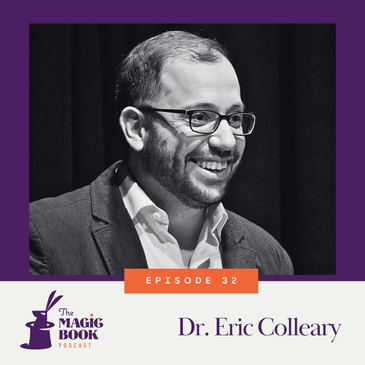
Harry Houdini was one of the greatest collectors of his era. Every corner of his Harlem townhouse held books, playbills, prints, and ephemera. Within months of his death in 1926, the collection was split, sold, and scattered. Dr. Eric Colleary, Cline Curator of Theatre and Performing Arts at the Harry Ransom Center, spent a decade piecing the story back together. He discusses his new book, the librarian Houdini kept in his attic, a bargain bought in wartime, and how Texas ended up with the rest.
Adrian Tennant [00:00:02]:
[MUSIC] Coming up in this episode of The Magic Book Podcast.
Dr. Eric Colleary [00:00:07]:
It helped me realize the extent of what Houdini collected, the importance of the collection to his life and his profession. I think you can see the ways that the library influenced the way that Houdini performed and the ways that he was trying to advocate for the professionalization of magic, which was so important to him. And he was arguing that it was a legitimate art form, which it absolutely is. You could see that through the collection.
Adrian Tennant [00:00:31]:
You are listening to The Magic Book Podcast, conversations about classic and contemporary books that teach, illuminate, and celebrate the art of magic. I'm your host, Adrian Tennant, a lifetime student of magic and mentalism, occasional performer, and longtime book collector. Thank you for joining me. [MUSIC FADES] My guest today is Dr. Eric Colleary, the Cline Curator of Theater and Performing Arts at the Harry Ransom Center at the University of Texas at Austin. The Ransom Center is a humanities research library, archive, and museum spanning theatre, dance, opera, circus, vaudeville, puppetry, and magic. Eric has been responsible for that collection since 2015, and he also teaches in the Performance as Public Practice graduate program. His previous exhibitions at The Ransom Center include “Vaudeville,” “The Golden Age of Magic Posters,” and “Words into Worlds: Creating Place in the Theater.”
Adrian Tennant [00:01:34]:
He's the founding executive director of the Queer Cultural Trust and a trustee for the Society of American Magicians Magic Endowment Fund. Harry Houdini's personal library came to The Ransom Center in 1958. It is one of the greatest collections of magic, spiritualism, theater, and popular entertainment anywhere in the world. And yet, for decades, much of it sat uncatalogued. Today we'll be discussing Eric's new book and the exhibition of the same name, which marks the centenary of Houdini's death and is now open at The Ransom Center: “Houdini's Library: Inside the Spellbinding Collections of the Great Illusionist.” [MUSIC FX] Eric, welcome to The Magic Book Podcast.
Dr. Eric Colleary [00:02:24]:
Thank you so much for having me. I've been a longtime listener, so it's really exciting to be here.
Adrian Tennant [00:02:28]:
Great, thank you! Unlike the majority of my guests, you didn't come into magic as a performer. So what's your earliest memory of magic?
Dr. Eric Colleary [00:02:40]:
I'm hoping that I'm kind of the consummate audience member for magic. I've always really loved magic shows. I think there's so few opportunities anymore where we're invited to experience the genuine wonder and awe that's in magic. I love it. My earliest memory of magic was my grandfather, who passed away when I was 5. I have these memories of him calling me over to his chair and pulling coins from my ear. It's probably something he learned when he was a kid in New York or when he was in the Navy, but it was so exciting to me. And of course, I grew up in that generation that watched David Copperfield's TV specials, which just sort of made me aware of the scale of spectacle that was possible.
Dr. Eric Colleary [00:03:17]:
So you could go from making coins appear to making the Statue of Liberty disappear, and that was just really exciting.
Adrian Tennant [00:03:24]:
Well, for listeners who don't know The Harry Ransom Center, Eric, can you describe what it is and how you became its curator of theater and performing arts?
Dr. Eric Colleary [00:03:36]:
Yeah. So The Ransom Center is one of the world's great humanities research libraries and museums, and it's based at the University of Texas at Austin. From the oldest surviving photograph taken from a camera obscura to the papers of artists like Tennessee Williams and Ethel Waters and Robert De Niro, the collections cover just a lot of ground. I think people are always surprised to see the other things. They come to The Ransom Center looking for something, and then they find all these other things. The performing arts collections alone date back to the 11th century and go all the way up to the present. We're constantly collecting new material all the time. I trained professionally as a theater director and stage manager and worked doing that many years before going to grad school. And I got a PhD in theater historiography with a minor in museum studies.
Dr. Eric Colleary [00:04:23]:
And then this job opened up. I've worked in nonprofits for decades and have been the curator for the performing arts collections here now coming up on just about 12 years.
Adrian Tennant [00:04:33]:
Well, magic in the late nineteenth century sat at the intersection of societal and technological changes: the Industrial Revolution, photography, the telegraph, and of course, arguments over spiritualism. Eric, how did magic reflect that moment?
Dr. Eric Colleary [00:04:53]:
This is such a great question, and it's one I think that people don't talk about enough. Magic and performance more broadly reflect the society around it. It's not a coincidence that the Golden Age of Magic coincides with so many technological innovations in the 19th century. There's this moment where travel and communication are happening so quickly that we have to collectively agree as a society that we're going to change time so that it's going to be standardized around the world. And we can capture images from nature through photography, We can fly through the air like birds. We can speak with loved ones across long distances in real time. We forget, I think, how truly mind-boggling this was at that moment. And so, when you think about it in that way, it's not so far-fetched to imagine that perhaps one could communicate with the dead or saw a live woman in half.
Dr. Eric Colleary [00:05:46]:
And this is really a remarkable moment, I think. A lot of researchers today are actually really excited to look at magic and performance as a way of understanding how people were thinking about and talking about the big social changes of the day. And I think it's really exciting. I think that's one of the gifts of magic history for cultural historians more broadly.
Adrian Tennant [00:06:07]:
When you arrived at The Ransom Center, the Houdini Collection was already well known in the magic world. The late Ken Silverman had worked there. I see his book on your bookshelf behind you. And of course, a previous guest on this podcast, Jim Hagy, had also done research there. And yes, his book is behind you. And yet there was, as I understand it, no proper inventory of what was actually in that collection. So what did you find?
Dr. Eric Colleary [00:06:36]:
Yeah, that's true. The collection had been here since 1958, and it was always popular from day one. It was always being used. There were always people coming here to look at it. The books had been cataloged, so it's not that the whole collection wasn't cataloged, but the books had been cataloged. The collection also spanned so many different topics that it had been sort of partly broken up into different genres. So Houdini's collection, for example, on opera was part of the general opera collection with a bunch of other material. There was his collection of other actors, and that was in the theater biography collection.
Dr. Eric Colleary [00:07:11]:
There's a popular entertainments collection, a music collection, a circus collection. All of that had been sort of broken up and cataloged differently. But what we were thinking of as the magic collection and as the collection of Houdini's papers, neither of those had really been fully cataloged. There were some rough inventories of the collections that if you read them together, you could sort of begin to navigate it, but those weren't available online. So cataloging the material properly was just going to be a big, expensive job, and none of my predecessors in my position really wanted to close the collection to do it since it would mean there was just going to be a long period of time when it wouldn't be accessible.
Adrian Tennant [00:07:51]:
I'm sure some listeners are quite surprised to hear opera and Houdini in the same sentence, but that's one of the revelations in the book, and of course in the exhibition, is just how broad Houdini's book collecting interests ultimately were. Well, your solution was, in fact, to close the collection for two years in order to catalogue it, which meant turning, I'm imagining, plenty of researchers away during that time. How did that go down with the people who relied upon it?
Dr. Eric Colleary [00:08:20]:
It's a really tough decision to make, but it was absolutely necessary. I mean, the work that we do with the collections, it's all about preservation and access. If we just preserve it, if we keep it and nobody accesses it, then it's just very expensive storage and it's not good for anybody. So we work really hard to make it accessible. And you really can't catalog a collection of this size when there's material getting pulled away to the reading room constantly. So we made the decision, we announced it publicly. We had this big month-long celebration of Houdini that included a pop-up display in the lobby. There was a cooking class actually here in Austin that focused on Houdini and his favorite recipes.
Dr. Eric Colleary [00:08:59]:
And then within months, we had closed the collection and we were still getting requests to borrow material for exhibits and getting emails from researchers. So, you know, we knew that this was going to happen. Most everybody was sympathetic and patient. And I think they realized that the resulting findings though that was just absolutely worth it. I have no regrets about that. And our archivist, Amy Armstrong, did an incredible job navigating such a complex project. I don't think people realize how much labor goes into this kind of thing.
Adrian Tennant [00:09:31]:
Hmm.
Dr. Eric Colleary [00:09:31]:
That's a full-time staff member's life for two-and-a-half years going through this collection, really trying to identify, “Okay, well, this letter says it's from John. Well, which John?” You know, they're doing a lot of the original research before the researchers actually even come in, in some cases, to the reading room. There's the cost of boxes, folders, photo sleeves. There's conservation. Treatments on material that's falling apart from age. And institutions like The Ransom Center depend on donations, they depend on endowments, some operating funds from the university to do all this work. We don't charge for access. We don't charge for admission to the exhibitions or public programs.
Dr. Eric Colleary [00:10:09]:
So it's a real investment for an organization to do this kind of work, but it's in such good shape now, and we're continuing to add to the magic collections as we're able to.
Adrian Tennant [00:10:19]:
What new information emerged from that cataloging process?
Dr. Eric Colleary [00:10:24]:
I think there's a lot. I think one of the things that I worried about is, you know, we had some incredible researchers over the years. You know, Ricky Jay would come to the collections, obviously. Ken Silverman, who did the Houdini biography in the '90s. Jim Hagy, you know, amazing, amazing researchers over the years. What worried me is that maybe there were things, because of the way it was organized, that were being missed, just because if you didn't pull down the box and go through every single thing, it was easy to miss stuff. So, I guess I could speak for me, personally – it made it much more possible to see what we had and what the connections were across the collection.
Adrian Tennant [00:10:59]:
Hmm.
Dr. Eric Colleary [00:10:59]:
It also helped me realize the extent of what Houdini collected, the importance of the collection to his life and his profession. I think you can see the ways that the library influenced the way that he performed and the ways that he was trying to advocate for the professionalization of magic, which was so important to him. And he was arguing that it was a legitimate art form, which it absolutely is. You can see that through the collection.
Adrian Tennant [00:11:23]:
Let's turn to Houdini's own beginnings as a collector. He was a working performer with a pretty punishing schedule. Eric, why did he start buying books?
Dr. Eric Colleary [00:11:35]:
Yeah, he was a voracious reader. Actually, I think people will be surprised to know that many of his earliest experiences of magic were through books. The majority of books in his home were his father's theological library, and Appleton, Wisconsin didn't have a public library when he was there. He didn't really have access to a library until he moved to Milwaukee. And so when they moved from Milwaukee and then to New York, he would say that he was skipping classes in his childhood to go to the library, and he was mostly reading books on adventure and on magic. Some of those earliest books that he owned were books of magic tricks and histories of magic, like “The Memoirs of Robert-Houdin,” which eventually he was able to recite entire passages from memory. But he didn't have much money in those early years, so he was on the road so much It wasn't really until he went to Europe and started making a name for himself that he began to have the income and the networks to really begin collecting seriously. And then he was able to buy a home that he could put it all in.
Dr. Eric Colleary [00:12:33]:
And that was really important. The big thing was this sort of turning point in 1902. He came back briefly from his tour for his birthday, and he bought a copy of Thomas Frost's “[The] Lives of the Conjurers.” He knew enough about magic history, and he'd met enough of the old-timers at this point that he knew that the book was just absolutely riddled with inaccuracies.
Adrian Tennant [00:12:52]:
Hmm.
Dr. Eric Colleary [00:12:52]:
And it really upset him. He was so angry that he committed himself to building a big collection on magic history that would allow him to write a better and more accurate Lives of the Conjurers. And we know this because he talks about it in his letters. He actually published editorials and magazine articles specifically calling out this book and why it was driving him to collect. And then a couple of years later, he'd meet the Victorian magician and collector Evanion, which was the focus of Jim Hagy's book. And realized that Houdini could acquire not just the books, but the posters, the playbills, the letters, the scrapbooks, the photographs, all of the ephemera, the primary sources that would really allow him to get to the truth of these histories. And that's exactly what he did.
Adrian Tennant [00:13:34]:
Well, book collecting didn't stay a professional interest for Houdini. There's a moment in Australia, with his famous flight on that continent still ahead of him, where he's still bringing up his collection in letters about something else entirely, and unprompted. Eric, at what point in the book did you realize how deep Houdini's obsession really went?
Dr. Eric Colleary [00:13:57]:
It was very early. I think I was working on the project— I've been working on it now for over a decade, and I remember at one point thinking I would track down any time that Houdini mentioned his collection, and I really quickly got overwhelmed. He mentions it in most of his interviews. He works it into letters that have nothing to do with his library and his collecting. He placed advertisements in the classified section of the New York Times and various magic magazines, appealing for material. He used it to sell his own books, saying how much he'd invested in the collection – “So you can benefit from my acquisitions by buying my book and reading it.” He was really serious about it. And I think that was a question I had early on was, you know, you sometimes will meet collectors who build a collection for the sake of having it.
Dr. Eric Colleary [00:14:41]:
You go to their homes and they open their closets and unopened packages from eBay and Potter and Potter come spilling out. And Houdini was not like that. He knew what he had. He'd often stay up all night. He'd say, you know, ‘til 4:00 in the morning, reading and digging through boxes, learning what he had, understanding why it was important. He often told reporters that he was looking forward to retiring from the stage so that he could spend the rest of his days with his wife in his library. It filled up his entire house. I think, you know, serious collectors have this problem.
Dr. Eric Colleary [00:15:13]:
And sometimes, you know, [they’re] very fortunate to have spouses or loved ones who were willing to put up with it. There were books and boxes piled up floor to ceiling, and there's interviews where he and Bess admit that they have real difficulty keeping housekeepers on staff. And sometimes he has to sneak material into the house through the basement so that Bess doesn't get upset about it. So, you know, you asked the question, how deep was his obsession? It was really— it was bottomless. He could— he was really acquisitive, but he also knew what he had. We even have lists where Houdini's working with booksellers and duping out materials. So he's aware enough of what he has that he's selling off duplicates and making money. And more importantly, he's making room for new material to come
Adrian Tennant [00:15:56]:
Mm-hmm. Houdini went a little further than most book collectors. He employed a librarian who lived in the house, Alfred Becks. Eric, who was he?
Dr. Eric Colleary [00:16:06]:
Yeah, so Alfred Becks – he was an old-time theater agent and a producer. He's one of these sort of elderly father figures that Houdini was always drawn to, and you see this throughout his sort of histories. Becks had worked with some of the greatest actors of the 19th century, and Houdini saw him as this living link to the past. In his later years, Becks had earned a living organizing the theatrical library of a guy named Robert Gould Shaw, who was a Boston-based collector who had just donated his collection to Harvard. And then Shaw became the first curator of what's now known as the Harvard Theatre Collection at Houghton Library at Harvard. Not much had really been written about Becks, but in my research, it's clear that his health wasn't great, and Houdini hired him not only to help organize the library, but it provided Becks with a source of income and a roof over his head, which Houdini was always really good about doing this for folks. So Houdini gave Becks a room on the top floor of his brownstone in Harlem. And there's stories about each morning that Becks would dress up in a full suit, have his breakfast in his room, and then walk across the hall to the workroom, where he'd spend the entire day just organizing playbills, identifying prints, cataloging books, and just getting the library organized.
Adrian Tennant [00:17:19]:
As you just mentioned, his health had been fragile from the start, and there were concerns about hiring him at all. What ultimately happened to Alfred Becks?
Dr. Eric Colleary [00:17:29]:
Becks worked for Houdini for about 5 years before he passed away. So for some time, I thought that Becks had been living elsewhere at that point. But I just recently came across a letter that suggests that Becks might have actually collapsed in the attic while Houdini was on tour, and then was hospitalized and then died shortly thereafter. Houdini covered his funeral expenses, his burial, wrote some lovely tributes to him in a number of different publications. It was a really big deal. He wouldn't have a librarian like that ever again. He had assistants, of course, including Oscar Teale, who'd help out with the collection, but nobody who really had that kind of expertise and experience that Becks had. You know, he had friends and connections in Boston, and he'd been living in New York, and so he'd make that trip between the two cities.
Dr. Eric Colleary [00:18:14]:
And so when Houdini was on tour, Becks would come in and bid on his behalf, especially at the major auction houses in New York. And there's incredible catalogs from those sales with Becks's notes, what went to Houdini, what went to other— actually names the other people who were buying at these auctions and how much they're spending on the different material, just in case something slipped through the cracks that they weren't able to buy. They know who to go to and how much they paid for it. It was a remarkable thing. And there's the collection, the library includes a number of those catalogs.
Adrian Tennant [00:18:45]:
And after Becks died, those dealers that he was working with didn't stop sending their material, did they?
Dr. Eric Colleary [00:18:53]:
No. And really, actually, a lot of those dealers knew that Bess was working on behalf of Houdini, and Houdini was very savvy about the relationships that he had with other booksellers. So, you know, those relationships would continue on. And in fact, even after Houdini died, a number of them were still sending material to the house on account, and poor Bess had to deal with all of that.
Adrian Tennant [00:19:16]:
Oscar Teale served as Houdini's secretary. I'm curious, what effect did being that close to Houdini's collection have on Teale's own writing?
Dr. Eric Colleary [00:19:27]:
Yeah, Teale would end up actually doing a lot of research in Houdini's own collection. So a number of the publications that Teale would come out with over the years owe a lot of their research to Houdini's own library. Teale was incredibly knowledgeable about magic and magic history and understood what was in this collection. He also wrote one of the early profiles of Houdini library for one of the magic magazines at the time. So some of the things that we know about what was in Houdini's collection at that moment, we know because of Teale's writing. So he's not an Alfred Becks who really understood especially the theater history side of it, but Teale absolutely understood and appreciated the magic history in Houdini's collection.
Adrian Tennant [00:20:11]:
[MUSIC] If you are enjoying this episode of The Magic Book Podcast, please consider leaving a rating on Spotify or a review on Apple Podcasts. You can also follow The Magic Book Podcast page on Facebook. Thanks. [MUSIC FADES] Eric, in “Houdini's Library,” you describe Houdini's association with one of the world's oldest antiquarian book dealers, Maggs Brothers. Just how important was that relationship?
Dr. Eric Colleary [00:20:39]:
Maggs Brothers was one of the book dealers he worked with often, and they're still very much active in London today and still a family business in many ways, selling just incredible stuff. Houdini developed very close relationships with dealers. They knew what he was interested in. They'd keep an eye out for material for him. He'd make a point to visit with them when he was on tours. He'd offer them complimentary tickets to his shows. And he took the time to genuinely befriend them, knowing that they could be of help to each other. From Maggs Brothers, Houdini bought some of his prized gems.
Dr. Eric Colleary [00:21:11]:
So, the documents related to Cagliostro and The Diamond Necklace Affair, the 1751 travel diary of the legendary actor David Garrick, just an amazing collection of letters from the actors Charles and Ellen Kean. And really importantly, the first edition of Reginald Scot's “Discoverie of Witchcraft.”
Adrian Tennant [00:21:29]:
Mm-hmm. Well, that first edition of “The Discoverie of Witchcraft” still has its receipt. So we know that he paid a little over £22.00 for the book. That's roughly £1,900 or $2,700 in today's money, which seems like a bargain, by the way ...
Dr. Eric Colleary [00:21:46]:
Not bad!
Adrian Tennant [00:21:49]:
But we should note Houdini paid an additional 14 shillings for war insurance because, of course, the book had to cross the Atlantic where ships were being sunk. What does that particular purchase tell you about him?
Dr. Eric Colleary [00:22:03]:
I think it says a lot. It also says a lot about the market and how it's changed over the years. I think it is a steal of a deal. I think it was a steal of a deal even at the time. And we know from the letter that accompanies the receipt that he got a discount from Maggs Brothers for being a good customer. So even then, it's a good deal. He gets it in 1917, which is right in the middle of World War One. The book, of course, is an absolute classic, and it's well known among collectors as one of the earliest books in the English language to explain how magic tricks are done. Houdini often showed this book to reporters and would open to the illustrations and explain, “People are still doing a lot of these tricks even today.”
Dr. Eric Colleary [00:22:40]:
So I think the fact that now such a book would go for quite a bit more, again, like I said, it says a lot not just about Houdini, but it says a lot about how the magic community has recognized this material, and in recognizing it, sometimes the value goes up.
Adrian Tennant [00:22:57]:
Another real revelation for me in your book was the extra illustrated volumes. Eric, could you just explain what those are, and why they matter?
Dr. Eric Colleary [00:23:07]:
Yeah, this was a really big practice in the 19th century. It was a way of being able to preserve and display a collection of ephemera, and you could do that by adding it to published books, So for example, Houdini would take an early English translation of “The Memoirs of Robert-Houdin,” have the book disbound, and then he would add blank pages to the book. And then on those blank pages, he would mount playbills, photographs, prints, letters, tickets, advertisements— incredible original material to those pages. And it was a practice that was known as “Grangerizing” or “extra illustrating.” So what might start off as a one-volume printed book from the publisher could turn into like an eight-volume set of just truly unique books. Houdini made a few of these himself, but he also acquired hundreds of them from other collectors, especially related to theater history more broadly.
Adrian Tennant [00:24:03]:
The German magician Wiljalba Frikell was highly admired among his contemporaries. Houdini tried to meet him on many occasions without success. Eric, you tell a story in the book about Houdini arriving at the home of the then-retired magician roughly an hour after the man had died. What did Houdini find that day?
Dr. Eric Colleary [00:24:27]:
It's such an incredible story, and it's one that he would tell often. It's certainly recounted in “The Unmasking of Robert-Houdin.” And for Houdini, Frikell he credits as the one who really brings black tie and tails and popularizes that as a magician, as opposed to the sort of sorcerer robes of magicians before. So it's such a great story. I mean, it's the kind of thing of movies. He arrives at the house after having been turned away many times and is led into the bedroom, and Frikell's body is still warm and lying on the bed. There's a bottle of rubbing alcohol next to the bed.
Dr. Eric Colleary [00:25:02]:
They've been trying to revive him, and he's passed away. And you would think that Houdini was exaggerating this story, except there's so much material in the collection that actually documents that moment.
Dr. Eric Colleary [00:25:13]:
He photographed himself outside of Frikell's house on the day that he died. He saved the telegram that he sent to Bess when he was first refused entrance to see Frikell. And Madame Frikell gave Houdini a note that had been in his pocket when he died in a straight pin that he often wore, just along with a whole bunch of other posters and photographs and playbills that belonged to the elder magician. And this was something that happened a lot, I think, for Houdini, where – not that he would show up and and the person he was meeting had just died! – but that he would meet a lot of elderly magicians, and oftentimes their descendants, and they would make gifts of their personal collections to him, recognizing him not only as an incredible performer, but as someone who was keeping these histories alive.
Adrian Tennant [00:25:57]:
Well, alongside the extensive books and materials on magic and spiritualism, The Ransom Center holds a body of material on The Diamond Necklace Affair, that you told me most visitors never ask about. So, Eric, what was that?
Dr. Eric Colleary [00:26:14]:
Yeah, it's a great story. It's one that I think a lot of people do know about, but not necessarily in connection to Houdini. And so folks who come and look at the Houdini papers will often miss The Diamond Necklace Affair material because it's just such a different kind of a thing. It's a famous incident in French history that fueled the events that led to the French Revolution. And inspired just countless writers including Alexandre Dumas. The short version is that at the center of the plot, there was this woman named Jeanne de la Motte. She was an ambitious aristocrat who led a scheme to obtain an extravagant diamond necklace that had been commissioned by the previous king. She convinced Cardinal de Rohan that the Queen, Marie Antoinette, wished him to purchase the necklace on her behalf.
Dr. Eric Colleary [00:26:59]:
Rohan was eager to garner royal favor. So he said yes. The conspirators basically took the necklace from the cardinal, fled to London, had the necklace broke apart, and sold the diamonds. And then when the royal jewelers demanded payment and the necklace failed to appear in court, the fraud completely collapsed and a number of people were arrested. There was a public investigation. Louis XVI and Marie Antoinette were implicated but found not guilty of any but the sort of controversy brought about a lot of anti-royal sentiment that helped lead to the French Revolution. And in this collection of papers, we have la Motte's handwritten memoirs, we have a number of original handwritten legal documents from the court case, and we have this open letter from Cagliostro to the people of France proclaiming his innocence of any wrongdoing in this case.
Adrian Tennant [00:27:52]:
You spent the better part of two years, I believe, not knowing why Houdini owned this material. How did you actually make that connection to Joseph Balsamo, better known, of course, as Count Cagliostro?
Dr. Eric Colleary [00:28:06]:
Yeah, I think in interviews, and this is during Houdini's lifetime, The Diamond Necklace materials always mentioned as a way of explaining the breadth of Houdini's collection and its importance for documenting global history, not just on magic specifically. So it's always in the sort of context of the French Revolution and global history. But as it turns out, Houdini was really interested in it because of Cagliostro, who Houdini saw as a kind of proto-spiritualist and mystic who was really popular with the French aristocracy. It did – it took me about two years to find an interview that Houdini gave, actually just about two months before he died, for the New York Times Magazine where he talks about these documents and how he acquired them because he really wanted to be able to pass his own judgment on the case and on Cagliostro's involvement. So when they asked about the apparent contradiction between Houdini's admiration for Cagliostro, which was huge— he had a portrait of Cagliostro hanging over his desk— so when they were trying to ask him about the contradiction between his admiration and Cagliostro's performing many of the same spiritualist tricks that Houdini was criticizing and debunking at the time, Houdini just dismissed that and said that “There weren't really many other ways to make an honest living back then. And so he can be forgiven of doing that.”
Dr. Eric Colleary [00:29:24]:
But yeah, it was an important part of the story. And of course, Cagliostro now is like Houdini in that it's a shorthand for magicians and magic. Cagliostro shows up in all kinds of literature and film.
Adrian Tennant [00:29:37]:
And a footnote, in 1961, the author Frances Mossiker used those original documents in the Houdini Collection to write her book, “The Queen's Necklace: Marie Antoinette and the Scandal That Shocked and Mystified France.”
Dr. Eric Colleary [00:29:50]:
She was one of the first to research that material when it came here to the university. And as part of her book tour, when the book came out, she commissioned a replica of the diamond necklace that she sort of toured with on her book tour. And then when the book tour was over, she donated the replica diamond necklace to the university, and now that's part of the collections with Houdini's original documents. So that's pretty special.
Adrian Tennant [00:30:15]:
Yeah. Houdini's close friend, collaborator, and of course magic historian Henry Ridgely Evans was the person who first suggested that Houdini bequeath his collection to the Library of Congress to ensure it remained accessible to magic scholars. Houdini's will seemed straightforward, leaving his magic and spiritualism and books to the Library of Congress and his drama library to his wife, Bess. But what happened after Houdini's death in 1926 was pretty chaotic by all accounts. Even the Library of Congress couldn't tell you exactly what happened. So, Eric, what did your research eventually reveal?
Dr. Eric Colleary [00:30:57]:
Yeah, I think this was the million-dollar question, and it was one of the reasons why I started this research in the first place. A lot of people knew that we had this Houdini collection. I think a lot of people misunderstood what The Ransom Center had. They knew that the Library of Congress had the Houdini Library. That's sort of what had been known for a long time. But I think a lot of people assumed that what we had at The Ransom Center really focused on Houdini specifically, and they didn't realize how much of it also included the history of magic, that included his entire collection of theater history, so much other material, a lot of his own personal papers for sure. How that collection got broken up had been absolutely a mystery. And the short version is that the magic act went to his brother Hardeen with the understanding that it would be destroyed on his death.
Dr. Eric Colleary [00:31:48]:
The magic and spiritualism books would be ultimately bequeathed to the Library of Congress, or if they didn't want it, it would go to the New York Public Library, and if they didn't want it, it would be left to Bess to dispose of as she saw fit. And then the dramatic library was given to Bess to sell, presumably so that she would have some source of extra income. In addition to what was left over for the estate, and I really want to especially thank Amanda Zimmerman at the Library of Congress, who provided access to some of their collection records that really helped to answer this question. We found this letter from the Librarian of Congress to an assistant in April of 1927. This is after Houdini's death and after the probate that cleared the courts, and he says that – this is the Librarian of Congress – is saying that he's “visited Mrs. Houdini at her home. And she's identified the magic library as all the books in the big bookcase in the back of the house. And then the spiritualism library is all the books piled up on the floor in the front room of the house.”
Dr. Eric Colleary [00:32:44]:
And that's what they got. It was over five thousand volumes and over one-hundred twenty scrapbooks. It was a lot of material. And Bess was desperate to leave the house and all the memories that it held. And then after the Library of Congress came and picked up their portion, she received a letter from a real estate developer named Messmore Kendall, who had many years ago been outbid by Houdini on a bookcase that belonged to a famous actor-manager named Augustin Daly. Kendall wanted to buy the bookcase, and when he arrived to look at it, Bess sold him the bookcase, everything that was in the bookcase, which was Houdini's theater library, and then the rest of the dramatic library, which was well over 30 crates worth of material. It was all over the house and in storage. And this cleared out a lot of the house, but we know that there was still quite a bit that was left there and quite a bit that got pulled out by Houdini's lawyer, Bernard Ernst, and a lot of that ended up in private collections.
Dr. Eric Colleary [00:33:40]:
But jumping forward to January of 1928, the Library of Congress cataloged the collection, and one of the first people there knocking on the door was Henry Ridgely Evans. And Evans had wanted to write a big biography of Cagliostro, but Houdini wouldn't let Evans see his collection. Evans worked for the Department of Interior as a librarian, and one of the reasons why he'd encouraged Houdini to place the collection at the Library of Congress was so that hopefully one day he might have access to it right in his backyard. So he's there on day one to do research, and he's so excited, but then he realizes that none of the material that he's looking for is there.
Adrian Tennant [00:34:18]:
Right.
Dr. Eric Colleary [00:34:19]:
None of the magic posters, none of the playbills, the photographs, the letters. So much of the Houdini magic collection wasn't there. And so it's amazing and important books, but none of the ephemera. So he writes to Bess, and he's told that Houdini's librarian, Alfred Becks, had filed all of this material with the Dramatic Library.
Adrian Tennant [00:34:40]:
Oh!
Dr. Eric Colleary [00:34:41]:
That he organized it alphabetically by performer, and that all of that had been sold to Kendall already.
Adrian Tennant [00:34:47]:
Right …
Dr. Eric Colleary [00:34:48]:
So Houdini's will had actually left Bess in charge of determining what constituted the various parts of the library, and that's just how it all shaked out. It was really spatial. It was about where things were. So the fact that, for example, Houdini's copy of “The Discoverie of Witchcraft” came to Kendall's collection and not to the Library of Congress was really because it was just not being stored with the magic library at the time that he died. And then Kendall's collection was eventually bought for the University of Texas by a donor, the vaudeville impresario Karl Hoblitzelle, and that material's been here since 1958. So that's how it sort of all shook out ultimately at the end. And like I said, all of that was new information up until recently.
Adrian Tennant [00:35:33]:
Right. So the collection is still split. The Library of Congress holds one part, and The Ransom Center holds another. Today, what is the difference between the two?
Dr. Eric Colleary [00:35:45]:
It's really sort of a split based on, again, it's that geography of what was in the house. So what the Library of Congress holds is this incredible collection, the vast majority of Houdini's books on magic and spiritualism, and 120 scrapbooks that Houdini had either assembled himself or collected from other people. What The Ransom Center holds is all of the magic ephemera, loose material, a lot of his personal papers, and the bulk of the theater library. What happened then, what I understand, is that a lot of the personal material, in addition to the magic act that went to Hardeen, when Hardeen died, the family sold some of that material to two collectors, McManus and Young. McManus and Young had quite an amazing magic library themselves. And they placed a large collection at the Library of Congress, which includes not only their published books, but a lot of this Houdini ephemera, including some famous letters and scrapbooks that had been passed down to Hardeen. So when you go to the Library of Congress and you see some of that material related to Houdini personally, not just the collection that he assembled, the personal stuff is actually in the McManus Young Collection. It wasn't the part that was bequeathed as part of Houdini's will.
Dr. Eric Colleary [00:37:04]:
And so that's sort of how that got split up.
Adrian Tennant [00:37:06]:
Right.
Dr. Eric Colleary [00:37:06]:
And then actually McManus and Young, because so many of their books duplicated what Houdini had already placed there, a number of the books in the McManus and Young collection were left over and were actually given to the University of Texas. So we have quite a large McManus and Young collection here.
Dr. Eric Colleary [00:37:25]:
And then there was a third set that went to UC Berkeley where McManus and Young wanted to geographically have the collection split across the country.
Adrian Tennant [00:37:33]:
Given the complicated history between Houdini and Arthur Conan Doyle, it's perhaps ironic that their collections are co-located at The Ransom Center. How did Houdini's material finally end up in Texas?
Dr. Eric Colleary [00:37:50]:
Yeah, the history of The Ransom Center really begins around the 1940s when this guy Harry Ransom, who was an English professor and then became the president of the University of Texas and then the chancellor of UT Systems. He had this vision that if the university was going to be one of the major research universities in the world, it needed to have a library that would sustain it, that would allow researchers to really dig deep in meaningful ways, something along the lines of the British Library or the Bibliothèque Nationale in Paris. He really had grand ambitions of what this library would be. By then, a lot of the major collections had already been bought up by other libraries or had been placed, and so we were working a lot with living writers and artists and building the collection that way. Arthur Conan Doyle, he had died not long before, and a lot of his material had come up for sale, and we were able to purchase that back in the 1950s and '60s. Houdini's collection, like I said, the part that had gone to Messmore Kendall, that material had stayed in Kendall's apartment. Kendall is credited with building one of the first purpose-built movie theaters in Manhattan, the Capitol Theater in Times Square. And above the theater, he had an apartment where all this stuff had been stored.
Dr. Eric Colleary [00:39:07]:
And in 1957, Kendall wanted to retire to Florida and sell off the collection, and get rid of it. And he first approached the New York Public Library, and this was well before the library at Lincoln Center, but they did have a drama curator, a guy named George Freedley. And Friedley said, “You know, we don't really have the money to acquire anything like this. We certainly don't have the space for it. But there's this library in Texas, and they're really focusing on performing arts and building a major performing arts library. They have a donor who just recently (in 1954) had bought this other very large collection of theater photography. What about approaching them?” And so George Freedley at the New York Public Library really steered it to Texas and made that happen.
Dr. Eric Colleary [00:39:54]:
And Karl Hoblitzelle, the guy, the donor who had purchased it for the university, had originally said, “No, you know, I just bought this other very expensive collection. I'm not going to … you know, you said it was a once-in-a-lifetime collection then, and now you're, now you're coming and saying it again.” And it eventually took Hoblitzelle actually flying out to New York to see it in person to realize the quality and the extent of it. And then they ended up finding an entire other room in Kendall's apartment that they hadn't even realized. And the collection was even better than described.
Adrian Tennant [00:40:27]:
Wow.
Dr. Eric Colleary [00:40:28]:
And that's how it all ended up here.
Adrian Tennant [00:40:32]:
[MUSIC] Just a reminder that you can be notified when new episodes of this podcast are published by subscribing to the email alerts. You'll find all the details on the podcast website at themagicbookpodcast.com, which is where you can also find transcripts plus accompanying blog posts with summaries, timestamps, and links to resources mentioned in each episode. [MUSIC FADES] Houdini's collection expanded well beyond magic and spiritualism into theatrical ephemera. So Eric, what was the eventual balance between the three?
Dr. Eric Colleary [00:41:08]:
Yeah, so he really started collecting magic and spiritualism, and he really didn't necessarily see for a long time a split between the magic and spiritualism books. That sort of came a little bit later. So really, when he was collecting magic and spiritualism, he would collect playbills, especially in bulk. He would be traveling, for example, in England and would say that he was walking by a library in Leeds and found that they were dumping out bundles of playbills into the garbage. And he'd ask them, he came over and said, “What are you doing?” He said, “don't throw those away. I will pay you for them and I will send a cart around. Please don't throw away anything. Just bundle it up there and send it to the theater,” and he'll have it sent back to New York.
Dr. Eric Colleary [00:41:52]:
And in 1915, he connects with a guy named Quincy Kilby, who is the former manager of the Boston Theatre and a theater historian who reaches out to Houdini about magic history and particularly Alexander Herrmann, and a photograph that he has that he wants to give to Houdini as long as maybe Houdini might give Kilby some of Houdini's own material back, a little bit of an exchange. And they start to talk about collecting theater, and Kilby sort of suggests he really maybe shouldn't do it, that there's so many dramatic libraries out there that are really good that you would have to spend a lifetime really and incredible resources to build up a really good dramatic library, and it's really not worth it. “If you want to go into this, you should focus in on something more specific like the Booth brothers. If you can look at Edwin Booth, Or his father, Junius Brutus Booth, or the famous John Wilkes Booth who assassinated Lincoln. Like, there's still a lot of really good material on the market. You could specialize that way.” And Houdini says, “Well, yeah, I could do that, and I will. Thank you for that feedback.”
Dr. Eric Colleary [00:42:57]:
“But actually, now that I think about it, I have all these playbills that have been sitting in my basement that I've been collecting with the hope that maybe there's just, at least in some of them, some mention of magic on the playbill.” And actually, we've got playbills in London dating back to the early 1700s and in New York dating back to the late 1770s. Some of the earliest playbills that survive from New York theater actually survived because of Houdini's collection. So he realizes that the theater collection can become a real thing, and he starts in 1915 to really collect actively. So when it comes to the split between the three, he gets started a little bit later collecting theater history, and he regrets actually some amazing opportunities he might have had, especially when he was more actively touring Europe to buy amazing things. But it is what it is, and it is an extraordinary collection.
Adrian Tennant [00:43:56]:
Leo Rullman was a familiar figure in the New York magic book trade. What was his connection to Houdini's library?
Dr. Eric Colleary [00:44:05]:
Leo Rullman was a friend of the family, and so Bess knew about him enough that when Houdini died, he had either reached out to her or she had reached out to him, and he offered to sell the dramatic library for her. And so as early as January of 1927, just months after Houdini died, there's a dated description of what the theater library looked like and there's a note on the surviving copy of that, which is now in the New York Public Library. There's a note that says, “Mrs. Houdini had very large expectations of what she wanted to get for this collection, and I didn't think I could get that much money from it.” She ended up selling it to Messmore Kendall, he says in this note, “for much less than what I thought I could get from it.” So I think by that point, In May of 1927, when Kendall buys it, she's just so eager to get out of the house and be done with it all, she ends up selling it for less than it's worth.
Adrian Tennant [00:45:04]:
Your research took you to the Library of Congress, the New York Public Library, Harvard, and David Copperfield's fantastic collection in Las Vegas. Did any of those visits change how you thought about telling the story of Houdini's library?
Dr. Eric Colleary [00:45:20]:
Absolutely. I mean, they were crucial. I had to see the Library of Congress collection, and I got to spend quite a bit of time there with the collection and with the staff, particularly Amanda Zimmerman, who cares for that collection now. The New York Public Library doesn't have a lot on Houdini, but the Ellison Collection is there, and it's an extraordinary amount of material. Harvard had a lot of the material related to Robert Gould Shaw and Quincy Kilby and Alfred Becks, and that was really great to dig through. I would say David Copperfield's collection is just so truly extraordinary. There were so many things in there that really opened up new avenues for research in this project. Among them, there were the original notes that Houdini had written for his speech to the Club of Odd Volumes in Boston in 1921.
Dr. Eric Colleary [00:46:09]:
It was the only major time that he really gave a talk about his collection.
Adrian Tennant [00:46:13]:
Hmm.
Dr. Eric Colleary [00:46:14]:
He talked about it a lot, but not in in any kind of formal way except for this 1921 talk to the Club of Odd Volumes, a group of fellow collectors and bibliophiles. So to have his actual speech and his notes about what he said and what he brought with him to that was extraordinary, and that's in David's collection. Also, David had a typed inventory of what was in the magic bookcase, and the bookcase of course is now in David's collection.
Adrian Tennant [00:46:41]:
Yes.
Dr. Eric Colleary [00:46:41]:
But I don't think anybody there had realized that the catalog actually— Houdini's own typed catalog of what was in that library was in the archival material. And what's extraordinary about that is that you can tell it's actually Houdini typing this list. It's not Alfred Becks. It's not Oscar Teale. And at the end of, you know, he'll give the author, the title, oftentimes the imprint, sometimes even where he bought it from. He'll also often include a sentence or two about what makes it special or what makes it really bad. He often will say things like, “The publisher should be dragged out and flogged for considering publishing something like this.”
Dr. Eric Colleary [00:47:20]:
“The author here is basically stealing this entire other book written by somebody else and not even giving them credit.” But then he'll also say, “Well, this is actually a really good book on spiritualism, and it tells the tricks better than almost any other that I've encountered.” And so there's real insight in that catalog about not only what he had collected, but what he thought about it, and really showed how deeply Houdini was engaging with his own collection.
Adrian Tennant [00:47:47]:
Some items in the collection are still in the conservation lab. What's currently being treated?
Dr. Eric Colleary [00:47:53]:
We're very lucky at The Ransom Center to have conservation labs in paper, books, and photography. And so we're not only able to care for this material and preserve it, but we're able to make sure that it has the longest lifespan. They've been doing especially a lot of treatments on posters and photographs lately, especially gearing up towards the exhibition. Amazing stuff. There was a three-sheet poster for “The Man from Beyond.” It's one of the only surviving known color posters for “The Man from Beyond.” There's a poster for Hardeen, a one-sheet, that doesn't seem to exist anywhere else in the world. And when it had been stored originally before it came to The Ransom Center, it had been stored folded up in different parts, and it had broken up into six pieces. And so, the paper conservators have spent hours and hours, days really, working on getting these posters back together.
Dr. Eric Colleary [00:48:48]:
We also have a different approach to conservation at The Ransom Center than a lot of collectors might, and this is something that I always talk to folks about. Because we're interested not only in the object itself, but in the long life of that object and the different kinds of information that it can tell us. We rarely want to conserve the object back to what it was like when it was first made. We're really interested, for example, in posters that have pinholes in them that show, well, “Okay, well, this was actually hung somewhere. This wasn't just something that was sitting in stock.” We're really interested in the posters that have the tags at the bottom that say, you know, “This is where they performed and how much the tickets were and the dates,” which some collectors will pull off so that they can get the pristine image. We don't bleach the papers to try to get rid of writing. We want the writing, we want the stories. So our approach is a little bit different, but we're really lucky to have the ability to do that work on site.
Adrian Tennant [00:49:45]:
“Houdini's Library: Inside the Spellbinding Collections of the Great Illusionist” is a large-format, richly illustrated book with 700 images. It's the kind of thing that I would think makes some publishers flinch. So, how did Abbeville become involved in publishing the book?
Dr. Eric Colleary [00:50:05]:
I was really lucky to connect with Abbeville. I was actually turned down by two publishers at first who really blanched at the thought of a heavily illustrated coffee table book like this. A good friend of mine, Marian Swaybill, connected me with her publisher, Abbeville, who's been making these beautifully illustrated books for over fifty years. And they really truly did not bat an eye and immediately saw what the book could be. And I couldn't be happier. As much as Houdini is the through-line of the book, there's so much magic in there, there's so much theater history. There's so much about the love and art of collecting more broadly that I think people will find so much of it interesting no matter what your background or interests are.
Adrian Tennant [00:50:48]:
The exhibition of the same name runs through January 2027, and holds hundreds of items. What should someone who visits Austin be sure not to walk past?
Dr. Eric Colleary [00:51:02]:
It's a bit of a Sophie's Choice kind of thing, but I would say maybe it's really hard to miss, but in the center of the exhibit, we have the big bookcase that belonged to Augustin Daly and held Houdini's dramatic library. Like I said, it's the bookcase that inspired Kendall to reach out to Bess, and if it wasn't for this piece of furniture, the whole collection probably would've been broken up and sold. So the fact that it survives intact, that it's still accessible for researchers from all over the world to come and use, can really be traced back to this one piece of furniture, and it's a beautiful thing.
Adrian Tennant [00:51:34]:
That's a lovely story. Well, Eric, you're the custodian of thousands of books that belonged to somebody else. If you could put one volume from the Ransom Center's holdings into a Magic Book Podcast listener's hands, which would it be?
Dr. Eric Colleary [00:51:53]:
There's so many incredible books in Houdini's library. And I'm actually— if it's okay, I'm gonna cheat. And instead of choosing a book, I'm gonna actually say it's the collection of letters that we have from Houdini to his wife, Bess.
Adrian Tennant [00:52:03]:
Mm-hmm.
Dr. Eric Colleary [00:52:03]:
I think there's so much mythology and legend and branding that's been built up around Houdini over the past century, and certainly during his lifetime, that I think it's important to remember that he was a real person. These letters offer an unfiltered look at the real man. They're really loving. They're funny. They show the relationship that they had with each other and the way that he really cared for her. And it really covers his entire life. There's other letters, of course. There's an incredible collection of letters, for example, from William Robinson, the performer known as Chung Ling Soo, who, you know, normally performed as a Chinese magician.
Dr. Eric Colleary [00:52:38]:
But in these letters, you get a sense of who he really was as a person. I think there's a lot of amazing unguarded moments in these letters, but the ones between Houdini and his wife are really, really special.
Adrian Tennant [00:52:51]:
And I'm curious, what is the most cherished book on your own shelves, and why?
Dr. Eric Colleary [00:52:56]:
Since I collect magic for The Ransom Center, I really actually don't collect much personally so that there's not a conflict of interest between myself and my work. But I do have a beloved copy of Ken Silverman's big biography of Houdini, which I admire immensely. I think Silverman did so much original research to try and get behind and beyond the legends of stories of Houdini, and it's really great seeing that kind of dedicated research happen. I want people to realize that at places like the Library of Congress, at The Harry Ransom Center, at other major research libraries, anybody with a photo photo ID and a sense of curiosity can come and use the collections, and that's really important to us. So it's been great seeing that kind of thing picked up by others like John Cox, for example, in his blog, Wild About Harry, and the much-anticipated chronologies of Houdini's life that's coming out in the coming years. I really respect and admire the people who've dedicated so much time to do the digging. It's not easy.
Adrian Tennant [00:53:54]:
You mentioned that it was an essay that you wrote in 2018 that was the catalyst for this entire project. Eric, I'm curious, was there anything that you thought about Houdini then that you no longer believe?
Dr. Eric Colleary [00:54:09]:
It's not that I think there's something I believed then that I don't think is true now, but what I realize now in a more fundamental way was how important the library was to Houdini. I think when I wrote that article in 2018, I was still at a point where the collection was just reopening for the first time after that big cataloging project, and it was also allowing me to dig into that collection for the first time in a meaningful way. And I could see all of the handwritten notes that Houdini had put on posters and playbills for other magicians. And I could see, “Oh, actually, this is really interesting: this poster here, this is the same trick that Houdini would do.” You know, this magician's doing it 100 years earlier, but it shows up in Houdini's act, and it's giving him different ideas for how he could do that trick. It really helped me understand in a much more nuanced and complex way what the role of the library was in Houdini's life.
Adrian Tennant [00:55:07]:
Well, the exhibition opened in late August and runs through January of 2027, as I mentioned. And of course, the book, “Houdini's Library,” is actually published today, September the 15th. So, Eric, what's next for you?
Dr. Eric Colleary [00:55:21]:
Yeah, it's really gonna be hard to put this to bed, and I don't think I actually ever will. It'll always be part of my work moving forward and my life moving forward. And of course, when the exhibit's over, all of it goes back into the stacks, and it's still available and accessible that way. I do have a smaller exhibit scheduled for a year from now at The Ransom Center that's going to focus on the early days of theater photography.
Adrian Tennant [00:55:43]:
Hmm.
Dr. Eric Colleary [00:55:43]:
So that other collection I mentioned that was bought in 1954, that collection of a guy named Albert Davis, it's this moment in time when lighting and camera technology advances to the point that photographers can actually take pictures inside the theater of actors on stage in their costumes with the backdrops and everything, the set pieces, instead of actors having to schlep their costumes down to a go to a studio and take pictures in front of sort of generic backdrops. So that's my next big project. That's what's on the docket.
Adrian Tennant [00:56:12]:
And Eric, how can listeners learn more about “Houdini's Library”?
Dr. Eric Colleary [00:56:17]:
The book for “Houdini's Library” is available wherever fine books are sold. And I would really hope that anybody who loves magic, who loves collecting, will pick up a copy. The exhibition is free and open to the public Tuesdays through Sundays at The Harry Ransom Center at the University Texas at Austin, and we're really hoping that people will come. We know that people from all over the world are actually already starting to book their flights, so I'm very excited about that.
Adrian Tennant [00:56:42]:
This has been a fascinating conversation. Eric, thank you very much for being my guest on The Magic Book Podcast.
Dr. Eric Colleary [00:56:51]:
Thank you so much again, Adrian.
Adrian Tennant [00:56:53]:
[MUSIC] You've been listening to The Magic Book Podcast. In this episode, we explored Dr. Eric Colleary's route into magic history through the theatre archives and the two-year project to catalogue a collection that had never been properly inventoried. We learned about Alfred Becks, the librarian who lived in Houdini's house and bought on his behalf, and about Maggs Brothers of London, who supplied some of the collection's greatest treasures. Eric explained why so much of what survives from magic's past survives by accident, and traced how Houdini's library came apart after his death and eventually found a home in Texas. Eric's book, “Houdini's Library: Inside the Spellbinding Collections of the Great Illusionist,” is published today by Abbeville Press, and the exhibition runs at the Harry Ransom Center in Austin through January the 24th. I'd also just like to thank Abbeville Press for providing me with a preview copy of Eric's book prior to publication. Eric will be giving a talk about the book and the exhibition at The Harry Ransom Center this Thursday, September 17th, that will also be streamed live on YouTube.
Adrian Tennant [00:58:05]:
You can find the details by searching @ransomcenter on YouTube. You'll find a transcript of this episode on our website at themagicbookpodcast.com. Along with a blog post containing a summary, timestamps, and links to the resources we mentioned. If you'd like to be notified when new episodes are published, please subscribe to our email alerts. All the details are on the website. And if you have a question or would like to suggest a topic, a book, or a guest for a future episode, you can reach me at adrian@themagicbookpodcast.com. Thanks for listening to The Magic Book Podcast. I've been your host, Adrian Tennant. Until next time, goodbye. [MUSIC FADES]