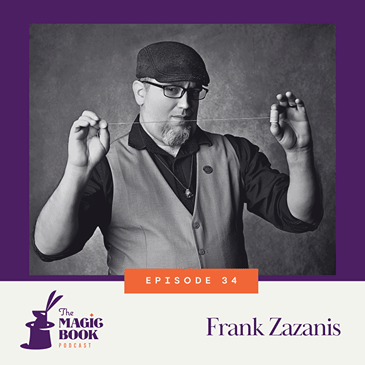
Frank Zazanis performs and writes as Franklin Williams, one of three personas he has built, each with a book of its own on the way. His first book, “Authentic Fabrications,” pairs 17 pieces of magical theater with 14 essays and carries a foreword by Jeff McBride. In this episode of The Magic Book Podcast, Frank explains why he scripts the closing line first, describes the third kind of audience he calls the seeking audience, and recalls how a thread routine pulled from his glove box for a Zoom show led to membership of The Magic Circle.
Adrian Tennant [00:00:03]:
[MUSIC FADES UP] Coming up in this episode of The Magic Book Podcast.
Frank Zazanis [00:00:07]:
The reason that I chose to write this book is because I wanted to kind of reignite the conversation about magic as an art, and that it doesn't have to be purely, “Haha, look what I can do and you can't!” It can be something much deeper, and it can touch people in a much deeper way through emotional connection.
Adrian Tennant [00:00:26]:
You're listening to The Magic Book Podcast, conversations about classic and contemporary books that teach, illuminate, and celebrate the art of magic. I'm your host, Adrian Tennant, a lifetime student of magic and mentalism, occasional performer, and longtime book collector. Thank you for joining me. [MUSIC FADES OUT] My guest today creates original magic out of things that actually happened to him: his son's autism diagnosis, a question from his therapist that he couldn't answer, and the friend who argues with everything you post online. Frank Zazanis is a magician, storyteller, creator, and autism advocate, who writes as Franklin Williams. He is a member of the Magic Circle in London, he teaches at Jeff McBride's Magic and Mystery School in Las Vegas, and he writes for Vanish Magic Magazine and the Mystery School's ‘Museletter.’ Frank is an Army veteran who spent his service years performing in a wide variety of settings and has also designed and published board games.
Adrian Tennant [00:01:36]:
Frank's book pairs 17 pieces of magical theatre with 14 essays and carries a foreword by Jeff McBride. The book is called “Authentic Fabrications: Smoke, Mirrors, and Truth.” [MUSIC] Frank, welcome to The Magic Book Podcast.
Frank Zazanis [00:01:57]:
Thank you, Adrian. It's a pleasure to be here. Really excited.
Adrian Tennant [00:02:00]:
There are photographs of you at 4 years old wearing the top hat from a “Hat Full of Magic” set your mom gave you. But you date the real start of your relationship with magic to a Little League barbecue a few years after that. Somebody had hired a magician. So, Frank, what happened?
Frank Zazanis [00:02:21]:
Well, I was the kid who had learned just enough about magic from that magic set that I thought I knew what was going on. And I got completely floored by him taking a bottle and putting it into a paper bag and making it disappear. That blew my little mind, and I was like, “Okay, this is what I want to do.”
Adrian Tennant [00:02:44]:
The magic bug had bitten, and much later on, you spent about a year behind the counter of a magic shop where you had to be able to demo anything they stocked. Which were your favorite effects?
Frank Zazanis [00:03:00]:
At that time, I was doing mostly card magic, so I loved showing people card magic and then being able to point them towards a book like “Card College” or “[The] Royal Road [To Card Magic],” things like that. But when it came to the actual prop tricks, I really loved The Hopping Halves and Lethal Tender and the Mismade Bill. Those were my favorite things to demo for sure. Yeah.
Adrian Tennant [00:03:21]:
You mentioned pointing people towards books like “Card College” and “The Royal Road to Card Magic.” You were drawn to cards yourself early on. Why was that?
Frank Zazanis [00:03:32]:
Well, mostly out of the fact that I grew up in a family who didn't have a ton of money, so cards were what I could afford. And I also saw that cards could do almost any effect in magic. So you could do a transposition, you could do a vanish, you could do the typical find a card, you could do mind reading. All that's possible with a deck of cards.
Adrian Tennant [00:03:55]:
Did you usually play it straight or did you have more of a comedy angle?
Frank Zazanis [00:04:00]:
I was much more of a comedy angle back in the day. I really fell in love with people like Harry Anderson, loved watching him on TV, and he had that card guy, con man, but funny guy bend to him. So that's what I found myself heading towards as well.
Adrian Tennant [00:04:18]:
Hmm. Well, you enlisted in the US Army, and throughout your time there, whenever anybody needed entertainment, somebody would call Charlie Troop and ask whether Zazanis was available, often with almost no notice. Frank, what did that do for your performing skills?
Frank Zazanis [00:04:38]:
That was an absolute trial by fire in many ways, because sometimes I'd be literally just doing my normal day-to-day job, didn't have anything on me, and I'd get called to go do some magic. So I would just, on the way over, I would find different things and go, “Okay, I can do something with this. I can do something with that.” To the point where I basically did an entire Vernon Cup and Ball routine one time out in the middle of a field training exercise. With some tomatoes and paper cups and the final load being a, like a canteen cup and just literally going, “Okay, let's do this.” And ended up doing Vernon Cups and Balls.
Adrian Tennant [00:05:16]:
Wow.
Frank Zazanis [00:05:17]:
Yeah. It definitely gave me the ability to see magic wherever I could see it because I had to be able to find ways to do things such as Two In The Hand, One In The Pocket with some rocks from the ground. Yeah. So I think that really helped me develop more performing skills, the ability to perform with almost anything, and the ability to create magic with almost anything.
Adrian Tennant [00:05:41]:
So you were already finding creative ways to bring magic ideas to life?
Frank Zazanis [00:05:46]:
Oh yes, absolutely. Absolutely. I was that creative kid and carried that on throughout my entire life.
Adrian Tennant [00:05:53]:
After leaving the Army, you joined the Magic Castle, performing fast-paced comedy card magic. And then, in your own words, you fell out of love with magic and let the membership go. Frank, what happened?
Frank Zazanis [00:06:10]:
There was a lot going on at that time in my personal life, but also I fell out of love with the magic that I was doing at that time. And magic in general because I got very tired of the grind of getting called to do a kid's birthday party and I tell them my fee and they go, “Oh, I was thinking like $20 and some pizza.” You know, I got very, very, very disenchanted with that side of magic. And I'd had some conversations with some other magicians that had kind of gone sideways and I was like, “You know what? I can do other things.” And I moved on. I moved along, but not entirely. I was always the guy who would watch the magic special when it came on TV.
Frank Zazanis [00:06:54]:
Something like that, but I wasn't doing anything.
Adrian Tennant [00:06:57]:
Hmm. So Frank, what brought you back to magic?
Frank Zazanis [00:07:01]:
What brought me back to magic is a really interesting story. I also developed board games for quite a while. I was at a board game convention. I was tabling, so I had a table, somebody else had a table nearby. It was a really like slow time of the day ‘cause everybody was out playing in the tournaments or whatever they were doing that nobody was really in the dealer room at that point. And the couple who had a booth next to me, they were playing a card game with a standard deck of cards. So I was watching them play a little bit and then I'm like, “Hey, can I see those?” They're like, “Sure!” And I did like 3 or 4 card tricks out of boredom really at that point.
Frank Zazanis [00:07:36]:
And the lady there was like, “You need to meet my friend, Kriss.” And I said, “Alright.” And Kriss – Kriss Sheppard – he had a podcast for a long time called Successful Performercast. And he lived in the next town over from me. So we ended up meeting up for coffee and we ended up talking magic and I got completely re-inspired during just that conversation.
Adrian Tennant [00:07:58]:
You'd been designing and publishing board games for several years at this point. What did you learn from designing games about building an experience for people?
Frank Zazanis [00:08:08]:
It taught me an awful lot about presentation in general and show building and how to guide somebody through an effect, because every board game starts the same way. There's the setup. You take the stuff outta the box, you have to put it where it goes in order for the game to begin. Same thing with an effect. You have some kind of setup, whether that setup is taking a deck of cards outta your pocket, opening the box and taking the cards out. “How do you do that?” Little things like that. Then you start, and when you're playing a game, you go to the beginning of the game where you're making your first initial moves. And those often are not super consequential.
Frank Zazanis [00:08:46]:
In some games they are, like two Chess Masters playing. Yeah, move 4 can be really important, but you're basically guiding them into how to play a little bit. Then they get to the middle game and that's where you need to make sure you don't lose people in game design because sometimes that middle portion can be just absolutely a grind. But then you get to the end game. And that's where you're making your last few moves and getting all your points and figuring out, “Okay, where do I stand right now? And how do I make sure that I can get those extra 3 points to win the game?” Or sometimes you think, “Okay, how do I make sure that I know I can win if I do this, but this other person I'm playing with, I feel like they really need the win more than I do right now. Let's make that experience happen.” So yeah, and in magic design, it's a very similar process. You have your setup for the effect, then you've got the opening, which could be something as simple as “Choose a card.” Or phrased differently: “Each of these represents a different experience in life.”
Frank Zazanis [00:09:47]:
“Which one are you drawn to most? Please take it.” Right? I didn't tell them what they all mean, but just gave a different option. Then you've got the middle game where you're basically putting it together so that the magic can take place. So the card is lost in the deck, for example. Now it's gonna take skill or magic to find it. And then there's the endgame. How do we find it and how do we make it important or impressive to the people who are watching? And we all know, and we've all been this young person or the brand new magician who does the card trick and just goes, “There's the card back in the deck. And now, look – is that it?” We've all done it.
Frank Zazanis [00:10:23]:
Whereas much better to build some tension. And then release that tension in a fun, interesting, or funny, or all the above way.
Adrian Tennant [00:10:34]:
Well, today you're on the faculty at Jeff McBride's Magic and Mystery School, and you've said that you think every magician should do Master Class at least once in their life. How did you and Jeff McBride first come into contact?
Frank Zazanis [00:10:51]:
We came into contact because I had written my routine Dreams for Shaden, and it was a piece of magic that I wasn't sure who could tell me if this was something that should be put on stage. So I sent an email to Jeff McBride because I remembered hearing that he was very into storytelling magic, and I sent an email to Christopher Hannibal as well, and both of them responded positively. And Jeff responded by saying, “I'd like to work with you. Let's set up a Zoom.” And I became his student at that point.
Adrian Tennant [00:11:27]:
[MUSIC] If you're enjoying this episode of The Magic Book Podcast, please consider leaving a rating on Spotify or a review on Apple Podcasts. You can also follow The Magic Book Podcast page on Facebook. Thanks. [MUSIC FADES] Frank, in “Authentic Fabrications,” you quote Max Maven saying that magicians of the 20th century took something inherently profound and managed to render it meaningless and trivial. Now, you've said that line blew the doors off your creative thinking. What did it change?
Frank Zazanis [00:12:01]:
Well, what it changed was the fact that I've always loved, you know, movies that are dramas, and I've loved stage plays that are dramatic. And for so long, I put magic in this category of we all have to be— I don't know, we all have to be Fielding West, you know, great comedy magician. But that line from Max made me go, “Magic isn't a trivial thing. It isn't just something that is a, you know, a quick ‘wow’ and then gone. It can be so much more.” So it literally opened up my eyes and I went, “Okay, what do I have to say? And how do I say it with magic?”
Adrian Tennant [00:12:42]:
Frank, on the first page of “Authentic Fabrications,” you tell the reader that magic is not your profession. You say it could have been, that you chose differently, and that the choice means you get to do the magic you want instead of the magic you have to do. So why write a book?
Frank Zazanis [00:13:03]:
It's a great question. The reason that I chose to write this book is because I wanted to bring a different perspective to the art form. I wanted to kind of reignite the conversation about magic as an art and that it doesn't have to be purely, “Haha, look what I can do and you can't!” It can be something much deeper and it can touch people in a much deeper way through, you know, emotional connection. And true connection, really. And the other thing that really made me want to write the book was the fact that Jeff McBride said one day during one of our lessons, he goes, “You need to write a book about this stuff.” I said, “Okay!” And it was a really fast process also in this case, as far as the writing, the writing just kind of came out.
Frank Zazanis [00:13:50]:
And Jeff's encouragement was very, very, very important in this whole process.
Adrian Tennant [00:13:55]:
Got it. Well, back to the introduction to “Authentic Fabrications,” and I'm quoting here, you say, “You may never have heard of me, and odds are pretty good I've not heard of you either.” Frank, why start a book there?
Frank Zazanis [00:14:10]:
Well, I started with that because one of the things as I was working on this book is I had some very well-meaning magician friends who said, “Well, who are you to write a book? You've never been on TV. You haven't done this and that. The magic community has no idea who you are except for a few of us. So what gives you the right to write a book?” And I went, “Well, I am a person who loves magic very deeply, and I have a different perspective, and I think that it's good to share multiple perspectives.” And so I wrote it. So the main reason I wrote that sentence was because I know that when I was a younger magician, I had a chip on my shoulder and I would say, “I haven't heard of this person. Why would I read their book?” Well, then as I grew and started reading books from people I'd never heard of, I found some really great magic in there. And many of our best creators were hobbyists or professional amateurs.
Adrian Tennant [00:15:07]:
Yep.
Frank Zazanis [00:15:07]:
So that's why I put that in there was just to kind of disarm the ego a bit of, “I've never heard of you.” Well, I probably haven't heard of you either. Doesn't mean that you don't have something valuable to say.
Adrian Tennant [00:15:18]:
“Authentic Fabrications” is a great title. Where did it come from?
Frank Zazanis [00:15:23]:
I have a background in marketing, and one of the things that I've always enjoyed doing is naming things, like coming up with something that's clever, something that's gonna stick. And I thought about it and I went, “Well, the main point of this book and in my storytelling magic is authenticity.” I said, “Alright, but I'm also doing something that's deceptive.” And I went, “Well, what are a few different ways to say deception?” And then I can't remember what book I read it in, but somebody's thinking about, you know, “this person fabricated the story.” And I went, “fabrication, fabrication … That's it! ‘Authentic Fabrications.’ Done.”
Adrian Tennant [00:15:55]:
In the introduction, you note that you don't love the word ‘patter.’ What's wrong with it?
Frank Zazanis [00:16:01]:
Patter tends to be something that comes with the instructions of a trick. But it also just kind of— it feels like it's something that you just have to say to move the trick forward, and you're not really thinking about what you're saying. You're just prattling on or pattering on, as opposed to what I call scripting and what Larry Hass calls “good words.”
Adrian Tennant [00:16:26]:
Mm-hmm.
Frank Zazanis [00:16:27]:
I feel like when we buy a trick and we stick to the patter that came with the trick, then the person could be watching anybody do that trick as opposed to watching Frank Zazanis or Franklin Williams do a piece of magic. So that's one of the reasons why I don't like the word patter, because it tends to kind of sound like “Turn the brain off and just say this.”
Adrian Tennant [00:16:46]:
In your essay, Script First, you share that you write the closing line before anything else, then the opening line, and only then the middle. Frank, why backwards?
Frank Zazanis [00:17:02]:
Well, because I'd like to know where I'm trying to go first. I want to know what the last thing I'm saying to them, to people, when they watch a routine is. For example, in Dreams for Shaden, I want to end on the word ‘hope.’ Then I write the opening line because I think, “Well, what's a good way to start that conversation and get it to where it's trying to go at the end?” So, I start with a different line entirely, and then I write the middle because that gives me a pathway. I have a start and an end. Now I just fill in the middle, scripting the important moments first, and then adding what needs to be added and taking out what needs to be taken out. Editing.
Adrian Tennant [00:17:42]:
Jeff McBride's foreword to “Authentic Fabrications” splits audiences into thinkers and drinkers, which actually comes from his book, “The Show Doctor.” But interestingly, you add a third one. You call it the ‘seeking audience.’ Frank, who's in that audience?
Frank Zazanis [00:18:01]:
People who are in the seeking audience are the folks who are looking for more than just some entertainment, and they're looking for something deeper. What I often say is these are the kind of folks who watch TED Talks for fun when they have free time. They're the kind of people who read books that are about improving some part of their life rather than just sitting there and watching the game or playing a game or something like that. Nothing wrong with that, but there are folks out there who are really seeking to improve life or understand life a little bit more. And I know that audience exists because that's me. That's what I like to do in my free time. I love trying to improve parts of my life.
Frank Zazanis [00:18:47]:
That kind of told me that there's that third audience and maybe I can talk to them.
Adrian Tennant [00:18:53]:
Well, you clearly think hard about what a routine does to the person watching. The Brave Deserve Better takes three so-called sucker tricks and gets rid of that sucker element. Frank, can you explain why you feel sucker trick presentations are so often flawed?
Frank Zazanis [00:19:13]:
Yes, they're often flawed because it takes somebody who's extremely skilled to do a sucker effect and not make the other person look stupid or feel stupid. And the last thing I want my audience to feel is stupid. So I like to remove the sucker portion of routines so that somebody in the story, not them …
Adrian Tennant [00:19:40]:
Mm-hmm. …
Frank Zazanis [00:19:41]:
is the one who's being suckered. Because I think the effects still have great impact and they can still be a lot of fun. But yeah, that's the main thing is I have a kind of a personal credo where I will not embarrass somebody on stage for a laugh. I'm never gonna stick a plunger on a kid's head. I'm not. Okay. To be clear, any more! I went through that phase, but now I just, I've seen too many of my friends and family get up on stage when I take them to a magic show and they happen to get called up and I've seen them get made to look like an idiot and it's just … “Nope.” “Can't do it.” And I think the deep flaw that it has in most sucker tricks is that it's basically saying to the audience, “Look how smart I am. and look how dumb you are!”
Frank Zazanis [00:20:24]:
And I don't— that's not the kind of magic I wanna present.
Adrian Tennant [00:20:27]:
In the book, you have two pieces built on the same prop, which is a handbell. Questions is about a child who stops talking. Social Skills is about the friend who can't let a joke go without arguing. We've all got friends like that. How do you determine which one of those you're going to perform in a given setting?
Frank Zazanis [00:20:53]:
Well, I look at which show I'm doing. If I am doing my one-man storytelling show, most of the time it's going to be Questions because it ends the first half of the show, and Dreams for Shaden closes the show. So I'm setting the audience up for what's coming without telling them directly. Whereas Social Skills is one that I do for more of the drinking or even thinking audience. It's more fun, and everybody has that friend who they realize, “Oh, why am I getting so wrapped up in this? I could just hit mute.” So yeah.
Frank Zazanis [00:21:30]:
It's basically looking at the audience as well. And I have changed completely in the middle of a show. I have noticed by watching the audience's reactions to various pieces that I've been doing, I'm like, “You know, I think these people are the kind of folks who want to see this,” and I will do Questions instead. But yeah, most of the time I start with Social Skills.
Adrian Tennant [00:21:50]:
Now, thinking about all of the routines in “Authentic Fabrications,” you've said you wouldn't do a whole show of these pieces at the Magic Castle or at a gig where you're hired strictly as an entertainer. How do you work out what to perform for an audience?
Frank Zazanis [00:22:10]:
The first thing I do is if I'm hired for, let's say, a corporation to do their Christmas party, right, then there's not many pieces in the book that I would choose to do except maybe Iago’s in a funny way. Mm-hmm. Because that's not what they're hiring me to do. They're not hiring me to enlighten their staff. They're hiring me to, as Donald O'Connor said, “Make 'em laugh, make 'em laugh, make 'em laugh.” Yep. So that's how I choose my material is I look at the audience and I go, “What type of show is this? Is this audience a drinking audience, a thinking audience, or a seeking audience?” And that's how I choose which ones I'm gonna do and which ones I'm not. And I have violated that a couple of times in the past couple of years. Because I've noticed that people are seeking deeper connection now because we're all so connected online all the time. When you get an actual person-to-person connection, it's a lot, it's a lot rarer now than it used to be.
Frank Zazanis [00:23:04]:
So for example, I have done Dreams for Shaden at a corporate Christmas party because as I was doing strolling before that show, I heard a lot of people talking about autism.
Adrian Tennant [00:23:17]:
Ah.
Frank Zazanis [00:23:17]:
And I went, “You know what? Let's do this piece for these people.” And it got a really, really great reaction, and I got rehired by that company.
Adrian Tennant [00:23:26]:
Wow.
Frank Zazanis [00:23:27]:
So, yeah.
Adrian Tennant [00:23:29]:
Well, we've referenced your routine, Dreams for Shaden, your work on the Gypsy Thread, which actually came out of your family's journey through your oldest son's autism diagnosis. Now, you showed it to magician friends locally, and several of them told you flat out not to do it. Looking back, what do you think they were really worried about?
Frank Zazanis [00:23:52]:
I think they were worried about the audience feeling something negative from the routine. They were also, I think, worried about the length of the script a bit, because most people, when they do the thread, it's 90 seconds or it's 3 minutes, maybe at the most. Whereas Dreams for Shaden is longer than that most of the time. And I think they were also just, they were very worried that if I hadn't earned the right to get that deep with people, then I was just gonna take the show off a cliff at that point.
Adrian Tennant [00:24:26]:
Well, that same piece is what got you accepted as a member of The Magic Circle. So Frank, how did that come about?
Frank Zazanis [00:24:34]:
Well, that came about in a really interesting way. I was invited to perform on a Zoom show that was called Open Mic Magic, hosted by Kevin Peel out of the UK, and Robina, who's a magician based out of Texas. And I had set up to do something different, and I was doing this while I was on my lunch break and realized, “Oh no, I forgot this stuff at home.” So I went to my car and went, “Okay, what do I have in the glove box?” Because I always keep some magic in the glove box just in case.
Adrian Tennant [00:25:06]:
Mm-hmm.
Frank Zazanis [00:25:07]:
And there was the thread and I went, “You know what, let's do this.” Went on the show, which was a really fun show to be on, and I did Dreams for Shaden. And after that, I got a message from Kevin. He said, “Hey, in our online Magic Circle meeting, we've been talking a lot about making magic your own. Can I show them the video of this piece? Because it really is your own.” I'm like, “Yeah, absolutely, go ahead.” Then the next week, I came back on the show. And I did Jace's Wish, which is one of my other routines that is about a family member, my son, my youngest. And I get a message from Kevin, “Hey, can I show them this too?” I'm like, “Sure, absolutely.”
Frank Zazanis [00:25:47]:
I came on the next week and I did The Tiger in the Kitchen, and that's my Chop Cup routine that talks about therapy. And I get a message after that from Kevin, “I'd like to show this video, and also, do you have a lecture?” I'm like, “Yes, I do.” And through that lecture, I was offered membership into the Magic Circle.
Adrian Tennant [00:26:06]:
Congratulations. And I love that Kevin's phrase for it was “making magic your own,” because that really is the thread running through the whole book. You mentioned The Tiger in the Kitchen there. That's a conversation with a therapist about a tiger that keeps turning up in the house. Now, in the essay, You Never Know, you say the tiger is really your own depression and anxiety. You also relate that people have come up to you after shows and told you they're still struggling, but at least now they know there's hope. A question, Frank: how much do they need to know for that to happen?
Frank Zazanis [00:26:48]:
Honestly, not that much, because most of the time I don't tell people what the tiger is in my life. I just leave it there and I say, “That's a conversation for another time.” And I still get people coming up. I don't have to say specifically what my tiger is because I think that the tiger's story is so universal because everybody's got something that's going on in their life that is kind of like that tiger that's growling at them but never actually does anything yet. So yeah, I think that's one of the reasons why people come up to me afterwards is because they recognize that there's a tiger somewhere in their life.
Adrian Tennant [00:27:27]:
You printed Dreams for Shaden and Jace's Wish in the book complete, and then asked your readers not to perform them. You wrote that you nearly left them out because, and I'm quoting you here, “our community is not known for its high standards of ethics.” Okay, Frank, why did you leave them in?
Frank Zazanis [00:27:50]:
What made me put those pieces in the book is I wanted to show my two, in my opinion, my two most personal and powerful pieces because I wanted to show people that magic can go there. One of the other books that I'm kind of working on, I've been working on it for a couple of years, is not a magic book, but it's called “Permission Granted.” So Per-Your-Mission. And I wanted to give people, magicians specifically in this case, I want to give them permission to go deeper. They don't need my permission, but sometimes, even though we don't need it, as soon as we have it, that's when the floodgates open and we can start working on what we really wanna be doing.
Adrian Tennant [00:28:33]:
Your essays in the book end with a creative challenge, so the reader finishes it with some homework. I'm curious, why make the reader do that work?
Frank Zazanis [00:28:45]:
I wanted folks to have something to work on on their own as well, because the book is all about basically making magic your own. So I put the creative challenges in there so that hopefully it gets somebody thinking about, “Okay, well, now I've seen this, now what do I want to say with this prop? What big story do I have to tell?” And everybody's got one, but sometimes people need a little bit of a nudge because I've noticed that in most of the magic literature, there's not really that much of a creative challenge. It's mostly, “Oh, here's an effect, here's how it's done. Here's some stuff you can say, go ahead and do it.” Whereas I really wanted to push people a little bit and say, “Alright, take 30 seconds and think about this.” Just to get those creative juices flowing.
Adrian Tennant [00:29:28]:
In the Big Boy Table Issue, you argue that beginners notice things professionals have stopped noticing. You're on a magic school faculty now. Does that argument still hold?
Frank Zazanis [00:29:41]:
Absolutely. That's actually one of the things I love the most about being able to help instruct at the Mystery School is there's not a big magician's table there, even though there are, you know, big names. You can sit down and have a conversation about magic and it doesn't feel like it's the typical gathering where, “Oh, you haven't done these 6 things in your magic career yet. You're not ready to talk about this.” I've learned in other areas of my life that does nothing to actually help things move forward. Because sometimes somebody with fresh eyes is gonna see something that we totally brushed off. Like example, the Ball and Vase routine.
Adrian Tennant [00:30:26]:
Mm-hmm.
Frank Zazanis [00:30:27]:
So many of us don't do that routine anymore because, “Oh, that was one of the first three things I bought.” “It came in my kid's magic set”. “It's hokey, it's cheesy.” Well, no, I have a good script for that that I'm putting out in my next work. And that came from a challenge from a newer magician. We were having a conversation about making magic your own, and they said, “Well, okay, what can you do with this?” And pulled the Ball Vase out. And I said, “There's something there.” About a week later, I was able to kind of bring that out.
Frank Zazanis [00:30:56]:
And that's because we're willing to have conversations with everybody. And sometimes the beginners will tell us that a moment in our routine looks fishy. But they don't know why. Because all of us who have been doing this for decades, we're gonna look past it and go, “Oh, it's okay. Everybody does that move. It's fine. It flies by the audience. It's fine.” Well, you can learn things from people.
Adrian Tennant [00:31:16]:
Mm-hmm.
Frank Zazanis [00:31:17]:
And also beginners can sometimes bring a different perspective because of what else they do in life.
Adrian Tennant [00:31:22]:
Yep.
Frank Zazanis [00:31:23]:
All of our lives can inform our magic. Pretty much everything that we've ever done in our lives can work its way in.
Adrian Tennant [00:31:29]:
Some of the advice young magicians usually receive is about patter. How should we introduce them to the kind of storytelling you teach in “Authentic Fabrications,” do you think?
Frank Zazanis [00:31:41]:
I think we're always saying, “Just be yourself. Be yourself up there.” Well, I know when I was younger, I had no idea who I was. And I think even now we have questions about, “Who am I?” So I want to encourage the younger folks. If they love doing Four Ace routines and gambling presentations and all of that, they can't stick with the typical pattern of, “Okay, so when I go to Vegas and I'm sitting there at the tables, this is what I do.” Because no table is going to let a 12-year-old sit at the table and play poker! But that same idea, you can talk about how you have a family friend who is really into this. And your dad thought it might be funny to play with them a bit. “So dad asked me to deal for them one night at their home poker game.”
Adrian Tennant [00:32:29]:
Yeah.
Frank Zazanis [00:32:29]:
That kind of thing. Or change the prop into something that is more likely that you will actually be able to connect with at a younger age. For example, Michael O'Brien has several really great effects with Pokémon cards. So if you're younger, you might want to learn these routines And do something with Pokémon cards or with Magic: The Gathering cards or with cards that you've drawn yourself. There's a lot of ways to do storytelling where the story can be much more believable, and it's much more believable if it comes from something in your own life. So if you're a younger person, look around your life and think, “Oh man, that was a really funny thing that happened to me at my family's pool party.” That might be a really fun presentation for a sponge ball routine. “So, my uncle threw my cousin in and then he threw me in.”
Adrian Tennant [00:33:19]:
Mm-hmm.
Frank Zazanis [00:33:20]:
“But I used my magic to come out dry” … or what, I don't know. I'm just spitballing. But that's what I always encourage younger folks to do is realize if the story you're telling makes sense for where you're at in life. And that can go for doing gambling routines, that can do for if you're telling a story about, let's say you're doing the Copper, Silver, Brass. Well, people are probably not gonna believe that you took a trip to China for 6 weeks. You know, that's where you got this. So come up with another reason why that coin is there. Yeah.
Frank Zazanis [00:33:51]:
So storytelling techniques are basically to figure out what story you know that can fit the effect, or start with the story and build the effect around it. And don't be afraid to be yourself. You're gonna connect with somebody out there. And the reason a lot of younger magicians have a hard time connecting with their audience, and even older magicians I've known have a hard time connecting with their audience, is because they come off on stage and they're just— they're being a jerk. Even if they're not trying to be, they are being one. And I know because I've been there and done that. And there's very few people who can pull off that kind of character really well. So figure out who you are as well and play with that character.
Frank Zazanis [00:34:30]:
Have fun with it.
Adrian Tennant [00:34:31]:
Great advice. Just a reminder that you can be notified when new episodes of this podcast are published by subscribing to the email alerts. You'll find all the details on the podcast website at themagicbookpodcast.com, which is where you can also find transcripts plus accompanying blog posts with summaries, timestamps, and links to resources mentioned in each episode. Frank, I mentioned in the introduction that “Authentic Fabrications” was written by Franklin Williams, but that's actually one of three personas. Who are the other 2?
Frank Zazanis [00:35:09]:
Yeah, the other two are Frank Z, or Frank Zazanis. I go by Frank Z a lot on stage and other places because Zazanis is so difficult for most people to look at and know how to pronounce well. And I don't want them to have that thought process of, “Am I saying this right?” So just Z, Frank Z. That's my comedy magician, my family fun entertainment magician. That's for my drinking audiences, whether that audience is drinking beer or drinking chocolate milk. And Frank Stiles, which since writing the book, I've stopped using the Stiles last name. I just have gone with Frank Zazanis on that one.
Frank Zazanis [00:35:52]:
That's magic with a hint of geek.
Adrian Tennant [00:35:54]:
Hmm.
Frank Zazanis [00:35:54]:
That is a show and a personality where I do magic for board gamers and people who love Anime and all my nerds out there, all my geeks.
Adrian Tennant [00:36:04]:
Mm-hmm.
Frank Zazanis [00:36:04]:
So I do magic with Magic: The Gathering cards in that show. I do, a mentalism piece with pieces from the board game Catan and all of that. And that one's style is very similar to my normal style of comedy magic, but it's got a different twist because the jokes are for people who, if I say it, if I said it in a 500-person theater, I'd get 30 people who go, “Huh, cool.” And everyone's going, “What?”
Frank Zazanis [00:36:31]:
So that's the character I use to talk to my people, my board game nerds.
Adrian Tennant [00:36:35]:
And Franklin Williams, how would you define him?
Frank Zazanis [00:36:39]:
Franklin Williams's persona is I'm a serious storyteller who does slip a little bit of comedy in there just to break the tension. But Franklin Williams has something to say about the human condition. I tend to slow down my speech pattern, and I— because I want to make sure that people are really getting every word. There's not really filler in my sentences, whereas when you're doing comedy magic, and family magic, yeah, there's some one-offs, there's some quips, there's something, sometimes I can rush through certain words. But with Franklin Williams, what I'm saying is so important to me that I wanna make sure it's getting through. And that's very much my campfire wisdom gatherer person,
Frank Zazanis [00:37:25]:
you know, the person who likes to pass on things that I've learned in life.
Adrian Tennant [00:37:30]:
Yeah. I think when we were preparing for this podcast, you said to me, the storyteller is quieter and slower, whereas maybe the other two can walk out more like a game show host.
Frank Zazanis [00:37:41]:
Yes, exactly. Because those two personas are here to, “Let's start the party. Woo, we're gonna have fun.” The storyteller’s “We're gonna have fun, but let's pay attention to what is about to happen.”
Adrian Tennant [00:37:55]:
Well, in the introduction, you lay out three books, actually, one in each character's voice. “And Nobody Got Embarrassed” for Frank Z. “On a Stage Far, Far Away” for Frank Zazanis, and I understand there's also a 4th title in the works, “Conscientious Conjuring.” Where does that one fit in?
Frank Zazanis [00:38:15]:
That book is the follow-up to “Authentic Fabrications.”
Adrian Tennant [00:38:20]:
Okay.
Frank Zazanis [00:38:20]:
That's a book where I've got, I think the running count right now is 18 other pieces
Frank Zazanis [00:38:26]:
and 12 other essays that are adding on to what I've learned about storytelling and adding on to what I've learned about being authentic on stage. Like, one of the routines in there is going to be the Ball and Vase I talked about earlier. The Ball and Vase routine in that is called Don't Play Ball in the House, and it's a story about my grandmother's potpourri vase and how she didn't allow balls to be played within her house. So she would take my little billiard ball and put it in there, and if it was still there the next day or the next morning, I would be allowed to go watch Copperfield on TV or something. So the Ball Vase has a really deep connection in that story because it's about myself and my grandmother. So yeah, just adding more to what I had to say.
Adrian Tennant [00:39:08]:
You build things for other performers too. Several props for Gary Brown over the years. And you and Jeff made Ruth Knafo Setton a ZigZag with her book cover on it so she could do something quick at signings. Of course, Ruth and Gary have both been on this podcast. Frank, what changes when you're designing a piece for somebody else to perform?
Frank Zazanis [00:39:35]:
Yeah, the main change is I'm looking at that performer's personality and their aesthetic and their scripts and their words and what they're trying to do with it. So I often will watch a lot of that performer. Or have a really long conversation with somebody just so I can get to know them so that when I'm designing what I'm designing for them, I can make sure that it's going more towards them and not becoming, “Here, you need to do a Franklin Williams piece.” I'm not designing it for me, I'm designing it for them. So that's what really changes is the lens at which I'm looking through.
Adrian Tennant [00:40:10]:
You do have an effect called Iago’s, which is about the ways people argue badly. And the argument you picked was very controversial: pineapple on pizza. Frank, why that one?
Frank Zazanis [00:40:27]:
Well, I wanted to do a Wild Card that did something different, and I went, “Well, I kind of want to talk about this. I want to talk about how in today's society, we've lost the ability to have a disagreement without it feeling like the end of the world.” And I thought, “Well, what's something people argue about all the time that really doesn't mean anything, but some people get really passionate about?” And I thought, “Okay, I can either do sports teams or I can do pineapple on pizza.” And pineapple on pizza, I thought, was funnier.
Adrian Tennant [00:41:00]:
Yeah, I agree.
Frank Zazanis [00:41:01]:
So …
Adrian Tennant [00:41:01]:
Now Iago’s is actually going out with two scripts, the serious one and a lighter one, because I believe you're going to commercialize this effect. Why both scripts?
Frank Zazanis [00:41:13]:
That's one thing that, as I've been growing as a performer and as an artist, I wish that years ago when I purchased an effect at the magic shop, I wish it had come with a couple different options for scripts. Like, “You want to do this serious, do this, here's some ideas. If you want to do it more comedically, here's some ideas. If you want to do it just as, ‘here's a cool trick,’ here's your script.” So yeah, I really wanna inspire other people to be who they are. If you're the funny person and comedy's your thing and it's great, cool, “here's a comedic script for it.” If you wanna be a little bit deeper and maybe you're performing for five people and you wanna be a little bit more down to earth, I'd say, “then we go with the serious script.”
Adrian Tennant [00:42:01]:
Well, this is The Magic Book Podcast. So I have to ask you, what is your most cherished book or books and why?
Frank Zazanis [00:42:12]:
Okay. I've got three of them. Eugene Burger's “The Experience of Magic” is a very important book in my life because the routines in here are really good, but the thinking in here is what's amazing about this because Eugene dissects so many things and thinks very deeply. And discusses things that magicians won't often discuss or haven't thought to discuss, 'cause we've been busy working on our Classic Pass. So this one's really important to me. It also was one of those books that I was trying to find for years, and then a bunch of things fell into place at exactly the right time, and I ended up getting it for the retail price of the book. Hmm. As opposed to the several hundred dollars that it typically demands. So that's another reason why it's important to me, because it kind of felt like it was made to be, or meant to be, because all these things happened. Another one is “Art and Magic” by S.H. Sharpe.
Adrian Tennant [00:43:08]:
Mm-hmm.
Frank Zazanis [00:43:09]:
This is a very, very good book of wisdom for magicians. I often compare it to the Book of Proverbs in the Bible. This is a bunch of proverbs for magicians, where it's giving you little snippets that are really, really impactful and deep. So I like to go back to this book on a regular basis to see how my thinking's changed and to get re-inspired. Because there are many quotes in here that I've read over the years and I go, “I don't get that.” I come back to it 6 months later, I'm like, “Oh yeah, there it is.” And my third book is not a magic book.
Frank Zazanis [00:43:46]:
It's called “Steal Like an Artist.” This is a book I treasure very much because this is a book about creativity, and it gives you the permission to take what you've learned and make it your own and make it different and unique. Now, I know in our community, when somebody says “steal” – somebody stole a routine, very different context than this book. So this is not saying take somebody else's work and just do it. It's talking about taking the things that you like and finding a way to make it your own. So yeah, I highly recommend this. Actually, it's a three-book series. Highly recommend it.
Frank Zazanis [00:44:25]:
“Steal Like an Artist,” “Show Your Work,” and I've forgotten the name of the third book, but look it up. It's really good.
Adrian Tennant [00:44:32]:
Yes. In Austin Kleon's “Steal Like an Artist” trilogy, the third one is “Keep Going.” We'll certainly add those to the blog post that accompanies this podcast episode for sure. Now, Frank, if folks would like to get a copy of “Authentic Fabrications” or follow your work, what are the best ways for them to do that?
Frank Zazanis [00:44:54]:
Yeah, the best way is to follow me is on Instagram. I am @frankmystery, which I always thought was kind of funny because the @ symbol can look like an A, so it looks like A Frank Mystery. That's the best way to find me there. Also on Facebook under my real name, Frank Zazanis. And to purchase “Authentic Fabrications,” the best place is Amazon.com for the hardback and the paperback. If you want the ebook, I took it down from Amazon and it is on Lybrary.com.
Adrian Tennant [00:45:22]:
Yeah, Lybrary is Chris Wasshuber's business, who was my guest back on episode 2 of this podcast.
Frank Zazanis [00:45:29]:
Yes, and Lybrary is such an important resource. I have found so many books that I would never have found anywhere else on there.
Adrian Tennant [00:45:38]:
So you mentioned there may be some more books in the pipeline, but Frank, more immediately, what's next for you?
Frank Zazanis [00:45:46]:
Well, what's next for me is I am working on relaunching something that I've done previously, which is I did some workshops on creativity for magicians. Where I did like a 6 or an 8-week thing where once a week we get together and I talk about something about creativity, but it's much more of a hands-on workshop style where it's, you need to bring one piece of magic with you that you want to change by the end of this workshop so I can specifically help you with your piece. Because I really enjoyed that a lot. I enjoyed teaching people to take their presentation one step further. Yeah. And to find out about those, that's something I'll be announcing probably in the next couple months. But what else is next for me is I am working on the books, obviously, and I now have a team that we call The Storytellers, and there's four of us, and we do an immersive experience show.
Frank Zazanis [00:46:39]:
We're currently looking for that show's next home because the place we were doing it at, their AC broke. And in Southern California, you cannot do a show without the AC on because …
Adrian Tennant [00:46:50]:
I'm in Florida. I can relate. …
Frank Zazanis [00:46:52]:
Yes, absolutely. Absolutely. So yeah, we're working on finding another home for that show. And we're all very different in our storytelling, which makes the show really interesting. So yeah, if you wanna know more about that, feel free to reach out on Facebook and I'll talk to anybody about that show.
Adrian Tennant [00:47:08]:
Excellent. Well, this has been a great conversation, Frank. Thank you so much for being my guest on The Magic Book Podcast.
Frank Zazanis [00:47:16]:
It was a blast, Adrian. I had a great time.
Adrian Tennant [00:47:19]:
[MUSIC FADES IN] You've been listening to The Magic Book Podcast. In this episode, we heard how a hired magician at a Little League barbecue made a bottle vanish in a paper bag. That moment hooked Frank Zazanis, who thought he already knew every secret, and started him on a path through a magic shop counter and army talent shows. We heard about the years Frank spent away from magic and how a borrowed deck of cards at a board game convention brought him back. We explored the thinking behind his book “Authentic Fabrications”— scripts written backwards from their closing lines, a third kind of audience Frank calls the ‘seeking audience,’ sucker tricks with the sucker taken out, and two deeply personal pieces printed in full with a request that nobody else perform them. And we learned that Franklin Williams is one of three characters Frank performs, each with a book of its own on the way. You'll find a transcript of this episode on our website at themagicbookpodcast.com, along with a blog post containing a summary, timestamps, and links to resources we mentioned.
Adrian Tennant [00:48:28]:
If you'd like to be notified when new episodes are published, please subscribe to the email alerts. All the details are on the website. And if you have a question or would like to suggest a topic or a guest for a future episode, you can reach me at adrian@themagicbookpodcast.com. Thanks for listening to The Magic Book Podcast. I've been your host, Adrian Tennant. Until next time, goodbye. [MUSIC FADES]