Introduction
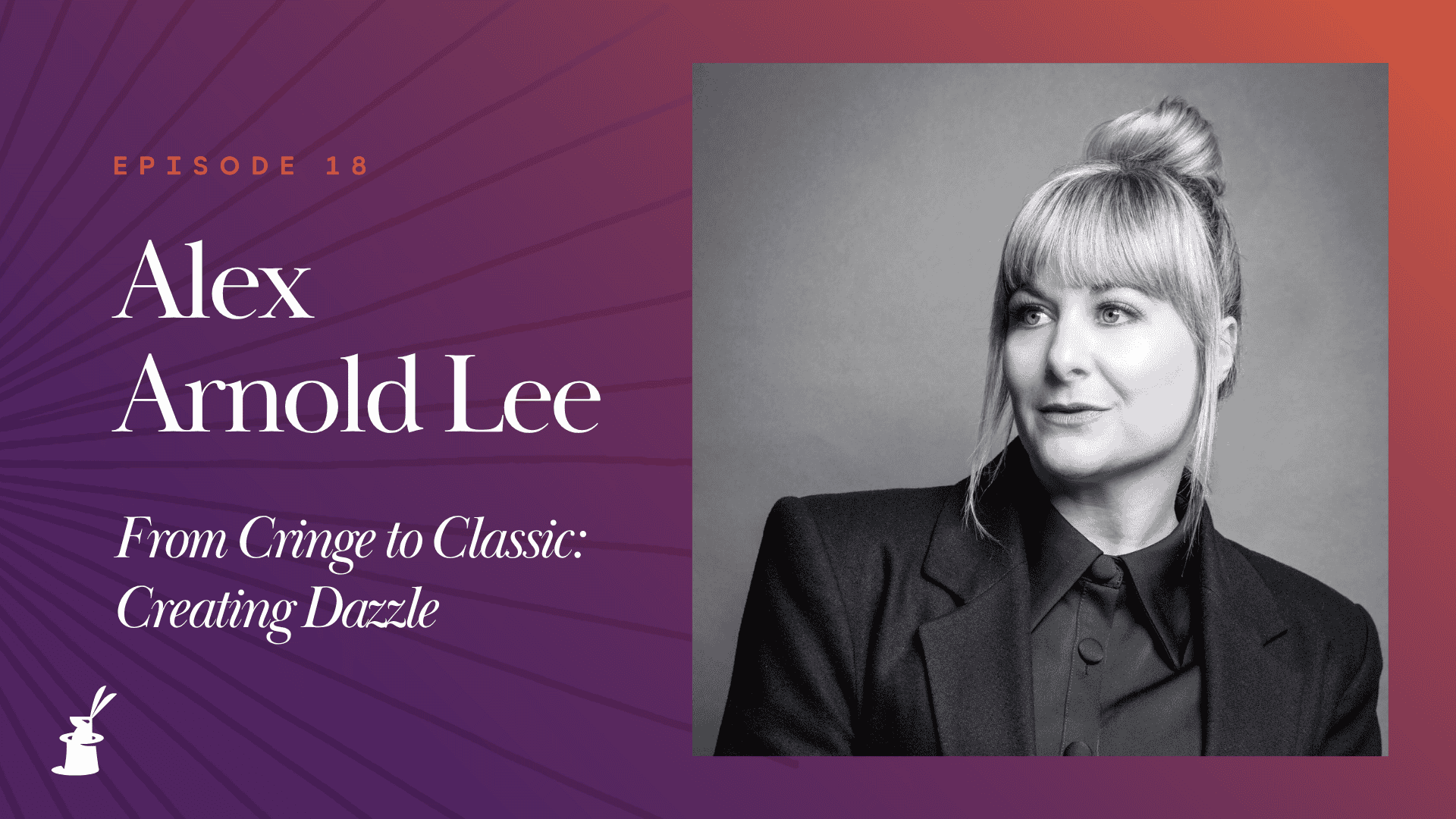
Alex Arnold Lee's path to becoming a children's book author was paved with sequins, birdseed, and a healthy dose of embarrassment. As a fourth-generation magician and the great-granddaughter of vaudeville legend The Great Leon, Alex seemed destined for a life in magic. But it took a truly cringeworthy moment in 2003—involving a broom suspension, a dated song, and a baby doll costume—to transform her into Dazzle, one of magic's most beloved comedy characters.
In 2025, Alex launched her children's book "Dazzle: The World's Worst Magic Assistant" at MAGIC Live, where she also delivered a powerful general session lecture titled "From Cringe to Classic." As a professionally-trained dancer, educator, and performer who has spent 20 years touring internationally with her father Les Arnold, Alex brings a unique perspective to both magic and storytelling.
During our conversation on The Magic Book Podcast, Alex shared intimate details about growing up in a magical family, finding her voice as a performer, and transforming her stage character into a children's book that celebrates being different, making mistakes, and dancing to the beat of your own drum.
Growing Up in Magic
For Alex, magic wasn't something exotic or unusual—it was simply family life:
"I don't think I ever knew anything different. It was just like some families eat dinner together at night. We did magic. We just always had magical things happening. And even as a kid, we would play, you know, like some people play dolls and I did, but we would also do like pretend magic shows."
These childhood games revealed an early love of performance, even if the magic itself was pure imagination:
"Meaning we didn't actually do magic, we would pretend the magic. I think it's hilarious. Like a Sub Trunk, we would stand on the coffee table and use a blanket and pretend we were doing this like fancy Sub Trunk, but you could totally see what was happening. And my dad and mom would just like play along."
Alex's father, Les Arnold, had discovered magic through a kit and learned from his uncle, making him a second-generation magician. But crucially, Les never pressured Alex to follow the family tradition:
"My dad always made magic just really fun. It was never a thing that I felt like I had to do. I really did enjoy it. As a little girl, I loved taking dance lessons, and dance and performance and stage was something that I just naturally gravitated to."
The Arnold family's approach to magic was notably relaxed. Les worked as a woodshop teacher during the week and built props, performing primarily on weekends. This meant magic retained its excitement:
"It never felt like it got redundant or it was always just, 'Oh, exciting! We get to do a show!' That's my dad's favorite thing: 'We get to do a show!'"
Finding Her Own Path
As Alex entered high school, dance increasingly took center stage in her life. She pursued it professionally, getting an agent and going on auditions. Magic became something else entirely:
"I realized, 'Ooh, I could go do this magic show for this other magician and show up and assist and make some really good money.' So for me, it was never like I wanted to be the magician. It was never that I wanted to, 'Oh, I just want to travel the world and just do magic.' It was there as a way to make a little extra money on the side while I focused on my bigger dream was dance at the time."
Alex's true passion lay in choreography and creation:
"I don't know what I wanted to do exactly, but I knew I loved choreographing. I think I'm a really good choreographer. I just love creating. That's where my passions lie, creating."
The Pivotal Moment
Everything changed in 2003 when Les was invited to perform during Mystics Week at The Magic Castle. He asked Alex, then in her early twenties, to assist him. What happened next in the family garage became the turning point of Alex's performing career:
"He said, 'Hey, you know, we have this show coming up. I really want you to assist.' It was only going to be maybe like for the Mystics Week at the [Magic] Castle. It was, I think he got like maybe a three- to five-minute spot, just really short. Wasn't going to be the whole show. And he's like, 'I think we should do the Broom Suspension.' Oh, man. And like, I just cringe at that Broom Suspension."
The situation deteriorated from there:
"It wasn't until he then pulled out his boombox and started playing such the cringeworthy moment, the song 'Up, Up and Away' by Fifth Dimension. And if you know that song, it was just so dated. I think the song came out like 1960s, 70s. And, you know, this was early 2000. And I was just, 'Dad!' Like, 'You couldn't be so any more far off from what's happening right now!'"
But the costume was perhaps the worst part:
"And then on top of that, the costume that he had for that trick was like a baby doll costume. So it wasn't even cool. Like I'm now in my early 20s and you want nothing more to be looked at as a little more of a sex symbol at this point. And instead I'm doing magic with my dad dressed as a baby doll."
Alex had to speak up:
"I just was like, 'Dad, this is hokey. This is like a Saturday Night Live sketch. We cannot possibly do this.' And it was that moment that it set us into the wheels spinning and let's think of something new. What can we do differently?"
The Confidence to Challenge
What gave Alex the courage to tell her father his act was terrible? She credits her upbringing:
"I think I attribute that to the fact that we were a family of three. I'm an only child. I never had to compete with any other kind of chaotic energy in the household. And we always called ourselves 'The Three Amigos' you know? And so I kind of always felt like I was part of like this team. And so I just always felt like, yeah, my voice mattered."
Equally important was how her parents received feedback:
"My dad listened. I think that's the difference. Some parents, I don't know, they might get angry or have a temper about it. My dad actually laughed when I was like, 'Dad, you cannot be serious.' And then I'm laughing. We find things funny. I think having more an approach with your children, having that sense of humor really allows for you to be candid."
Creating Dazzle
Alex and Les decided to pivot toward comedy, but their first attempt wasn't working. Alex played the assistant as disinterested and bored. That's when her mother, Charlee, made a crucial intervention:
"My mom was the one that said, that's what you're referring to, 'Oh, Alex, this is not even funny at all. You guys, this is not great.' That's when she said, 'I think you should play it like Lucy would. Just can't wait to get on stage.'"
The suggestion sparked Alex's imagination:
"To be honest, the minute she said it, the movie 'Strictly Ballroom' popped in my head. Like this wannabe Latin ballroom dancer meets stage magician, magic assistant. And I don't know, it was her prompt, but my imagination just took off when she said that."
Alex used a Method Acting approach without realizing it:
"I'm not an actress. So this was just a natural response. Like, 'Hey, maybe if I get into costume and like a look, more will come out.' I think it's called Method Acting, if I'm not mistaken. And I didn't really know what I was doing, but it was a really organic approach of like, 'Okay, I'm going to get into costume. I'm going to see what comes out.' And then once we played the music and in costume, just personality, little nuances. Yeah, it was just a natural response to her suggestion."
Opening Night at The Magic Castle
Mike Caveney's reaction to hearing about their comedy plan wasn't encouraging:
"When Mike - when my dad said what we were going to do, Mike just took this sigh. It was just like this - 'Ahhhh.' Like 'Like, I don't know, man' type of thing. And that puts doubt because you're already freaked out."
Alex and Les were so uncertain they brought backup costumes and music in case they bombed. The pressure was immense:
"Every peer from the Mystics, It was Mystics Week and his best friends. They've known me since before I was born because they grew up with my dad as teenagers. So then on top of that, now I'm this young adult and I have this extra pressure of we've got to deliver."
But something magical happened that opening night:
"And it was in that moment we knew we had an act, because they're doubled over laughing. As I was going back and forth through the wings, we could see them just laughing. And when we got off, Mike even said, 'Like, you guys, you just came up with a new act. That was brilliant. That was so great!'"
Who Is Dazzle?
For Alex, Dazzle represents something deeply personal:
"Dazzle is that girl that just wants so badly to be part of the act, part of something. I think we all are like that, you know, in a way of just wanting to belong and feel appreciated and to shine. The only problem is she just doesn't have a whole lot of talent. And she does not have charisma. And she's not that refined assistant that she so hopes and desires to be. But I think you fall in love with her because she's just unapologetic."
In many ways, Dazzle is Alex's aspirational alter ego:
"And for me, she represents everything I kind of wish I was. I happen to be very hard on myself in real life. I'm very critical. But I think that helps me, too. You know, they always say, like, your weakness is sometimes your superhero power. Because I have such a critical eye, I know what's funny."
Playing Dazzle has been therapeutic for Alex as a performer:
"When I'm Dazzle and this character, it's okay to make mistakes because it's almost sometimes funnier when she does. When a mishap happens, it's allowed me to kind of heal as an artist, like to embrace it."
The character embodies a family motto that has guided multiple generations:
"You know, my great-grandfather, The Great Leon, had a saying: 'If you can't be the best, be different.' And that has stuck with me. And in our family, I think time and time again, it's really hard to be the best. And us perfectionists struggle with that because it's what is perfect. You're never going to find it. But if you could just be different, unique, yourself, you find your own path. That's really what Dazzle's about. She found her own path. She totally dances and moves to the beat of her own drum."
From Stage to Page
Alex had long been drawn to children's books, spending time in bookstore children's sections and dreaming of writing her own. As a dance studio owner who taught children for 20 years, she understood young audiences:
"I love children's books. You will always find me in a bookstore in the children's section. I find them just completely magical. So for the longest time, I've always wanted to write a book."
But like many aspiring authors, she faced barriers:
"I think that's usually what stops people from writing the book that they so wish to write is the fact that, 'Well, I've never done it. I don't know what I'm doing really. How do you even get something published?'"
She wrote an early version of the Dazzle story but then lost the manuscript for several years. When she sold her dance studio and found the manuscript again, the timing was perfect—her daughter Frankie was eleven, the ideal age for her vision of Dazzle:
"I had forgotten about it. And I was busy. I had the studio and everything. But I sold the business. And it was at that moment that I was like, 'Oh, I want to do this. I have the time now to do this.' And right when that happened, weirdly, magically found it. And I was like, 'Oh my gosh! Okay, this is divine timing.' I believe in divine timing."
Frankie became Alex's muse:
"Just watching her and seeing her, and she really started to get heavily into dance by that time. I saw a little version of myself in her. And when I was deciding on the age that I wanted to represent, because I'm now in my 40s, I didn't want to write a children's book about some old broad dancing around the stage in her 40s, it just made sense that Dazzle would be Frankie's age, like an 11-year-old that's really starting out."
The Writing and Illustration Process
Alex's approach to writing the book was decidedly non-traditional:
"To be quite honest, it was a lot of trial and error and not knowing but do it anyway. So when I set out to figure out how to write a children's book, it's just context. reach out to people that have written books, pick people's brains."
She experienced what she considers divine intervention in a Barnes & Noble parking lot:
"I sat in my car praying. I'm a very prayerful person. And I was like, 'Lord, send me somebody, a mentor, something. I need the next direction. I feel lost. I feel like I'm meant to do this, but I don't know.' I was in the parking lot of Barnes and Noble, actually."
Inside the store, a woman approached her and asked if she was doing research as a children's author. This chance encounter turned into a six-hour conversation and an invaluable mentorship.
Alex's advice for aspiring authors:
"Just do just start do a little bit something each day that pushes you towards that main goal. So for me, it was go to Barnes and Noble, look around, find books, do some research. I would go on Pinterest. I would go to Instagram... You have to start talking to people and put it out there in the universe. Say, 'I'm writing a book.' Not 'I want to', not 'I hope to', but 'I'm doing this. This is what I'm doing.'"
Choosing Human Collaboration Over AI
While she could have used AI to generate illustrations, Alex deliberately chose to work with a human artist:
"I am an artist. I am a dancer. I am a choreographer. I love collaboration. I think dance is something that is so emotional and so communicative because you're with other people all the time. And writing is more of a solo mission. It can be a little lonely. I craved the conversation. I craved being able to collab with somebody on this."
She found illustrator Adam in Brisbane, Australia, after extensive searching:
"I had to go through great lengths to find him, a lot of just scrolling and looking at things. And I had Pinterest his artwork and actually had no idea that I pinned him and found him months later through a different avenue."
Their collaboration happened entirely through email due to the time difference, requiring Alex to articulate her vision clearly:
"The cool thing with Adam is that he really listened to what I was trying to convey. He really understood the vintage vibe I was going for. He really understood body language was important to me because of being a dancer. And Dazzle has such quirky body language. I wanted the drawings to represent her quirkiness as well."
The process took over a year, with countless emails exchanged. Alex was meticulous about details:
"When I say I'm very nit-picky, whoo! And to the point where we got the book almost finalized and I realized I did not like the look of the mother that he had done. And that was like early on in the first stages of character development. And I was so embarrassed that I had to go back and be like, 'Adam, I'm so sorry. She's bothering me. I just don't love her.'"
She sent reference photos, including images of her own family, and insisted on specific details:
"I would show photos of my real family. I would show photos of Frankie of a younger version. I was very adamant, even down to jewelry. 'She needs to have a bracelet on. You forgot the bracelet on this wrist.' I mean, just little nit-picky things."
Alex believes the human element was essential:
"I don't know that AI would really get it, you know? And the way he shades, his color choices, and just being able to have a human to talk about this with, I don't think it would be the same book. Not even I don't. I know it would not be the same book had I not used an actual artist to collab with."
Life Imitating Art: The Birdseed Incident
One scene in the book—involving birdseed left on stage from a dove act—actually happened to Alex during a performance:
"Amos Levkovitch, he's since passed, but he used to do a wonderful dove act. And my dad and I were doing a show where I think we were closing and he was on right before us. And the stage was a sea of birdseed."
Alex didn't realize the danger until it was too late:
"There's a moment where the music gets more upbeat and I come rushing on. I do a big high kick. When I did it, it was like a cartoon where you see the person slide on gravel or marbles. I slid like halfway across the stage, flew up into the air, landed on my back. The crowd went wild. So much humor, so much laughter."
Afterward, Amos asked her where she learned to do such a stunt. Alex's deadpan response:
"I just looked at him with a blank face and I just said, 'Birdseed.' And he got it. He goes, 'Oh my gosh, I'm so sorry.'"
The painful experience (requiring chiropractic visits) taught Alex an important lesson:
"I'll never forget that story. I had to go to the chiropractor a few times after that show. It was very painful, but it taught me that people like falling. So I added later in the show, like as I'm dancing a slip into the splits because the splits is a fall that I could do that gets a huge crowd please and it's funny."
MAGIC Live 2025: A Career Milestone
MAGIC Live 2025 became a landmark moment when multiple opportunities converged. Alex had been considering how to launch her book when Instagram changed everything:
"Had I not started a Magical Dazzle Instagram page, MAGIC Live wouldn't have known I had a book. And so they had seen it and said, 'Hey, this is really cool. Woman in magic. We should really look into this.' And so I got the call about maybe launching my book there."
She was invited not only to launch the book but also to deliver a general session lecture:
"And then on top of that, the icing on the cake was, 'And we think you should give a general lecture.' Well, of course I said 'yes' right away, but then after I said it, reality sunk in because I'd never actually done a lecture before."
Despite her extensive teaching experience, giving a TED Talk-style presentation was different:
"I've taught my whole life, and I've done lectures in dance classrooms, and I've traveled on dance conventions, so I'm used to speaking in front of large audiences. It wasn't that. It was the fact that it was like a TED Talk-style, and I'd never done that before. And it sent me, for the next few months of planning this lecture, I was a nervous wreck."
The convention also invited Alex and Les to perform in the gala show. Alex found herself managing a booth, a lecture, and a performance simultaneously:
"I barely ate the four days that we were there. And then to be honest, it ended on a Wednesday. I've never been so excited for a Thursday in my life. It was the best Thursday of my life when it was just all over, the feeling of accomplishment and true gratitude."
The Vulnerability of Being Yourself
For Alex, performing as Dazzle is actually easier than appearing as herself:
"Oh my gosh, the vulnerability when it's just you up there. Dazzle, I get to hide behind the quirky. I hide behind this facade and this character, the makeup and the wig, and Dazzle's like my alter ego. You know, Beyonce has Sasha Fierce. You know, I would say Dazzle's my alter ego."
She was caught off-guard by the camera setup during her lecture:
"I did not realize that they were going to have a camera on my face while giving the lecture the whole time. And that threw me for a loop because I thought, 'Well, you know, it's a big stage. I could look at my notes and people aren't going to see me.' And then I realized, 'Oh, no. My big old face is going to be behind me the whole time.'"
The experience helped people see Alex, not just Dazzle:
"To be honest, a lot of magicians don't even know me as Alex. They'll call me Dazzle. And sometimes people don't even recognize me as Alex. This was the first experience that I had in a magic setting where people started to recognize me as Alex. And that was very cool because often they don't even know me unless I'm dressed up."
The Grassroots Challenge
Self-publishing meant Alex became her own publicist, which she describes as the hardest aspect of the entire project:
"Holy moly, it is the hardest thing I've ever done! I think I would pick going and doing another lecture in front of 1,600 magicians. PR, it doesn't come as natural to me. It's hard to boast about yourself. It's hard to promote yourself."
Her practical advice for self-published authors:
"Learn to work Instagram. I've learned this, that it's not even about how many followers you have, it's about who's viewing. So I have some views that are in the thousands, but I don't have really that many followers. So at least people are viewing it. And I've gotten actually a lot of sales just because of Instagram."
Alex always carries books with her:
"I always keep my book with me. It is with me in a bag, and I have about 20 always in my car. And believe it or not, I've sold them to toy stores, to bookstores, just because I have them."
She emphasizes the importance of personal connections:
"Real human contact is the best way to do it. If you can meet someone and talk in person, if you can talk to someone on the phone, but sending an email and then just waiting and hoping that someone's going to reach back out. Often I've gotten some responses, but it really is about making those personal connections, a face to the name."
Her philosophy extends beyond just selling books:
"You're not just selling your book. You really are selling you. And I've noticed that people are really excited to help you out when you've built a friendship. When you've built a connection, they're more excited to see this thing grow than when they just think it's a book."
The Heart of the Story
Alex hopes young readers will take away an empowering message from Dazzle's story:
"I want them to know that all the things, all the little dreams, all the passions they have are doable. What's so hard is I think I was so lucky because I had two parents that really nurtured those dreams."
The book's central message resonates with Alex's own journey:
"The biggest message in the book is fall in love with your gifts. Fall in love with your God-given talents, the things that make you stand out in this world. And often when you embrace that, that is when you start thriving. That is when you start finding your people. When you really embrace who you are and your special gifts, I think that's when you start to shine."
This realization came to Alex later in life:
"It took me a long time to find that. When I was a kid, I just was trying to always fit into that mold. Sometimes I was just almost like weary of saying, 'Oh, I do magic with my dad' because it sounds hokey and embarrassing, unless you see the act and you're like, 'Oh my gosh, this is totally cute.' To me, it felt like, oh, this might be cringy or embarrassing. And then as I've gotten older, I realized how special and unique and I wish I would have embraced it even sooner."
Embracing the Cringe
Alex's lecture title, "From Cringe to Classic," encapsulates her philosophy about transformation:
"The cringe? Lean into the cringe. The cringe is where I think your vulnerability comes out. And it's not until you allow yourself to be vulnerable and to witness yourself making those mistakes that you can do the necessary means to change."
For children especially, she sees mistakes as essential learning opportunities:
"If someone makes a mistake, like, that's your best learning tool. This is when we grow our most. Okay, now ask the intelligent questions. 'Why? Why is this cringy? Why isn't this working? What needs to change? What could we do differently?' It's in those questions that you start asking yourself that I think all of those ideas, the wheels start turning and you can start creating maybe something really amazing."
The Next Generation
Alex's daughter Frankie performed with her parents at MAGIC Live, and while she enjoyed it, Alex isn't sure magic is in her future:
"Frankie is so comfortable on stage. And if you go look at 'Masters of Illusion' she, at the age of four, did help us one time. And afterwards I said, 'Did you like that?' And she said, 'Yeah.' And I go, 'do you want to do it again?' And she said, 'no.'"
Now thirteen, Frankie helped at MAGIC Live but seems more focused on competitive dance. However, Alex's five-year-old son shows promising interest:
"I have a son, and he's five. And he's very interested in magic. So him and Papa Les sit there, my dad mesmerizes him. And he will sit there and watch things. And he's the one that will say, 'Papa, show me magic.' So I don't know. We might have a little fifth-generation magician on our hands as he gets older."
Looking Ahead
Alex's vision for Dazzle extends beyond the book:
"I see her becoming a little bit more of a household name. That would be my ultimate dream. I would love for the Dazzle book to get in the hands of more children because I think more than anything the time right now we need to get off of computer screens and sit with humans and have conversation and what better way than laying in bed at night, reading to your children, having conversations about the books."
She dreams of expanding the Dazzle brand:
"I would love Dazzle to become a doll. That would be an ultimate dream. So I need to start looking into that. And who knows? Maybe even Dazzle-themed magic kit. That could be cool."
As an author, Alex is eager to continue writing:
"I would love to write more books. I would love to collab again with Adam. He made my vision come to life."
Beyond celebrating Dazzle specifically, Alex sees an opportunity to recognize an often-overlooked role in magic:
"I love the role as assistant. I love embracing that. And so I think we could highlight the importance of magician's assistance more so and celebrate them. I think that would be really cool, whether you're a girl or a boy."
A Cherished Legacy
When asked about her most cherished magic book, Alex chose one with deep personal significance:
"The thing I cherish most, it's a book that Mike Caveney wrote, you know, he's has written many. And he wrote it in 1987. So a while ago, I was still a little kid, there was only 1000 copies made. So it's a collector's item. And it's actually a biography about my great grandfather, The Great Leon."
The book connected Alex to family history she wouldn't have known otherwise:
"I love this book because Mike was able to delve into things that I don't think I would have ever known because he's a historian. He really loves history. He knows how to write in such a way that paints a picture. I mean, how many times have we read history books? and it's about people we don't really know, right? This is a history book that was written about my family member, one which I never met."
Connect with Alex Arnold Lee
Website: MagicalDazzle.com
Alex sells "Dazzle: The World's Worst Magic Assistant" through her Shopify store, along with themed merchandise including t-shirts, sparkle capes, wands, and magic-themed jewelry. She also creates box bundles with magic tricks for holiday gifts.
Other Locations:
Alex welcomes inquiries from bookstores, toy stores, and theaters interested in carrying the book and is happy to make personal deliveries when possible.
Resources
The Book: "Dazzle: The World's Worst Magic Assistant" by Alex Arnold Lee Available at: MagicalDazzle.com
Performances Referenced:
Masters of Illusion (TV show featuring Alex and Les Arnold)
MAGIC Live 2025 (general session lecture and gala performance)
Influences Mentioned:
Lucille Ball
"Strictly Ballroom" (film)
The Great Leon (Alex's great-grandfather, vaudeville magician)
Venues:
The Magic Castle (Hollywood, California)
Mystics Week at The Magic Castle
Timestamps
00:00: Family Legacy of Magic
02:17: Growing Up in Magic
03:37: Alex Finds Her Own Path
05:12: A Pivotal Moment
09:00: Speaking Up
10:37: Channeling Lucille Ball
12:26: Opening Night Nerves
15:05: The Birth of Dazzle
18:19: Creating a Children's Book
20:43: Influence of Family
22:54: Writing Process
25:34: Choosing Collaboration
27:49: Illustrator Connection
30:44: Timeline of Creation
32:37: Real-Life Inspiration
35:06: MAGIC Live 2025
39:14: Vulnerability on Stage
41:09: Next Generation
42:40: Grassroots Promotion
45:17: Message to Young Readers