
Introduction
The levitation changed everything. Watching from the wings of the Riviera Hotel and Casino in Las Vegas, a young circus performer found herself transfixed by something she'd never expected. She had seen Doug Henning on television as a child, but this was different. Barclay Shaw's illusion of a woman quivering under his control, floating midair, then rising inside a plexiglass box awakened something that would redirect the course of her entire life.
"Barclay Shaw's levitation tapped something inside me. It was just breathtaking."
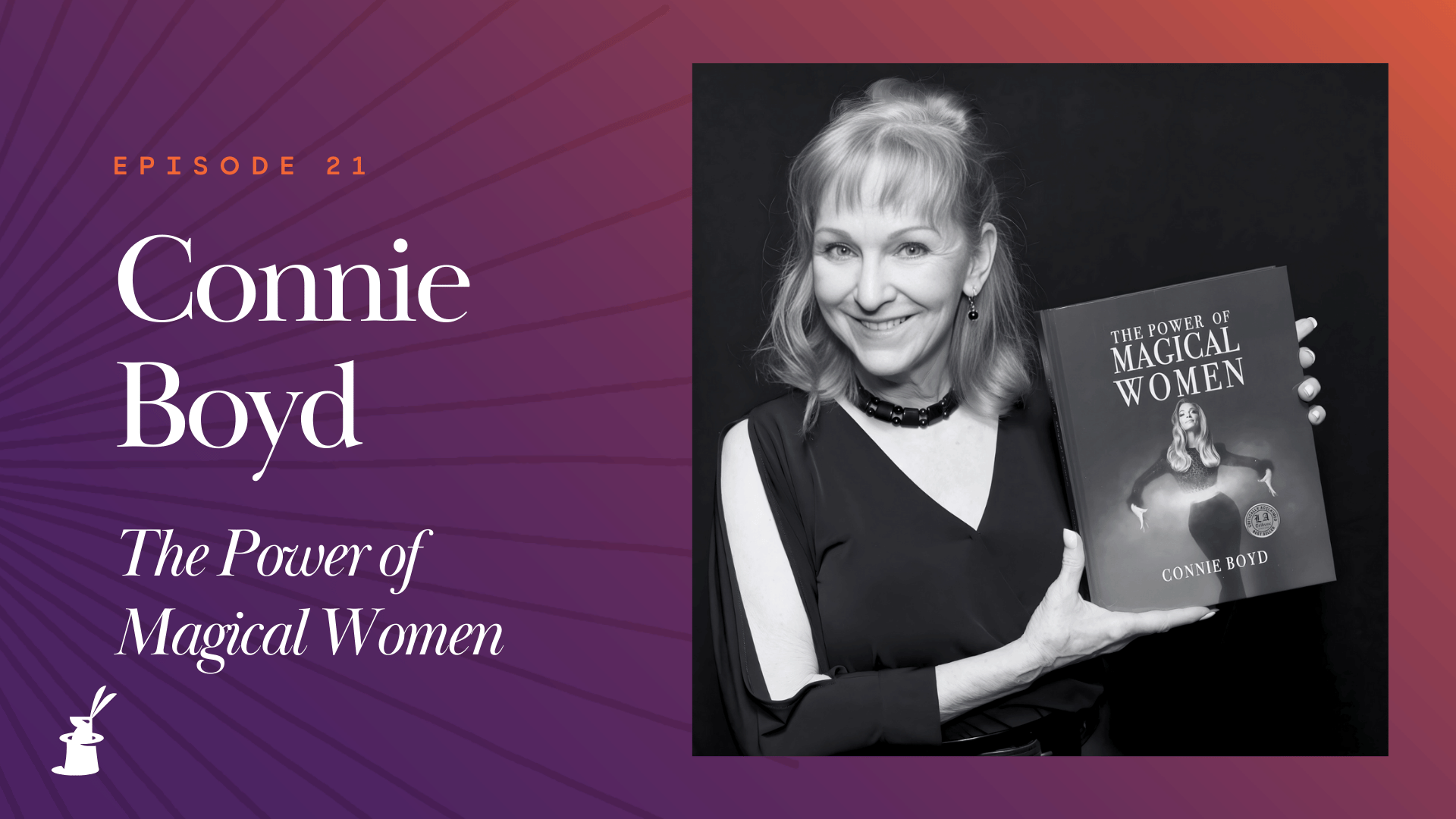
Connie Boyd had already survived the end of one dream and rebuilt from catastrophic injury. She would do it again, five times in total, before arriving at her current mission: documenting the largely untold stories of women in magic through her YouTube channel, her articles for VANISH Magazine, and now her groundbreaking book, "The Power of Magical Women," which profiles more than 70 trailblazing female magicians in what's being described as the first book of its kind in history.
The Circus Calls
Connie Boyd's path to magic followed a route that not even the great Max Maven could have predicted. Her childhood dream was ballet. She trained with the National Ballet of Canada in Toronto on scholarship, but severe pain in her ankles, pain she admits she foolishly ignored, eventually spread to her knees. By the time she sought help, the damage was done. Rehabilitation ended her ballet career.
Then an audition notice appeared on the board: a one-ring circus was looking for performers.
"I went to the audition not knowing anything about the circus, and I ended up getting the job."
Her parents were not amused. But the skills she'd developed as a ballerina—coordination, strong legs, theatrical presence—translated surprisingly well to aerial work. She learned trapeze, learned to juggle, and traveled with circuses across North America, to Japan, and Hawaii. The circus became her new world.
Then, at the Houston Astrodome, a piece of rigging snapped during a live performance. Connie fell, shattering both feet on concrete in front of families watching the show. Surgery followed. The right foot was worse than the left, reconstructed with pins. Doctors told her she would probably limp and have a collapsed arch. Connie said: "Send me to physiotherapy."
She rejoined the circus while still recovering, visiting physiotherapists in every city on the tour, determined to prove the prognosis wrong. Through sheer determination, she corrected her collapsed arch and eventually worked in heels without a limp. The setback that should have ended her performing career became instead a testament to what she calls the defining quality of her life: resilience.
The Girl in the Box
It was while performing with a juggling act in the Las Vegas production show "Splash" that Connie encountered Barclay Shaw's levitation. She watched him every day, from the wings or from the front of house, mesmerized by the theatrical beauty of the illusion.
"It never occurred to me to be the magician. But Barclay saw me every single day watching him in the wings or watching from the front, and he said, 'You know, if you like magic that much, you should be a magician.'"
The suggestion carried weight Connie wouldn't fully understand until years later, when she began researching the history of women in magic. Barclay Shaw himself had been inspired to become a magician by a woman, Cleopatra, whom Milbourne Christopher described on page 315 of "The Illustrated History of Magic" as "the best female illusionist that he had ever seen."
Cleopatra's story, as recorded by Christopher, reads like something from a novel. Originally Russian, she married a Greek magician and toured Spain during the era of the buzzsaw illusion. During one journey between towns, their vehicle was involved in an accident. The buzzsaw went through the cab of the truck, severing her husband's neck. In widowhood, Cleopatra became the magician, eventually performing at the Winter Garden in Berlin and touring the Caribbean.
"Representation matters," Connie reflects. "And when you see somebody that looks like you or that you aspire to, that can trigger something inside you."
Barclay Shaw came to Connie's first magic performance and built her one of her earliest pieces of magic: a small screen that produced a duck. Because of his encouragement and his own story of being inspired by a female magician, Connie changed career paths once more.
An Expensive Education
The transition to magic was not smooth. Connie invested all her savings into creating her first act, assembling what looked like a winning team on paper: a manager, a magic consultant, a prop builder. What she lacked was knowledge.
"I didn't have knowledge. I didn't understand the type of magic that would suit me. I didn't do my research. I really came in on the left foot."
The prop builder constructed equipment that didn't work. Her first choreographer stood on a prop and fell through the base. It was, in her words, "a fiasco." But the expensive failure taught her a crucial lesson: she had to be responsible for her own work, do her own due diligence, and understand what she wanted as an artist.
She asked friends in the industry a simple question: who is the best magic consultant you know? Everyone gave the same answer: Don Wayne.
Don Wayne was David Copperfield's magic consultant, responsible for some of the most memorable effects associated with David Copperfield's name. Connie called Don Wayne, explained her predicament, and asked for help. Don agreed to meet her, examined her equipment, and gave her a test: three single-spaced lines of tasks to complete before his return in two weeks.
"I worked day and night. I sewed, I went to welders. I did things I never thought I could do. And when he came back, I had completed my list."
Don became a mentor and close friend until his passing. He encouraged her to build her own equipment, create her own mockups, and develop signature material that would help her stand out in a market where the world's best magicians competed with massive budgets. Through Don Wayne, Connie met Joanie Spina, David Copperfield's director and lead assistant, who would become her best friend.
When Connie developed a new routine called "Floating and Flying," which combined a Don Wayne floating ball with her own aerial skills, Joanie came to see it. Connie thought the routine was excellent. Joanie had other ideas.
"Joanie looked at it, and she came back and said, 'I'd like to restage and redirect the entire number.'"
Joanie put Connie in a minimal leotard that showcased her dance and acrobatic background, found the perfect music, and restaged the entire piece. When Connie flew up to retrieve the floating ball, the audience responded with what she calls "the magic gasp."
"And when you have 1,500 people go 'aaaaaah,' it moves you. And you got them. And that's that wonder, that awe, that curiosity, all of those elements, they were in that piece of magic."
Building an Empire, Then Losing It
By 2000, Connie had become a Las Vegas headliner, winning Best Cabaret Magician at the World Magic Awards, the Mandrake d'Or in Paris, and a Special Fellowship from The Academy of Magical Arts at The Magic Castle. But she noticed the industry shifting. Budgets were shrinking. Husband-and-wife magic teams were becoming the norm, economical arrangements that didn't work for a solo female illusionist with professional assistants.
She pivoted to international work, where her visual magic, effective even without language, found enthusiastic audiences in Europe and Asia. Cruise lines noticed. Soon she was consulting on magic production shows, teaching dancers to perform illusions, learning to teach magic "like choreography" so trained dancers could learn quickly.
By 2016, she had three production shows running simultaneously: "Illusions," "Chicks with Tricks" (featuring predominantly female talent), and her original award-winning show "The Beauty of Magic." Then she broke her femur in Italy, requiring a hip replacement that ended her stage career as she'd known it.
The injury became an opportunity to step back from performing and focus on directing, mentoring, and producing. She trained new magicians for her shows, built relationships with talent from around the world, and maintained a demanding schedule, until March 2020.
When the COVID pandemic hit, Connie was in Italy training a Ukrainian magician on a new act. She had three ships coming in from the Caribbean and South America with magicians aboard. Getting everyone home became a logistical nightmare.
"It took 47 days to get Terry Lee Aspeling home … from Italy to South Africa, because there were deaths on her ship because of COVID."
With her shows sitting on ghost ships in the Mediterranean or warehoused in Italy, Connie found herself with abundant skills but nothing to do. She made a decision that would define her next chapter.
Documenting What No One Had Documented
"I determined that there wasn't a place that was documenting women in magic. And I thought, 'Well, wouldn't that be splendid?'"
With everyone in lockdown and performers who were normally impossible to reach suddenly available, Connie launched a YouTube channel called "Magical Women with Connie Boyd." She began interviewing legendary performers: Tina Lenert, Diana Zimmerman, Fay Presto. The list grew and grew.
What she discovered surprised her: there was no other place in the world that had systematically documented these women. The channel became a free resource and a personal mission. The pressure she put on herself to produce content while everyone was accessible resulted in more than 300 uploads, interviews, mini docu-series, and vintage performance footage of magicians like Celeste Evans and Susy Wandas.
Paul Romhany, founder and editor of VANISH Magazine, invited her to write monthly articles. She wrote from 2020 through the following years, never imagining where the work would lead. Then Paul noticed something she hadn't.
"He said, 'Connie, do you know you've got enough here that you could write a book?'"
The Power of Magical Women
The book that emerged gathers more than 70 profiles of female magicians, combining reimagined VANISH articles with new connective writing and over 200 photographs. Connie rewrote every article in her own voice, reaching out to each magician to verify accuracy. Her editor, Marianne Ward, deliberately chosen from outside the magic community, helped structure the content into six chapters organized not by genre but by theme: women using magic for social change, women breaking barriers, women incorporating storytelling, and rising stars.
"I wanted to expand the stories of these women in magic beyond the magic community. Because I think the stories are really important. They're motivating and they're inspiring."
Securing permissions for the photographs took more than half a year. Each living magician had to confirm they owned their images or could properly credit the photographer. Connie believes the images are as important as the text.
"They say 'a picture is worth a thousand words,' and these images really support the stories that we are trying to tell."
Margaret Steele, author, historian, producer, and previous guest on The Magic Book Podcast, became what Connie calls her "silent partner" on the project. It was Margaret who encouraged indie publishing, allowing Connie and Paul to produce the book they envisioned rather than a version shaped by commercial publishers.
The Los Angeles Tribune awarded the book its "Critically-Acclaimed Bestseller" label and announced its submission for a Pulitzer Prize at the live-streamed launch event. For Connie, the recognition belongs to everyone featured in its pages.
"I figure I won. And I think all of the women included in the book feel that they've won, just being seen and being heard."
A Discovery That Rocked Her World
When asked about her most cherished magic book, Connie reaches for a stack she's prepared. She acknowledges the recent wave of excellent historical work: Charles Greene III on Ionia, Kobe Van Herwegen on Susy Wandas, Michael Claxton on Dell O'Dell, Margaret Steele on Adelaide Herrmann, and Lance Rich's "Neon Dreams," which revealed that Gloria Dea was the first magician to perform on the Las Vegas Strip, an 18-year-old woman in 1941.
But her choice surprises even her: "The Modern Conjurer" from 1903, by C. Lang Neil.
"This book rocked my world. I was doing some research and I discovered just through an image; I went, 'That looks like a woman's hand.' And it is."
The book is filled with photographs of a woman demonstrating and teaching magic to male magicians. Her name was Mademoiselle Patrice. She was the author's wife, trained by Charles Bertram, and skilled enough that Bertram trusted her to cover his shows when he was out of town. She performed for royalty. Yet her story had been largely forgotten, evidence, Connie notes, of how thoroughly women's contributions to magic have been overlooked or reduced to footnotes.
Looking Forward
Connie's book tour has taken her to The Magic Castle, where she received a Special Fellowship for the Magical Women project; to Hocus Pocus in Fresno, where she signed all 150 copies of the collector's edition; to The American Museum of Magic in Michigan, where she presented her talk in front of Harry Houdini's authentic Milk Can Escape; and to the Chicago Magic Lounge, where she performed for the first time in nearly a decade.
A second book is already in development with Margaret Steele, focused on the historic women in magic, those from the 1800s whose stories were omitted or reduced to footnotes. Their stories, and many others, are waiting to be told.
"We need to keep magic peeling the onion, to expand artistically and, you know, intellectually. And so it's really important."
The woman who once wanted to be a ballerina, who fell at the Houston Astrodome and shattered both feet, who stood in the wings of a Las Vegas casino watching a levitation that would change her life, has found her ultimate role: giving voice to the women whose magic has been overlooked, forgotten, or never recorded at all.
Books and Publications Mentioned
Connie Boyd's Works:
"The Power of Magical Women" (2025)
Classic and Historical Texts:
"The Illustrated History of Magic" by Milbourne Christopher (1973)
"The Modern Conjurer" by C. Lang Neil (1903)
"Modern Card Manipulation" by C. Lang Neil (circa 1904)
"Isn't It a Wonderful Life?" by Charles Bertram (1896)
Recent Historical Works on Women in Magic:
“Ionia: Magician Princess Secrets Unlocked” by Charles Greene III (2022)
“Suzy Wandas: The Lady with the Fairy Fingers” by Kobe Van Herwegen & Christ Van Herwegen (2020)
"Don't Fool Yourself: The Magical Life of Dell O'Dell" by Michael Claxton (2014)
"Adelaide Herrmann: Queen of Magic" by Margaret B Steele (2011)
"The Great Boomsky: The Many Lives of Magic's First Black Superstar" by Margaret B Steele (2024)
"Neon Dreams: The Story of Las Vegas Magic" by Lance Rich (2023)
Resources
Listeners interested in exploring Connie Boyd's work and the Magical Women project can visit:
Book website: https://www.thepowerofmagicalwomen.com
YouTube channel: https://www.youtube.com/@MagicalWomenwithConnieBoyd
Production shows: https://www.connieboydmagic.com
VANISH Magazine: https://vanishmagic.com/index.html
Timestamps
00:00:22: Introduction to Connie Boyd and her career achievements
00:02:24: From National Ballet of Canada to circus performer
00:04:18: The fall at Houston Astrodome and recovery
00:05:45: Discovering magic through Barclay Shaw's levitation in Las Vegas
00:07:28: Cleopatra and the importance of representation
00:10:29: Investing savings in magic and the "expensive education"
00:11:58: Meeting Don Wayne and Joanie Spina
00:14:20: Creating "Floating and Flying" and the magic gasp
00:17:17: International career and transition to producing
00:20:44: Breaking her femur in Italy and stepping back from performing
00:22:45: COVID pandemic and getting performers home
00:24:14: Launching the Magical Women YouTube channel
00:27:09: Paul Romhany's suggestion to write a book
00:28:48: Criteria for including profiles in the book
00:33:15: The painstaking process of securing photo permissions
00:35:51: Margaret Steele's guidance and indie publishing decision
00:37:53: The Los Angeles Tribune book launch and Pulitzer submission
00:43:53: Response from the magic community
00:49:33: Reactions from readers outside the magic world
00:51:08: Upcoming book with Margaret Steele on historic women in magic
00:52:37: Most cherished magic book: "The Modern Conjurer" and Mademoiselle Patrice
00:55:54: Where to purchase "The Power of Magical Women"
00:58:36: Online resources for the Magical Women project