
Introduction
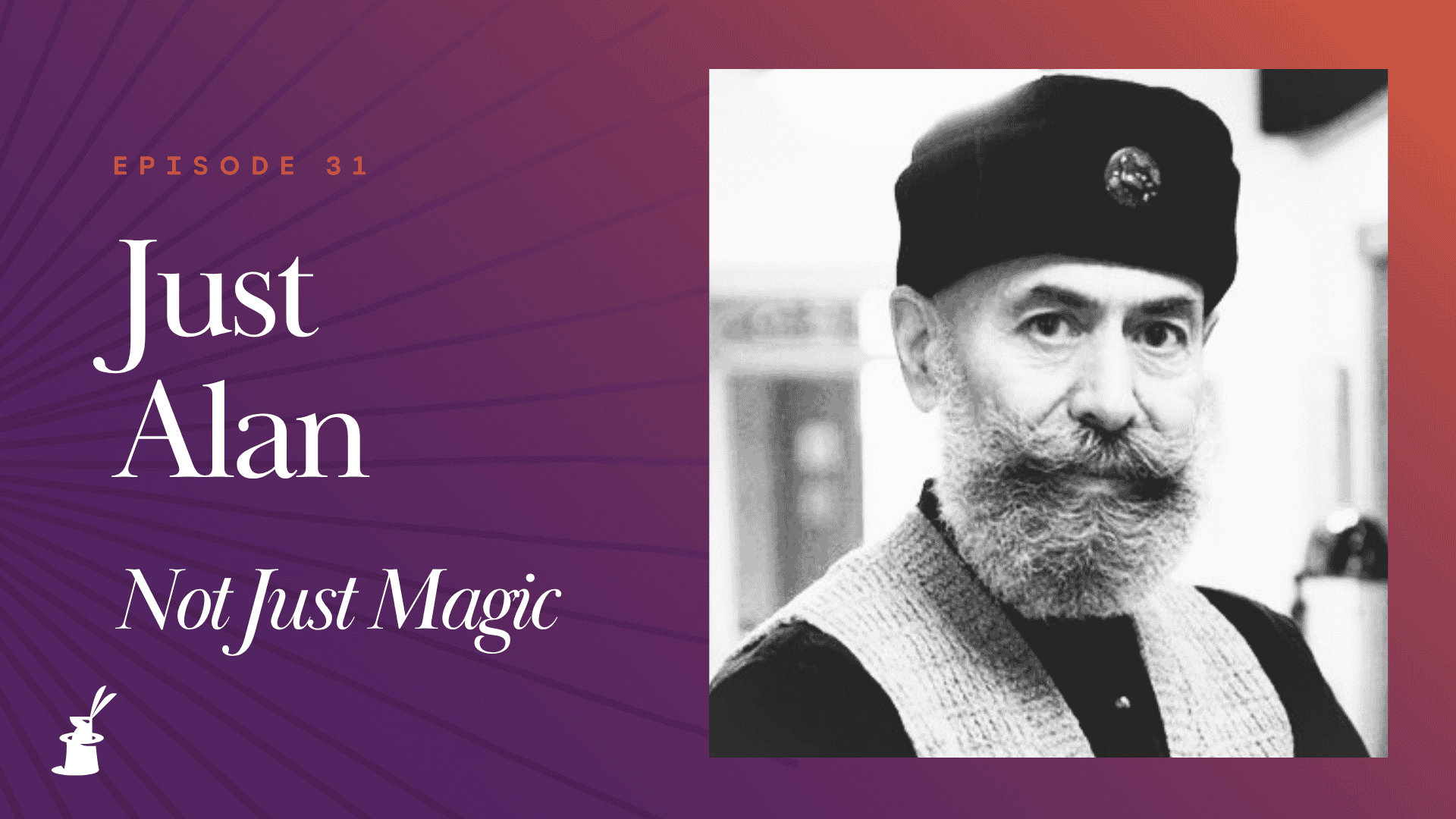
Alan Eisenson is known professionally simply as Just Alan. For many years he was the resident magician of Woodstock, New York, where he and his wife Juliette ran a store that sold, as he puts it, everything people did not need but things people really liked. A magic department and a café grew inside it, and for decades that store served as a laboratory where Alan could test an idea on real strangers, day after day. His work is now collected in "Just Alan - Not Just Magic," a limited archival edition written and illustrated by Jay Fortune, edited by Dr. Larry Hass, with a foreword by Jeff McBride and an afterword by Brad Henderson.
A sponge ball in junior high school
Alan was nine or ten when he first saw magic tricks, and he is clear that those were not what got him. What got him happened at a new junior high school, where another boy vanished a sponge ball. The boy was not a performer or a professional. He was another kid, and what Alan noticed was his hands.
"He was a kid, but he had all the ingredients of a magician. And it was that moment being right there in front of him."
What followed was less a career decision than a slow accumulation. Alan performed at birthday parties, worked shows for the S.A.M. and the I.B.M. as a kid, and later built a performing life within a fifty or sixty mile radius of home, doing private work that supported the store rather than chasing convention bookings. He describes himself as a performer who was never quite inside the magical world of performing, even after more than twenty shows with Jeff McBride. Among the work he mentions with the most feeling is a program he set up at rehabilitation centers for young people one step away from jail, where he made up small magic kits for each kid.
At sixteen, Alan's father signed him out of high school. He was the only person in his entire family network who did not finish high school, and the only one who did not go to college. What his father said to him on the way out turned out to be the shape of everything after.
"Alan, you'll be successful at whatever you do. Your life's work will be finding out what that is."
Alan's verdict is that it gave him freedom, though not ease. Separating from school friends and going into the working world as a young man was hard. What followed was a run of jobs and time to think about each one, which he now describes as the foundation of becoming a successful person, and he is careful to say he does not mean that only in monetary terms.
India, 1971
In 1971, Alan took a year and travelled around the world. India is the place he returns to. He watched bodies burning on the funeral pyres at Varanasi and recorded a message home on a little Norelco tape recorder, telling his parents that the people who had so much less than his family seemed happier than they were with everything. He still holds that to be true. He asked a shopkeeper how long the business had been running and was told five hundred years.
"It kind of gave me the look that life is finite and you got to get on with living your life."
The store as laboratory
Back home, Alan and Juliette, whom he had met in Madrid while travelling, opened their European-styled store in Woodstock. Magic arrived almost by accident. Tom Heyman, who owned a local magic shop called Skulduggery, used to sit in Alan's café sketching on napkins, and when he decided to retire he asked Alan whether he wanted the business. Alan describes the moment as a lightning bolt. He moved the inventory in, took the contacts, and built a magic department that ran for years, with photographs of visiting magicians set under the glass on the café tables.
What the store gave him was repetition in front of real people. It was also where Werner Reich walked in one day, watched Alan demonstrate something at the front counter, and told him about a convention he called Mystery School. Reich then told him he had learned magic in Auschwitz, from a magician named Nivelli who had the bunk above his own. Alan applied, was accepted, and the visit reshaped his sense of what magic could carry.
Transcending technique
The phrase at the center of the book, and of a lecture Alan gave at Mystery School in 1998, is transcending technique. His argument starts from a claim about the audience, which is that no matter how skilled a performer becomes with cards, coins, silks, or ropes, nobody sees the method. If method is invisible, then the thing an audience actually receives is whatever else the performer has built around it.
"Let's get beyond just showing somebody a puzzle and frame it so you're giving people a magical experience."
The practical questions follow from that. What did you love about this effect, and what can you bring to it? Music, a script, slides, video. Alan's own answer has been personalization, telling a story about his own interests and life and bringing the audience into it, so that the magic arrives as punctuation rather than as the point.
The framework he uses came from his friend Frankie Lumia: visualize, internalize, actualize. Visualizing means using imagination to see what you want to happen. Internalizing means bringing that fantasy into reality by scripting it and building the context it lives in. Actualizing means taking all of that and putting it on its feet. Alan adds a fourth step that he is emphatic about, which is recording yourself. He worked in front of mirrors as a young man and found them insufficient, because the moment you walk away you cannot remember your own expressions or the turn of your hands.
Magic made from a life
Almost every routine in the book comes from Alan's own life. It was not a strategy so much as a gradual discovery, and over the last twenty years or so he has performed almost nothing else. His presentation of the Needle Through Arm, discussed in the book by Brad Henderson, grew from hitchhiking three thousand miles through Kenya and Tanzania. Sitting under a tree waiting for a lift, he noticed his arms, feet, and face swelling, with no idea whether he had been bitten or poisoned. A truck driver who spoke only Swahili got him to a village clinic fifty kilometers away, where he waited his turn and finally reached a doctor who was picking her teeth with a hypodermic needle.
Dad's Trumpet began with a container of little discs sitting unused on a shelf in his studio, and a photograph of Houdini that Zelig Hammer had given him and that happened to be propped nearby. Love, Aunt Doris came from a real aunt who gave him two dollars every birthday until he was about forty, and a mother who gave him five. When Alan saw Bill Pryor's effect at a convention, he knew immediately what it would become.
"That happened almost instantly - which it rarely ever happens instantly, but I knew that it would be something."
Where the truth ends
Alan is unusually candid about the fact that these true stories contain invention, and about where he thinks the boundary sits. The line, for him, is when a story drifts too far from the real facts. Dad's Trumpet is his own example. The little stops he tunes in the trumpet are not how a trumpet is tuned at all, and the story of his father tuning the instrument backstage for Harry Houdini is something he built. What anchors it is that his father did play, and could have worked at the Hippodrome. He has performed the piece perhaps a thousand times for audiences that included famous Woodstock musicians, and nobody has ever questioned it.
In the Sands, he never saw the routine performed in India. In the Africa story, the detail of smelling a jar of liquid that put him into a state is invented, laid over an experience that otherwise happened exactly as he tells it. What he says he gets from working this way is not a technical advantage.
"When I perform my magic and I'm telling true stories and maybe adding a piece here or there, it brings back such an emotional surge in me."
The Sands of India
As a boy, Alan hung out at Lou Tannen's magic shop, and on Saturdays, after Lou closed at four, the magicians went down to the Automat to session while the kids watched from the background. Afterward Alan would go to Hubert's Flea Circus on 42nd Street, where he saw a performer called Congo run around the stage with a galvanized bucket, a can of water, and beach sand, banging things around and finally taking the sand out dry.
"It was the most magical thing that I had seen in a long time."
He carried it for thirty years. He bought sand and left it on a shelf. He saw other magicians perform Sands routines and found that none of them had what Congo had. When he finally started thinking about what he might do with it, the sand reminded him of India, and the piece assembled itself out of things already around him: Japanese rice bowls, brass jugs, and a display sense built from a lifetime working in retail.
The rest arrived through people. Robert Starer, a contemporary composer and a customer of the store, agreed over coffee to record the voiceover and warned that at his age he had perhaps two takes in him. Two takes is what it took. Gail Carr put gold crests on the bowls. Zelig Hammer built a table that collapsed for travel and made the props Alan needed. The glass bowl in the routine is his mother's salad bowl, which his brother's partner Nancy went into the house and fetched after Alan mentioned he still needed one. Frankie Lumia sat through the rehearsals telling him to smile and move his hand. Alan estimates a foot of printouts, edits, and edits.
The finished piece went to Mystery School first, where they ran it for the evening. Alan describes it as a perfect match for him, written for himself, his own interpretation of what an Indian fakir would be doing while a man watches from a train window, surrounded by a crowd. He took it to the Society of American Magicians national stage competition in 1997, having been told by two people he trusted that he could not possibly win. He won.
"I loved performing it. I loved creating it."
Playing a character from another culture
In The Sands, Alan plays an Indian fakir and does not speak. He is direct about the question this raises. He remembers magicians of his youth taking on Chinese personas and mimicking them into caricature, and he draws a firm distinction between that and what he is doing.
"I don't want to be a caricature. I want to be an actor who's playing a part."
His reasoning is that he is not making fun of anyone, that the character in the piece is producing a miracle and delivering a warning about water for future generations, and that he would be careful about which personas he would take on at all. He has never had negative feedback, and he still ends on caution rather than reassurance, advising anyone playing a character from another country to be mindful of the audience and of how it plays.
The Three Treasures and Tarot Theater
Alan knew Daido Roshi, the head monk at Zen Mountain Monastery, because he taught Kyudo there with his teacher Shibata Sensei. That relationship is what let him ask directly whether a magical piece on Zen Buddhism would be offensive. Daido told him to go ahead. The piece that followed uses slides of Japan and a voiceover, and the search for the right voice took Alan first to Eido Roshi at Daibosatsu, whose accent proved too strong for an American audience, and then to Jeff Shapiro, a potter famous for his work and married to Alan's Japanese teacher, whose reading was exactly right.
Tarot Theater came later, and Alan is careful about what he claims for it. He does not believe cards or numbers or stars can tell anyone about their life. What he offers is a theater production and a sincere reading, using handmade prompt cards made only for him, incense, books, statues, and crystal balls, and a wealth of experience reading people gathered across a lifetime in retail. He has people write out their question, because he cannot answer it himself, though he can interpret the cards in light of it. At the end he gives a small gift that grants a wish, with instructions to put it under the pillow and be careful what they wish for.
"I'm never telling people what they should do or could do or can't do."
An email from Blackpool
In 2020, Jay Fortune wrote to Alan. He had seen Alan perform The Sands once, in 2007, and it had stayed with him. Alan is emphatic that this was not luck.
"I'm not a believer in luck. I'm a believer in opportunity and selecting opportunities out of life."
Jay asked whether he had ever written a book. Alan said no. Jay asked whether he would like to, and Alan said absolutely not, because it meant computer work and felt like self-promotion. They corresponded. Alan sent a tape, liked the vibe, and asked for a Zoom call. They did one, in 2020, and it remains the only one. They have never spoken on the phone and have never met in person.
Ava, Alan's daughter, came in after the first few years. She helped him with the computer work, moved material around, kept track of what had changed on which page, and made it possible for him to get his own words onto a screen and off to Jay. Before that, she and her friend Isaac Klein, a director who has written a book on acting, had spent years working with Alan on a one-man show. Ava is an actor, trained at Boston University, and Alan describes the family as a team that grew up together in the store and still functions as one. Larry Hass edited the book, and Jeff McBride, Brad Henderson, and Bryce Kuhlman all contributed to it.
"So, how was it working with my daughter? One of the greatest experiences a man could have."
The show that never happened
The one-man show, five years in development, was booked for five performances in the spring of 2020. Four weeks before it opened, the theater cancelled. Alan had an hour and twenty minute show that was seamless, with the script, the videos, the voiceovers, and every element ready. When he called Ava to tell her, she asked how he felt. Alan said "Relieved!"
His explanation is that the work itself is what interests him. He had already done the show in his own mind, and having it complete was the accomplishment. He allows that he was disappointed for a few moments, and then returns to the same position, which is that the applause is nice but he did not need it.
Books
Alan's most cherished books start with “The Tarbell Course in Magic,” bought as a young man, from which he believes anyone could build a life's work. In the shop, the books he loved and sold to serious people were “The Books of Wonder.” He saw Tommy Wonder perform several times and counts him a hero. He also names “The Encyclopedia of Impromptu Magic” by Martin Gardner, and for children coming into the store, “The Klutz Book of Magic,” which he liked because it gave a young reader the story of magic, the props to start with, and things they could actually accomplish.
What's next
Alan is open to guest appearances where the experience would be new to him, and willing to travel for those, though he has no interest in racking up conventions or lectures. He would like to take on a few new magic students, particularly young people who have already developed a style that he might help refine. He plays table tennis twice a week, goes to yoga once a week, and is building a private park.
"The only thing that's real is this moment that we're having right now."
Just Alan spent six decades building a body of work from the material of his own life, and the result is magic that no one else could perform. This conversation traced that method from a sponge ball in a junior high school hallway to a piece of theater that won a national competition against the advice of two people he trusted. It also followed the unlikely path by which that work became a book, written by a stranger who saw a single performance and remembered it for thirteen years. What comes through most clearly is Alan's conviction that the work itself is the reward, and that everything else is punctuation.
Books and Publications Mentioned
“Just Alan - Not Just Magic,” written and illustrated by Jay Fortune, edited by Dr. Larry Hass, foreword by Jeff McBride, afterword by Brad Henderson (Jay Fortune, 2026)
“The Tarbell Course in Magic,” by Harlan Tarbell (Louis Tannen, 1941; originally issued as a correspondence course, 1928)
“The Books of Wonder”, by Tommy Wonder and Stephen Minch (Hermetic Press, 1996)
“The Encyclopedia of Impromptu Magic,” by Martin Gardner (Magic, Inc., 1978; originally published in Hugard's Magic Monthly from 1951 to 1958)
“The Klutz Book of Magic,” by John Cassidy and Michael Stroud (Klutz Press, 1990)
Resources
“Just Alan - Not Just Magic” is an archival edition, complete with links to online presentation videos, sent worldwide with complimentary shipping and available exclusively from Jay Fortune's Conjuring Archive: https://store.jayfortune.co.uk/product/just-alan
Alan Eisenson by email: JustAlanmagic@verizon.net
Magic and Mystery School: magicalwisdom.com
Zen Mountain Monastery: zmm.org
Timestamps
00:00:04 Cold open
00:00:31 Introduction
00:02:30 First seeing magic, and the sponge ball in junior high school
00:03:48 Starting to perform, private work, and magic in rehabilitation centers
00:06:39 On being a seeker
00:07:26 Leaving high school at sixteen
00:09:29 Travelling the world in 1971, and India
00:12:56 Opening the store in Woodstock, and magic arriving by accident
00:15:09 The store as a laboratory, and meeting Werner Reich
00:18:27 Transcending technique
00:21:39 Visualize, internalize, actualize, and video as the great teacher
00:25:09 Building routines from his own life
00:26:16 Needle Through Arm and the journey through Africa
00:30:18 The origins of Dad's Trumpet
00:32:12 Where a true story ends and invention begins
00:36:22 The Sands of India, from Hubert's Flea Circus to the S.A.M. competition
00:45:23 Playing a character from another culture
00:48:01 The Three Treasures and Daido Roshi
00:51:59 Tarot Theater
00:56:22 The email from Jay Fortune
01:03:13 Working with Ava on the book
01:07:01 The one-man show that never reached the stage
01:09:27 Most cherished books
01:10:50 Where to find the book
01:11:23 What's next
01:13:32 Outro