
Introduction
Harry Houdini spent thirty years buying books. He bought them on tour, through agents, by post, and in bulk from libraries that were about to throw them out. By the time he died on Halloween 1926, the collection filled every corner of his townhouse in Harlem, and his wife Bess was having difficulty keeping housekeepers on staff because of it. Within a year, that collection had been divided, sold, and dispersed across the country, and for the better part of a century nobody could say exactly how it happened.
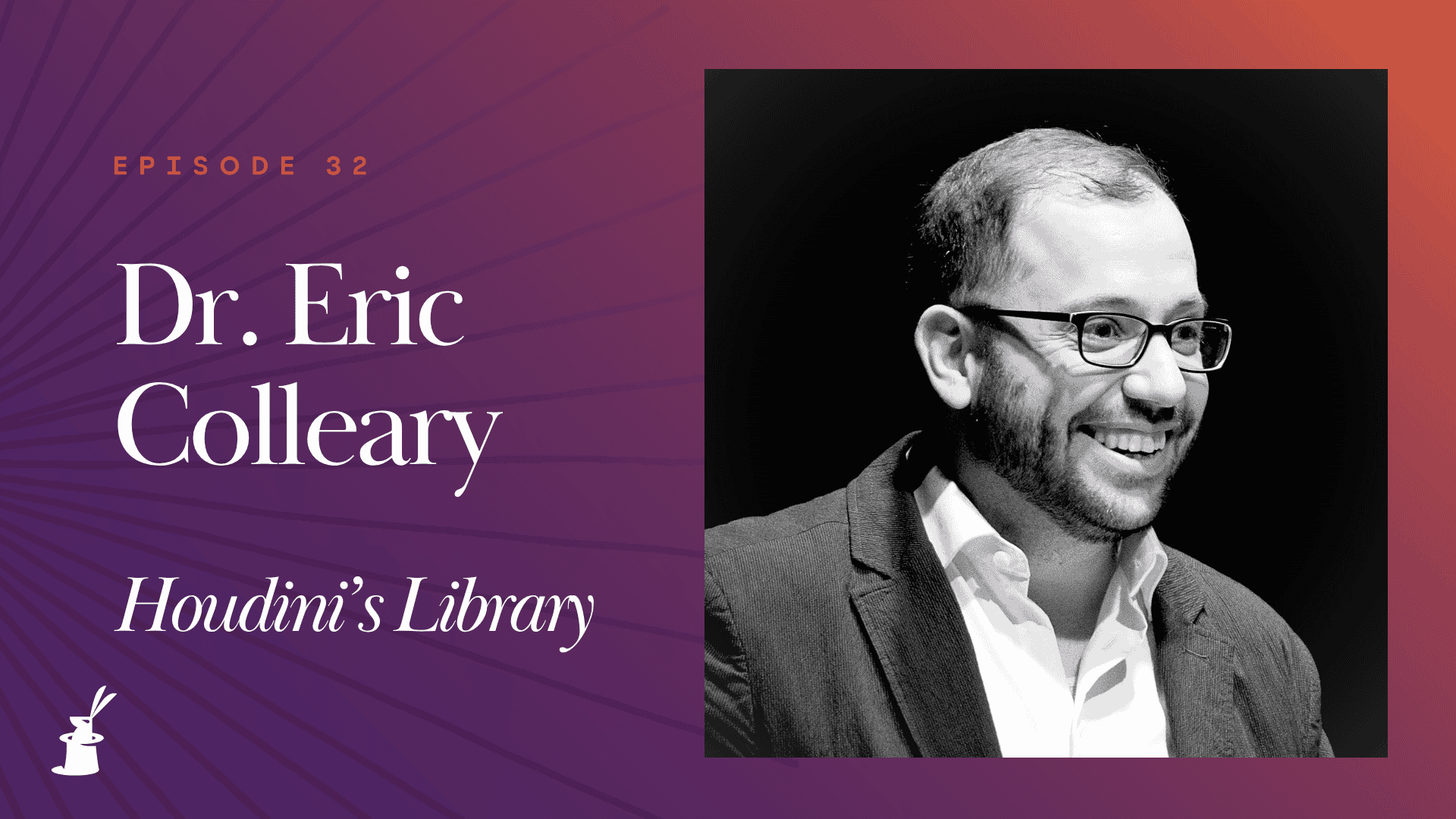
Dr. Eric Colleary can. He is the Cline Curator of Theatre and Performing Arts at the Harry Ransom Center at the University of Texas at Austin, where much of what Houdini gathered has been held since 1958. His new book, “Houdini's Library: Inside the Spellbinding Collections of the Great Illusionist,” published by Abbeville Press, is the first study of that collection, and it accompanies an exhibition of the same name now open at the Ransom Center.
A curator, not a performer
Eric did not arrive at magic the way most guests on this podcast did. His earliest memory is of his grandfather, who died when Eric was five, calling him over to his chair and pulling coins from his ear. After that came the David Copperfield television specials, and the realization that magic ran from coins in the hand all the way up to making the Statue of Liberty disappear. He trained as a theatre director and stage manager, worked in that world for years, and then took a doctorate in theatre historiography with a minor in museum studies. The curatorial job at the Ransom Center opened up, and Eric has held it ever since.
That background shapes how he reads magic. Eric makes the case that the golden age of magic and the technological upheaval of the nineteenth century are the same story told twice.
"It's not a coincidence that the golden age of magic coincides with so many technological innovations in the 19th century."
Travel and communication were accelerating so fast that societies had to agree collectively to standardise time. Photography could capture images from nature. People could fly. Voices could cross continents in real time.
"And so, when you think about it in that way, it's not so far-fetched to imagine that perhaps one could communicate with the dead or saw a live woman in half."
The collection nobody had counted
The Houdini material had been at the Ransom Center since 1958, and it was popular from the first day. Kenneth Silverman worked there. So did Jim Hagy, a previous guest on this podcast. Ricky Jay came. And yet, as Eric explains, the collection had never been properly inventoried. The books had been catalogued, but the collection spanned so many subjects that it had been split across other holdings. Houdini's opera material sat in the general opera collection. His material on other actors sat in theatre biography. There were rough inventories that a determined researcher could navigate by reading several of them together, but none of it was online.
The obstacle was not funding alone. Cataloguing it properly meant closing it, and none of Eric's predecessors had been willing to do that. He was. The Ransom Center announced the closure publicly, ran a month-long Houdini celebration first, including a cooking class built around Houdini's favourite recipes, and then shut the collection for two years while the archivist Amy Armstrong worked through it. Eric is careful to say what that actually costs: it is a full-time staff member's working life for two and a half years, plus boxes, folders, photo sleeves, and conservation treatment on material that is falling apart from age, at an institution that charges nothing for access or admission.
What came out of it changed Eric's understanding of what he was holding.
"It also helped me realize the extent of what Houdini collected, the importance of the collection to his life and his profession."
Why a working magician starts buying books
Houdini was a voracious reader long before he could afford to be a collector. There was no public library in Appleton, Wisconsin when he lived there, and most of the books in the house were his father's theological library. He got proper access only after the family moved, and then he skipped school to read adventure stories and books on magic. He could eventually recite passages of “The Memoirs of Robert-Houdin” from memory.
The turning point came in 1902. Back briefly from touring for his birthday, Houdini bought a copy of Thomas Frost's “The Lives of the Conjurers,” and found it riddled with errors. He had met enough of the old-timers by then to know. The anger stuck, and he resolved to assemble a collection large enough to let him write a better and more accurate version. Houdini said so in letters, in editorials, and in magazine articles that named the offending book directly. A couple of years later he met the Victorian collector Henry Evanion, and understood that the truth was not only in books. It was in posters, playbills, letters, scrapbooks, and photographs.
From there the collecting became something closer to a compulsion. Houdini worked mentions of his library into correspondence about entirely unrelated matters. He advertised for material in the classified pages of the New York Times. He told reporters he was looking forward to retiring so he could spend his days with his wife among his books. And he was not one of those collectors whose purchases stay in the box; he knew what he had.
Houdini reportedly stayed up until four in the morning reading and going through boxes. He sold duplicates back to dealers, partly for the money and mostly to make room. And when the room ran out anyway:
".... sometimes he has to sneak material into the house through the basement so that Bess doesn't get upset about it."
The librarian in the attic
Houdini went further than most collectors: he hired a librarian who lived in the house. Alfred Becks was an old-time theatre agent and producer, one of the elderly father figures Houdini was drawn to throughout his life, and a living link to the great actors of the nineteenth century. Becks had previously organized the theatrical library of the Boston collector Robert Gould Shaw, who donated it to Harvard and became the first curator of what is now the Harvard Theatre Collection.
Becks was in poor health, and Houdini was warned against hiring him. He hired him anyway, which gave Becks an income and a roof. Becks took a room on the top floor of Houdini's Harlem brownstone, dressed in a full suit every morning, ate breakfast in his room, and walked across the hall to spend the day organising playbills, identifying prints, and cataloguing books. When Houdini was touring, Becks bid on his behalf at the New York auction houses, and the surviving catalogues carry his notes on what went to Houdini, who else was bidding, and what they paid.
Becks worked for Houdini for around five years. Eric recently found a letter suggesting he collapsed in the attic while Houdini was on tour, was hospitalised, and died shortly afterwards. Houdini paid for the funeral and the burial and wrote tributes in several publications. He wouldn't have a librarian like that ever again.
The dealer relationships Becks had built outlived him. Material kept arriving on account, and after Houdini died it was Bess who had to deal with it. Oscar Teale, Houdini's secretary, did not have Becks's grasp of theatre history, but he knew the magic side thoroughly and did a great deal of his own research in Houdini's collection. Teale also wrote one of the earliest published profiles of the library, which is part of how we know what was in it at the time.
A wartime bargain
Among the dealers Houdini worked with, Maggs Brothers of London was the most important, and it is still trading today. Houdini cultivated his booksellers deliberately. He visited them on tour, gave them complimentary tickets, and befriended them properly, knowing the relationship would work both ways. From Maggs came the Cagliostro and Diamond Necklace documents, David Garrick's 1751 travel diary, tour letters of Charles and Ellen Kean, and a first edition of Reginald Scot's “The Discoverie of Witchcraft.”
The Scot still has its receipt. Houdini paid a little over £22.00 in 1917, roughly £1,900, or $2,700 today, plus 14 shillings for war insurance because the book had to cross an Atlantic where ships were being sunk.
"I think it was a steal of a deal, even at the time!"
Houdini got a customer discount from Maggs on top of it, as the accompanying letter shows.
Books that grew
One of the real revelations of Eric's book is the extra-illustrated volume, a nineteenth-century practice also known as Grangerizing. Houdini would take an early English translation of "The Memoirs of Robert-Houdin," have it disbound, add blank pages, and mount playbills, photographs, prints, letters, tickets, and advertisements onto them. A single printed volume could become an eight-volume set that existed nowhere else. Houdini made a few himself and acquired hundreds more from other collectors.
An hour too late
Houdini had tried for years to meet the German magician Wiljalba Frikell, whom he credited with putting magicians into black tie and tails rather than sorcerer's robes. He was turned away repeatedly. When he finally reached the house, Frikell had died about an hour earlier. Houdini was led into the bedroom, where the body was still warm and a bottle of rubbing alcohol stood beside the bed from the attempt to revive him.
"You would think that Houdini was exaggerating this story, except there's so much material in the collection that actually documents that moment."
He photographed himself outside the house that day. He kept the telegram he had sent Bess when he was first refused entry. Madame Frikell gave him a note that had been in her husband's pocket, a straight pin he often wore, and a quantity of his posters, photographs, and playbills. Eric points out that the gift was not unusual, even if the circumstances were. Elderly magicians and their descendants gave Houdini their collections regularly, because they recognised him as someone who would keep the histories alive.
The Queen's necklace
Visitors to The Harry Ransom Center usually walk straight past a body of material on the Diamond Necklace Affair, the 1780s fraud that helped turn French opinion against the monarchy. The Ransom Center holds Jeanne de la Motte's handwritten memoirs, original legal documents from the court case, and an open letter from Cagliostro to the people of France proclaiming his innocence.
Eric spent about two years unable to explain why Houdini owned it. During Houdini's lifetime the material was always described as evidence of the collection's breadth. The real answer turned out to be Cagliostro himself, whom Houdini saw as a kind of proto-spiritualist and whose portrait hung above his desk. The proof was an interview Houdini gave the New York Times Magazine roughly two months before he died, in which he explained that he had bought the documents in order to reach his own verdict on the case. Asked about the contradiction between admiring Cagliostro and debunking the very tricks Cagliostro performed, Houdini answered that there were few other honest livings available at the time.
What happened after 1926
It was Henry Ridgely Evans who first urged Houdini to leave his collection to the Library of Congress. The will looked simple enough. Magic and spiritualism books to the Library of Congress, the drama library to Bess. What followed was chaos, and it is the question that started Eric's research in the first place.
The Librarian of Congress visited Bess at home in April 1927. She identified the magic library as the books in the big bookcase at the back of the house, and the spiritualism library as the books piled on the floor of the front room. That is what Washington took: over five thousand volumes and more than a hundred and twenty scrapbooks.
"It was really spatial. It was about where things were."
Bess wanted out of the house. Leo Rullman, a friend of the family and a familiar figure in the New York magic book trade, offered to sell the dramatic library for her, and by January 1927 had produced a dated description of it. A note on the surviving copy, now at the New York Public Library, records that her expectations were higher than he thought he could deliver. In May she sold to Messmore Kendall, a real estate developer who years earlier had been outbid by Houdini on a bookcase that once belonged to the actor-manager Augustin Daly. Kendall came for the bookcase. He left with the bookcase, everything in it, and more than thirty crates besides.
The consequence only became clear in January 1928, when the Library of Congress opened its Houdini collection and Evans was first through the door, hoping at last to see the Cagliostro material Houdini had never let him near. None of the posters were there. No playbills, no photographs, no letters. Becks had filed all of it with the dramatic library, arranged alphabetically by performer, and it had gone to Kendall.
How Texas got it
Harry Ransom, an English professor who became president of the University of Texas and then chancellor of the UT system, had decided in the 1940s that a great research university needed a great research library, something on the order of the British Library. Conan Doyle's papers were bought in the 1950s and 1960s, which is why the two men's collections now sit under one roof despite how their friendship ended.
Kendall, meanwhile, had kept Houdini's material in his apartment above the Capitol Theater in Times Square. In 1957 he wanted to retire to Florida and approached the New York Public Library first. Its drama curator George Freedley had neither the money nor the space, but he knew who did, and he steered the collection to Texas. The donor, vaudeville impresario Karl Hoblitzelle, said no at first, having recently bought a large theatre photography collection already. It took a trip to New York to see the material in person. Once there, they found an entire further room in Kendall's apartment that nobody had accounted for.
Pinholes and punch marks
The Ransom Center has conservation labs for paper, books, and photography, and they have been busy ahead of the exhibition. A three-sheet poster for “The Man from Beyond,” one of the only surviving colour posters for the film, has been treated. So has a Hardeen one-sheet that appears to exist nowhere else and arrived in six pieces after decades folded in storage.
Eric's approach to conservation will interest anyone with material of their own. The Ransom Center rarely restores an object to how it looked when new, because the marks it has picked up since are evidence. Pinholes prove a poster was actually hung rather than sitting in stock. The tags at the bottom record where a performer played, on what dates, and what the tickets cost, and some collectors remove them to get a clean image.
"We want the writing, we want the stories."
The book, the exhibition, and one bookcase
Two publishers turned the book down before Abbeville took it, both of them uneasy about a heavily illustrated volume running to seven hundred images. A friend made the introduction to Abbeville, who have been producing books like this for over fifty years and did not hesitate.
As for the exhibition, Eric calls the choice of a single highlight a Sophie's choice, then picks the object at the centre of the room. It is Augustin Daly's bookcase, the one that held Houdini's dramatic library and the one that brought Messmore Kendall to Bess's door in 1927.
"If it wasn't for this piece of furniture, the whole collection probably would've been broken up and sold."
Asked what single item from the Ransom Center's holdings he would put into a listener's hands, Eric chooses a run of letters rather than a book: Houdini's correspondence with Bess.
"These letters offer an unfiltered look at the real man."
He is equally keen that people understand these collections are not sealed off. Anybody with a photo ID and a sense of curiosity can walk in and use them, at the Ransom Center, at the Library of Congress, and at other major research libraries. The exhibition itself is free.
In this episode, Eric Colleary describes how a theatre historian came to spend a decade inside the private library of the most famous magician who ever lived. He explains why Houdini collected, who helped him do it, and what it cost him. He traces the collection's dispersal after 1926 through Bess, Rullman, Kendall, and Hoblitzelle to the shelves in Austin where it sits today. And he makes the case that the story of a collection is inseparable from the story of the person who built it.
Books and Publications Mentioned
“Houdini's Library: Inside the Spellbinding Collections of the Great Illusionist” by Dr. Eric Colleary (Abbeville Press, 2026)
“The Discoverie of Witchcraft” by Reginald Scot (1584)
“The Memoirs of Robert-Houdin” (First in English by Geo. G. Evans in Philadelphia, edited by Dr. R. Shelton Mackenzie, 1859; concurrently in London by Chapman and Hall, translated by Lascelles Wraxall)
“The Lives of the Conjurers” by Thomas Frost (Tinsley Brothers, 1876)
The Unmasking of Robert-Houdin by Harry Houdini (The Publishers Printing Company, New York, 1908)
“Early English Conjuring Collectors: James Savren and Henry Evanion” by Jim Hagy (First self-published in 1985; expanded, revised edition by Reginald Scot Books, 2020)
“Houdini!!! The Career of Ehrich Weiss” by Ken Silverman (HarperCollins, 1996)
“The Queen's Necklace: Marie Antoinette and the Scandal That Shocked and Mystified France” by Frances Mossiker (Simon & Schuster in the US; concurrently by Victor Gollancz Ltd in the UK, 1961)
Resources
Houdini's Library exhibition, Harry Ransom Center, University of Texas at Austin. Free admission, Tuesday to Sunday, through January 24, 2027. hrc.utexas.edu
Dr. Eric Colleary's website: stagestories.org
Abbeville Press: abbeville.com
Wild About Harry, John Cox's Houdini blog: wildabouthoudini.com
Harvard Theatre Collection, Houghton Library: https://library.harvard.edu/collections/harvard-theatre-collection
McManus-Young Collection, Library of Congress, part of the Rare Books and Special Collections: https://www.loc.gov/research-centers/rare-book-and-special-collections/collections/selected-special-collections/
Timestamps
02:28: Eric's earliest memory of magic
03:24: What the Harry Ransom Center is
04:33: Magic and the technological upheaval of the nineteenth century
06:07: A famous collection with no proper inventory
07:51: Closing the collection for two years
10:19: What the cataloguing revealed
11:23: Why Houdini started buying books
13:34: The depth of the obsession
15:56: Alfred Becks, the librarian who lived in the house
17:19: What happened to Becks
19:16: Oscar Teale
20:39: Maggs Brothers of London
21:29: A first edition, twenty-two pounds, and war insurance
22:57: Extra-illustrated volumes
24:03: Arriving an hour after Wiljalba Frikell died
25:57: The Diamond Necklace Affair
27:52: The Cagliostro connection
30:15: The chaotic dispersal after Houdini's death
35:33: What the Library of Congress holds, and what Texas holds
37:33: Conan Doyle, Harry Ransom, and how the collection reached Austin
41:08: The balance between magic, spiritualism, and theatre
43:56: Leo Rullman
45:04: Inside David Copperfield's collection
47:47: What the conservation lab is treating
49:45: How Abbeville came to publish the book
50:48: What not to walk past in the exhibition
51:34: The one thing Eric would put in your hands
53:54: What changed since the 2018 essay
55:07: What's next