
Introduction
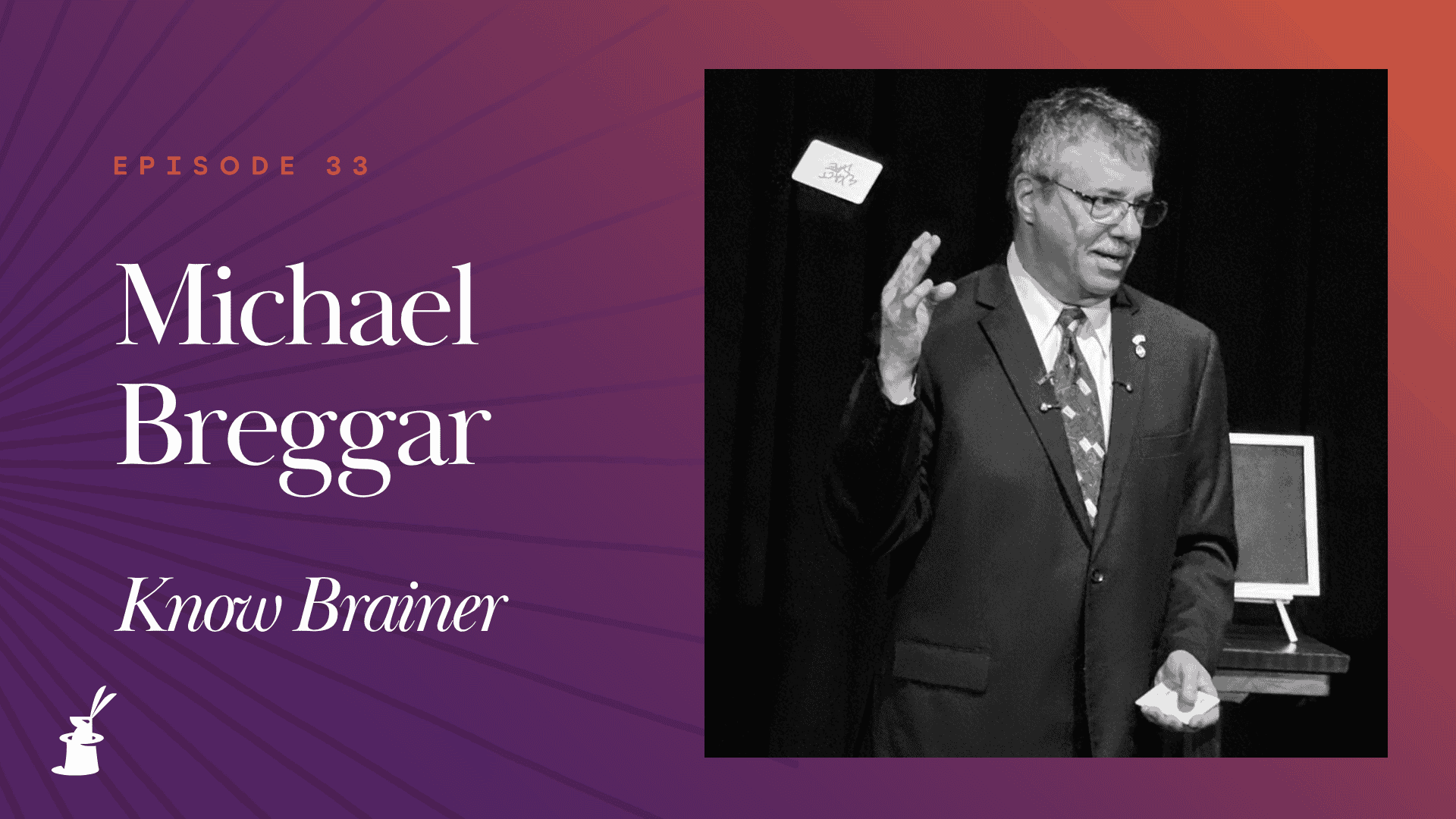
For nearly twelve years, Michael Breggar has written a monthly column for The Linking Ring, the journal of the International Brotherhood of Magicians. The column is called "Auto-Magic." It argues that tricks needing little or no sleight of hand still need clever construction and a performer who knows how to entertain. It has won an award, drawn letters from some of the most respected writers in magic, and fed eight self-published books.
His ninth book, Know Brainer, is his first with a traditional publisher. Published by H&R Magic Books, it runs to 474 pages and collects more than 35 routines of comedy mentalism, with introductions by Marc DeSouza, Marc Salem, Marc Paul, and Mark Strivings. Before all of that, Mike spent close to thirty years as a management consultant in the life sciences and taught at Temple University's Fox School of Business. He is also now the editor of a revived edition of The Phoenix, one of the best-loved magic periodicals of the twentieth century.
A Martian on Saturday mornings
Mike's interest in mind reading began with a sitcom. On My Favorite Martian, Ray Walston's Uncle Martin could levitate objects, turn invisible, and read minds by rubbing his temples. Even as a boy, Mike could picture the strings behind the levitation. The mind reading was harder to explain, and it stayed with him because it needed no apparatus. The actors simply said their lines.
"Their gimmick was the script. And they pulled it off, at least to this kid growing up in Philadelphia."
Saturday mornings also brought Mark Wilson's Magic Land of Allakazam and, in Philadelphia, Mr. Wizard right after it. As a teenager, Mike became a weekend regular at two Philadelphia magic shops. Jack Chanin, a "grizzled" magician, told customers what they ought to buy. Kanter's, a block and a half away, looked like a jewelry store, with glass cases at the top of a flight of stairs and racks of books along the back wall. Mike spent most of his time at that back wall. His early purchases included Tanner and Dean's The Mentalist and Tannen's reproduction of Annemann's The Jinx, which he read on his bedroom floor, the spot usually reserved for comic books.
Two other teenagers were Kanter's regulars. They nodded at each other for years without becoming friends. Decades later, Mike learned they were Marc DeSouza and Marc Salem, two of the four performers who would write introductions to Know Brainer. His first attempt at a Q&A act, at summer camp, bombed. He thinks mentalism needs a little sage wisdom behind it, whether it's played seriously or for laughs, and that's hard for a teenager to supply.
A question that became a column
The column began while Mike was a partner at a large international consulting firm, spending his evenings in New York hotel lounges with a burger, a Diet Coke, and an inbox full of ads for self-working miracles. He had always found self-working tricks the hardest to perform. Without close attention to presentation, they turn into mechanical rituals.
Late one night he emailed the I.B.M.'s president to say that somebody ought to curate these claims. The message went to Sammy Smith, editor of The Linking Ring, who replied the next day asking for three articles. Mike called the column "The Pencil Dot," after the tiny mark a card magician makes on the edge of a card. Sammy asked for a new title. A week later, back in the hotel lounge, Mike landed on the pun: "Auto-Magic." He expected the column to last ten months.
Then the letters arrived. Jon Racherbaumer wrote to congratulate him and warned that some months his mind would be as blank as the page. He offered to send occasional notes on style, and the notes came every month. Harry Lorayne helped Mike find his voice. Lorayne usually disliked anyone tinkering with his tricks, but he made an exception for Mike because of the jokes.
From self-publishing to H&R Magic Books
Self-publishing made Mike his own writer, editor, layout artist, and distributor.
"I was okay with just writing the books, but I'm a terrible proofreader by myself. I could read my manuscripts 1,000 times and on the 1,001st time still find typos!"
At Fechter's Finger Flicking Frolic, the invitation-only close-up convention known as 4F, Charlie Randall of H&R Magic Books asked whether he was working on anything new. Mike said he wanted a well-printed hardbound book and no part of the distribution. Charlie told him that is what a publisher does. Mike had already started a book of stand-up and parlor mentalism, built around a comedy Q&A he developed in the early 2000s and had long called "Know Brainer." H&R took on the layouts, the printers, and the proofreading. Mike is quick to add that it was still an awful lot of work.
Is comedy mentalism even a thing?
The book opens with that question. Mike's answer starts with Annemann, who in the drawings in The Jinx always looks as though he has a migraine. Mike admires the technique of serious mentalists. He also believes magicians are entertainers, and that mentalism depends on the audience more than any other branch of magic.
"It's not like doing a silent act on stage with The Miser's Dream where you just keep plucking coins outta the air or a rope trick. I mean, you need minds to read."
He points to Larry Becker, Richard Osterlind, Lee Earle, and Marc Salem as performers who visibly enjoy their work, and whose audiences relax because they do.
The turning point came from Groucho Marx. Watching You Bet Your Life, Mike realized that the quiz mainly gave Groucho people to talk to, and that the show worked as a quiz and as a comedy at once. A Q&A act could do the same. One compliment he values came from a well-known, very serious performer. He doubted the book applied to him, then phoned a few weeks later to say it had shown him he didn't need to be a comedian. He just had to listen and respond, which is exactly what Groucho did.
The executive board
Mike calls his four introducers his executive board. He sends them half-formed ideas and asks whether he's overdoing it, gilding the lily, or making a method too obvious.
"And I'll just throw those ideas out there. And it's kind of like sessioning, but not with a completed trick. You're sort of sessioning with the rudiments of the effect."
The routine readers keep singling out, Un-Scene, began after Mike watched Marc Paul perform an effect in a video lecture. Five spectators each choose a scene card (a library, a restaurant, an auto mechanic's garage) and imagine themselves inside it using all five senses before Mike reads their minds. The method draws on Marc Paul, Larry Becker, and Jack Yates, and Mike asked Marc's permission before publishing it. Mark Strivings, whom he met at MINDvention, is his model for research and crediting, and Mike urges anyone putting tricks on paper to do the same.
Three acts, every time
The Know Brainer Q&A is built in three acts, like everything Mike performs. He came to the idea through Syd Field's book on screenwriting: roughly a quarter for the beginning, half for the middle, and a quarter for the end. The middle is where the process happens, and when the process takes over, the trick goes flat.
"You don't want the process to become the focus of the trick because then it becomes boring. And way, way too many self-working tricks are like that. Way too many."
When audiences walk away talking about the math, it means they weren't following the story. Mike applies the same structure to a whole act, looking for changes in texture so a set never offers three versions of the same plot. He has lectured on the subject at 4F, where Boris Wild told him afterward that the room needed to hear it. He also has a request for listeners: after twelve years of deadlines, he would welcome submissions of good sleight-light tricks for "Auto-Magic."
A chicken from the pocket
The props in Know Brainer include Lego bricks, paper plates, sweatpants, lottery tickets, and eggs. Mike enjoys the incongruity of a performer in a fine suit pulling a chicken out of his pocket. He still loves the brightly painted U.F. Grant apparatus he bought at Kanter's, and he admires the methods of propless mentalists, though he can't watch more than ten minutes of it because the texture never changes.
"I want somebody to entertain me. I'm going to sit down in my seat and for the next half an hour or an hour or whatever, however long the show is, I want to have a good time. I want to laugh."
The Phoenix rises again
In July, at a House of Magic show in Philadelphia, Paul Romhany and Nick Lewin joined by video to announce that Mike would edit a revived Phoenix, published as a magazine within VANISH. The original launched in 1942 to pick up where Annemann's The Jinx had left off. Its editors were Bruce Elliott and Walter Gibson, the prolific writer behind The Shadow pulp novels. Every couple of weeks, subscribers received a few pages in a business envelope. Mike points to the Benson Bowl and the seed of Paul Curry's Out of This World among the classics that first appeared in its pages.
Mike reads old magic periodicals the way you'd read a book, from the first page to the last. He prizes the original Phoenix for its material and for the Back Room, the editors' page of tips and comment. His version updates routines from the original, adds one new piece written in the old style, and revives the Back Room with Nick Lewin's help. The first issue appeared in August and continues the original numbering at issue 401, picking up from the last issue Karl Fulves edited in 1965. Part of the fun is giving the old material something it often lacked.
"They never gave you scripts to work with, just a couple of words to say where you needed to say certain words. A lot of the writers, they weren't great writers. They were great magicians and great thinkers, but they weren't great writers."
Cherished books and what's next
Mike's most cherished books begin with The Mentalist, which he still rereads, and Bruce Elliott's Classic Secrets of Magic, the first real magic book he owned. He also chose Harry Lorayne's The Magic Book, Scarne on Card Tricks, and Mark Wilson's Complete Course in Magic.
Know Brainer is available from magic dealers worldwide and direct from H&R Magic Books. If you email Mike, he'll sign a copy and send it at the $65 cover price with free shipping. His next book, probably titled Deep Six, will take a deep dive into six effects, including one he cut from Know Brainer at the last minute. He hasn't started writing it yet. Between two years on this book, a revived magazine, and twelve years of the column, he has earned the break.
In this episode, Michael Breggar describes how a Martian sitcom, two Philadelphia magic shops, and a skeptical late-night email led to twelve years of the "Auto-Magic" column and nine books. He explains why he moved from self-publishing to H&R Magic Books for Know Brainer, and how Groucho Marx's You Bet Your Life shaped his comedy Q&A act. He makes the case that every routine needs three acts and that mentalism, more than any other branch of magic, depends on its audience. And he tells the story behind the revival of The Phoenix inside VANISH, with the original numbering intact.
Books and Publications Mentioned
“Know Brainer” by Michael Breggar (H&R Magic Books, 2026)
“The Linking Ring” (International Brotherhood of Magicians, 1922 to present)
“The Mentalist” edited by Don Tanner and Jack Dean (periodical, 1962–1965; collected as “The Complete The Mentalist,” AB StageCraft, 2006)
“The Jinx” by Theodore Annemann (periodical, 1934–1941; reprinted in three facsimile volumes by Louis Tannen)
“Raiders of the Lost Card” by Michael Breggar (self-published, 2024)
“Influence-Enza” by Michael Breggar (self-published, 2019)
“Screenplay: The Foundations of Screenwriting” by Syd Field (Dell Publishing, 1979)
“Poetics” by Aristotle (c. 335 BCE)
“The Phoenix” edited by Walter B. Gibson and Bruce Elliott (periodical, 1942–1954; continued as “The New Phoenix,” 1954–1965)
“The Shadow” pulp novels by Walter B. Gibson, writing as Maxwell Grant (Street & Smith, 1931–1949)
“The Sphinx” (periodical, 1902–1953)
“Hugard's Magic Monthly” edited by Jean Hugard (periodical, 1943–1965)
“Apocalypse” by Harry Lorayne (periodical, 1978–1997; later collected in bound volumes)
“The Pallbearers Review” by Karl Fulves (periodical, 1965–1983)
“VANISH International Magic Magazine” edited by Paul Romhany
“The Phoenix Magic Magazine” edited by Michael Breggar (published within “VANISH,” 2026 to present)
“Classic Secrets of Magic” by Bruce Elliott (Harper & Brothers, 1953)
“The Magic Book” by Harry Lorayne (G. P. Putnam's Sons, 1977)
“Scarne on Card Tricks” by John Scarne (Crown Publishers, 1950)
“Mark Wilson's Complete Course in Magic” by Mark Wilson (Courage Books, 1975)
“Deep Six” by Michael Breggar (forthcoming)
Resources
H&R Magic Books: https://hrmagicbooks.com/
Signed copies of Know Brainer and Raiders of the Lost Card from Michael Breggar: mbreggarmagic@gmail.com
Raiders of the Lost Card, print on demand: lulu.com
"Auto-Magic" in The Linking Ring, International Brotherhood of Magicians: magician.org
The Phoenix Magic Magazine in VANISH Magic Magazine: https://VANISHmagic.com/
Fechter's Finger Flicking Frolic: ffffmagic.com
You Bet Your Life with Groucho Marx: episodes on YouTube
Timestamps
00:02:12 Uncle Martin and “My Favorite Martian”
00:03:22 Mark Wilson, Allakazam, and Mr. Wizard
00:04:52 Kanter's and Jack Chanin's magic shops
00:07:45 The Kanter's kids: Marc DeSouza and Marc Salem
00:08:35 First purchases and “The Mentalist”
00:09:41 A Q&A that bombed at summer camp
00:10:41 How the “Auto-Magic” column began
00:12:02 Why self-working tricks are the hardest to perform
00:14:02 The Pencil Dot, and how “Auto-Magic” got its name
00:15:46 Mentors by mail: Jon Racherbaumer and Harry Lorayne
00:18:40 Working with Charlie Randall at H&R Magic Books
00:21:01 From “Influence-Enza” to “Know Brainer”
00:23:40 Is comedy mentalism even a thing?
00:25:25 Mentalists who enjoy themselves
00:27:34 Groucho Marx and “You Bet Your Life”
00:29:46 A Q&A act modeled on a quiz show
00:30:44 A compliment from a serious performer
00:31:22 The four Marcs: Mike's executive board
00:32:36 Un-Scene and Marc Paul
00:34:08 Mark Strivings and the importance of crediting
00:35:44 Why a Q&A routine needs three acts
00:38:39 Building an act, and the value of texture
00:40:19 A call for “Auto-Magic” submissions
00:41:00 Unglamorous props
00:42:23 Why propless mentalism isn't for Mike
00:44:35 The response to “Know Brainer”
00:45:43 Giving readers the actual scripts
00:46:51 Reviving “The Phoenix”
00:47:21 What “The Phoenix” was
00:49:09 Classics that debuted in “The Phoenix”
00:50:13 Reading magic periodicals cover to cover
00:51:40 Planning the revival
00:53:08 Nick Lewin, Paul Romhany, and a home in “VANISH”
00:54:00 Continuing the original numbering
00:55:19 Mike's most cherished books
00:57:42 Where to find “Know Brainer”
00:58:49 What's next: “Deep Six”