Introduction
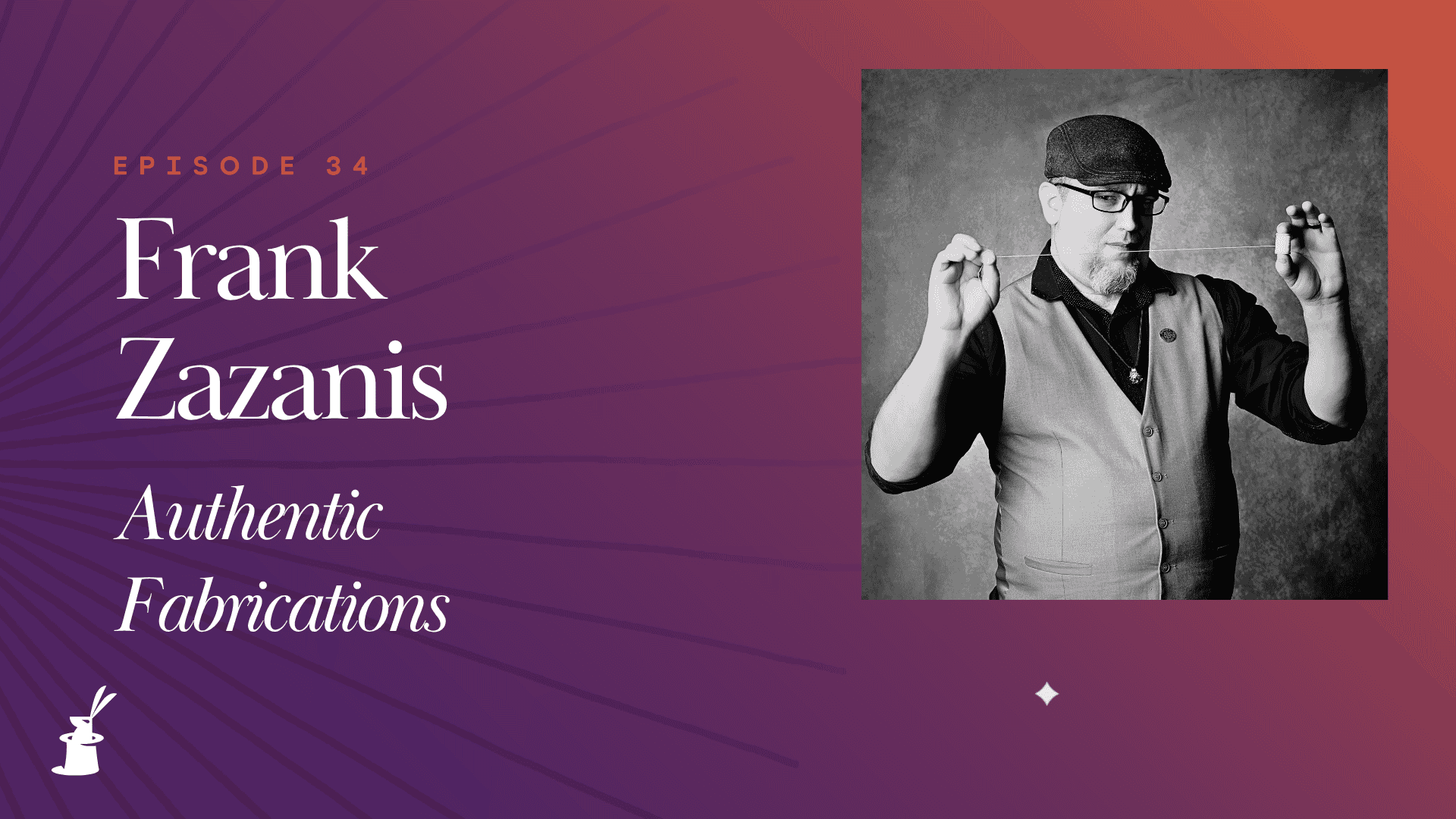
Frank Zazanis writes as Franklin Williams, and his book "Authentic Fabrications: Smoke, Mirrors, and Truth" pairs seventeen pieces of magical theater with fourteen essays. He is a member of The Magic Circle in London, he teaches at Jeff McBride's Magic and Mystery School in Las Vegas, and he builds his material out of things that actually happened to him. His son's autism diagnosis. A question from his therapist he couldn't answer. The friend who argues with everything you post online.
A bottle in a paper bag
Frank was four when his mother gave him a Hat Full of Magic set, and there are photographs of him in the top hat. The real beginning came a few years later, at a Little League barbecue where somebody had hired a magician.
"I was the kid who had learned just enough about magic from that magic set that I thought I knew what was going on."
What floored him was a bottle going into a paper bag and disappearing. Money was tight at home, so he went toward cards, which were what he could afford, and he noticed that cards could do almost any effect in magic. Later, a year behind the counter of a magic shop gave him access to everything he hadn't been able to buy as a child. His favorites to demonstrate were the Hopping Halves, Lethal Tender, and the Mismade Bill. He was performing comedy in those days, having fallen for Harry Anderson on television and that card guy, con man, funny guy bend.
Trial by fire
Through his Army years, whenever anybody needed entertainment, somebody would call Charlie Troop and ask whether Zazanis was available. Often with no notice at all. He once performed a full Vernon Cups and Balls routine in the middle of a field training exercise, using tomatoes, paper cups, and a canteen cup for the final load.
"It definitely gave me the ability to see magic wherever I could see it because I had to be able to find ways to do things such as Two In The Hand, One In The Pocket with some rocks from the ground."
Away, and back
After the Army, Frank joined the Magic Castle and performed fast-paced comedy card magic. Then he let the membership go. Part of it was the grind of quoting a fee for a children's party and hearing back that the client had twenty dollars and some pizza in mind. Part of it was conversations with other magicians that went sideways. He stayed away for years, watching the occasional television special and doing nothing himself.
What brought him back was a board game convention. Frank was tabling during a slow afternoon, borrowed a deck from the couple at the next booth, and did three or four card tricks out of boredom. The woman told him he needed to meet her friend Chris. That turned out to be Kriss Sheppard, host of the Successful Performercast, who lived in the next town over. They met for coffee, talked magic, and Frank came away re-inspired.
The lessons of game design
Frank designed and published board games for years, and the discipline carried over more directly than you might expect. Every game has a setup, an opening, a middle game, and an end game, and so does every effect.
"It taught me an awful lot about presentation in general and show building and how to guide somebody through an effect, because every board game starts the same way."
The middle game is where a designer risks losing people, and Frank applies the same warning to magic. He contrasts the beginner who finds the card, shows it, and asks "is that it?" with the performer who builds tension and then releases it.
Why write a book
Jeff McBride entered the picture when Frank sent him the script for Dreams for Shaden, unsure whether a piece that personal belonged on a stage. McBride wrote back offering to work with him. Frank became his student, and later joined the Mystery School faculty.
Part of what pushed Frank toward writing was a line from Max Maven, quoted in the book, about magicians of the twentieth century taking something inherently profound and rendering it meaningless and trivial. Frank had spent years assuming every magician had to be a great comedy performer in the Fielding West mold. The Maven line reopened the question.
"So it literally opened up my eyes and I went, 'Okay, what do I have to say? And how do I say it with magic?'"
The other push was simpler. McBride told him during a lesson that he needed to write a book about this stuff, and Frank said okay.
Not everyone agreed. Well-meaning friends asked what gave him the right, pointing out that he had never been on television and that the magic community had no idea who he was. That exchange produced the book's opening line, which tells the reader that Frank has probably never heard of them either.
"And many of our best creators were hobbyists or professional amateurs."
The title came out of his marketing background and a habit of naming things. Authenticity is the point of the work, and a magic effect is a deception, so he went looking for other words for deception and landed on fabrication.
Scripting, not patter
Frank dislikes the word patter, and the reason is precise. Patter arrives in the instructions with the trick, which means the audience could be watching anybody perform it.
"So that's one of the reasons why I don't like the word patter, because it tends to kind of sound like 'Turn the brain off and just say this.'"
He calls the alternative scripting, and notes that Dr. Larry Hass calls it "good words." His essay Script First describes a method that runs in reverse: write the closing line, then the opening line, then fill in the middle.
"For example, in Dreams for Shaden, I want to end on the word 'hope.'"
A third kind of audience
Jeff McBride's foreword to the book divides audiences into thinkers and drinkers, a distinction from his own book "The Show Doctor." In his prefaces, Frank quietly adds a third. He calls them the seeking audience: people who watch TED Talks for fun, who read books about improving some part of their life.
"And I know that audience exists because that's me."
The brave deserve better
The essay The Brave Deserve Better takes three sucker tricks and removes the sucker. Frank's objection is partly practical, since it takes real skill to run a sucker effect without making the volunteer feel foolish, and partly a matter of principle.
"And the last thing I want my audience to feel is stupid."
His solution is to move the suckering onto a character in the story rather than the person standing beside him. He has a personal credo about not embarrassing anybody on stage for a laugh, delivered with one memorable qualifier.
"I'm never gonna stick a plunger on a kid's head."
The qualifier was "any more." He went through that phase, then watched friends and family get called up at other people's shows and made to look like idiots.
Reading the room
Two pieces in the book use the same handbell. Questions is about a child who stops talking, and closes the first half of Frank's storytelling show. Social Skills is about the friend who cannot let a joke go by without arguing, and belongs to a lighter room. He has swapped one for the other mid-show after watching how an audience was responding.
The same judgment governs the whole set. A corporate Christmas party is not hiring him to enlighten the staff, as he puts it, but to make them laugh. He has broken his own rule, though, and told the story of doing Dreams for Shaden at a corporate party after overhearing guests talking about autism during the strolling set. The company rehired him.
Dreams for Shaden
Dreams for Shaden is Frank's work on the Gypsy Thread, and it came out of his family's journey through his oldest son's autism diagnosis. Local magician friends told him not to perform it. Looking back, he thinks their worry was partly about the audience feeling something negative, partly about length, since most thread routines run ninety seconds to three minutes, and partly about standing.
"And I think they were also just, they were very worried that if I hadn't earned the right to get that deep with people, then I was just gonna take the show off a cliff at that point."
The piece is also what got him into The Magic Circle, by a route nobody could have planned. Booked onto a Zoom show called Open Mic Magic, hosted by Kevin Peel in the UK and Robina in Texas, Frank realized on his lunch break that he had left his props at home. He checked the glove box, found the thread, and performed Dreams for Shaden. Kevin asked to show the video to an online Magic Circle meeting that had been discussing making magic your own. The following week Frank performed Jace's Wish, the week after that The Tiger in the Kitchen, and Kevin asked whether he had a lecture. Membership followed from the lecture.
The Tiger in the Kitchen
The Tiger in the Kitchen is a conversation with a therapist about a tiger that keeps turning up in the house. In the essay You Never Know, Frank says the tiger is his own depression and anxiety. On stage, he leaves it unnamed.
"Most of the time I don't tell people what the tiger is in my life."
People still come up afterward. His explanation is that the story works precisely because it stays open, and that everybody has something growling at them that never quite does anything.
Permission to go deeper
Frank printed Dreams for Shaden and Jace's Wish in full and then asked his readers not to perform them, writing that he nearly left them out because our community is not known for its high standards of ethics. He included them anyway, to show what magic can carry. The reasoning connects to another book he has been working on for a couple of years, a non-magic title called Permission Granted.
"They don't need my permission, but sometimes, even though we don't need it, as soon as we have it, that's when the floodgates open and we can start working on what we really wanna be doing."
Every essay in the book ends with a creative challenge, which is the same instinct pointed at the reader. Frank notes that most magic literature explains the effect, supplies some words, and stops there.
"Whereas I really wanted to push people a little bit and say, 'Alright, take 30 seconds and think about this.'"
His essay The Big Boy Table Issue argues that beginners notice what experienced performers have stopped seeing, and he says the argument holds even now that he teaches. A newer magician handed him a Ball and Vase and asked what he could do with it, and a week later he had a routine, now called Don't Play Ball in the House, built around his grandmother's potpourri vase.
"Because sometimes somebody with fresh eyes is gonna see something that we totally brushed off."
Asked how to introduce younger magicians to storytelling, Frank is blunt about the standard advice. Telling a twelve-year-old to be himself is no help when he has no idea who he is yet, and no casino is going to seat him at a poker table, so the Vegas patter has to go.
"All of our lives can inform our magic."
His practical suggestions are to find the story you already have that fits the effect, or to start with the story and build the effect around it, and to change the props to things a young performer actually touches. He points to Michael O'Brien's work with Pokémon cards.
Three voices, four books
Franklin Williams is one of three characters. Frank Z is the family and comedy performer, named that way because people stumble over Zazanis.
"That's for my drinking audiences, whether that audience is drinking beer or drinking chocolate milk."
The third is his geek show, magic with a hint of geek, built for board gamers and anime fans, with routines using Magic: The Gathering cards and a mentalism piece using pieces from Catan. He performed it as Frank Stiles when the book was written and has since dropped the Stiles name.
Franklin Williams is the one who slows down.
"And that's very much my campfire wisdom gatherer person, you know, the person who likes to pass on things that I've learned in life."
The book's introduction lays out three volumes, one per character: "Authentic Fabrications", "And Nobody Got Embarrassed" for Frank Z, and "On A Stage Far Far Away" for the geek show. A fourth title, "Conscientious Conjuring", is the direct follow-up to "Authentic Fabrications", currently running to eighteen pieces and twelve essays.
What's next
Frank also builds props for other performers, including several for Judge Gary Brown over the years and, with Jeff McBride, a zigzag carrying the cover of Ruth Knafo Setton's book so she could perform at signings. Both Gary and Ruth have been guests on this podcast.
"I'm not designing it for me, I'm designing it for them."
His Wild Card routine Iago's uses pineapple on pizza to lay out the ways people argue badly, chosen over sports teams because it was funnier, and it is heading to market with two scripts, one serious and one light. He is relaunching a six or eight week creativity workshop for magicians, where participants bring one piece of magic they want to change. And he is part of a four-person team called The Storytellers, who stage an immersive experience show and are currently looking for a new venue after the air conditioning failed at the last one.
Final thoughts
Frank Zazanis came to storytelling magic the long way around, through a magic shop counter, an Army talent circuit, a decade away from the art, and a borrowed deck at a board game convention. “Authentic Fabrications” is his argument that a fabricated effect can carry a true story, and that the audience for one is larger than magicians assume. The book asks its readers to find their own material rather than borrow his, and ends every essay with a challenge to go and do it. Our thanks to Frank for a conversation that ranged from Vernon Cups and Balls with tomatoes to a tiger that nobody in the audience ever gets to meet.
Books and Publications Mentioned
“Authentic Fabrications: Smoke, Mirrors, and Truth” by Franklin Williams, with a foreword by Jeff McBride (self-published, 2022)
“The Show Doctor” by Jeff McBride (Theory and Art of Magic Press, 2012)
“The Experience of Magic” by Eugene Burger (Kaufman and Greenberg, 1989)
“Art and Magic” by S.H. Sharpe (The Miracle Factory, 2003)
“Card College, Volume 1” by Roberto Giobbi (Hermetic Press, 1995)
“The Royal Road to Card Magic” by Jean Hugard and Frederick Braue (Harper & Brothers, 1948)
“Steal Like an Artist” by Austin Kleon (Workman Publishing, 2012)
“Show Your Work!” by Austin Kleon (Workman Publishing, 2014)
“Keep Going” by Austin Kleon (Workman Publishing, 2019)
Forthcoming from Frank Zazanis: “Conscientious Conjuring,” “And Nobody Got Embarrassed,” “On A Stage Far Far Away,” and “Permission Granted”
“VANISH Magic Magazine” edited by Paul Romhany, and the Magic and Mystery School's “Museletter”, both of which Frank writes for
Resources
“Authentic Fabrications” in hardback and paperback at Amazon.com, and as an ebook at Lybrary.com
Frank on Instagram at @frankmystery, and on Facebook under Frank Zazanis
Jeff McBride's Magic and Mystery School: https://magicalwisdom.com/
The Magic Circle, London: https://themagiccircle.co.uk/
Episode 2 of The Magic Book Podcast: “Chris Wasshuber: The Cardsharp and his Book”
Episode 10 of The Magic Book Podcast: “Judge Gary Brown: Inventive Magician, Historian, and Author”
Episode 23 of The Magic Book Podcast: “Ruth Knafo Setton: Zigzag Girl.”
The Successful Performer Podcast with Kris Sheppard: https://podcasts.apple.com/podcast/id866935997
Michael O'Brien's effects with Pokémon cards: https://www.penguinmagic.com/p/S21632
Timestamps
00:26 Introduction
02:00 A Little League barbecue
02:44 Behind the counter of a magic shop
03:21 Why cards
04:18 Performing in the Army
05:53 Falling out of love with magic
06:57 What brought him back
07:58 What game design taught him about shows
10:34 Meeting Jeff McBride
11:27 Max Maven and the trivial
12:42 Why write a book
13:55 “Who are you to write a book?”
15:18 Where the title came from
15:55 The trouble with patter
16:46 Script First
17:42 The seeking audience
18:53 The Brave Deserve Better
20:27 Two pieces, one handbell
21:50 Choosing material for a room
23:29 Dreams for Shaden
24:26 Joining The Magic Circle
26:06 The Tiger in the Kitchen
27:27 Printing the personal pieces
28:33 Creative challenges
29:28 The Big Boy Table Issue
31:29 Advice for younger magicians
34:31 Three personas
36:35 Defining Franklin Williams
37:55 Four books
39:08 Building for other performers
40:10 Iago’s and pineapple on pizza
42:01 Most cherished books
44:32 Where to find the book
45:38 What’s next