Introduction
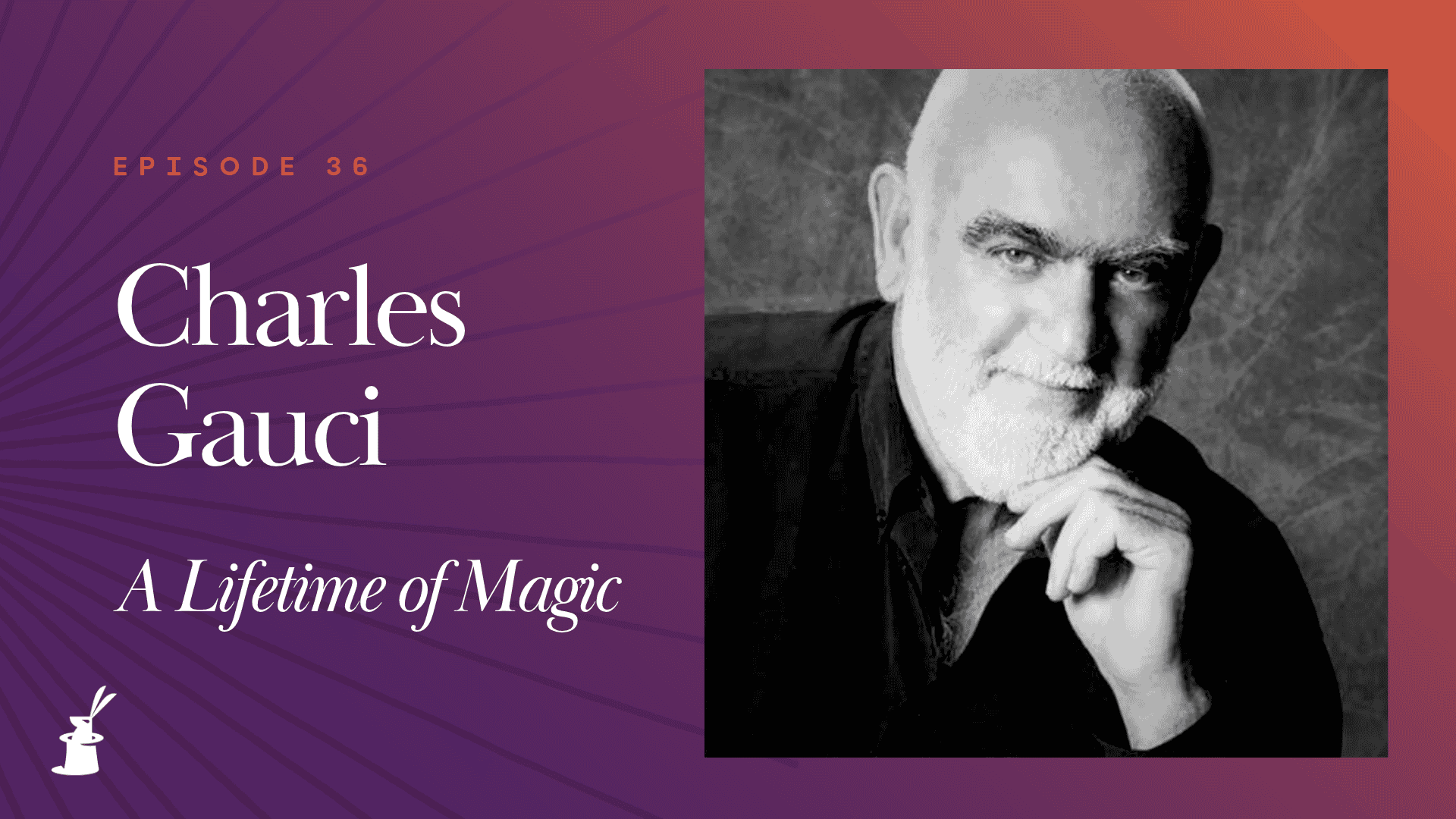
Charles Gauci has been working professionally in magic since 1953. Born in Malta in 1937, he went to Australia as a boy of twelve, joined the Australian Society of Magicians at fourteen, and turned professional at sixteen with an act built on fire eating, a bed of nails, and the bullet catch. In a second career as a creator, he brought nineteen effects to market and lectured across North America, Europe, and Asia. His book A Lifetime of Magic gathers thirty-six of his effects in a limited edition of 500 copies. At eighty-nine, he is still performing, with a new show opening at the Windsor Hotel in Melbourne this December.
A book sold from the stage
Charles was twelve when his family left Malta. His father had died, his older siblings had already gone to Australia, and his mother followed with her two youngest children. Soon after they arrived, she took Charles and his younger brother to a Saturday matinee at the Princess Theatre in Melbourne to see a famous New Zealand hypnotist, the Great Franquin, whose real name was Francis Quinn.
After the show, Franquin sold a book on hypnosis from the stage, and Charles talked his mother into buying it. He read it a dozen times, taught himself self-hypnosis, and within four weeks had stopped the bed-wetting that his siblings had given him such a hard time about. Franquin’s act also combined hypnotism with memory feats and lightning calculation, and that left a mark too. One routine had the audience call out objects against numbers from one to twenty on a blackboard.
“He also performed a magic square routine, and that got my interest in doing research in magic squares, which became one of my strongest routines.”
Three years in the State Library
“The library closed at 9 o’clock, and I would spend all that time every day, 5 days of the week, reading books on psychology, psychiatry, you name it, anything to do with the mind.”
At St. John’s School in Mitcham, Charles went up four grades in a single year and ended up helping the nun correct the other children’s books. His mother was the main earner, so at thirteen he went to work at the British Australasian Tobacco Company, about 500 meters from the State Library in Melbourne. Franquin’s book had left him fascinated with the powers of the mind, and with no tertiary education, he describes himself as more or less self-taught. He finished work at 4:30 every afternoon and walked to the library, and he kept that up for three years.
A question at Hall’s Book Store
One day Charles walked into Hall’s Book Store on Bourke Street, a secondhand bookshop, and asked the attendant whether he had any secondhand books on hypnosis. He did.
“And as he was leading me [to] that section, he turned around, and he said, ‘Are you interested in magic?’”
Charles told him he knew nothing about it. The man invited him to a club meeting, and Charles joined the Australian Society of Magicians at fourteen. He has been a member ever since.
A bed of nails in the shop window
Charles and Peter Reveen were friends, and Peter was keen to take his hypnotic show on the road. The first tour ran from Melbourne through some fifteen towns in South Gippsland. By then Charles had an act of his own, an Indian act with fire eating, a bed of nails, the bullet catch, and a memory routine, and he pitched Peter an idea for publicity.
The day before the show reached a town, their advance manager would arrange a large shop window. At eleven in the morning, Peter would pretend to hypnotize Charles and lay him down on the bed of nails. At nine that night, Charles and the bed of nails were carried to the stage, where Peter woke him up.
“Now, of course, within 2 hours of this performance happening in the shop window, the entire town knew that the Reveen show was going to be in town. So we had sellout audiences every night.”
Twenty shows a day
Charles performed wherever he could, often for free at Lions Clubs and elderly citizens’ clubs, on the principle that the greatest magician in the world gets nowhere if nobody sees him. What really made him was the agricultural show that every Australian state holds each year. In Melbourne, variety acts performed in tents along Sideshow Alley, and Charles booked himself a twenty-five-minute show on a program that ran from ten in the morning to ten at night. That meant twenty shows a day.
Each show included a memory routine. Audience members called out objects against numbers from one to thirty-six, which Charles recalled in order, in reverse, and at random, before wiping them from his mind for the next show. By the end of a day, he had memorized 720 objects. After ten days of that, his short-term memory was never the same, and he still has to give himself a suggestion to send a new name to his long-term memory.
“Because you could offer me a million dollars 30 minutes later, and I couldn’t tell you your name.”
As powerful as his self-hypnosis is, he says, he has never overcome it.
The bullet catch
“One rule ... I made when I decided to become professional was that I wanted to be original.”
Nobody else in Australia was doing the bullet catch. Charles’s marksman was Lionel Bibby, whom he calls Australia’s greatest, and the shot passed within two inches of his ear into a sandbox at the back of the stage. Once he had stopped performing it, Charles was happy to share his version, and it appeared in the February 1965 issue of Genii, illustrated with his own drawings. He was twenty-seven. Ben Robinson later included it in Twelve Have Died, his book on the history of the bullet catch.
Charles no longer owns a copy of that article. Some years ago, a computer virus destroyed both his files and his backup disk, and with them the records of many effects he had created.
Five hundred copies
Charles once ran a mail-order business that brought in some $12,000 a month without any advertising. Then copies of his effects began to appear from manufacturers in China, and they are still being sold. When he came to publish A Lifetime of Magic, he told Joe Stevens that he didn’t want to sell thousands of copies. The edition was limited to 500 and aimed at collectors, priced at $160 when the average magic book sold for $60.
The decision was deliberate. To Charles, success in magic depends on performing something different and new, and a flood of copies works against that.
“Eighty percent of amateur or semi-amateur magicians are performing other people’s tricks, and this is why a lot of them don’t really achieve any height.”
A gallery opening in Nice
After performing seven nights a week for more than twenty years, Charles burned out. He gave magic away, kept only his twelve best corporate clients, and earned his living as a hypnotherapist. Then, on a trip to France, a friend who was president of Club Magica in Nice took Charles and his wife to the opening of an art gallery and asked the manager whether Charles could perform. With a few borrowed props, he did a short set of mentalism. Afterward, the commodore of the biggest yacht club on the French Riviera asked whether he could repeat it at the club that Saturday.
“I approached my friend, and I said, ‘I don’t know what to charge him.’ So he told me.”
A local entertainment booker then offered him six months of work a year, entertaining the wealthy people who gathered on their yachts along the Riviera. Charles spent the next eight years working there, and the bug was back. He began creating his own effects and touring the world to lecture and hold workshops.
Good magic is simple magic
Charles set himself three rules for everything he created. Each effect had to be small, because a lecturer who sells his tricks after the show has to carry them. Each had to be cheap to manufacture.
He was also the only dealer at conventions who would perform an effect and then explain how it was done, so that onlookers could see they would be able to do it themselves. The nineteen effects he marketed earned hundreds of thousands of dollars over twenty years, and his aim throughout was to encourage amateurs to create and sell their own magic.
The third rule, which he calls an insult to one’s intelligence, is the one he credits for all of it.
“And three, and this is the insult, but it’s the strength, any fool can perform my tricks within 5 minutes of reading the instructions.”
Credit where it’s due
“I could claim originality, but I wanted to give credit to the person who created the original effect.”
Charles’s Body Language grew out of Max Maven’s Kurotsuke. He liked the effect but not the method, so he developed a different one. On his first night performing at the Magic Castle, Max Maven was in the audience, and Charles introduced him and credited him with the idea. Max appreciated it. In print, Charles also credits Eddie Joseph behind Astral Projection and Paul Curry behind Intuition. He sees crediting as the only way magic can continue, at a time when the fear of being copied keeps many creators from sharing their work at all.
Ideas while he sleeps
Charles had been performing his own version of the card through the ribbon when, on a flight from Shanghai to Mumbai, he decided to improve it. He put himself into a trance, gave himself a suggestion, and woke with the idea of a bolt. He also wanted the new version to repeat, a lesson he took from watching a magician perform the Ambitious Card, where each return of the card to the top hit harder than the last. His father-in-law in England, a toolmaker, made the first two dozen. The result, the Houdini Card Mystery, became one of his best sellers, and Charles took a hundred with him on every tour.
That flight was typical. Charles says he very rarely creates a trick deliberately while he is awake. Before he goes to sleep, he gives himself a suggestion, such as inventing a coin trick or a stage trick, and one to three days later, an idea arrives.
“But what’s incredible about it is the solution came with it. Not only the idea of the trick, but also how to do it.”
Self-hypnosis on its own rarely reaches a deep enough trance, he explains, so during the day he plays himself a recording instead. Even reading someone else’s magic book sets his mind working within a couple of minutes.
Stage hypnosis and therapy
“A hypnotized person is the most boring person in the world.”
In his Hypno-Dream booklet, Charles names Franquin and Peter Reveen as the two greatest stage hypnotists of all time, yet he has little time for stage hypnosis. He has practiced hypnotherapy for many years and believes it could help with a large share of mental health problems. People often come to a hypnotherapist as a last resort, though, and arrive so desperate to be hypnotized that the effort works against them, which he calls the law of reversed effort.
His eighteen months on the road with Reveen showed him what really happens on stage. When a volunteer genuinely goes under, a stage hypnotist recognizes it and sends them back to their seat, because they won’t be entertaining. On the Gippsland tour, six or seven young people followed the show from town to town, unpaid and unasked, to be hypnotized again. Charles concluded that the stage gave inhibited people permission to do what they had always wanted to do, and to tell their families afterward that they had been deeply hypnotized.
Al Koran and Barrie Richardson
When Al Koran came to Melbourne for a seven-day engagement at the Chevron nightclub in St. Kilda, Charles introduced himself on the first day. For the rest of the week, they spent about twelve hours a day together, with Charles showing him around. Koran showed him material that has never been published, and Charles has kept it to himself.
He counts Koran and Barrie Richardson, whom he also knew well, as his most important mentors. Koran stuttered a little, Charles remembers, and was generous with everything he knew. Charles was sorry to hear that he never found success in America and died not long after moving there.
“Now, Al Koran, to me, is one of the greatest mentalists ever. Wonderful man.”
Giving something back
Charles’s other book, Hypno-Dream & The Power Within Program, is a compilation of the talk on self-improvement that he gives alongside his magic. It comes with a CD for people to play at night for six weeks.
“I’d like to think that I’ve lived life three times over with all the experiences I’ve had worldwide, and I want to give something back.”
He no longer charges for these talks. He gives them freely at Lions Clubs, elderly citizens’ clubs, and wherever else he is asked.
Books on his shelf
“I cannot honestly say to you I have a favorite book, but having said that, I’m an avid reader.”
Pressed for his favorites, Charles named Al Koran’s two main books, the books by Barrie Richardson, and Greater Magic. Beyond those, he says, there are too many to mention.
What’s next
Charles’s new show, Magic of the Mind, opens in December in a sixty-seat theater at the Windsor Hotel, which he calls one of Melbourne’s finest. It is an hour of mentalism, mixing new effects with old. One new piece is a fifteen-minute experiment that pits the human mind against artificial intelligence, and Charles is challenging universities to replicate it. He is thinking about marketing it, but only to one performer in each state, so that it never becomes common.
He has canceled plans to tour the United States because travel insurance has become prohibitive, but he will keep touring in Europe, where his European passport gives him better health coverage. Retirement is not on the agenda.
“I mean, the day I stop thinking of magic, I’ll die. That’s what keeps me alive. I know you’re going to laugh. I’ve just extended my life expectancy to 110 from 100.”
Final thoughts
Charles Gauci’s life in magic began with a book sold from a theater stage, three years of evenings in the State Library, and a bookseller’s question on Bourke Street. A Lifetime of Magic collects the work of a performer who decided at sixteen never to perform what anyone else was doing, and kept to that rule for seventy years. He limited the book to 500 copies to protect effects that had already been copied around the world, which makes a copy a real find for any collector. Our thanks to Charles for a conversation that ran from a bed of nails in a shop window to a new show at the Windsor Hotel.
Books and Publications Mentioned
A Lifetime of Magic by Charles Gauci (Stevens Publishing, the publishing arm of Stevens Magic Emporium, 2011)
Hypno-Dream & The Power Within Program by Charles Gauci (self-published, 2009)
“Catching a Marked Bullet” by Charles Gauci, Genii, February 1965
Twelve Have Died by Ben Robinson with Larry White (Ray Goulet’s Magic Art Book Co., 1986)
Al Koran’s Professional Presentations by Hugh Miller (Harry Stanley, Unique Magic Studio, 1967)
Al Koran’s Legacy by Hugh Miller (Repro71, 1972)
Theater of the Mind by Barrie Richardson (Hermetic Press, 1999)
Act Two by Barrie Richardson (Hermetic Press, 2005)
Curtain Call by Barrie Richardson (Hermetic Press, 2011)
Greater Magic by John Northern Hilliard (Carl Waring Jones, 1938)
Resources
Contact Charles by email at charlesg37@hotmail.com
The February 1965 issue of Genii is searchable through Ask Alexander, from the Conjuring Arts Research Center: https://askalexander.org/
The Hotel Windsor, Melbourne: https://whatson.melbourne.vic.gov.au/places-to-stay/the-windsor
Timestamps
00:23 Introduction
02:22 Leaving Malta for Australia
02:45 The Great Franquin
05:56 Three years in the State Library
07:02 A question at Hall’s Book Store
08:09 On the road with Peter Reveen
09:55 Twenty shows a day on Sideshow Alley
12:43 What memory work did to his memory
14:01 Lionel Bibby and the bullet catch
14:55 Writing for Genii in 1965
16:45 Twelve Have Died
17:47 Why A Lifetime of Magic was limited to 500 copies
20:27 A gallery opening in Nice
23:33 Good magic is simple magic
25:28 Body Language and Max Maven
26:28 Inventing through self-hypnosis
30:14 The Houdini Card Mystery
32:16 Crediting sources
33:35 Stage hypnosis and hypnotherapy
36:59 Al Koran and Barrie Richardson
38:41 Hypno-Dream and The Power Within
40:29 Magic of the Mind at the Windsor Hotel
42:17 Most cherished books
43:18 Getting in touch
43:53 What’s next