
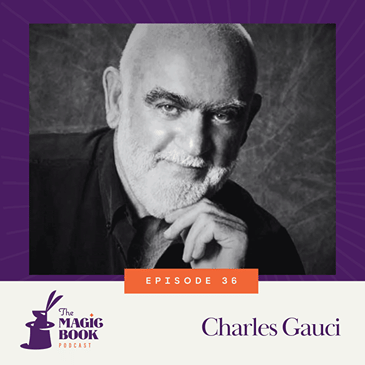
Maltese-born mentalist Charles Gauci has performed since 1953. At twelve, he bought a book from a hypnotist's stage that changed his life, and a bookseller's question later led him to the Australian Society of Magicians. Charles recalls lying on a bed of nails in shop windows for Peter Reveen, twenty shows a day on Sideshow Alley, and publishing his bullet catch in Genii at 27. He also explains why he limited “A Lifetime of Magic” to 500 copies and how he invents effects in his sleep.
Adrian Tennant [00:00:05]:
[MUSIC FADES UP] Coming up in this episode of The Magic Book Podcast.
Charles Gauci [00:00:09]:
Life’s been good to me. In fact, I’d like to think that I’ve lived life three times over with all the experiences I’ve had worldwide, and I want to give something back.
Adrian Tennant [00:00:23]:
You’re listening to The Magic Book Podcast, conversations about classic and contemporary books that teach, illuminate, and celebrate the art of magic. I’m your host, Adrian Tennant, a lifetime student of magic and mentalism, occasional performer, and longtime book collector. Thank you for joining me. [MUSIC FADES OUT] My guest today has been working professionally in magic since 1953. Born in Malta, Charles Gauci went to Australia as a boy of 12, joined the Australian Society of Magicians at 14, and turned professional at 16 with an act built on fire eating, a bed of nails, and the bullet catch. He went out on the road with the hypnotist Peter Reveen and spent the decades that followed on Australian stages and television. In a second career as a creator, Charles brought 19 effects to market, 5 of them international best sellers, and he lectured in the United States, Canada, Britain, Europe, India, and China.
Adrian Tennant [00:01:30]:
Charles served as President of the Melbourne Assembly of the Australian Society of Magicians, and in 2010, he received the Dave Lederman Memorial Award for Creativity in Mentalism from the Psychic Entertainers Association. He has also practiced hypnotherapy for most of his life, much of it with Australian footballers and cricketers, and in 2009, he published his self-improvement program, “Hypno-Dream and The Power Within.” At 89, Charles is still performing, and he has a new show opening in Melbourne next month. Today we’re talking about his life as a working professional and his book, “A Lifetime of Magic.” [MUSIC] Charles, welcome to The Magic Book Podcast.
Charles Gauci [00:02:19]:
Thank you, Adrian, for having me.
Adrian Tennant [00:02:22]:
You were 12 when your family left Malta for Australia. Charles, why did you move?
Charles Gauci [00:02:29]:
My father died in 1949, and my eldest siblings migrated to Australia. And with my mother having been left with 2 children, she decided to migrate also to Australia.
Adrian Tennant [00:02:45]:
Soon after you got there, your mother took you to a matinee performance in Melbourne. Who was on the stage?
Charles Gauci [00:02:53]:
There’s a story to this. At 12 years of age, I had a physical ailment in that I was still wetting the bed. And my siblings used to give me such a hard time. One day, my mother came to both myself and my younger brother and said, “Look, on Saturday, I’m going to take you to a matinee at the Princess Theatre in Melbourne. There’s a famous New Zealand hypnotist performing a show.” His name was the Great Franquin, and we went to see the show. I have to say that at that age, I was blown away by seeing all these people on stage performing all these antics.
Charles Gauci [00:03:44]:
And after the show, he was selling a book on hypnosis, and I managed to talk my mother into buying it for me. I read the book some 12 times, teaching myself self-hypnosis. And I know it’s hard to believe that within 4 weeks, I stopped wetting the bed.
Adrian Tennant [00:04:07]:
Wow.
Charles Gauci [00:04:07]:
I was absolutely blown away by this. It had a tremendous effect on me. And at 13 years of age, I only spent 1 year at St. John’s School in Mitcham, where I went up 4 grades in 1 year: 5, 6, 7, and 8. I ended up helping the nun with correcting the children’s books, in fact, in the end. And because, of course, my mother was the main earner, I took a job at 13 years of age at the British Australasian Tobacco Company.
Adrian Tennant [00:04:46]:
Franquin, as you mentioned, was a New Zealander. His actual name was Francis Quinn. And at the time you saw him, he must have been partway through his run of more than a year, I think, at the Princess Theatre. And his act combined hypnotism, memory feats, and lightning calculation. So he obviously had quite an impression on you as a young man. Do you remember his act?
Charles Gauci [00:05:14]:
Yes, I do. In fact, that’s what really got me interested in magic in a way, and memory routines.
Adrian Tennant [00:05:24]:
Yeah.
Charles Gauci [00:05:25]:
He did a memory routine with a blackboard in those days where he had numbers from 1 to 20, and he asked members of the audience to call out objects and a number, and he’d memorize them and recall them back. He also performed a magic square routine, and that got my interest in doing research in magic squares, which became one of my strongest routines.
Adrian Tennant [00:05:56]:
Indeed. Well, as you mentioned, you did leave school at 13 and went to work at that tobacco company in Melbourne, which was a few minutes’ walk from the State Library, which you visited every night. Tell us about that.
Charles Gauci [00:06:13]:
Well, the situation is this. Franquin’s book impressed me so much that I became fascinated with the powers of the mind. And of course, having no tertiary education… The State Library was about 500 meters from where I worked. So for the next 3 years, I would finish work at 4:30 in the afternoon. The library closed at 9 o’clock, and I would spend all that time every day, 5 days of the week, reading books on psychology, psychiatry, you name it, anything to do with the mind. So I’m more or less self-taught.
Adrian Tennant [00:07:02]:
Well, one day you walked into a secondhand bookshop in Melbourne and asked the man behind the counter for books on hypnosis. Charles, what happened?
Charles Gauci [00:07:15]:
That was an interesting experience. The attendant approached me. It was… I remember it very clearly. It was Hall’s Book Store in Bourke Street. It was a secondhand bookstore. So I approached the attendant, and I said, “Do you have any secondhand books on hypnosis?” And he said, “Yes.” And as he was leading me [to] that section, he turned around, and he said, “Are you interested in magic?” Now, his name was Ron Hedgecock. And I said, “No, I know nothing about it.”
Charles Gauci [00:07:53]:
He said, “Oh, would you like to come to the club for a meeting?” And I said, “I would love to.” So I ended up joining the Australian Society of Magicians at age 14 and have been a member ever since.
Adrian Tennant [00:08:09]:
You and Peter Reveen got to know each other well. How did you end up going on the road with him?
Charles Gauci [00:08:16]:
We were actually friends, and Peter was very keen to start performing his hypnotic show. And the first tour that he organized was a tour from Melbourne to South Gippsland, some 15 towns. Now, by that time, I had already developed an act, an Indian act, doing fire eating, sleeping on a bed of nails, bullet catching, and a memory routine. And I said to Peter, I said, “Look, I’ve got an idea. You need to promote the show.” I said, “How about we do this? We’ll get our advance manager.” The day before we go to a town, he would organize a large shop window where Peter would pretend to hypnotize me, and I’d be picked up and laid down on a bed of nails. This used to take place about 11 o’clock in the morning, and at 9 o’clock at night, me and the bed of nails would be picked up, transported to the stage, and he would wake me up.
Charles Gauci [00:09:36]:
Now, of course, within 2 hours of this performance happening in the shop window, the entire town knew that the Reveen show was going to be in town. So we had sellout audiences every night.
Adrian Tennant [00:09:52]:
Wow.
Charles Gauci [00:09:53]:
It was incredible.
Adrian Tennant [00:09:55]:
Now, you mentioned that you were eating fire, sleeping on a bed of nails, and catching a bullet. Where were you typically performing these shows?
Charles Gauci [00:10:05]:
I started performing anywhere I could. I’d like to think I was a very good salesman. I could talk myself into anything. And I used to contact clubs like the Lions Clubs we have, elderly citizens’ clubs. The name of the game was to get out and expose myself. I mean, you can be the greatest magician in the world, but if nobody saw you, you just don’t get anywhere. So I used to do a lot of free shows everywhere, and then one thing led to another. And of course, what really made me was, in Australia, each state every year has an agricultural show, where all the farmers would bring their animals, et cetera, et cetera.
Charles Gauci [00:11:00]:
And in Melbourne, in particular, we had in those days what we called Sideshow Alley. That is an area where variety shows used to perform in tents. Now, this is rather interesting, because I booked myself to perform my show. The show lasted 25 minutes, and the program was open from 10 o’clock in the morning to 10 o’clock at night. So I used to do 20 shows a day.
Adrian Tennant [00:11:34]:
Gosh!
Charles Gauci [00:11:35]:
Doing my memory routine, my bullet catching, and fire eating. I mean, imagine this situation for a moment. On my blackboard, I had numbers from 1 to 36, and I would invite members of the audience to nominate a number and an object, and my assistant would write it down. So they might say, “19 is a car.” I’d say, “What’s the registration number?” And he’d write that down. Or, “What make?” And then once the 36 were written down, I would call them from 1 to 36. By way of a change, I would then say, “Call an object and I’ll tell you the number,” or, “Call a number and I’ll tell you the object.” And in the end, I would recall them back from 36 back to 1. Now, 10 minutes later, I’d have to memorize another 36 objects.
Charles Gauci [00:12:37]:
At the end of the day, I’d memorized 720 objects.
Adrian Tennant [00:12:42]:
Gosh, yes.
Charles Gauci [00:12:43]:
Now, the situation here became an automatic process. The moment the show finished, I would wipe those 36 objects from my mind in readiness for the next show. The problem with this, because it was so repetitive and I was doing it solidly for 10 days, it ruined my short-term memory. So, for instance, if I was to meet someone and they’d introduce themselves, I learned later on that I had to give myself a suggestion: “I want this to go in my long-term memory.” Because you could offer me a million dollars 30 minutes later, and I couldn’t tell you your name.
Adrian Tennant [00:13:33]:
Wow.
Charles Gauci [00:13:33]:
It’s incredible. And as powerful as my self-hypnosis is, I still haven’t overcome that problem. I’ve tried for years. So short-term memory is a problem. If I want to remember something, I have to specifically say to myself, “I want this to go into my long-term memory.” Interesting.
Adrian Tennant [00:14:01]:
It is interesting. I know bullet catching was part of your act. Do you remember who the marksman was that you trusted the most during those shows?
Charles Gauci [00:14:12]:
Yes, it was Australia’s greatest marksman, Lionel Bibby, because the routine that I had developed was such that we had a sandbox at the back of the stage, and he used to aim the rifle at me and virtually shoot within 2 inches, going past my ear. So I had to make sure I had a good shooter; otherwise, it was very, very dangerous. And I developed a technique. I published it in Genii, and it was good from this point of view that I used to invite the audience to examine my mouth, that I had nothing hidden there.
Adrian Tennant [00:14:55]:
I found that February 1965 Genii magazine with your version of the bullet catch in it and your own drawing alongside it. You were 27 at the time. What made you write to an American magazine like Genii?
Charles Gauci [00:15:15]:
Well, I contributed several articles to different magazines. And I decided at the time, I had stopped performing it, and I didn’t mind sharing the secret. So I had it published in Genii magazine. I don’t have a copy of it, unfortunately, because I had an accident a few years later. I had my computer hooked to my backup, and unfortunately, I got a virus, and [it] attacked the computer and my backup disk, and I lost everything. So a situation developed where I had created a lot of effects, and years later, it took me quite some time to try and recall the method, you know. I had a very good agent in Melbourne. He was fantastic.
Charles Gauci [00:16:14]:
And I must say, I probably gave him as much work as he gave me, because every show that I did, I used to have 2 or 3 people come up and ask me for my card. And I always used to do the right thing. If I got a private booking, I still gave it to him and paid him his 10% fee. Tried to keep sweet. So, no, he was very good. I must confess, he really helped to make me.
Adrian Tennant [00:16:45]:
Ben Robinson interviewed you 20 years after that Genii article and included your method in his book, “Twelve Have Died: Bullet Catching, the Story and Secrets.” Charles, do you remember that?
Charles Gauci [00:16:58]:
I remember reading about that book and about the 12 people that had died. And of course, that’s what excited me more into performing, because, well, frankly, nobody in Australia ever did the bullet catching. One rule, by the way, I made when I decided to become professional was that I wanted to be original. And I went out of my way to study every act that was performed by any professional magician and made sure that I didn’t perform any of their tricks. So that’s when I started to be creative and create my own stuff.
Adrian Tennant [00:17:47]:
[MUSIC] If you’re enjoying this episode of The Magic Book Podcast, please consider leaving a rating on Spotify or a review on Apple Podcasts. You can also follow The Magic Book Podcast page on Facebook. Thanks. [MUSIC FADES] Let’s talk about your book, “A Lifetime of Magic,” which runs to 222 pages and holds some 36 effects. Charles, what made you decide the time had come to publish your work?
Charles Gauci [00:18:17]:
Look, I’ve been very fortunate in that I’ve created a lot of effects. And the problem was that, unfortunately, like other magicians, all my effects were being knocked off by the Chinese. It was heartbreaking, because I had a great mail-order business, you know, doing some $12,000 a month in mail order without doing any advertising whatsoever. And even now, they’re still pushing my stuff. So what I did in the end, I decided to publish a book of some of my favorite effects. And I spoke with Joe Stevens at the time, and I said, “Look, I don’t want to sell thousands of these books. Let’s limit it to 500 only.” It was mainly aimed at collectors.
Charles Gauci [00:19:21]:
We priced it very expensively. It used to sell for $160, which was unheard of at the time. The average magic book was $60. So that was done deliberately, because the way I think is this: to succeed in this business, you have to perform something different, something new. Eighty percent of amateur or semi-amateur magicians are performing other people’s tricks, and this is why a lot of them don’t really achieve any height. You understand me? So at one stage, after performing 7 nights a week for over 20 years, I got burnt out and gave magic away and used hypnotherapy for an income, only keeping about 12 corporate customers, my top 12, which I traveled all over Australia doing shows for.
Charles Gauci [00:20:27]:
Then, by accident, we were touring France, and I have a friend of mine who, at that time, was president of Club Magica in Nice, in France, and we were invited to an opening of an art gallery. My wife was a great designer at that time. She’s now a very famous and successful author, having recently published her 17th book. Anyway, he approached me, and he said, “We’re invited to an opening on Saturday. Would you like to come?” I said, “Yes, of course. We’re interested in art.” He said, “I’ll see what I can do for you.” So about an hour later, he came back, and he said, “Look, I’ve spoken to the manager, and I’ve told him what you do, and he asked if you could do a short gig for us.” And I said, “Of course.”
Charles Gauci [00:21:32]:
So I had nothing with me, but him being a magician, I just borrowed a few props, and I mainly do mental stuff anyway. And I performed, and I spent the next 8 years working on the French Riviera as a result of that one show. Two people approached me after the show. One of them was the commodore of the biggest yacht club on the French Riviera. He said, “I really enjoyed what you did. Could you do it at my club on Saturday?” And I said, “Oh, give me a few minutes to think about it.” I approached my friend, and I said, “I don’t know what to charge him.” So he told me.
Charles Gauci [00:22:18]:
Anyway, a second person approached me. It was a woman, and she was a local entertainment booker. She said, “I can give you work for 6 months of the year,” because on the French Riviera, you can imagine all the wealthy people would congregate there on their yachts, and they were looking for English-speaking entertainers. And so that’s what happened. It shows you in life that it doesn’t matter how good you are. You just need that stroke of luck to be at the right place at the right time, and that worked for me. After that show in France, the reception was so good that I got the bug to get back into magic. Now, having lost all my corporate clients other than the 12 that I kept, I decided on a new venture. I thought what I’d like to do is start to create my own stuff and tour the world lecturing and holding workshops.
Adrian Tennant [00:23:33]:
Well, “A Lifetime of Magic” really illustrates your creativity. You often say that good magic is simple magic. Can you tell us about that?
Charles Gauci [00:23:46]:
I made myself 3 rules, and one of them is an insult to one’s intelligence. Because when you’re traveling, of course, particularly if you’re selling your tricks after doing a lecture, you need stuff that’s small, because you have a weight problem. So the 3 rules were simply this: A, it must be small. B, cheap to manufacture. And three, and this is the insult, but it’s the strength, any fool can perform my tricks within 5 minutes of reading the instructions. And that’s what made me successful. And I was the only dealer at any convention where I would perform the trick, and then I would explain to them how it’s done. And of course, the onlookers would say, “Gee, even I can do that.”
Charles Gauci [00:24:45]:
And that’s contrary to other magicians, who wanted to keep secrets. I was the opposite, and that’s why I was extremely successful. The 19 effects that I marketed were a huge success all over the world. We’re talking hundreds of thousands of dollars over a 20-year period. What I’ve been trying to do for the last 20 years was to encourage people, particularly those amateurs who don’t perform professionally, to try and get into a mindset where they can create stuff and make big money selling magic. That was my aim.
Charles Gauci [00:25:28]:
And the next big one was Body Language. I saw Max Maven’s version, and I liked it, but I didn’t like the methodology so much. And that’s when I came up with the idea. And I’ll never forget, I was performing at the Magic Castle, and who should be there the first night? Max Maven! And I introduced him, and I said, you know, “The idea of this I got from Max,” et cetera, and he really appreciated it. And just to give you an idea how the mind works, so I’m touring China doing lectures, and I had to do 2 conventions in India. Now, at that time, I’d been performing the card through the ribbon effect. I developed my own method where a card is selected and pushed back into the deck.
Charles Gauci [00:26:28]:
The deck had a hole in it. You put a ribbon through it, and eventually, you produce the card. And flying from Shanghai to Mumbai, I said to myself, “I’d like to improve that trick.” So I put myself in a trance, gave myself a suggestion on how to improve it, and the idea of the bolt came to me. Now, what’s incredible about this, and that’s why I ended up producing my Hypno-Dream presentation and talk, was how powerful the subconscious mind is. You see, you’ve got all this experience that you’ve gathered all your life. So by giving myself a suggestion, as I sleep, the subconscious mind would go through everything that I’ve seen, everything that I’ve read, and everything that I’ve heard.
Charles Gauci [00:27:27]:
It would pick up an idea here and another idea there, and 2 days later, I could be driving or reading a book, and an idea would hit me. But what’s incredible about it is the solution came with it. Not only the idea of the trick, but also how to do it. And so I can honestly say I very rarely create a trick whilst I’m awake deliberately. It’s always as a result of a self-hypnotic suggestion. Now, self-hypnosis as such is a contradiction in terms, because for suggestions to work… There are 6 trance stages, okay? Where if I hypnotized you and got you to that 6th stage, I can get you to commit a murder without you being aware of it. That’s how powerful it is.
Charles Gauci [00:28:36]:
In order for self-suggestions to work, you should be in at least the 3rd stage in a trance, which means you’ve lost consciousness. So self-hypnosis as such doesn’t work that way. So the only way to use self-hypnosis effectively is to make a recording and then play it back to yourself. Now, I’ll be quite honest. Sometimes, if I want to do it during the day, I’ll make a recording, I’ll lie down on the couch, and I’ll play it back. And of course, the recording puts me into a trance. It acts as a hypnotist, and it’s giving me the suggestions. Now, of course, the technique I then developed was, as I go to bed at night and say I want to invent a trick, I might just say to myself, “I want to invent a coin trick, or a stage trick, or a card trick.”
Charles Gauci [00:29:40]:
And then I’d give myself a suggestion, and as I sleep, my mind would work on that. And as I say, one, two, or three days later, an idea will hit me. And the beautiful part about this is this. I’ve developed it to such a stage, I start reading somebody’s magic book, and within 2 minutes, my mind starts to wander. It triggers off. It’s incredible how the mind works.
Adrian Tennant [00:30:14]:
Well, just going back to that flight that you were on from Shanghai to India and the trance that you put yourself into…
Charles Gauci [00:30:22]:
Yes.
Adrian Tennant [00:30:23]:
Can you tell us about the effect that you came up with?
Charles Gauci [00:30:27]:
I’m a great believer in repeating an effect. I saw a magician performing the Ambitious Card routine, where the card was selected, shoved back in the middle of the deck, next minute it appears on the top, back in the middle of the deck, back on the top, and each time it kept blowing me away. And I realized the power of repeating the same trick. I mean, it’s easy enough to fool a person performing a trick once, because they don’t know what’s happening, so it’s easy for you to misdirect them. But if you can repeat it 2 or 3 times, it trebles the effect. So that was one thing I wanted to put into the effect. So when I woke up from the trance, the idea of the bolt came to me. My father-in-law, who lived in England… I couldn’t get to the phone quick enough to ring him.
Charles Gauci [00:31:33]:
He was a toolmaker, and I explained to him what I wanted. So he made it up, and he sent a couple of dozen to me. That became one of my greatest sellers. I used to take 100 with me on every tour and sell it at $60 US. And honestly, I’ve sold thousands of them worldwide. I still think it’s one of the greatest close-up tricks that you can perform, because it’s so simple, so straightforward.
Adrian Tennant [00:32:09]:
And what is the name of that effect, Charles?
Charles Gauci [00:32:12]:
It’s called the Houdini Card Mystery. Yeah.
Adrian Tennant [00:32:16]:
In print, you credit your sources: Eddie Joseph behind Astral Projection, Max Maven, as you just noted, behind Body Language, and Paul Curry behind Intuition. Other creators don’t always credit their sources, so why do you?
Charles Gauci [00:32:36]:
I think you have to give credit to where it’s due. Okay, I might change the methodology, but the point is, Max Maven created Kurotsuke. I called my version Body Language. It was basically doing the same effect, but the methodology was totally different. I could claim originality, but I wanted to give credit to the person who created the original effect. Now, there’s nothing wrong with that. That’s the only way magic can continue, you know, to exist. And this is what’s preventing a lot of people from creating or exposing their creations, because they’re being knocked off.
Charles Gauci [00:33:30]:
Now, it’s important to give credit where credit is due.
Adrian Tennant [00:33:35]:
In your “Hypno-Dream” booklet, you write that Franquin and Peter Reveen were the two greatest stage hypnotists of all time. Yet you don’t care for stage hypnosis at all. How do you hold both of those views?
Charles Gauci [00:33:51]:
Okay, let me tell you why. Look, I’ve practiced hypnotherapy for many, many years, and I’m such a believer in hypnosis. I do believe that 60% of our mental problems could be cured by using hypnosis. Now, of course, the medical profession doesn’t want to cut its own throat. And where the problem is with hypnosis is this: when people go to see a hypnotherapist, it’s the last thing. They’ve tried everything else. They want to give up smoking, for instance, or to give up drinking.
Charles Gauci [00:34:34]:
They’ve tried everything. And the problem here is this: because they are so desperate, what I call the law of reversed effort comes in. They are so desperate to be hypnotized that the hypnotist, in the end, isn’t able to put them into a deep enough trance. Now, I know this from experience, having traveled with Reveen for 18 months, doing hundreds of shows. A hypnotized person is the most boring person in the world. It’s the last person you want on stage. In fact, 5% of the population can be hypnotized just like that.
Charles Gauci [00:35:22]:
However, occasionally, when a hypnotist, a stage hypnotist, gets someone and they actually go under, the hypnotist immediately recognizes this, wakes them up, and sends them back into the audience, because they’re not going to be entertaining. The mind’s incredible. When we toured Gippsland, there’d be 30, 40 miles between each town. Now, I’m going back to the 1950s, when teenagers didn’t have their own car. Yet we had some 6 or 7 people who would travel from one town to the other to come up on stage to be hypnotized again. We didn’t pay them. We didn’t ask them. They did it themselves.
Charles Gauci [00:36:17]:
And what we came to the conclusion is this: you get a person that’s inhibited, and he’s got the opportunity to get up on stage and, under the guise of being hypnotized, make an absolute idiot of himself. And he’ll go back to tell his wife or his mother or whatever that he was deeply hypnotized. He’s using hypnosis to do what he’d love to do, but he normally can’t do it because he’s too inhibited. Honestly, I could talk about the mind for hours. It’s absolutely fascinating.
Adrian Tennant [00:36:59]:
Charles, you met a lot of really well-known magicians over the years, including Al Koran. What was he like?
Charles Gauci [00:37:07]:
Ah, Al Koran was my mentor. He came to perform at the Chevron nightclub in St. Kilda for 7 days, and I went to meet him on the first day. I introduced myself, and for the next 7 days, we would probably spend 12 hours a day together. I took him around and showed him around the place, and we became very firm friends. And he showed me some stuff that has never been published, and I’ve still kept them to myself.
Adrian Tennant [00:37:47]:
Mm-hmm.
Charles Gauci [00:37:48]:
I regard him as my most important mentor, him and Barrie Richardson, who I got to know very, very well. We were very close friends. Al Koran was brilliant, and he was so practical. And although he stuttered a little bit, he was a gentleman and quite willing to share all his knowledge. I absolutely loved him, and I was so sorry to hear that he never made a success in America. And of course, he passed away not long after migrating to America. Now, Al Koran, to me, is one of the greatest mentalists ever. Wonderful man.
Charles Gauci [00:38:34]:
I’ve got both of his main books, and I cherish them absolutely.
Adrian Tennant [00:38:41]:
Charles, “Hypno-Dream and The Power Within” is the other book with your name on it. Who did you write that book for?
Charles Gauci [00:38:51]:
Apart from performing magic, I do give talks on self-improvement, and the Hypno-Dream booklet is a compilation of that talk. And with it normally comes a CD, so people can play it at night when they go to sleep for 6 weeks. And believe me, it would change your life. I mean, according to what I’ve read, up to 50% of people out there have either low self-esteem or lack self-confidence. This is an enormous loss. Can you imagine that? I mean, we’re all good at something. We all excel at something.
Charles Gauci [00:39:42]:
The problem is finding what that something is and then having the confidence. So I do a lot of presentations at elderly citizens’ clubs, because life’s been good to me. In fact, I wrote recently that I’d like to think that I’ve lived life three times over with all the experiences I’ve had worldwide, and I want to give something back. I no longer charge. I do it freely. I give talks at Lions Clubs and you name it. And it’s good. If I can help my fellow man, it gives me great pleasure.
Adrian Tennant [00:40:29]:
Well, you have a new show opening at the Windsor Hotel in Melbourne next month.
Charles Gauci [00:40:35]:
Yes.
Adrian Tennant [00:40:35]:
What are you building?
Charles Gauci [00:40:36]:
Well, the Windsor is one of our finest hotels in Melbourne. It’ll be called “Magic of the Mind,” and it’s 60 minutes of mentalism. I’ve been working on it for quite some time. There’s some new effects, some old effects, and I’m really looking forward to it. It’s a very intimate 60-seat theater. I’ve come up with some very interesting stuff. I am challenging universities to try and replicate one effect that I’m doing. And the idea here is this: AI has taken over the world.
Charles Gauci [00:41:18]:
And one experiment that I’ve created more or less illustrates how powerful AI is compared to the human mind. And it’s a very interesting 15-minute experiment. So I more or less want to show how powerful the human mind is, how it can compete, you know, with AI, as it were. And it plays very, very well. I’m seriously thinking of marketing it, but it’s too good to give it to everyone. So my thinking is this: I would sell it to only one person in each state. So provided they don’t do it on TV, they can be the only individual within the state that performs that effect, and therefore it doesn’t kill it. Do you understand me?
Adrian Tennant [00:42:17]:
Yeah. Well, Charles, this is The Magic Book Podcast, so I have to ask, what is your most cherished book, or books, and why?
Charles Gauci [00:42:30]:
Oh, well, I cannot honestly say to you I have a favorite book, but having said that, I’m an avid reader. I love reading magic books. If you ask me my favorites, I would say both of Al Koran’s books…
Adrian Tennant [00:42:50]:
Yep.
Charles Gauci [00:42:50]:
The books of, uh, Richardson…
Adrian Tennant [00:42:53]:
Barrie Richardson.
Charles Gauci [00:42:54]:
…which I love.
Adrian Tennant [00:42:55]:
Yep.
Charles Gauci [00:42:56]:
“Greater Magic.” There’s a lot. There’s a lot of books, too many to mention, frankly.
Adrian Tennant [00:43:03]:
Okay, that’s a good starting list, and we’ll make sure that we include those on the blog post that accompanies this episode. So, Charles, if people want to get in touch with you, what’s the best way to do that?
Charles Gauci [00:43:18]:
Look, for me, the best way is through my email address, which is charlesg37@hotmail.com. I spend some 2 hours a day answering emails. I prefer that to doing stuff on Facebook or whatever, because I like to keep a record of both sending and receiving.
Adrian Tennant [00:43:45]:
Mm-hmm.
Charles Gauci [00:43:46]:
So yes, if anybody has any queries, I’d be delighted to answer any questions they might have.
Adrian Tennant [00:43:53]:
Charles, what’s next for you?
Charles Gauci [00:43:58]:
Well, you know, recently I was going to retire. I canceled my trip to the States, mainly because the insurance costs have become very prohibitive. And because I’m not selling stuff as such, it’s not worth my while touring anymore in America. I will be touring in Europe, because with Europe, I’ve got a European passport. I can get better health coverage. I live for magic 24/7. I mean, the day I stop thinking of magic, I’ll die. That’s what keeps me alive.
Charles Gauci [00:44:37]:
I know you’re going to laugh. I’ve just extended my life expectancy to 110 from 100. I’m not afraid of death, mind you. I just don’t want to be there when it happens.
Adrian Tennant [00:44:56]:
Well, on that note, this has been a real pleasure. Charles, thank you so much for being my guest on The Magic Book Podcast.
Charles Gauci [00:45:05]:
Well, thank you very, very much for having me. I greatly appreciate it.
Adrian Tennant [00:45:11]:
[MUSIC FADES IN] You’ve been listening to The Magic Book Podcast. My guest this week was Charles Gauci, whose story began with a book on self-hypnosis and 3 years of evenings reading in the State Library. A bookseller’s question at a secondhand bookstore led him to the Australian Society of Magicians at 14. We heard about the bed of nails in shop windows that sold out Peter Reveen’s shows, 20 performances a day on Sideshow Alley, and the bullet catch he wrote up for Genii at 27. Charles explained why he limited “A Lifetime of Magic” to 500 copies, the 3 rules behind everything he creates, and how a trance on a flight from Shanghai to Mumbai produced one of his best-selling effects. “A Lifetime of Magic” is now out of print, but copies do become available from time to time. And if you’re in Melbourne this December, you can see Charles’s show, “Magic of the Mind,” at the Windsor Hotel. You’ll find a transcript of this episode at themagicbookpodcast.com, along with a blog post containing a summary, timestamps, and links to resources we mentioned.
Adrian Tennant [00:46:26]:
If you’d like to be notified when new episodes are published, please subscribe to our email alerts. All the details are on the website. And if you have a question or would like to suggest a topic or a guest for a future episode, you can reach me at adrian@themagicbookpodcast.com. Thanks for listening to The Magic Book Podcast. I’ve been your host, Adrian Tennant. Until next time, goodbye. [MUSIC FADES]