Introduction
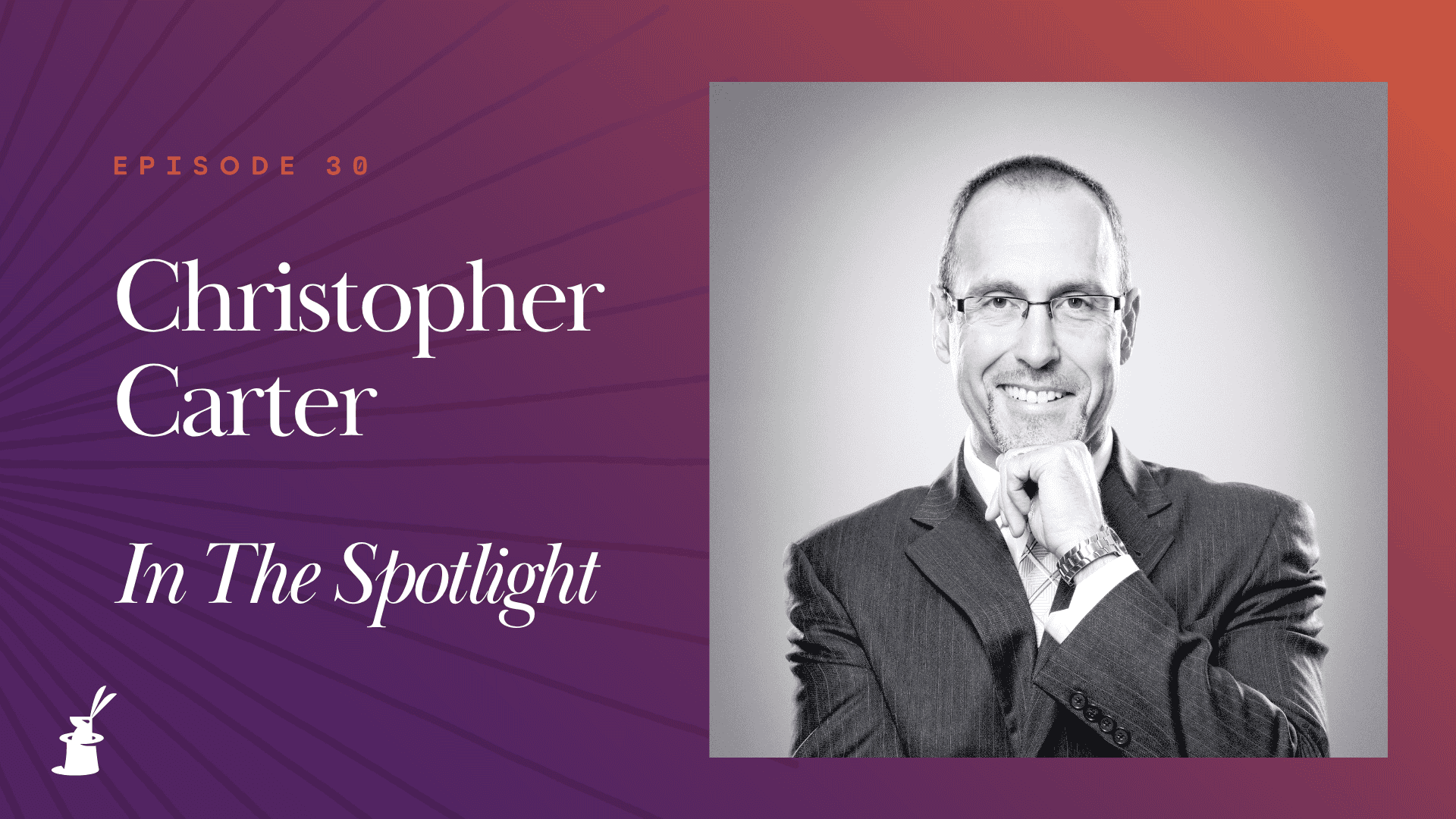
Christopher Carter was ten years old when his parents handed him his own TV Magic Set, and by then the question of what he would do with his life was already settled. A socially awkward kid had found something that gave him a small bump in status, and he held onto it. What he could not have known was that the path would run through a doctoral program, a one-way move to Chicago, and 35 years on stages ranging from college union ballrooms to Fortune 500 boardrooms.
His book, "In the Spotlight", published by Penguin Magic, collects 28 routines and a set of essays drawn from that career. This year it was named Penguin Magic's Book of the Year, and Christopher received the Psychic Entertainers Association's Dave Lederman Memorial Award for Creativity in Mentalism. He is also the recipient of the Dunninger Award and the Milbourne Christopher Award, and the only performer ever to sweep all the major Campus Activities Magazine awards in a single year.
I had the pleasure of watching Christopher perform at The Magic Studio in Orlando a few weeks before we recorded, an experience that shaped a good deal of our conversation.
The Trick That Gave Itself Away
About seven years after that first magic set, a teenage Christopher sat in a convention audience watching Glenn Falkenstein perform his blindfold question and answer act. He had almost no experience with mentalism, and had decided Falkenstein must be the greatest cold reader on earth. Then Falkenstein made a joke, one that happened to reveal the entire method. For most people it might have deflated the mystery. For Christopher it did the opposite.
The revelation didn't disappoint him because of what it showed him about the audience, not the trick.
"I found myself just flabbergasted that people would have that kind of powerful emotional response to something that was so fundamentally simple. And that tickled something in my mind. That was really it."
He built his own version, performed it while still a teenager, and spent the next several years working out why his wasn't as powerful as Falkenstein's. He eventually figured it out. The pull toward that kind of response never left him.
The Scholar Who Wanted Out Of The Bubble
Christopher took an unusually academic route for a performer: a double major in Business Administration and Theater at Illinois Wesleyan, then a PhD program in Theatrical Movement at Michigan. A 4.0 undergraduate average and a near-perfect GRE meant theater programs were offering him money, and a well-meaning mentor pointed him toward graduate study. His own attitude, he admits, was closer to "why not?" The decision to leave came from watching how the academic world worked from the inside.
"I enjoyed playing scholar for four years. It was a thrill. But I saw the limitations of it as a way of life. It's very insulated. Academics at that level is kind of incestuous."
There was a simpler truth underneath it too. He knew he didn't want a boss. In 1990 he quit, moved to Chicago, and set out to become a close-up magician, before realizing in short order that he had no idea what he was doing. He was eager to learn, and it worked out.
A Fly On The Wall In Eugene Burger's Chicago
Few names come up on this podcast more often than Eugene Burger, and Christopher knew him well. The mechanism was practical: a young magician with a car, and Eugene without one. In exchange for driving, Christopher got access to the stream of famous magicians who came through Chicago to visit Eugene, and a seat to watch him work a real lay audience in a bar. What he took from it had almost nothing to do with method.
"Eugene was, in my opinion, the greatest sit-down close-up magician ever, that I have ever seen. Not because of the technique, but because he could immediately build a bond between him and the other people."
Christopher was never formally one of Eugene's students. He describes himself as a fly on the wall, and says he would rather have been a fly on the wall with Eugene than anybody else, for the deep thought, the focus on human connection, and the kindness with which Eugene offered even his sharpest criticism.
What Happened To The College Circuit
Like Irv Weiner, the subject of our previous episode with Scott Martell, Christopher built his reputation on the college circuit. He is generous about the competition, telling listeners to buy Mr. Fingers alongside his own book. He is candid about what has happened to that market since.
A combination of shrinking budgets, national politics, and a Gen Z audience raised on screens made live campus entertainment harder to sustain, especially after COVID. In his prime he could get booked 200 days a year, though he's quick to note that getting booked and actually performing them were two different things. He also names the quieter reason performers age out.
"A big problem with the college campus market is the performers get older, but the audience stays the same age."
He mourns the loss of it as a training ground. The chance to hone an act night after night in front of a fresh audience is a gift he wishes on everybody, and one that barely exists now.
Packs Flat, Plays Big
The phrase "packs flat, plays big" is often treated as a convenience. Christopher treats it as a discipline, while being the first to say it isn't necessarily a good artistic choice, since ideally a prop should be whatever size it needs to be. The constraint came from the reality of traveling to new cities day after day, unable to carry much. What it produced was a performer forced to solve every problem theatrically.
"It forces you then to think, 'How can I take this small thing and make it accessible to a very large audience?' And I think that exercise is incredibly helpful."
Premise, effect structure, pacing, stagecraft, and the creation of an image in the audience's mind: all of it came from asking that question over and over. He credits the constraint with unleashing him as a performer.
Theory That Comes From The Stage, Not The Other Way Around
"In the Spotlight" took 35 years to arrive, and Christopher is precise about why he writes only about his own material. He has friends who are inventors rather than performers, and who understand the technical side deeply. For him the two cannot be separated, because performance and method feed each other. He won't write about anything he doesn't deeply understand, and understanding, for him, comes from repetition on the road.
Underneath that is a conviction about theory itself, one he traces back to Aristotle's “Poetics.”
"What Aristotle is doing is he's describing what's successful in the plays that he's watching. He's not fantasizing about what could be good."
Magic theory, he argues, is only valid to the degree it emerges from successful performance. Anything else is just a prescription, and if it wasn't derived from real work in front of real audiences, it's fantasy. That is the book he wanted, the one for practitioners rather than theorists, and based on reader feedback he thinks he mostly succeeded.
Mentalism Is Radio
The idea running through the whole book is that mentalism is radio, playing out in the theater of the mind. Christopher points to Dunninger, the Piddingtons, and Maurice Fogel, all of whom worked the medium, and to the fact that radio demands a picture be built in the listener's mind through narration and premise rather than shown. When I mentioned the Piddingtons' famous diving bell routine, he lit up at the premise: you never need to see anyone underwater, you only need to be told they're cut off.
"Those pictures that you create in your imagination are so much more vivid and emotionally loaded. They come out of all of your personal experience."
He isn't dismissing visuals. His point is that mentalism was handed this gift by its very structure, and it would be strange not to use it. The insight arrived through his father, a man raised on radio who found television disappointing because the pictures were never as vivid as the ones in his own head. Christopher, a self-described child of TV, didn't believe it at first. Then he listened to the radio of his father's generation and fell in love, the same way he'd fallen for the stories his great-grandmother told.
Question And Answer
Christopher writes that Bob Cassidy called the question and answer act one of the major effects in mentalism, and then goes further, claiming it is really the only effect. He knows the line is provocative, and he meant it to be. Cassidy's "major effect" described something the whole audience could take part in.
Christopher means something different, and more pointed. Q&A, he argues, is the one thing that matches what an audience already imagines a mind reader can do.
"Q&A largely fulfills the stereotype, or really the paradigm, something that's deep in the spectator's mind when they watch a mind reading show. They expect to see minds being read."
The problem is that you can't simply walk on stage and pluck thoughts from the air, even if you could do it for real, because nobody would believe you. The work is in building the credibility that lets an audience take the leap. Once you're moving through a Q&A, you get as close as mentalism can to that fantasy of hearing thoughts one after another.
The Mental Interview
That credibility depends on a distinction Christopher draws between reading minds and reading papers. The audience does need the method hidden, but what he's after is something warmer than a demonstration of accuracy. He calls it the Mental Interview: a conversation, a kind of Twenty Questions, that moves back and forth between what a person tells him out loud and what he presents as flashes of psychic insight.
The point is to restore something he thinks most mentalism throws away.
"Because I think that's really missing in an awful lot of mentalism is this idea that you're in any way actually interested in the content."
Reframing mind reading as an interview gives it an emotional register. People are amused, shocked, or moved, and they feel listened to. That feeling, he says, is a large part of why audiences get so much more out of it.
Danger And The Absurdity Of Dying For A Gig
One of the standout routines in the show I saw was the Staple Gun Roulette. Christopher's thinking about stage danger is counterintuitive. He argues that when a performer appears to risk death every night, the audience lands on one of two conclusions, and both are dead ends. Either it's obviously a trick because you do it nightly, or you genuinely risk your life, in which case you're an idiot for doing so.
His solution is to choose a risk that is real without being fatal.
"You can actually make a more compelling demonstration if you choose a risk that isn't mortal, but is real, people would actually buy that you might be willing to do that."
A non-lethal risk also lets him find the center of absurdity he likes in stage work, and to have some fun with it, while drawing the audience genuinely into the danger. He thinks the staple gun routine achieves exactly that.
Keeping The Record Honest
"In the Spotlight" includes a routine called A Kiss on the Hand that Christopher no longer stages as originally written. Rather than quietly revising it, he kept the original write-up and added a note explaining why. The routine originally had five women on stage and a male participant concentrating on his first kiss. On a modern college campus, that gendered staging drew objections, and he came to agree with them.
He left the evidence of the change visible on purpose.
"It's really crucial for our routines to reflect contemporary reality. We cannot see them as fixed. In fact, that's the one great thing about performance art. It's not fixed. It shouldn't be."
He points to Peter Brook's book, “The Empty Space” and its account of what makes art dead: a performance that no longer connects to the modern world. Keeping the old version beside the new one shows the reader that the work is alive and still moving.
Premise, And The Build Toward The Reveal
Throughout our conversation, Christopher keeps returning to one word: premise. He arrived at it, like everything else, by watching video of himself and naming the patterns he already fell into.
A good premise, for him, is a simple declarative sentence stated as an intention: "I'm about to project an image into this person's mind," or "I'm going to try to make you say only what I want you to say." Stating it sets up a conflict with the audience, and clarifies what to cut.
That principle connects directly to his essay "Thinking About Reveals," which argues the reveal is not the important moment. He's careful to correct any impression that the reveal doesn't matter.
"The reveal is the expression of the process, and it can't be an expression of something that doesn't exist. So we need to dig in, focus on that process."
Using the example of an Olympic high jumper, he points out that the leap only means something if the audience has watched the run-up. Skip the theatrical process of receiving the thoughts, and there's no show, only clubs thrown in the air and called juggling.
The Last Reinvention
Christopher reckons he's about two-thirds of the way through what he expects to be his final reinvention. The first turned him from an aspiring close-up magician into a mentalist, a change so complete that he cut himself off from the magic community for at least 20 years, unwilling to be caught in a world of constant comparison. You can't invent yourself, he says, while measuring yourself against everyone else.
The current shift is a response to age and to a buyer class that has moved on.
"The buyers are all at this point millennials moving on to Gen Zs. They have this idea that performers of my generation are out of touch, and you know what, they're probably a little bit right."
His answer is corporate speaking, a hybrid of entertainment and what he calls high-content speaking on executive presence, teaching people to own a room. It scratches an old itch for teaching, offers a sustainable alternative to 200 days a year on the road, and gives him the shelf life to carry him toward retirement.
Where Technology Belongs
At The Magic Studio, Christopher told the audience up front that no electronics were used. Two routines in his book, Ringtone and Digital Prediction, use everyday technology openly. Asked to square that, he laughed that the question would get him in trouble, then drew a clear line. Technology used openly is fine. Covert electronics, especially apps that dig into a person's private life, he loathes, with a single exception he's happy to praise, Toxic+, precisely because it's done openly and involves everyone.
His real objection is to what technology does to the performer.
"I find that in most performers, it makes them dull. It inhibits their real creative expression."
Christopher is aware he's spitting into the wind, and cheerfully calls the curmudgeon act a bit of a costume. Approaching the age of 61, he'll stick to cards and pencils as long as he can. He even folds the argument into his act, addressing the audience members he calls "husbands," the ones convinced there's someone in his earpiece, and appealing openly to artistry and integrity. He offers a nominal ten thousand dollars to anyone who can prove outside help, though the more important point is that the work represents 36 years of his life, and he wants the audience to know it matters to him. It works, he says, because people like the sense that they're watching a genuine virtuoso. His one caveat: don't say it if it isn't true.
Cherished Books
Asked for his most cherished book, Christopher offered several, each for a different reason. "13 Steps to Mentalism" he prizes for its comprehensiveness, and for the way a motivated performer could open it and build an act that looks like nobody else's, if they refuse to treat it as dated. He praises his friend Joshua Quinn for being so clever that his work opens the mind to possibilities even when Christopher doesn't perform any of it.
He reserves his highest regard for one creator.
"Bruce Bernstein's material always stands out in my head. In fact, I think that he's probably the greatest single creator of mentalism that's alive today."
He recommends Bernstein's “Unreal”, recently out of print and worth every dollar it now commands secondhand, and Al Koran's Professional Presentations, for the way each insight lets you into the author's brain.
What comes next for Christopher is less mentalism and more speaking, and, when it's artistic, storytelling. He performs at storytelling events all the time now, and rather than developing new effects, he's writing new stories. For a man who first learned the power of the form at his great-grandmother's knee, and again through his father's love of radio, that has the feel of a circle closing.
Books And Publications Mentioned
"In the Spotlight" by Christopher Carter (Penguin Magic, 2025)
“Mr. Fingers: The Magic of Irv Weiner” by Scott Martell (Penguin Magic, 2026)
“Poetics” by Aristotle
“The Empty Space” by Peter Brook (Atheneum, 1968)
"13 Steps to Mentalism" by Tony Corinda (originally published as thirteen individual booklets by Corinda's Magic Studio, 1958; first US hardbound edition Louis Tannen, 1968)
“Unreal” by Bruce Bernstein (Squash Publishing, 2012)
“Al Koran’s Professional Presentations” Edited by Hugh Miller (Harry Stanley Unique Magic Studio, 1967)
“ParaLies” by Joshua Quinn (Self-published, 2008)
“Immaculate Misconceptions” by Joshua Quinn (Self-published, 2026)
Resources
“In the Spotlight” by Christopher Carter is available from Penguin Magic. Readers who buy the book will find a qualifying question on the last page that grants access to the private In the Spotlight Facebook group.
On the performers and ideas discussed in this episode:
Marshall Brodien, whose TV Magic Set and TV Magic Cards first drew Christopher into the art, is the subject of “The Magical Life of Marshall Brodien: Creator of TV Magic Cards and Wizzo the Wizard” by John Moehring (McFarland, 2007).
Glenn Falkenstein, whose blindfold question and answer act Christopher watched as a teenager, performed for decades with his wife Frances Willard.
Eugene Burger, the Chicago close-up magician and writer whose influence Christopher describes at length, left a large body of published work, including “The Experience of Magic” and “Mastering the Art of Magic.” Listen to Episode 24 with Dr. Larry Hass for more information about Eugene Burger.
Bob Cassidy, whose framing of the question and answer act Christopher takes as a starting point, wrote widely on mentalism. His “The Art of Mentalism” is a good entry point.
The Piddingtons, the husband and wife telepathy act that captivated postwar Britain on BBC radio, are chronicled in The Piddingtons by Russell Braddon (T. Werner Laurie, 1950), written by the fellow Changi prisoner of war who helped devise the act. Martin T. Hart’s book “Piddington's Secrets” (Manipulatist Books Global, 2014) includes photos, diagrams, witness evidence, and testimony from people who worked behind the scenes with the famous duo.
Maurice Fogel, one of the mid-century mentalists Christopher cites, is the subject of “Maurice Fogel: In Search of the Sensational,” by Chris Woodward and Richard Mark (Hermetic Press, 2007), now out of print. Chris Woodward was Fogel's son-in-law. Fogel’s methods were published in a series of pamphlets: "The Gambling Ghost"; "The Fortune Formula"; "Technicolour Chance"; "The Houdini Seance"; and "Cheating the Gallows" (all Supreme Magic Company).
Joseph Dunninger, the American mentalist Christopher names alongside Fogel and the Piddingtons, published several popular books, including “Dunninger's Complete Encyclopedia of Magic.”
Sir Ken Robinson's TED talk is "Do Schools Kill Creativity?" (TED 2006), which Christopher recalls when discussing creativity and education. It is available on YouTube at youtube.com/watch?v=iG9CE55wbtY and on TED.com.
What Women Want (2000 is, the film Christopher references, in which Mel Gibson's character suddenly hears women's thoughts.
The Magic Studio is an intimate theater on International Drive in Orlando, set inside a working television studio. It presents nationally touring magicians and mentalists. Find out more at https://magicstudioorlando.com/
Timestamps
00:00 Cold open
00:24 Introduction
01:51 What drew Christopher to magic, and Marshall Brodien
02:50 Glenn Falkenstein and the joke that revealed everything
05:24 The academic route and the PhD in theatrical movement
06:46 Choosing Chicago over the lecture hall in 1990
08:57 Eugene Burger, mentorship, and connection
11:33 Scott Martell, Irv Weiner, and what changed on the college circuit
14:26 Packs flat, plays big
15:57 Why the book took 35 years, and theory that comes from the stage
18:44 The book he wished he'd had
20:39 Mentalism is radio
22:58 His father, radio, and storytelling
24:01 Scripting, editing, and forward momentum
26:05 The room leaning in, stagecraft, and Sir Ken Robinson
28:06 Ad-libs that were scripted all along
29:01 The Q&A act as the only effect
31:24 Reading minds versus reading papers, and the Mental Interview
34:08 Why not to stack card tricks
35:40 Staple Gun Roulette and the danger theme
37:37 A Kiss on the Hand, and keeping the record honest
40:07 Premise as the organizing principle
42:09 Thinking about reveals
44:03 The last reinvention
46:59 Where technology belongs in mentalism
49:39 What still excites him, and the "husbands" bit
52:05 What the community response has meant
53:15 The second printing
54:30 Christopher's most cherished books
56:27 Where to follow his work
57:31 What's next
58:30 Close